
Chauvin Case/Small Business Workshop
Season 49 Episode 18 | 26m 46sVideo has Closed Captions
Chauvin Case/Small Business Workshop | Episode 4918
Talking about the guilty verdict in the Derek Chauvin case and what it signals in the fight for racial justice. We have a special panel of guests to talk about police accountability and racial bias. Plus, the annual small business workshop is virtual again this year. Episode 4918
Problems playing video? | Closed Captioning Feedback
Problems playing video? | Closed Captioning Feedback
American Black Journal is a local public television program presented by Detroit PBS
Chauvin Case/Small Business Workshop
Season 49 Episode 18 | 26m 46sVideo has Closed Captions
Talking about the guilty verdict in the Derek Chauvin case and what it signals in the fight for racial justice. We have a special panel of guests to talk about police accountability and racial bias. Plus, the annual small business workshop is virtual again this year. Episode 4918
Problems playing video? | Closed Captioning Feedback
How to Watch American Black Journal
American Black Journal is available to stream on pbs.org and the free PBS App, available on iPhone, Apple TV, Android TV, Android smartphones, Amazon Fire TV, Amazon Fire Tablet, Roku, Samsung Smart TV, and Vizio.
Providing Support for PBS.org
Learn Moreabout PBS online sponsorshipComing up next on "American Black Journal," we've got a really important show for you this week.
We're gonna talk about the Derek Chauvin trial and the verdict, what it means for racial justice, what it means for police reform, and what it means for the future of America.
A great panel of guests is gonna discuss that with us.
We'll also catch up with the Small Business Workshop here in Detroit, which is going to be virtual for a second year.
Don't go away.
"American Black Journal" starts right now.
Announcer 1: From Delta faucets to Behr paint, Masco Corporation is proud to deliver products that enhance the way consumers all over the world experience and enjoy their living spaces.
Masco, serving Michigan communities since 1929.
Announcer 2: Support also provided by the Cynthia & Edsel Ford Fund for Journalism at Detroit Public TV.
Announcer 1: The DTE Foundation proudly supports 50 years of "American Black Journal," in covering African-American history, culture and politics.
The DTE Foundation and "American Black Journal," partners in presenting African-American perspectives about our communities and in our world.
Announcer 2: Also brought to you by AAA, Nissan Foundation, Ally, Impact at Home, UAW, Solidarity Forever, and viewers like you.
Thank you.
♪♪ Welcome to "American Black Journal."
I'm Stephen Henderson, your host, and I'm really glad you've joined us this week.
Where do we go from here?
I think that's question on just about everybody's mind after the verdict in the Derek Chauvin trial in Minneapolis.
Yes, Chauvin is going to be held accountable for murdering George Floyd, and he may very well spend much of the rest of his life in prison, but there are still big questions about the future of policing, the relationships between police and African-Americans in this country, and a host of other issues.
We have assembled a really great panel to talk about all of these things.
Here's my conversation with Southfield Police Chief, Elvin Barren, Black Lives Matter Detroit co-leader, John Sloan III, and Dr. Riana Anderson, who is an assistant professor at the University of Michigan School of Public Health.
I first wanna get you to react to the Derek Chauvin verdict, but then, get us started on the concept of why defund the police is the policy position that you think has gotta be the starting point for reform.
So Derek Chauvin case was a trial that, if I'm gonna be really honest, I tried to avoid watching.
I had so much anger, emotion, and I talk a lot internally, in our group, and with other friends of mine about anger being a complex emotion, right?
Like nobody ever wakes up angry.
You're hurt, you're afraid, you're fearful, you're frustrated, and all those things kinda swirling together to create that anger and that energy inside of you, and I had so much of that that I didn't know how to process it.
And watching the trial, watching the defense attorney do their job, and try to defend that individual was disgusting to me, and it was something that I had a real difficulty in processing, and that's odd, for me, at least.
Normally, I can watch things, and I can try to disconnect a little bit.
I can see things dispassionately and as objectively as I try to, but that one was hard, and then came the announcement of the verdict.
My next door neighbors apparently saw before I did, because they screamed, and I so I knew what was coming, and there was this void.
People were happy and excited, and I couldn't be.
And I think it was because I found it difficult to accept that this was worth being excited over.
This, to me, seemed to be the bare minimum.
If my life is worth so little that the only way that my murderer can come to justice is by having videotape of somebody standing on my neck for close to 10 minutes, and that that deliberation of that trial takes more than five seconds, right, to me, is nothing to be proud of, and it's nothing to be excited about.
There's an interesting dichotomy that Black Americans have, that I have, I'm the grandson of a Tuskegee Airman.
I come from a largely military supportive family, even those of us that did not serve, in recognizing that sacrifice and knowing that I was not brave enough to sign up for that duty, but I also think that we have to be really honest about this system of government that we have.
It's not a system that is broken.
It's a system that's built and functioning the way it was meant to function, to maintain a social hierarchy, to maintain social order.
So when we talk about how we respond to Derek Chauvin, and we talk about what it means to defund the police, what we're talking about is removing ourselves from a system that has brought these types of murders.
And when people hear defund the police, I think there's this rhetoric out there, I know there's this rhetoric out there that makes people feel like there's lawlessness that we want, that we don't want any sort of order or safety.
We are separating the idea of safety from the idea of policing.
We are saying that safety in and of itself is an inherent concept that communities have every right to be able to govern themselves, and that, for as long as this system of policing has existed, it has been inherently antithetical to that concept of safety for a huge swath of Americans.
And so, when we talk about defunding the police, I'm not talking to walking up to individuals like Chief Barren and saying, "You are an awful person.
"I want you gone, I want you out of my community, "and I wanna run everything myself."
What I'm talking about is moving funds, is divesting and reinvesting.
So Chief Barren, I would love for you to respond to what John's saying there.
I think he did a wonderful job of pointing out that, look, he's not personally opposed to you or the job that you do, but that the systems that underpin policing in this country are functioning the way they were intended, which is to reinforce social order that devalues Black lives.
Much like John, I had anxiety myself waiting for the verdict to be read, 'cause here's my thoughts.
Would there be that one or two jurors who spin it into a mistrial after receiving all this overwhelming evidence that Mr. George Floyd was, in fact, murdered?
And so, I did have a sigh of relief when the verdict came in, that this individual was guilty on all three counts.
Much like John, the work still has to continue.
We look at the history of law enforcement, there is a history of racism and police brutality.
It's a fact.
It's not only a fact, it's a documented fact, and so, reforms must take place, they must take shape.
You need leaders in policing who are courageous enough to make the much-needed changes and support those changes.
And so, when you look at the George Floyd Justice in Policing Act, there are a number of things that should happen.
We'll start off with the conversation of qualified immunity, 'cause right now, it's a hot topic.
And so, yes, there need to be some reforms in qualified immunity, but here's my projection on that.
If a police officer is determined to be responsible for criminality or gross negligence, yes, they should lose their qualified immunity.
Do understand that this business is a risky business, where things are gonna happen in policing.
So officers acting in good faith, they should retain their qualified immunity, and so, your next question may be, well, how do you determine which is which?
And that would, or should take place in a process where it's evaluated per incident, and then, a determination is made based on criminality, gross negligence, whether that officer should lose qualified immunity.
When we have conversations about defunding the police, so yes, I'm not an advocate of defunding the police.
Right now, we do a number of different jobs.
We do a lot of community efforts.
As you see in the recent death of the young man with this taser incident occurred, I don't believe that officer intentionally tried to kill him.
That's what I would call gross negligence.
You cannot make that kind of error in policing, because lives are lost.
What does the training look like for that police department?
Why was that taser introduced in that situation that early on in the first place?
When you make a decision to deploy a taser is for active aggression when the individual is in the process of fighting with the officer.
What that young man was doing was resisting.
Now we can have another discussion, 'cause I want us to also have discussions about compliance, but it happened.
The young man was resisting, but he was not displaying active aggression, and so, what should've happened, they got control of that young man, maybe take him to the ground.
There was plenty of officers there, where a taser should not have been introduced.
And so, the idea that she may have had a trick taser, and there's concerns about that, as well, because a taser is very bright yellow.
That's the color of the tasers in my agency, that's the color of the tasers in that agency.
So it should not have happened.
But with defund the police, as I mentioned before, there's a lot of hats that we wear in this business.
I believe that the government has money, I see the government spend money on many different things that are really not necessarily, and so, some of that money should be used for some of the programs.
For example, we're starting a mental awareness response, where we're looking to hire a medical professional to assist us in those types of calls for service.
Although there are calls for service for persons suffering from mental illness that have the potential to be violent, a majority of those are nonviolent, and we could use a medical professional to assist us in those types of response calls.
Dr. Anderson, it strikes me that there's a couple of different things kinda going on here.
One is the question of what the police do, what they're capable of doing, what they're asked to do, what the history is of what they're doing, and kinda separately, how we decide to sort of prioritize services for people.
But I think there's still that fundamental question about policing, and what it is, and what it means in this country.
I wonder if you can sort of help us bridge that gap a little bit.
Is policing itself the problem?
So you just wanna ask me that million dollar question off the top.
Thanks so much for that, Stephen.
Let me just.
No problem.
(both laughing) Let me say a great thank you to the other panelists here who have really created such a rich backdrop for what I am hoping to contribute here and the question might be, why is there a psychologist, right, in the midst of this?
This is where I actually think it's really important for me to be, and I'm hopeful that a perspective might be important here.
I'm gonna introduce what some colleagues and I have been calling whack-a-mole to this conversation.
So whack-a-mole, for those folks who may have not made it to the Michigan State Fair, you grab this hammer, you start to hit at something that emerges, that's coming from this ground, something that you see, something that's obvious, that you want to go back into the earth.
So we've been coming up with this whack-a-mole analogy because policing is often something that's emerging as a problem, and sometimes, we're trying to hit it back down into the ground, or into this field, but one thing that I want us to really be mindful of is that the field itself, this American soil, that it's emerging, that this problem is emerging from, is racism.
We have had a problem in this country of racism since its inception, because things that have occurred in this country have been based on race.
Categories of people have been enslaved, categories of people have been stripped of their land, et cetera, so when we look at the American history and our culture through a lens of race, then you're able to understand as these problems emerge, as policing problems emerge, whether it's the entire system of policing, or individual cases, because we often also look at a Daunte Wright and we try to handle that, and we create a hashtag, and then we move to Ma'Khia Bryant.
We move to all of these cases that are emerging but the entire problem of racism is what is feeding this systemic problem of policing in America and these individual cases that are emerging.
So Stephen, I wanna say that, because for me, it's not enough just to say that policing is a problem.
It is, but that people become police officers are born and raised in a society, in a country that sees people racially, and has continued to treat people in different ways.
To Chief Barren's point, perhaps Kim did not see Daunte Wright as someone who she should be pulling a gun out on.
Maybe we can all agree on that, but that she thought a taser, as you pointed out, was needed so early on for a 20-year-old man who posed no violent threat to her, is a psychological problem that not only police officers have, but educators, that other technicians, people within our community who are running our community see Black people as inherently less.
That is an American racial problem.
That is not specific just to policing, though when we talk about policing, Stephen, we have a confluence of power, weapons, and immunity, and those three things are what make policing inherently more challenging, more heated than other places where, perhaps, the teacher is suspending.
That's gonna have consequences, and that's gonna be bad, but lethality, the ability to take a gun and to end someone's life because of that stereotype, in the same way that we have stereotypes about other people in our community with other professions, this is a lethality question, and when we talk about humanity, the need to live, one's ability, one's purpose in life to live, when we're taking that out, and when someone has the capacity to take that out, that, Stephen, is what makes policing incredibly challenging in an American context.
Of course, that panel had a lot more to say about the subject, and you can see the entire conversation at americanblackjournal.org.
Let's turn now to the 7th Annual Small Business Workshop, presented by the Lee Group and Fifth Third Bank.
This year's theme is Reemerging from the Abyss, a reference to the major challenges faced by businesses during the pandemic.
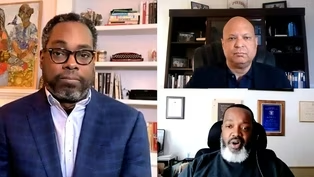
I got the details on the virtual workshop from Mark Lee of the Lee Group and Jason Paulateer of Fifth Third.
So Mark, I wanna start with where we were a year ago, when we talked about the business workshop, and we were at the beginning of the pandemic, and it was disrupting everything then, in profound ways.
We're still a little disrupted.
You're gonna be virtual again this year, but business-wise, I feel like things are starting to clear up just a little, maybe some normalcy returning to people's activities.
Give us a sense of where we are in that process.
Yeah, a year ago, we were in the abyss, we were in the depths of despair, so to speak.
Businesses were shutting left and right.
We know that 41% of African-American businesses shut down, partially or permanently within the first few months of the pandemic, versus 17% of small businesses.
Fast forward to today, we're seeing a slow improvement.
We're beginning to work our way out of that abyss.
Are we there yet?
Absolutely not.
But clearly, we're seeing that the state is beginning to reopen a little bit, the city is beginning to reopen a little bit, and we're finding that some businesses are beginning to reopen, although challenges still remain.
So let's talk about the workshop, the virtual nature of the workshop.
How'd that go last year, for starters, and what are you anticipating for this year?
I gotta tell you, first of all, I wanna thank you to you, "American Black Journal," you've been a wonderful supporter of the workshop for the last several years, and last year, as a result, we reached over 500 engagements, 500 people through technology.
So it went very well, and what's interesting, is, and when we do face to face, we get upwards of 120, but through technology, we can reach more people, and so, the workshop went very well.
And so, this year, we're gonna continue the virtual series until everybody's totally comfortable getting back face to face, and I'm so pleased to announce that this year's theme is Reemerging from the Abyss, and from our friends at Fifth Third Bank, we're able to offer this workshop for free, as well.
Yeah.
Jason, talk about what you guys have seen from a banking perspective, in terms of emergence from the pandemic, and going back to quote-unquote, "business as usual," and then, your engagement with the Small Business Workshop.
Yeah, so thanks, Stephen.
Thanks for, again, for having me on.
Yeah, well, so what we're seeing is, you know, this time last year, we were knee-deep in figuring out the Payroll Protection Program, and getting that set up.
You know, we actually had to build a system around that, because it was a different SBA program than the ones that we already had on board.
And you know, we were able to process more than 40,000 loans through that system last year, right, and then, so, as we're coming out of kinda the pandemic and reemerging from the abyss, the demand, while the programs remains open for, till the end of May, you know, the demand has gone down dramatically, right?
So to date, this year, we've only processed about 15,000 of those loan applications.
So certainly, I see that as an optimistic sign that we are indeed reemerging from the abyss.
And you know, we partner with Mark on the Small Business Workshop, really, because of his ability to really curate, curate a series and a stream of professionals that's really gonna provide businesses with the information and the tips that they need for now and into the future.
Yeah.
That's a really interesting fact you just slipped in there, the idea that fewer businesses are now seeking help because of the pandemic.
That is incredibly good news.
Jason, I wonder, though, if you have ideas about what the new administration in Washington should be doing to try to help businesses get back up on their feet.
I mean, just because they're not in search of those loans anymore doesn't mean everything is the way it should be.
What would you wanna see them doing to help businesses get going again?
That's a really good question, Stephen.
What I'd like to see is, you know, continued support for how companies can improve their revenue streams, right?
Really connecting businesses with the opportunities for, let's call it federal contracting, as an example, and providing them with the tools and resources, much like we're gonna do in this workshop, to be able to actually compete for those federal contracts that are coming out.
You know, the latest that we've heard in some of what the administration is doing is really around infrastructure improvement, right, and so, as you can imagine, there's gonna be a number of contracts that are awarded to make that happen.
Now I may be a little bit preliminary, because it hasn't been approved yet, right, but I would hope that people are tuning into a workshop like this to really connect with the professionals in the industry, in the ecosystem for small businesses that can really help them to be ready, right?
I always say, if you stay ready, you don't have to get ready and one of the things that I think that this workshop will do is help people to get ready now, so that they can be ready when the time comes.
Yeah, yeah.
And obviously, Mark, this is what you'll be talking about in these workshops, is being ready, and being ready now means something different, looks different, I suspect, than it did a year ago.
Yeah, last year, at this time, we were, people were just grappling to figure out what was going on.
This year, economists are projecting, Stephen, that we're expecting a partial recovery beginning the back half of this year of 2021, and a full recovery in 2022, assuming, obviously, the vaccination rollout and some other assumptions.
So that's why we structured the workshop the way it is.
We're gonna have a Fifth Third Chief Economist coming on board, and talking about the impact of the economy on Detroit, the overall economy of Detroit and the state of Michigan.
From a business standpoint, the focal point of the workshop is exactly what Jason was saying, what he just referenced, is your business ready?
Are you ready to hopefully capitalize and leverage on this stronger economic projection that we're expecting for the balance of the year?
So we have speakers and panelists and other entrepreneurs who will be sharing their experiences throughout the four week series.
We're doing it in a weekly series, beginning this Wednesday, and through the month of May, every Wednesday at 10:00.
Mark, you mentioned earlier the number of Black businesses we lost.
Yeah.
In the pandemic, which is just, you know, it's staggering, when you really sit and think about it.
When we talk about recovery, what's the possibility to recover some of those businesses, to get people who maybe had to give up to be able to start again?
Is that something that we should be anticipating?
Yeah, I think so, but here's the difference, Stephen, is the businesses need to be covered through adjustments.
If they're gonna adjust under the old business model, they're not gonna come back.
I'll just be matter of fact about it.
If they're going to adjust, leveraging the new technologies, leveraging and using creativity, becoming that much more innovative, the prospect of them reopening, repositioning themselves to an ever-changing market, then they have the prospect of coming back.
But it's gonna require change and adjustment in order to reopen, reposition your business for the longterm.
Yeah.
Well, and that change and adjustment, of course, affects everybody.
I mean, the way that everything works, the way that everything looks is just really different than it was before the pandemic.
Absolutely.
Yeah.
Okay, Mark Lee, always great to have you here to talk about your Small Business Workshop and good luck with the second year virtual.
Next year, it'll be in person, right?
(laughs) We'll see, and by the way, it's our 7th year, and I wanna say, go to leegroupinnovation.com, leegroupinnovation.com to register and it's free.
That is gonna do it for us this week.
Thanks for watching.
You can find more about our guests at americanblackjournal.org, and as always, you can follow us on Facebook and on Twitter.
We'll see you next week.
♪♪ Announcer 1: From Delta faucets to Behr paint, Masco Corporation is proud to deliver products that enhance the way consumers all over the world experience and enjoy their living spaces.
Masco, serving Michigan communities since 1929.
Announcer 2: Support also provided by the Cynthia & Edsel Ford Fund for Journalism at Detroit Public TV.
Announcer 1: The DTE Foundation proudly supports 50 years of "American Black Journal," in covering African-American history, culture and politics.
The DTE Foundation and "American Black Journal," partners in presenting African-American perspectives about our communities and in our world.
Announcer 2: Also brought to you by AAA, Nissan Foundation, Ally, Impact at Home, UAW, Solidarity Forever, and viewers like you.
Thank you.
♪♪
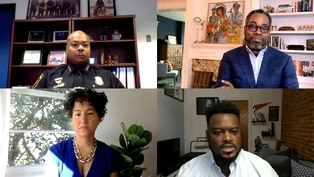
Video has Closed Captions
Clip: S49 Ep18 | 13m 37s | Chauvin Case | Episode 4918/Segment 1 (13m 37s)
Chauvin Case (Extended Version)
Video has Closed Captions
Clip: S49 Ep18 | 33m 14s | Chauvin Case (Extended Version) | Episode 4819/Extended Segment (33m 14s)
Video has Closed Captions
Clip: S49 Ep18 | 8m 32s | Small Business Workshop | Episode 4918/Segment 2 (8m 32s)
Providing Support for PBS.org
Learn Moreabout PBS online sponsorship
- News and Public Affairs

Top journalists deliver compelling original analysis of the hour's headlines.

- News and Public Affairs

FRONTLINE is investigative journalism that questions, explains and changes our world.












Support for PBS provided by:
American Black Journal is a local public television program presented by Detroit PBS