
Chauvin Case/Vickie Thomas
Season 49 Episode 19 | 26m 46sVideo has Closed Captions
Chauvin Case/Vickie Thomas | Episode 4919
Minnesota attorney general Keith Ellison joins me to talk about the Derek Chauvin verdict and his hopes for the former officer’s sentence. Plus, journalist Vickie Thomas reflects on her thirty years in radio and looks ahead to her next chapter with the city of Detroit. Episode 4919
Problems playing video? | Closed Captioning Feedback
Problems playing video? | Closed Captioning Feedback
American Black Journal is a local public television program presented by Detroit PBS
Chauvin Case/Vickie Thomas
Season 49 Episode 19 | 26m 46sVideo has Closed Captions
Minnesota attorney general Keith Ellison joins me to talk about the Derek Chauvin verdict and his hopes for the former officer’s sentence. Plus, journalist Vickie Thomas reflects on her thirty years in radio and looks ahead to her next chapter with the city of Detroit. Episode 4919
Problems playing video? | Closed Captioning Feedback
How to Watch American Black Journal
American Black Journal is available to stream on pbs.org and the free PBS App, available on iPhone, Apple TV, Android TV, Android smartphones, Amazon Fire TV, Amazon Fire Tablet, Roku, Samsung Smart TV, and Vizio.
Providing Support for PBS.org
Learn Moreabout PBS online sponsorshipComing up on American Black Journal, we have a really great show for you this week.
We're gonna talk with Keith Ellison, who's the Attorney General of Minnesota, about the Derek Chauvin trial, it's outcome, and what's next in the conversation around race and justice in America.
We'll also catch up with Vickie Thomas about her long standing career as a journalist here in our community, and what's next for her.
Stay where you are.
American Black Journal starts right now.
Announcer 1: From Delta faucets to Behr paint.
Masco corporation is proud to deliver products that enhance the way consumers all over the world experience and enjoy their living spaces.
Masco, serving Michigan communities since 1929.
Announcer 2: Support also provided by the Cynthia and Edsel Ford Fund for Journalism at Detroit Public TV.
Announcer 1: The DTE foundation proudly supports 50 years of American Black Journal in covering African-American history, culture and politics.
The DTE foundation and American Black Journal partners in presenting African-American perspectives about our communities and in our world.
Announcer 2: Also brought to you by AAA, Nissan Foundation, Ally, Inpact at Home, UAW solidarity forever, and viewers like you.
Thank you.
♪♪ Welcome to American Black Journal.
I'm Stephen Henderson.
And as always, I'm really glad that you've joined us.
My first guest led the prosecution of former Minneapolis police officer Derek Chauvin in the murder of George Floyd.
Minnesota Attorney General Keith Ellison, who is originally from right here in Detroit, was involved in every aspect of the case, including preparing witnesses and weighing in on jury selection.
Now his attention has turned to Chauvin's sentence and the trial for the other officers who are charged in the death.
Here's my conversation with Keith Ellison.
So, first of course, congratulations for the outcome of the Derek Chauvin trial which everyone has taken note of at this point.
But I want to start the conversation in a slightly different place.
This was a monumental achievement in the sort of relationship between police and their community, especially the relationship between police and African Americans.
And a lot of people are describing it as a potential turning point, right?
That maybe we go in a different direction.
I want to start with you talking about what you think that direction could look like now that we've gotten a conviction for a police officer who murdered a citizen.
And we got a jury to say that.
What's next?
I mean, obviously that's not the full repair that we need to this problem.
What would you like to see us do from here?
First thing, let's pass the George Floyd Justice and Policing Act.
That is an immediate short-term thing we could do.
We need the support of the Michigan congressional delegation, of the Minnesota congressional delegation, and it's stuck a little bit in the Senate.
And so I asked my friends, Debbie and Gary to do all they can to unstuck it and get it moving.
I've made the same request to Amy Klobuchar and Tina Smith here in Minnesota.
I know that Corey Booker and Tim Scott are negotiating right now.
They need to stay in the room until they come out with something good.
That is, that would be a substantial and important step forward.
I'd love to see him pass it before the anniversary of George Floyd's death, which would be May 25th.
And you know what?
I was so overjoyed when President Biden said that in his address to the Congress.
That's step one, job number one.
Let me say too, that you know, Kym Worthy, Wayne County prosecutor, tried a historic case involving the death of Malice Green.
And I think she got conviction there.
So it's important to get these convictions.
I think the more you get convictions, the more police have to say, "Okay, maybe I'll be more careful in doing my job.
Maybe people are going to hold me to account."
I think it is important for prosecutors all over the United States to know that the public expects them to prosecute police misconduct and excessive force, just like they would any other misconduct and illegal behavior.
Nobody's above the law.
Nobody's beneath the law.
Accountability is the key.
You can write all the policies you want but if they're just words on a page, you know, officers know that.
They know what's enforced and what's just written there.
And so there's gotta be a cultural shift towards accountability for everyone.
And you know, quite honestly I really believe officers who go to work every day to serve really want us to hold those who are not there for that purpose to be held to account.
And then of course I mentioned federal legislation.
I mentioned what prosecutors can do but really what I'm talking about is what community must demand.
Community must say, we expect these crimes to be prosecuted.
But then the Michigan state legislature, Minnesota state legislature, lot to be done there.
And I think we need to look at how a lot of these collective bargaining agreements are constructed between police departments and the police union.
Because if you have an arbitration clause regarding misconduct, where the arbitrator always just puts the officer back over and above what the chief wants, that's a bad sign.
The chief needs more control over discipline in the department, particularly as it relates to customers, consumers, citizens, residents, things like that.
Yeah, so I'm also curious what you make of this part of the narrative that says we can't fix policing the way it's constructed, the way it's imagined in this country.
It is not safe for particularly people of color and that we've got to do something completely different.
Now some people say it's defund the police.
I think that's a problematic term because that's not actually what their...
It's really a hashtag.
Right, right.
That's what it is.
It's not a policy prescription.
It's not a policy approach.
But the idea of deconstructing and reconstructing the police.
Do you think we have to go to that extreme?
Well, the answer is yes.
But I would never adopt the language of defund the police, abolish the police.
I wouldn't use that term.
What I would say is we need to make the main thing, the main thing.
What's the main thing?
Public safety is the main thing.
That's the main thing.
We're trying to keep people safe.
How do we do that?
Is having every single case, having it responded with an armed person, the gun, whose training is to use the gun or the nightstick, the only way to achieve public safety.
I would say that in some cases, you get an armed shooter, you need that.
You have somebody threatening violence, you might need that.
But what about George Floyd?
Where he was accused of a fake 20?
Do you need a armed response to essentially a low level property offense where nobody has ever alleged that George Floyd even knew that the 20 was fake?
Right?
So, I mean, and then what about people who are in mental health crisis?
I mean if you're an officer who wants to help, but this person just looks angry and maybe they look assaultive, but they haven't yet assaulted anyone, maybe they are in a autistic meltdown.
What you need there is a professional who's gonna come and ascertain the problem and deescalate the problem.
And I think to a certain extent, American policing has let punitive measures and tough guy tactics be a surrogate for public safety.
And I think that we need to get back to, let's keep the community safe.
What do we need to do that?
And really reemphasize that.
And we will have armed people responding to crises.
That is an inevitability.
We will also do a lot more upstream things.
We will do a lot more.
We will diminish, we will reduce the number of unnecessary contacts.
I mean, if you have a camera, why do you need to stop somebody?
They could have let Daunte Wright go, and then mailed him his ticket for tags, right?
And you know, police have learned years ago, the high-speed chase are probably more dangerous.
It's probably safer to let that person go than to chase them, you know.
Because then they get an accident, kill civilians.
So we need to really put public safety as the driver.
Not, "I'm a macho man, And don't you talk back to me and if you sass me I'm gonna stick a gun in your face and call you a lot of foul names."
I mean, if you're just... What the police did to George Floyd in the very first, is deemed to be by our existing law, legal.
But in the very beginning, it's like, put the gun up in his hands.
He's got the hand gun cocked sideways, "Get the F out of the car."
I would submit to you that while the law protects the officer's behavior in that situation, because he didn't see his hands, that sort of set the tone for the entire encounter, you know?
(audio cutting) the incident, rather than the deescalation of the incident.
Right.
Right.
Police are there to deescalate, but often they don't.
Right.
"Step out of the car, sir.
I need to talk to you."
Just saying sir.
What if you just said, "Step out of the car, sir.
I need to talk to you," as opposed to "Show your effing hands!"
You know, I mean, look, is there an occasion where an officer has to draw a firearm on a person?
Sure.
There is.
Nobody's saying there's not.
I believe in officer safety and officer wellness.
But if your first move is, "Show me your effing hands!"
I mean, you know, honestly, a lot of people in our society don't believe African-Americans are routinely treated that way.
Right.
That's one of the cases, that's one of the reasons I'm glad this case was televised, so that the world could see, here is... this is routine in certain parts of our country.
And in other parts of our country, it would be absolutely intolerable.
I do wanna talk a little about Chauvin trial and what's next there.
You've made a sentencing recommendation in Chauvin's case and you've got more trials.
You have more officers.
Yeah, we do.
We have them.
And they're tough.
And we're gearing and we're working hard on it.
I have to say to everybody listening, the three defendants remaining are presumed innocent until proven guilty.
I want to be very clear.
They have a right to a fair trial, impartial jury.
And I stand by that as a prosecutor.
I'm not a minister of punishment.
I'm a minister of justice.
So I stand on that.
So that's coming up and I'm not gonna be able to speak that much about those three that's happening on August 23rd.
When it happens, the world will know.
But as it relates to Mr. Chauvin, yeah, in Minnesota law, the second degree unintentional murder, which is the top count he was convicted of, carries with it a guideline sentence of 150 months.
And then in Minnesota, you do two thirds, right?
So it works out to a hundred months, which is about eight years inside.
And then you do the rest on supervised release.
We are arguing, and we have argued, and we are arguing now that there are aggravating factors in this case.
One is that Derek Chauvin was entrusted with the power prestige and esteem of the police department.
He was a person of trust and authority and used it in a way to effectively murder.
So that is more, that drives us in the direction of greater level of accountability and culpability.
George Floyd was particularly vulnerable.
He was in a prone position, hands behind his back.
There has been testimony that George Floyd had fentanyl in his system, that in my mind doesn't make it worse.
It makes it worse for Chauvin.
It makes him more vulnerable in greater need of care and concern by people who have rendered him helpless.
Right?
So those are two, number three.
It was performed in front of kids.
You commit an act of violence in front of kids.
that can mark them for a lifetime.
Traumatic.
Number three.
Number four I think I'm on is that I think it was particularly cruel to stay on top of him as he yelled that he couldn't breathe 27 times, screamed for his mother, stayed on top of him three four minutes after he didn't even have a pulse.
You know?
And so those are some of the aggravating factors that we identified, reasons why the judge we believe should depart support in this particular case.
I do want to give you a chance to talk about your roots here in Detroit.
Oh yeah.
You know, I'm so very proud of being born in Detroit and grew up in Detroit.
I went to Hampton Elementary, you know I went University Detroit High School on seven mile, went to Wayne State.
My dad went to Wayne State, you know?
And you know, my family is a product of the great migration.
My mother directly from Louisiana.
My father, his parents were from Florida and Georgia, came up to Detroit, worked in the factories there.
My grandfather worked at Boeing Aluminum and you know very proud to have those roots and got so many good friends and family members in Detroit, which I admire so much.
And my dear mother who we lost last year to COVID, you know was a staple and a stalwart and a pillar at Wayne County juvenile court services, and (indistinct) church, and I maintain made the best gumbo in Detroit.
And so, you know, yeah.
You know, I'm so proud of Detroit.
So fond of my roots there, and I get back there two three times a year, and I always have a great time.
Attorney General Ellison had a lot more to say about policing and race in America.
You can check out the entire interview at americanblackjournal.org.
All right, my next guest just retired from Detroit's WWJ radio after 30 years as the city beat reporter.
Vickie Thomas, a long time member and officer of the National Association of Black Journalists is gonna continue to do a weekly black business minute segment on WWJ.
She will also of course keep working for diversity in newsrooms.
I talked to her about her new position with the Duggan administration and her long career in journalism here in Detroit.
Vickie Thomas, congratulations on your retirement and welcome to American Black Journal.
Hey, thank you so much, Stephen.
And it's great to be back on American Black Journal.
That's right, that's right.
You've been here many times before.
So let's start with this.
What makes this the right time to step away from this work that you've been doing for such a long time?
And I think I speak for most of your listeners when I say, look, you don't seem like you're ready to stop yet and we're not ready to give you up.
(Vickie laughing) Why now?
Yes, I have gotten a lot of that.
And here's the thing, Stephen.
So I knew my 30th anniversary was coming up and, you know pre COVID was planning a big blow out, you know 30 years at one station, and wanted to do a sit down dinner and all that.
And because of the pandemic, obviously that didn't happen.
So I was a little, I know how those school kids feel about graduation and prom and all of that because that just can not happen now, right?
So when I initially got the call from the mayor, I said, well, Mr. Mayor, you know, I really love what I do, but you know, I'm willing to have a conversation.
And I just really bought into his vision about, you know what he wants to do for the residents of Detroit.
And, you know, it lit me up really, to be honest with you.
I didn't say yes right away.
I did my due diligence, as anyone should do.
And, but when I thought about the opportunity to make a difference in the lives of Detroiters, wrap around services, making sure they know about all the opportunities that are available through the city, I'm like, man, that's what I do.
That's what I care about, making a difference in the lives of people.
So the opportunity arose.
It just so happened to be right near my 30th anniversary.
They wanted me to start early, but I said no.
I'm gonna reach this 30 year milestone first.
And I'm really, really glad I did it that way because I've had time to, you know share my experiences and just get the accolades for people I've been overwhelmed.
I really have.
You just never know how people feel about you until you step away from something that they're accustomed to.
I have Vince McCraw, our president of the Detroit chapter of NABJ called me and say, I'm having withdrawals.
I've got my radio set to come on at 7:30, and I know your first live shot is at 7:30 and no Vickie.
So it's just been, it's just been amazing.
It's been amazing.
Yeah.
So, so I do want to talk about the work that you're going to do with the mayor, Mike Duggan but first let's look back at what's changed over 30 years.
So radio is really different than when you started.
Journalism is really different than when you started.
And Detroit of course is really different from when you started.
What stands out for you among those changes?
Well, I remember cutting and splicing.
Now the younger kids probably have no idea what a reel to reel is.
(laughing) But I would spend hours and hours cutting and splicing, you know, my reports and special reports.
And then it went from reel to reel, from reel to reel to I think it was then the cassette.
And then it was the mini disc.
And now it's all audio.
I did my job, you know, over the last year because of the pandemic right on my phone.
And I would go live, you know, using a tie line on the phone and found some apps and actually found those apps and trained my colleagues at WWJ.
Cause we weren't used to it.
And you know, we were working from home.
So we had to get up to speed like snappy.
Right?
So I've found apps.
And so yeah, all this stuff can be done on the phone now.
So it has changed quite a bit, but you know we change with the times, you know?
Yeah.
What about the city when you started out, was Coleman Young still mayor?
I would imagine?
Yes.
That was like one of the highlights of my career, covering his administration.
I was actually talking with some friends recently about covering him and the scrums we used to do with all the reporters gathered around the mayor.
And it really taught me a lot about, you know, how to cover the political angles, a mayor and so forth.
But he, boy, he was tough.
And I just remember some of those times when you asked the wrong question in his mind and his jaws would start moving, that's when you know he's upset.
(laughing) So he would let you have it.
But man, did you learn a lot about just having the fortitude and the sticktuitiveness to just keep plugging away, no matter what.
So covering him really served me well down the line and just being able to get these exclusive stories, breaking news and all that.
So yeah, that was one of the highlights for me.
And then in terms of what the city looks like, obviously it is quite different today than 30 years ago.
Like they used to say, you could roll a bowling ball down Woodward and not hit anybody?
Yeah.
That really was the case.
And growing up, you know, we used to go to the Fox theater.
They used to show movies and we... was is the Fox?
I think so.
But we used to go downtown to watch the movies.
The Bruce Lee flicks when I was a kid.
But yeah.
Things changed and I think they've changed for the better.
I know people have their concerns about certain developers, Dan Gilbert specifically monopolizing, but just think about if we didn't have a Dan Gilbert, if he did not buy those buildings.
Everybody had the opportunity to buy them, right?
So, you know, he's contributed a lot to what downtown looks like and you know I think we're just on the up and up from here.
Yeah.
Yeah.
So, you started by talking about, you know the mayor reaching out to you to see if you would come help his efforts to improve Detroit.
He's talking differently about what his third term would be like and what the focus would be.
And it is much more on equity and opportunity, For the residents.
For the residents.
And it sounds like that was what for you was really attractive.
Yeah, because I'm just a people person, Stephen.
And I think that's why my career has been so successful over the last 30 years at WWJ because I'm part of the community, part of Highland park part of Detroit.
Grew up, on the West side of Detroit, Highland Park.
And so it's just something about the inner city that I just you know, I'm just part of it.
So I can relate to a lot of residents when they're struggling with high gas bills, high car insurance, homeowners insurance, and then just the approach that you have when you're conducting interviews.
So it has served me well and having that connectedness is also part of being able to do a good job in this business and people respect it, you know me calling them early in the morning sometimes.
(laughing) I just really, I can't even...
I can't even put into words, these last 30 years and just how blessed I've been to be able to do my job.
And you know, another thing that I've found out over this last week or so is that, you know people really appreciated that.
They knew that I had a job to do but I always did that job in a respectful manner.
You know, it's all about getting both sides of the story, all sides of the story.
And, you know, I pride myself in doing that.
So I'm really excited about being able to tell stories of the people of Detroit as it relates to the opportunities that are available.
I'm just thrilled.
(chuckling) That is going to do it for us this week.
I'm so glad you've joined us.
You can get more information about our guests at americanblackjournal.org.
And as always, you can follow us on Facebook and on Twitter.
We will see you next time.
Announcer 1: From Delta faucets to Behr paint, Masco corporation is proud to deliver products that enhance the way consumers all over the world experience and enjoy their living spaces.
Masco, serving Michigan communities since 1929.
Announcer 2: Support also provided by The Cynthia and Edsel Ford Fund for Journalism at Detroit Public TV.
Announcer 1: The DTE foundation proudly supports 50 years of American Black Journal in covering African-American history, culture and politics.
The DTE foundation and American Black Journal partners in presenting African-American perspectives about our communities and in our world.
Announcer 2: Also brought to you by AAA, Nissan Foundation, Ally, Inpact at Home, UAW solidarity forever, and viewers like you.
Thank you.
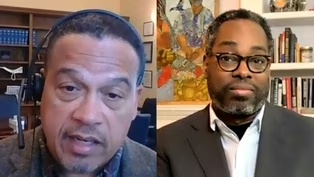
Video has Closed Captions
Clip: S49 Ep19 | 13m 25s | Chauvin Case | Episode 4919/Segment 1 (13m 25s)
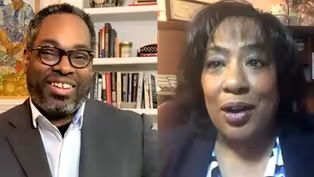
Video has Closed Captions
Clip: S49 Ep19 | 8m 59s | Vickie Thomas | Episode 4919/Segment 2 (8m 59s)
Providing Support for PBS.org
Learn Moreabout PBS online sponsorship
- News and Public Affairs

Top journalists deliver compelling original analysis of the hour's headlines.

- News and Public Affairs

FRONTLINE is investigative journalism that questions, explains and changes our world.












Support for PBS provided by:
American Black Journal is a local public television program presented by Detroit PBS