
Chicago Saw Decline in Homicides in 2025. How Can That Be Sustained?
Clip: 1/26/2026 | 16m 53sVideo has Closed Captions
The decline in violent crime echoes a nationwide trend.
In 2025, there were 417 people who died from homicide — that's down nearly 30% from the previous year and is a 60-year low in the city. It's also a nearly 50% decline from the COVID-era high of 805 homicides the city saw in 2021.
Problems playing video? | Closed Captioning Feedback
Problems playing video? | Closed Captioning Feedback
Chicago Tonight is a local public television program presented by WTTW
WTTW video streaming support provided by members and sponsors.
Chicago Saw Decline in Homicides in 2025. How Can That Be Sustained?
Clip: 1/26/2026 | 16m 53sVideo has Closed Captions
In 2025, there were 417 people who died from homicide — that's down nearly 30% from the previous year and is a 60-year low in the city. It's also a nearly 50% decline from the COVID-era high of 805 homicides the city saw in 2021.
Problems playing video? | Closed Captioning Feedback
How to Watch Chicago Tonight
Chicago Tonight is available to stream on pbs.org and the free PBS App, available on iPhone, Apple TV, Android TV, Android smartphones, Amazon Fire TV, Amazon Fire Tablet, Roku, Samsung Smart TV, and Vizio.

WTTW News Explains
In this Emmy Award-winning series, WTTW News tackles your questions — big and small — about life in the Chicago area. Our video animations guide you through local government, city history, public utilities and everything in between.Providing Support for PBS.org
Learn Moreabout PBS online sponsorship>> 2025 saw a reduction in violent crime in Chicago last year.
There were 417 people who died from a homicide.
That's down nearly 30% from the previous year.
And is a 60 year low in the city.
It's also nearly 50% decline from the COVID era.
High of 805 homicides.
The city had in 2021.
The decline in violent crime echoes a trend we're seeing nationwide.
However, more work still lies ahead in preventing shootings and saving lives.
Joining us now are Gerry and Kate would deputy mayor of Chicago for community safety.
Eddie Bocanegra, former senior adviser to the assistant attorney general at the U.S.
Department of Justice and executive director of Noah's Ark Foundation.
Reverend Sierra Beats Chamberlain, executive director of Live Free, Illinois and Andy Wheeler, interim co-director of trauma Recovery and injury Prevention at Stroger Hospital Cook Cook County Health.
I can say Cook County Health.
Welcome all 4 of you and thank you for joining us for this doing so, Reverend, want to start with you.
What is your reaction when you hear these numbers?
So as someone who has been working just go the quite naturally, it's exciting to hear.
>> That the community solutions are working.
However, we do know that there are many people in our communities on the fact that side of Chicago who may not necessarily feel the numbers that are being reported.
>> Right.
And I want to get into both of those as as we talk.
Andrew.
Was this decline something that you will feel like you've noticed at the hospital?
>> Yeah, for sure.
I during the few years during the pandemic we had this massive surge and it was very taxing on our staff our communities.
But I think the past you're so everything is felt much more manageable.
And it's been very promising.
>> Deputy mayor, what we know what we know works to reduce gun violence.
How like River Basin said, I think is a lot of collaboration, community-based organizations work that we do at the police department being very intentional about how we use our resources and partners we've seen by was decrease year-over-year pretty considerably.
Then we had a 60 loss.
really a big challenge to make sure not only do we keep up that work.
We were to say more lives in this this year and years ahead.
>> Bocanegra supporting the work of community violence intervention.
Cbi, it's often called big part of your previous role at the U.S.
Department of Justice.
We hear Cvi live.
So for folks who are sort of new to that conversation, tell us what it is, what it looks like.
Sea ice is next with 4 committee by intervention.
It is an approach that community actually help defined by incorporating all levels of supports for people who the high school going bombing victimization and perpetration.
And so.
>> Our efforts at the O J would support that specific group of people that typically in most cities account for 60% of islands.
But Billy represent about one percent or less.
>> Reverend, it's it's of course, it's one thing to see a decrease in homicides.
But there are some of the victims and families of victims who don't get that closure and your organization, you all have works to pass the Homicide Data Transparency Act in Illinois.
Tell us about that.
What to do.
a major piece of violence reduction in the rp is addressing clearance rates.
>> And some of the clearance rates does not mean necessarily Right?
clear space basically is the department is measuring the cases that are closed, not necessarily solved.
And so with we identified the high would be communicated to community.
We developed a homicide data, transparency, eggs so that we can ensure that that they do was made transparency to community so that we can be able to see how many cases were actually been solved within particularly year.
cleared case could be.
Is there an example that comes to mind that?
>> case that has cleared but not solve.
There's not someone who has been arrested and adjudicated in court for sure.
So, for example, someone can be cleared through exceptional means, which means that the police may feel that they have significant evidence, but they may not be able to close the case because they believe that that person is the seats.
>> So that means that the case will be cleared through exceptional means.
But it doesn't necessarily means that it's solved.
So some of the issues with Eddie where we've had many conversations, even with the previous states attorneys within CPD it with the community.
A lot of times we are looking is seen that the 8th back in we'll put this is data from about 23.
Where are the reports were clear stories were about 54%.
But then when CPD, we identified that in Englewood, there will be about 7 to 13% of those cases And so that is the word that we're trying follow layout and say we have a huge issue around one, how we're talking about clearance rates, the importance of making sure that communities understand saw rates how we can work within CPD work with the state's attorney.
What across the state?
Because of not only Chicago issue, but we really, really need to improve clearance rate.
Saw rates because if people are not head wound just the right thing.
families who lose Leavenworth designed to know that justice was fired.
But then we also make need to make sure that we're not meeting spaces where people want to take a law enforcement into their own hands because they do believe that justice will be served.
Deputy mayor, what is the city doing to ensure that homicides and other crimes, of course, are actually getting soft?
Yeah, absolutely.
So that's a great question.
So a lot of work has gone into improving class or something classes class right?
>> Highs we've had in the last decade when it happened in his work across the girls.
So you have the Durham Tech Tips, bureau troll, the Bureau of Counterterrorism, all working together across the board to work solve those cases.
Now, to the reference point, when you talk about clearance rates using the national standard, we asked and so a homicide that may have happened last year.
And if it's clear this goes into this year's class right now, what I will say for those families who get that closure.
They don't care when it will solve clinic last that they have closure.
When they can get that close.
And I think it's really good that not only are we looking at improving homicide clearance rates will also non-fatal shootings.
Right?
Because I know a lot of focal point comes on a homicide.
Really thinking about how we can hold people accountable who are causing harm and communities overall.
And I think another way we get to those better clears rates as my people communicating the things that they've seen and really letting people know causing harm in those communities so we can take the necessary resources between the police department.
see the states attorneys office in all really work together to try to bring closure to families.
>> Andrew, Walk us through sort of what happens at Stroger Hospital when someone experiences a shooting.
When you've got a victim that comes in.
>> Yeah.
When a patient comes in, it activates a whole team of people very large team at a multidisciplinary team of physicians, nurses, respiratory techs x-ray, Texas Cetera.
Whose goal is to really, you know, keep a person alive and save their life.
And most people who arrived in the trauma unit who have a pulse when they arrive will survive.
And since the vast majority of shooting victims will survive its our duty to provide them with the proper wrap-around care.
And so what our team provides our trauma recovery and intervention Program provides is that type of service.
So they're able to connect with a social worker.
We call a trauma intervention specialists or called a community resource.
Navigators can provide that patient with inpatient crisis intervention, mental health care for them and their families.
And then based upon the needs we have they need follow-up care.
We can provide that or we off also work within this vast network within the city to make sure they can get get connected to the CBI organizations, housing organizations or other types of services that they may need.
You say it's your duty as the hospital to provide that sort of wrap around care.
>> It may be that includes, you know, mental health care as well.
But it sounds like the programming that you all do.
It's more than than just help, right?
You've got social workers and folks who can help with is that housing is unemployment like what are the other need to have and providing that is a service in the hospital.
Is that not a shift in the and in the kind of treatment that a hospital would give for a gun shooting victim.
>> It is a shift and I started in the trimming about 13 years ago and at that time a lot of people would be like, what is this thing that you're doing and nowadays out of a lot of the work that the folks here in communities and leaders have done is now it's more of a standard of care.
And this is what people mean by approaching gun violence as a public health issue.
It's a shift away from and a moral judgment or thinking that you can incarcerate you way out of the problem and using a public health approach saying, you know, we understand that somebody who's a victim of gun violence is a very high risk of being injured, again, injuring somebody else or being incarcerated.
And so you tell your interventions to mitigate that risk.
>> lot of credit has gone to the work of CBI and reducing crime rates.
But there's so many factors.
And, you know, as we mentioned earlier, this is something that nationwide that other cities are experiencing as well.
This decline.
What else do you think could be behind this nationwide decline in violence that we're seeing?
Well, I think, you know, best a few things.
I was a department just as we push that about 300 million dollars.
Fortunately how those funds got cut.
>> With a new administration, different Priorities Committee.
Public safety was not a priority.
The current station.
But having said that, what we did see those 3 plus here as well part of justice.
We saw struggle between cbr relations in law enforcement.
You could look at some of the cities like Kansas City, Chicago, La New York.
Clearly these are places that they're struggling since there.
They're also organizations besides CBI, organs that are coming together to provide was wrap-around services.
We have seen better data and research to emphasize not only the quality of the service of people are receiving, but also the impact that it's having.
Chicago, the prime example, because it's giving birth to 2 projects here, one byte or Western and one by the Chicago's crime Lab, which is the our city Chicago.
Reverend, you know, we we talk about homes to homicides falling overall, but domestic homicides have also climbed according to police data.
>> What more needs to be done to address gender-based violence.
>> believe that we have to continue to invest in community organizations.
Community continue to invest in the into recalls solutions.
And more importantly, I think we really have continue to make those investments in mental health so that people can receive a carefully in the trauma services that they need.
We know most of the time from people are of victims or survivors of domestic violence that they're still confirm type of cycle.
We break those like about making sure that people are able get the resources and the support that they need to have info.
For example, we have the community, Hillary for theaters network with they in live free, Illinois, which is is issues will trauma related to gun violence.
Incarceration have a lot of our receive families who I have been survivors of domestic violence trying trying to get out of those situations.
And so major pieces making sure that families have the support resources that they need.
even in this place where we feel a lot of budget cuts, these are the areas that we need to Passaic make sure that we're protecting these families and how to that piece.
>> We've got some work to really expand training to see the size of gender-based violence working Sceviour actions like the one mentioned to really have folks be able identify signs that they see domestic violence as a city, we increased the dollars that we put identified the violence and really making sure we can wrap around support for those victims were actually going to add pillar gender-based violence in the people's way a community safety.
So it won't just be an off be a focal point of city Safety network in the planning going forward.
Yes, because of those funds were point of contention during budget season.
Not just Pastor Eddie yeah, that I do actually want to build on as a matter of fact.
being DOJ getting the kind of a bird's eye view was happen across the country.
>> And that was Chicago by far has a deep as investment.
CBI.
Since 2016, we put so much buzz dollars into this kind of effort, I'm not surprised that we've seen the kind of reduction 30 plus national gun violence here has been declining for the last several years.
But here's another.
The bottom line is that's the decision Illinois and our Cook County has also seen this emerge.
A workforce of people who are doing the CBI work.
Well, they're investing in development and training to creating career path was one of the vigils, right?
That addresses will be a traitor on promise supporting wrap-around services.
There are encouraging more the collaboration and that's really important because that is one of the best ways that we are seeing evidence around the dues reduction gun violence.
Deputy mayor, we also saw, as I mentioned, this decline in homicides around the country.
So I want to pull up a graph from new Chicago crime lab, as you mentioned.
>> It shows how the city's recent decline in homicide echoes that of other cities.
I believe that to be St.
Louis.
That's at the top there, it to what extent would you say the city can take credit for for these decreases in violence, kind of similar to that question to Eddie about what are some of the other reasons for this decline beyond CBI work?
Yeah.
When it comes to credit, I think the credit goes to the people who live in a city, Chicago people who have been working to bring violence down.
>> It's not a single policy is literally everyone working together to drive.
I was out throughout the city now.
What do you like when we talk about the national transit van was gone and that's a trend which I'll be excited about because that means they're more people alive.
More people left, fewer people causing on.
And that's a bigger opportunity for us to do better.
So I think the work that's happening across the city of Chicago can be replicated in other parts of the country.
I was going what does that work includes, right?
Because like even the crime lab has pointed to, it could education, improving in graduation rates, getting better I mean, it could be any number of like actual tangible factors around the city.
That means.
>> Lower violent?
Yeah, absolutely.
So I think it's a myriad of factors, right?
There's a focus improving housing.
There's a focus on holding people accountable who calls as a actually clearing cases and holding people accountable.
There are more resources put into youth jobs as more resources into be put into jobs.
What adults expansion to see behalf of the first time in history to see the Chicago we had to lead organizations, Lee, it be at work.
We've also for the first time this year, the city.
Put dollars into hospital as well as we mentioned, that he was speaking to Hurley.
So really expanding where we're putting our resources is really helping us see the results that we've seen.
And just, again, that level of collaboration with seeing across the entire cabinet, not just what folks inside of government and we do have great collaboration with our partners in the county in the state, really a partisan faith.
is all of us working together.
>> Andrew, want to get you in here before we run out of You know, we talked a little bit about sort of like the shifting to a public health approach to reducing violence.
Tell us more about that and how I guess how other hospitals, how the rest of the country sort of gets in on that as well.
>> So like I mentioned, have a public health approach means you're identifying risk of providing the right intervention time scaling it out.
And so we work with our other level one trauma centers within the city of Chicago.
And we work with a lot of the CBI organizations through the city.
Also just too, coming how it goes nationally as were part of a national network the hospital at the headlines or violence intervention with a hobby which isn't a lot of great work of like any mention standardizing practice of CBI work using research to know we can all use research that we can share to our partners and in other cities as well.
We've got like 30 seconds left.
>> What can you say about your role in DOJ and how why into believing that in 30 seconds?
3 seconds.
In fact, it was it was an incredible opportunity, be appointed there and then become a career fad.
The the people should know that communities Committee safety is not a priority.
This administration, you could tell by the cuts and with the investments are at or not.
And I think there was a level of of us Chicago modeling to the rest of United States of what what community looks like when partners with business and others.
All right.
Good to have you back.
Thank you so
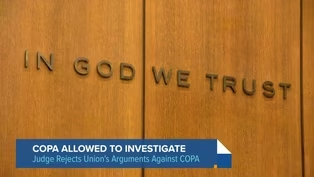
Judge Allows COPA to Investigate Fatal Chicago Police Shootings
Video has Closed Captions
In less than nine years, COPA has probed 138 deaths caused by Chicago police officers, records show. (3m 9s)
Providing Support for PBS.org
Learn Moreabout PBS online sponsorship
- News and Public Affairs

Top journalists deliver compelling original analysis of the hour's headlines.

- News and Public Affairs

FRONTLINE is investigative journalism that questions, explains and changes our world.












Support for PBS provided by:
Chicago Tonight is a local public television program presented by WTTW
WTTW video streaming support provided by members and sponsors.