Chicago Stories
Chicago Stories: Toy Town
10/9/2026 | 53m 50sVideo has Audio Description
Take a nostalgic trip back to a time when the city was a leader in toy innovation.
Tinker Toys. Lincoln Logs. Beanie Babies. Radio Flyer. Kids obsessed with these iconic toys and games would surely have been surprised to learn that these and many others were born in Chicago. Take a nostalgic trip back to a time when the city was a leader in toy innovation. Audio-narrated descriptions are available.
See all videos with Audio DescriptionADProblems playing video? | Closed Captioning Feedback
Problems playing video? | Closed Captioning Feedback
Chicago Stories is a local public television program presented by WTTW
Lead support for CHICAGO STORIES is provided by The Negaunee Foundation. Major support is provided by the Abra Prentice Foundation, Inc. and the TAWANI Foundation.
Chicago Stories
Chicago Stories: Toy Town
10/9/2026 | 53m 50sVideo has Audio Description
Tinker Toys. Lincoln Logs. Beanie Babies. Radio Flyer. Kids obsessed with these iconic toys and games would surely have been surprised to learn that these and many others were born in Chicago. Take a nostalgic trip back to a time when the city was a leader in toy innovation. Audio-narrated descriptions are available.
See all videos with Audio DescriptionADProblems playing video? | Closed Captioning Feedback
Where to Watch Chicago Stories
Chicago Stories is available to stream on pbs.org and the PBS app.
Chicago Stories - New Season!
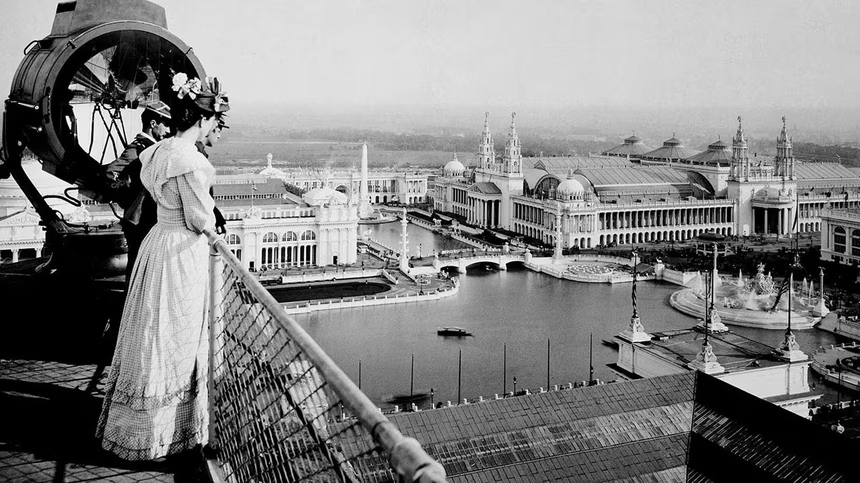
Season 6 includes: The World’s Fair of 1893, Toy Town, Skyscrapers, and Home of the Irish.Providing Support for PBS.org
Learn Moreabout PBS online sponsorship(upbeat instrumental music) - Coming up.
- Chicago is an enormous deal in the toy business.
- [Narrator] The city that taught the world how to play.
- There was "Mr.
Machine", ("Mr.
Machine" whirring) "Lite-Brite", "Operation", (buzzer beeping) "Simon".
- And "Mousetrap", right.
You had no idea these were made right here.
- [Narrator] From plastic to plush, iconic toys and games that defined generations.
- Your dreams are gonna be fulfilled if you open up that box.
- [Narrator] And the dreamers who turned imagination into industry.
- You behave like children.
You're playing all day long.
It's beyond fun.
- He was P.T.
Barnum.
He was the showman.
- I was a 19-year-old kid responsible for the online branding of the biggest toy company in the world.
(Nikhil laughing) - [Narrator] But the business of play wasn't always fun and games.
- People thought they had to get in while the getting was good.
There's a sucker born every minute.
(screen transition whooshing) (upbeat instrumental music) - [Narrator] "Toy Town", next on "Chicago Stories".
(upbeat instrumental music) (upbeat instrumental music continues) (upbeat piano music) (garage door whirring) - [Narrator] This is where the magic happens.
Toy inventor, Jeffrey Breslow, is working on his next big hit.
- This is "Giggle Pickle" and you can talk to him.
("Giggle Pickles" quaking) And he says anything you want him to say.
("Giggle Pickles" quaking) There's a little tube in here with a little whistle going back and forth.
But when you move it up and down, (tube quaking) it makes the sound.
- [Narrator] With a job this fun, it's no wonder he's been at it for more than 60 years.
- It is a wonderful toy and we have kids that delight in this thing.
(upbeat instrumental music) - [Narrator] A toy industry Hall-Of-Famer, Breslow has helped create dozens of iconic toys and games, including "Simon".
- [Announcer] Light the lights that Simon lights or he'll tell you that you're wrong.
- "Operation".
- You never do that.
Don't touch the sides.
(buzzer buzzing) - [Advertiser] It takes a very steady hand.
- [Narrator] And many more.
- Early on, I was fascinated with taking things apart and putting them back together.
- [Narrator] Several of the toys he knew and loved as a kid, like "Tinkertoys" and the "Radio Flyer" wagon he pulled along his newspaper route were invented right here in the city he's always called home, Chicago.
(upbeat instrumental music continues) - Chicago is an enormous deal in the toy business.
- There's a lot of dreamers and a lot of magicians here, and it's always been a really special place for creative minds.
- [Narrator] That creativity has been inspiring toy design for more than 100 years.
Going back to the early 1900s, a time when the city was being built from the ground up.
- Cities across the nation are starting to boom.
Parents are seeing these skyscrapers going up all over the city and what better way to prepare their boys to eventually be the builders and the architects of these buildings than to buy them construction sets.
- There was the progressive era of reformers who wanted all toys to be purposeful, to teach a skill.
(birds chirping) - [Narrator] Homemade play things like marbles and hoops gave way to building sets called construction toys, designed to train young minds.
- Construction toys were thought to build spatial intelligence, understanding of math, basically, general building principles that you could apply in the real world.
(classical instrumental music) - [Narrator] In the average American family today, children are the object of more concentrated thought and concern than the young of any previous generation.
- [Narrator] In 1914, 39-year-old stone mason, Charles Pajeau, of Evanston, Illinois was looking to break into the growing toy business.
(upbeat instrumental music) - He was working for his father's stone monument business, and he was not particularly happy doing that.
- They made headstones, not very fun or playful.
So on the side he was working on a couple of inventions.
- Pajeau had seen children playing with wooden spools and sticks, building different things, and he decided to make a toy based on this principle.
- [Narrator] Using a few simple materials, the children had discovered endless possibilities.
(screen transition whooshing) Pajeau was inspired and created "Tinkertoys", a wooden set of sticks and spools that, with nimble hands and a little imagination, could become anything.
- With "Tinkertoys", you can build incredibly large structures.
- Houses, airplanes, windmills.
It was really anything you could think of.
(upbeat instrumental music) - [Narrator] Sales of "Tinkertoys" soared in 1915 when Pajeau landed a spot in the coveted Marshall Field's Christmas windows, visited by wide-eyed children every season.
(upbeat instrumental music continues) - They hired people to dress as elves and to demonstrate the various models you could build and how the toys worked.
And this was during the holiday season, so it immediately took off.
- The Sears Wish Book was a huge part of Christmas time.
So even children in rural areas who didn't have access to the toy stores can see advertisements for dolls or "Tinkertoys" and decide that they want those too.
- [Narrator] Within a year, 900,000 Tinkertoy sets were sold.
The distinctive tube packages delivered to eager children everywhere.
- [Curator] So this is a collection of "Tinkertoys".
It also shows the mailing label, and this way the department stores could ship it to children around the country very easily.
- [Narrator] Over the years, "Tinkertoys" has evolved, from the materials, to the mechanics, to adding color, and the set continues to be produced today.
(relaxing instrumental music) Another iconic construction toy, "Lincoln Logs", hails from the Chicago suburb of Oak Park and was designed by John Lloyd Wright, son of the famous architect.
(relaxing instrumental music continues) - So Frank Lloyd Wright was a pretty progressive father for the day and he was deeply invested in his children's education.
He gave them access to his library and his design studio.
And John and his sisters had this magical playroom, growing up.
- [Narrator] That seemingly idyllic childhood was shattered when Frank walked out on his wife and six kids.
- His father, Frank Lloyd Wright, abandoned his family and left for a client's wife, which was a huge social scandal and was incredibly traumatic for the family.
- [Narrator] Though estranged, 18-year-old John would follow in his father's footsteps, finding work as a draftsman.
(train clackety-clacking on rails) Five years later, in 1917, Frank Lloyd Wright took his son under his wing, offering him an apprenticeship designing the Imperial Hotel in Tokyo, Japan.
John admired the building's interlocking timber beams, designed to withstand the region's powerful earthquakes.
But the apprenticeship, like the rekindled relationship, didn't last long.
- They got into a disagreement about his salary, and Frank fired John.
When John arrived to Chicago, he wasn't quite sure what to do with himself, so he started selling wooden toys, mostly to Marshall Field's.
And he also started coming up with a concept for a construction toy.
- And he bases what becomes "Lincoln Logs" on the interlocking beam design that he was working with in Japan.
- [Narrator] With pieces of notched red wood, children could build sturdy structures of all shapes and sizes.
- Not only could you build the traditional cabin that we think of today, you could also build giant cathedrals.
You could build wooden forts.
- [Narrator] Named after President Abraham Lincoln, the set came with instructions to build Lincoln's Kentucky boyhood home.
- It was the all-American childhood, being able to build and be free, just this idealized, romantic idea of what it was like to grow up in America.
- [Narrator] The toy became an instant success.
- So John Lloyd Wright was still very much interested in being an architect, and he eventually decided to sell off "Lincoln Logs" to Playskool in the 1940s.
(relaxing instrumental music continues) - [Narrator] John reportedly sold "Lincoln Logs", one of the most cherished toys of all time, for just $800.
Today, more than 100 million sets have been sold worldwide.
- It is not typical for toys to last as long as "Lincoln Logs" and "Tinkertoys" have.
- "Tinkertoys" and "Lincoln Logs" allow children to use their imaginations to build whatever world that they want to.
And I think that that allows a toy to be relevant throughout time.
- [Narrator] That sense of wonder and nostalgia, coupled with a low price point, allowed these toys to survive tough times, like the Great Depression.
- [Reporter] Millions were unemployed, on some form of relief.
- [Narrator] It was a decade of scarcity.
Most families couldn't afford to buy toys, so children relied on their imagination and simple toys fashioned from scraps.
While many toy companies struggled, sales of this little red wagon were actually on the rise.
(upbeat jazz music) The "Radio Flyer" story dates back to the spring of 1914, (ship horn blowing) when 16-year-old Italian immigrant, Antonio Pasin, came to America.
(upbeat jazz music continues) Within a few years, he was making a modest living crafting wooden furniture and wine presses in a garage on Chicago's West Side.
- They say necessity is the mother of invention, and the little red wagon is no exception to that rule.
And the first wagon my grandpa made, he used to haul tools around in his workshop.
But then people were asking him if he would make one for them, and even better, for their kids to play with.
- [Narrator] The wooden wagon sold as quickly as Pasin could build them.
He called it the Liberty Coaster, an homage to the Statue of Liberty that greeted him in this new country.
(upbeat jazz music continues) As sales grew, he ventured away from wood and turned his eye towards steel.
And in Chicago, its skies filled with the smoky plumes of the steel mills.
Everything needed was close at hand.
- He was always looking for new ways and new technologies to make his product better.
So one time when he was visiting a supplier, he saw punch presses that were stamping out big pieces of metal.
And he thought, "Oh, I could use that to make wagons."
(whimsical instrumental music) - [Narrator] Using his company's entire savings, Pasin purchased an automobile factory and repurposed the equipment to stamp metal wagons, doubling his output to 1,500 wagons daily.
He added a coat of shiny red paint, and the "Radio Flyer" was born.
(whimsical instrumental music continues) - They were the two coolest high tech inventions of the day, the radio and the airplane.
He loved the best parts of America, the fact that there was opportunity, the fact that you could use your creativity and hard work to build something amazing.
- [Narrator] In 1933, the World's Fair drew 39 million visitors to Chicago.
- He saw it as this once-in-a-lifetime opportunity to promote his new product and his new brand.
But to get into the Fair, you had to build an exhibit worthy of the Fair.
(ominous instrumental music) - [Narrator] On the fair's five-acre Enchanted Island, Pasin built a 50-foot high display, a "Radio Flyer" wagon with a giant boy riding inside.
- And they made these little miniature wagons that were sold for 25 cents.
Thousands of these mini wagons that said "Radio Flyer" went out into the world and it was kind of this beautiful, perfect story.
(Robert chuckling) - [Narrator] After the Fair, "Radio Flyer's" popularity soared.
- I think "Radio Flyer" has stood the test of time because it represents the best parts of childhood, playing outside, using your imagination, being with people you love, and really imagining that anything is possible.
(upbeat instrumental music) - [Narrator] In the 1940s and '50s, a new class of toy called novelties flooded the market.
Unlike toys designed to educate and shape young minds, novelties were small and silly, built simply to delight, trick, or amuse.
- So a novelty, which was also known as gags, pranks, joker items, they were sold in dime stores.
- [Narrator] Thanks to the advent of plastic injection molding, toys could now be mass produced at low cost.
- It was revolutionary for the toy industry.
Toys really became so much more affordable for families and kids had many more toys to play with.
(relaxing instrumental music) - [Narrator] In 1947, the $3 million-a-year novelty industry caught the attention of a 34-year-old toy inventor in Chicago named Marvin Glass.
- Marvin didn't have the easiest childhood.
He had a mother with mental illness that was abusive to him, a father that abandoned him.
He knew poverty, but he persevered.
(birds chirping) (whimsical instrumental music) - [Narrator] Marvin was also a dreamer who channeled his trauma into invention.
When he wasn't given any toys to play with, he created his own.
After college, Glass took a job with a toy company, selling paper cutout sets.
A natural salesman and inventor, Glass eventually bought out his partners before going all in on his latest creation, a collection of tiny plastic stained glass Christmas tree ornaments.
Glass invested $1 million, but it was a total flop.
He was in debt, left with $300,000 of worthless product.
- It's very high risk, and he learned it the hard way 'cause he put all of his eggs in one basket and he lost everything.
- [Narrator] Glass borrowed money to stay afloat.
And in 1948, he got lucky when an inventor named Eddy Goldfarb came knocking.
- It was a match made in heaven because Eddy knew plastics.
He was a great inventor.
- [Narrator] Goldfarb had designed a few plastic prototypes, including a set of wind-up chattering teeth.
Marvin loved them and soon struck a deal with a top novelty manufacturer who bought the Yakity-Yak Talking Teeth for $2,500.
(teeth chattering) (upbeat instrumental music) - Arguably, the most well-known novelty in the history of the world.
It wasn't licensed.
It was sold outright.
- [Narrator] The $1 talking teeth would go on to earn millions, but Glass and Goldfarb wouldn't receive a penny more.
- It was never-ending pain and suffering for Marvin every time he saw it for the rest of his life, all the money that he lost.
- [Narrator] There had to be a better way.
From the Christmas ornament debacle, Glass learned that manufacturing toys was a costly gamble.
After the talking teeth, he vowed to never sell a toy outright again.
These were painful lessons for Glass, but ones that would transform his career and the business of toy invention itself.
- Marvin really invented the business of independent toy design.
You write a book, you make a record, if it sells a lot, you make a lot of money.
If it doesn't then you don't make anything.
So he looked at this example of what he wanted to do in the toy business.
(upbeat instrumental music) - [Narrator] Glass would launch an idea factory, the first of its kind.
He would invent toys, license those ideas to the big toy manufacturers, and then watch the royalty checks roll in.
- Marvin was able to license the toy to the Mattels or the Hasbros or other companies, which was unheard of at the time.
(upbeat instrumental music continues) - [Narrator] Over the next year, Glass and Goldfarb would test this licensing model on some of Goldfarb's other inventions, (screen transition whooshing) like the Merry-Go-Sip, a fun way to get young children to drink their milk.
And the Busy Biddy Chicken, which when pressed would lay white marble eggs.
(chickens clucking) (marble clanging) Kids couldn't get enough of it.
(whimsical instrumental music) More than 14 million plastic chickens were sold.
Glass and Goldfarb pocketed 5% of each sale, (chickens clucking) netting $314,000.
(coins jingling) - The more that a company sold, the higher the royalties were for Marvin Glass and his partners.
It truly revolutionized the whole inventing business.
- [Narrator] Goldfarb was ready to strike out on his own.
He moved his family to California and went on to become one of the most prolific toy inventors in history.
Meanwhile, Glass found other idea men to fuel his business.
Over the next decade, he would cement his reputation, inventing novelties like the Hypo-Phony, a fake hypodermic needle, giant glasses called the Super-Specs, and a pile of fake vomit called, Whoops.
- Fake vomit.
(Mary chuckling) I mean, it was a hit.
It's still a hit.
(upbeat instrumental music) - [Narrator] By the mid-1950s, a seismic shift was underway.
The economy was booming and growing families were flocking to the suburbs in record numbers.
Children were now the center of family life and a new era of consumerism sent the toy industry soaring to new heights.
(dramatic instrumental music) - The advent of television changed the marketing of toys pretty dramatically, and it shifted parents away from being the primary gatekeepers into these toy companies being able to speak directly to children.
(whistle blowing) - [Advertiser] Hey, kids.
Look.
- The purchase power changed.
It was the kid saying, "Of all these toys and games, that's the one I'm excited about.
That's the one I want."
- The child is now the consumer and points to the television screen and says, "I want that."
- [Narrator] The toy industry had grown into a $1.6 billion-a-year business by 1960.
Marvin Glass and Associates continued to expand with designers and model makers tinkering and toiling away, vying to be the first to invent that next must-have toy.
- The game changer was "Mr.
Machine".
(upbeat instrumental music) - [Narrator] "Mr.
Machine" grossed 14 million in sales in just two years.
♪ Here he comes, here he comes ♪ ♪ And his name is "Mr.
Machine" ♪ - [Narrator] And became so popular that the manufacturer, Ideal Toys, could barely keep up with the demand.
- After the massive success of "Mr.
Machine", all the companies are like, "What's the next big hit?
It's gonna be a Marvin Glass item.
We want the next "Mr.
Machine"."
- [Robot Commando] Robot Commando is here to help you.
- [Narrator] Glass met the demand, releasing Robot Commando and a mechanical dinosaur called King Zor.
- [Advertiser] There's never been a fighting dinosaur like King Zor.
- That's what he was known for, big TV demonstrable features that would make kids' dreams come to life.
- [Narrator] MGA earned roughly 5% of the wholesale price on every product the manufacturers sold.
And they sold a lot.
They also had a lot of fun doing it.
- This is a way to make a living.
(people laughing) - Not necessarily.
(hand rattling) (people laughing) (people applauding) - I was just part of the group, part of the group.
I was one of them.
This is me.
- [Narrator] In 1960, Glass hired 22-year-old Dalia Ancevicius, fresh out of industrial design school, as the firm's first ever female inventor.
- It was a very interesting place to work.
I was able to use my abilities as a creator in that job.
- [Narrator] Dalia got to work on a prototype for a game called "Mousetrap", one of the first three dimensional board games, inspired by the complex machines of cartoonist Rube Goldberg.
- We had such a hysterical time because we were looking what was funny.
What can we put this thing that's funny?
Oh, a bathtub is funny.
(motivational instrumental music) A shoe kicking something is funny.
- [Narrator] An overly complex trap designed to catch a humble mouse.
(mouse squeaking) For Glass, the humor was part of the sell.
- And the stop sign hits the shoe, which hits the bucket, which releases the steel ball, which goes down here.
- And we put it together and it worked.
(Dalia chuckling) It was a good seller.
- [Marvin] Which releases a trap that catches the mouse.
- [Narrator] The game sold 1.2 million copies in its first year, becoming one of the most successful games of the century.
Despite her contributions, Dalia, like most women in the mid-1960s, earned about 60 cents for every dollar paid to her male counterparts.
- I did come up with a lot of ideas.
I was definitely making less than the men, definitely.
- The guys would get bigger bonuses.
The guys would be on the patents and sometimes she would be left off.
- That's when I really got upset.
That's when I really got upset.
That's when I went on a business on my own.
(screen transition whooshing) - [Narrator] Meanwhile, MGA released another huge hit, Rock'em Sock'em Robots.
- The Blue Bomber and Red Rocker in the fight of the century.
- [Advertiser] A left to the jaw and... (head buzzing) - Oh my block is knocked off.
- [Advertiser] But you can press it right back on.
It's Rock'em Sock'em Robots.
- [Narrator] The groundbreaking tabletop toy provided young kids with hours of entertainment.
- Wait till next time.
- One of the most successful products that was ever produced at Glass and one of the benchmark toys in the toy industry.
- [Narrator] And it's still being produced today.
- Its form follows function.
First, it has to work, and then it can look beautiful.
- [Narrator] In 1964, Jeffrey Breslow was a sophomore at the University of Illinois, studying industrial design.
- We did a toy project: design a new type of toy or game or anything else.
- [Narrator] Breslow fell in love with toy design.
His class project came in second.
- So the thing that came in first place was a little blue box with a buzzer and a battery and a little probe.
And you stuck the probe in and if you touch the metal, it buzzed.
(buzzer buzzing) - [Narrator] The top prize went to Breslow's friend and classmate, John Spinello.
- And I asked John what he was gonna do with that?
And he said that he had an uncle that worked for this guy, Marvin Glass.
And I said, "What do they do?"
He said, "It's a toy design company."
"You're kidding me."
And John sold the box to Marvin Glass for $500.
(upbeat instrumental music) - [Narrator] Glass turned around and sold that little box with a buzzer to Milton Bradley.
(buzzer whirring) And it became one of the most popular games in history, "Operation".
- [Child] Don't touch the sides.
(buzzer buzzing) - [Advertiser] It takes a very steady hand.
- [Narrator] Learning about Marvin Glass and Associates would change Breslow's life from that day forward.
- All I thought about was when I finished college, I wanted to find out if I could work for Marvin Glass.
That was my dream.
- [Narrator] Business at Marvin Glass and Associates was booming.
With big hits like "Mystery Date".
- [Child] He's here.
My "Mystery Date".
- [Narrator] And a beloved classic, "Lite-Brite".
♪ Lite-Brite, making things with light ♪ - "Lite-Brite", the number one game in the country.
You could imagine how much money that was.
- [Narrator] By this time, the company had moved to a state-of-the-art facility on LaSalle Street, the imposing stone building built to protect the magic happening inside.
- [Reporter] Security is tight here because as Glass explains it, the ideas worked on inside are worth millions.
- And what we're protecting is not just a little toy that mama buys for $2.90, but the idea that might be worth $5 million or $3 million.
That's a lot of money to protect.
- Secrecy is very important in the toy industry.
- [Narrator] A hot item could yield a major payday for inventors.
It's why Marvin Glass kept his prototypes under lock and key.
- The actual super-secret design work is done behind this securely locked door.
- When somebody was working on a toy or game, at the end of the day it had to be locked up into a safe every night.
When at Toy Fair, they would have suitcases with these hidden high secure toys handcuffed to the employee's wrist.
Some of it was showmanship and he was a little paranoid.
- [Narrator] With every major toy company in America knocking on his door, Glass had his pick of the best toy makers and visionaries out there, including 24-year-old Jeffrey Breslow, who finally scored an interview with Marvin Glass in 1967 and was invited to pitch directly to the toy king himself.
(upbeat instrumental music) - The door opens and in walks Marvin, okay.
And he's 5'3", smoking a cigarette and he sits down and he says, "Okay, we're ready."
And I started going through my portfolio.
And then when he got done, he said, "I really like your work.
You got the job."
And that was it.
(upbeat instrumental music continues) - [Narrator] Breslow got to work.
- And I started by making a list of names and then sayings, a bird in the hand, ants in the pants.
(whimsical instrumental music) And then I said, "Okay.
I gotta design a game that fits the name."
♪ Ants, ants, ants ♪ ♪ Flip them right into the pants ♪ - It was pretty simple, just an ant that you could make jump.
- [Narrator] Glass liked the prototype and asked Breslow to pitch at the next client meeting.
- [Child] I did it again!
- And when I brought it in, I put it out there.
I flipped it.
He says, "It's mine.
That's it."
He says, "I don't need to see anything else.
I'm making this."
That was it.
(whimsical instrumental music continues) - [Narrator] Within months, he had invented another game called "Bucket of Fun", sold to Milton Bradley.
And Breslow's creative gears kept on turning.
- I was producing a lot of stuff.
I mean, I was making mockup after mockup.
I was very productive.
Pressure motivates creative people.
Marvin knew that.
- Marvin was a visionary that people wanted to work for, wanted to work hard for, and work extra hours for and be creative for.
- [Narrator] Pressure was tempered by a playful atmosphere, largely driven by the boss himself.
(whimsical instrumental music continues) - He was P.T.
Barnum.
He was the showman.
He would go on the intercom, play marching music and say, "Rally the troops.
We gotta work harder and faster."
Which could cause people just to roll their eyes.
"Oh, that's Marvin being Marvin."
- Unbelievable character, you'll never meet anybody like that in your life.
(upbeat jazz music) - [Narrator] The eccentric toy genius had become something of a legend.
After channeling his inner child all day, after hours, Glass' Evanston home became an adults-only playhouse, featured in "Playboy" magazine.
- He would have parties that would include hot tubs and playmates and such.
He was friends with Hugh Hefner.
Marvin at one time dated one of Hugh's secretaries.
(camera shutter clicking) Marvin loved women and put them on a pedestal.
(upbeat jazz music continues) - [Narrator] By the early 1970s, Glass and Associates was raking in nearly $9 million per year, over 75 million in today's dollars.
And a new trend was sweeping the business.
Companies were partnering with entertainment franchises, licensing popular characters and turning them into must-have toys.
- Marvin always felt that our toys were original and that we didn't need to license other products.
But Marvin had a stockbroker friend who knew somebody who knew Evel Knievel.
- If I look like I'm rigging up for a trip into outer space, you're right.
- He built his career on jumping motorcycles over things and busting his body up and busting his body up.
That's what he did.
- [Commentator] Getting that bike off the approach ramp - [Narrator] When Evel Knievel was in Chicago for a motorcycle jump at the International Amphitheater, Breslow and Glass went to watch and Glass invited the daredevil to a meeting the next day.
(crowd cheering) - So he came in and he's got this outfit on, red, white and blue.
Very handsome guy, and we were kind of taken with him.
- [Narrator] Without any specific toy ideas in mind, Glass got Knievel to sign an exclusive deal for all rights to toys, games, and other licensed products.
Just before Christmas, the "Evel Knievel Stunt Cycle" hit the market, becoming an immediate sensation.
- If you grew up in the '70s as a kid, you wanted that toy.
- [Advertiser] Here's Evel, up and over that four-foot ditch.
- (Bill) He's popping wheelies, doing somersaults, arguably, the greatest boy's toy ever.
And we made a fortune on it.
We paid him a fortune on it and it was very successful.
- [Narrator] Cashing in on another hit toy, Marvin Glass was on top of the world.
It seemed like nothing could knock him from the throne.
But in July of 1973, Glass suffered a stroke.
(ominous instrumental music) - Marvin didn't take care of himself, okay.
Two packs of cigarettes a day.
He was beyond stressed about everything.
We knew he was not gonna recover from it.
(ominous instrumental music continues) - [Narrator] Marvin Glass died at his Evanston home six months later at the age of 59.
Serving as pallbearers at his funeral, Glass' business partners and Evel Knievel.
- I never met anybody like that before, or never will again.
It was tough on everybody.
It was just a difficult transition for the company.
It was not quite the same.
- [Narrator] Shortly before his death, Glass named longtime associate, Anson Isaacson, to run the company, which then employed 75 people.
A shrewd numbers man, Isaacson expanded the licensing business and the company released.
- [Advertiser] But be careful.
- [Narrator] The game of "Jaws".
(dramatic instrumental music) (child exclaiming) - [Narrator] And the "Mickey Mouse" phone.
As electronic toys and games surged in popularity, the company hired its first electrical engineer, Al Keller, to integrate the complex circuits into toys.
- I mean, he was a quiet guy.
He minded his own business and that was pretty much it.
- [Narrator] Four years into the job, Keller had been working on a game called "Tin Can Alley", an electronic rifle shooting game for children.
- An exciting new electronic target game that truly tests your marksmanship.
- [Narrator] Under Glass' leadership, the company had gone more than a decade without designing a game with a toy gun.
- Well, after the Kennedy assassination, Marvin was very upset and said, "We're not gonna do those kind of toys anymore."
- I have never designed a war toy and I never will.
When I see a kid pointing a toy pistol at me and going, "Bang, bang," I get a very uneasy feeling.
- [Narrator] Now with Isaacson at the helm, the company had reversed its stance on toy guns, but no one could foresee the events that transpired on a summer's day in 1976.
(somber instrumental music) The morning of July 27th began like any other work day, a morning meeting with the partners.
- And I was in the office with all the people and the phone rang on the table next to me.
(telephone ringing) - [Narrator] Breslow stepped out to take the call from another office.
- And then I hear, boom, boom, boom, boom, boom.
(somber instrumental music continues) I walked in the office and Anson was slumped back in the chair.
(somber instrumental music continues) - Anson Isaacson had been shot, along with partners Joe Callan and Kathy Dunn.
(somber instrumental music continues) Three other employees had been seriously wounded before the killer, Al Keller, put the gun to his own temple and fired.
- The truth is the guy was a sick guy.
He worked for us for a long time and his mind made up all these things and he killed people and killed himself.
(somber instrumental music continues) - [Narrator] Police discovered a hit list containing the names of 14 coworkers hidden in Keller's shoe.
Second on the list, Jeffrey Breslow.
- If I didn't get the phone call and take the phone call, I wouldn't be here.
- [Narrator] After the tragedy, 33-year-old Breslow assumed the reins as managing partner.
With one foot in front of the other, the company moved forward and began creating again.
(brush rustling) One day, partner Howard Morrison walked into Breslow's office with an idea for an electronic memory game of lights and sounds.
- I demonstrated the idea by saying, "Okay, Jeff, I'm gonna do this.
Okay."
- And he tapped on a cup.
I hit the cup.
He tapped on the plate.
I hit the plate.
- And he added one and then I said, "Okay, I can do that and add one."
And we kept doing that to each other till we realized that I couldn't remember anymore.
- And he said, "I think we can do something with this chip where we can make sounds and lights and follow along."
I said, "Okay.
It sounds like a good idea."
(Jeffrey chuckling) - So I went ahead and worked out a game and made a prototype, and this was really the first prototype of "Simon".
(upbeat instrumental music) (screen transition whooshing) - [Narrator] Named after the children's game, "Simon Says", the Glass version was bought by Milton Bradley.
After a glitzy launch party at Studio 54, the addictive game began flying off the shelves.
- [Jeffrey] Big success, on the cover of "Newsweek".
We never had another toy on the cover of "Newsweek".
(game beeping) - [Narrator] "Simon" would become a pop culture phenomenon and remains one of the most iconic toys created by Marvin Glass and Associates, even five decades later.
(screen transition whooshing) By 1988, many of the company's original partners had retired and the remaining three were forced to close Marvin Glass and Associates.
- And Marvin in our contract said, "When there's only three of the original partners left, the business must dissolve."
- [Narrator] The designers split into a slew of other studios and they kept creating right here in Chicago.
- Chicago became the toy design capital.
All that came from Marvin Glass.
I mean, the whole experience was amazing, and I'm reflecting on it now, a long, long time ago.
(upbeat instrumental music) - [Narrator] Toy design continued to evolve with new technologies.
A Vernon Hills company called Tiger Electronics was on the cutting edge.
(upbeat instrumental music continues) - Our first big toy, "Skip It".
♪ Skip it, skip it ♪ - A little plastic circle and had a ball on the end with a counter built in.
Everybody had a "Skip It".
(upbeat instrumental music continues) - [Narrator] In the 1990s, Tiger became synonymous with handheld video games, popular with kids around the world.
- So where you've got Nintendo and Game Boy, which are cartridge-based systems, our games were self-contained, and we did everything.
At Tiger, we were kind of the black sheep in the toy business.
People loved to hate us.
We would get licenses that people wouldn't give other people.
- [Narrator] Tiger's success drew the attention of celebrated filmmaker, John Hughes.
- He called me on a Friday afternoon and said, "We're doing a follow-up to 'Home Alone'.
We need to create a toy Macaulay Culkin can use to get into The Plaza Hotel."
And he said, "Will you guys help?"
And we sat down and we started brainstorming.
Within a couple of hours, someone had the idea that Macaulay should actually change his voice to be his dad.
- Kevin, you better go put your tie on.
We don't wanna be late for the Christmas pageant.
- [Narrator] Tiger went into overdrive.
And within weeks they had a prototype for a voice-changing device called "Talkboy".
- Honey, are you packed yet?
- [Narrator] Which made its debut in "Home Alone 2: Lost in New York".
(upbeat instrumental music) - How do you do?
This is Peter McCallister, the father.
I'd like a hotel room, please, with an extra large bed, a TV, and one of those little refrigerators you have to open with a key.
- The Plaza Hotel reservations.
May I help you?
- [Talkboy] How do you do?
This is Peter McCallister, the father.
- [Receptionist] Yes, sir.
- [Talkboy] I'd like a hotel room, please.
- [Receptionist] Yes.
- [Narrator] After the movie's release, demand for the "Talkboy" skyrocketed.
- It became a million-piece selling unit.
"Talkboy" really became a legend.
- [Narrator] The toy was a big hit, but the antics that followed were priceless.
- The original "Talkboy" came as a Try Me.
And I got a call from a news station that said, "We heard that 'Talkboy' comes packed with obscenities."
And I'm like, "What are you talking about?"
And it turned out that people would go into the toy store, they would record their messages and leave it on the shelf.
So we ended up putting it in a sealed box, no longer as a "Try Me" and the rest is legend.
(Marc chuckling) (whimsical instrumental music) - [Narrator] In 1998, toy manufacturer Hasbro acquired Tiger Electronics for $335 million.
But the Tiger brand was so strong, Hasbro continued to use its name on products for years to come.
(whimsical instrumental music continues) Including during the launch of "Furby".
- That's "Furby".
♪ Furby ♪ - [Narrator] An interactive robot pet.
- In the mid-to-late '90s, you really had a proliferation of anthropomorphized toys.
- People would treat them as pets, but it was really a new way to play.
And the idea was you would nurture them and you would feed them and they would do everything that a pet does.
- [Reporter] When it's left alone, "Furby" will squeal, laugh, blow raspberries, and other less attractive noises.
- Well, they didn't have stuff like this when we were kids.
We made the noises.
We made the sounds.
(customer laughing) (whimsical instrumental music) - [Narrator] But no other toy inspired the kind of obsession and cult following than this Chicago area product.
"Beanie Babies".
(whimsical instrumental music continues) Chicago-born Ty Warner was a college dropout and failed actor who finally found his calling in sales.
After a decade selling stuffed animals for Dakin, Warner was fired for pushing his own designs on the side.
The 40-year-old went all in and put his life savings into Ty Inc., creating a line of plush cats.
(whimsical instrumental music continues) - Beautiful, rich-looking fluffy cats.
(whimsical instrumental music continues) - [Narrator] In 1992, 19-year-old college student, Lina Trivedi, took a part-time telemarketing job with Ty.
- I was the 12th employee, so it was a pretty small office.
- [Narrator] In November, 1993, Warner launched a new product, "Beanie Babies".
(screen transition whooshing) Nine styles of miniature beanbag animals, featuring shiny eyes and cute names like (bubble popping) Legs the Frog (bubble popping) and Patti The Platypus.
- He was very meticulous with how the plush looked, grooming them with hair dryers and brushes.
Every animal he put his soul into creating.
(upbeat instrumental music) - [Narrator] Ty Warner was unconventional in most respects, eccentric and reclusive.
A shrewd marketer, Warner sold only to mom and pop stores, creating the perception of scarcity.
- His sales reps would come in and align the products just right.
This is how Mr.
Ty wants it displayed.
- [Narrator] One day, Warner got word about an issue with his Asian fabric supplier for Lovie the Lamb.
In a stroke of marketing genius, he turned a supply problem into gold, announcing he would retire Lovie the Lamb, in turn, creating a buying frenzy.
- Yeah, the retiring was brilliant, brilliant.
Ty gave that perception of scarcity when there was none.
People believed that they were rare, even though everyone had them and they were selling millions of them every year.
(upbeat instrumental music) - [Narrator] As Warner rolled out dozens of new "Beanies" in limited quantities, sales skyrocketed.
- They were flying off the shelves so quick, we had collectors that were calling our company, wanting to know how many "Beanie Babies" are there?
- Trivedi had an idea to further the aura of collectability.
On the "Beanies'" ear tags, they could add a playful poem and a birthday.
(upbeat instrumental music continues) - Obviously, "Beanie Babies" were adorable.
How do we make that stand out and make that connection with people?
And the poems were a way to build that connection.
Ty liked the idea and he asked me if I would be able to write one for each of the "Beanie Babies", which at that time there was like 85 of them.
- [Narrator] Drawing on the help of her brother, Nikhil, still just a senior in high school, Trivedi wrote 85 poems in just a couple of days.
- She would throw out an animal and be like, "What do you think this poem's about?"
And that we would kind of ad-lib some poems.
(Nikhil laughing) - "Bongo the Monkey lives in a tree.
He's the happiest monkey you'll ever see.
In his spare time he plays the guitar.
One of these days he's gonna be a big star."
(Lina chuckling) It was adorable.
I loved writing these poems.
They were so fun to write.
- [Narrator] The poems made collectors fall even more in love with "Beanie Babies".
And now, they could share that love on the website, which went live in late 1995, at a time when only 14% of Americans were online.
- We had this blank template.
There was no reference because there was no companies that were making websites.
- It was like a feedback loop between what collectors were wanting and needing, and what we were producing.
- [Narrator] The brother, sister team helped fuel the frenzy online, driving the market to madness.
- I was a 19-year-old kid responsible for the online branding of the biggest toy company in the world.
(Nikhil laughing) That's a ton of freedom.
(numbers clicking) - [Narrator] Sales reached a staggering $280 million in 1996.
(cash register pinging) Once a $5 plushie, retired "Beanies" were now seen as a way to make a pretty profit.
(coins jingling) - There are people who bought Bones the Dog for $5 or Princess Di Bear and could sell them for $1,000 two months later.
But a lot of them got addicted to that behavior.
(upbeat instrumental music) - 150, 200, $300.
- They're 600.
- $600?
- Yes.
- I would say over 5,000.
- $5,000?
- Yes.
- [Narrator] The Beanie resale market really caught fire after the launch of eBay.
- The online resale market just took off and that propelled them to the stratosphere.
"Beanie Babies" were a 10th of eBay revenue.
People thought they had to get in while the getting was good.
- [Interviewer] What sort of money do you have tied up in "Beanie Babies"?
- I would say I probably have tied up about $5,000.
- We could be millionaires.
- Yeah, it could be our college money.
- There was a spillover on the interstate in Atlanta.
A semi was carrying mini "Beanie Babies" for a McDonald's promotion.
People would stop their cars on the freeway, run, and just grab as many "Beanie Babies", throw them in their car.
- [Reporter] Oh my God.
Look at this.
- So they really risked life and limb so they could get a bunch of stuffed animals.
- [Narrator] At its 1998 peak, just five years after launching "Beanie Babies", Ty Inc.
's revenue exceeded $1.4 billion, making Ty Warner one of the richest people in the world.
It seemed like nothing could stop the collector mania.
But what goes up must come down.
(relaxing instrumental music) - When you have tens of thousands of people filling up their basement with "Beanie Babies" and putting them in little glass cases, eventually too many people are doing that and too many people have this glut of "Beanie Babies", that they become worthless.
People have free will to make those choices.
It's not Ty's fault that there's a sucker born every minute.
(relaxing instrumental music continues) - [Narrator] In 2013, Ty Warner was charged with tax evasion for hiding assets in an undisclosed Swiss bank account.
He pleaded guilty and was sentenced to probation and community service and agreed to pay back-taxes and a $53 million civil penalty.
Today, Warner remains the CEO and sole owner of Ty Inc., continuing to evolve the brand with new lines.
(relaxing instrumental music continues) Ty is just one company in Chicago's long and storied history of toys.
- Chicago is the home to so many good inventors, toy companies, toy designers, and it stems from the strength of the industry here.
Chicago's the real deal.
(relaxing instrumental music continues) - [Narrator] For more than a century, Chicago has been quietly shaping childhoods, and an entire industry, (paint spray hissing) as dreamers turned their ideas into wonders.
- There's just something magical about the toy industry, the people, the creativity, and knowing you're making other people happy, I mean really happy.
- I mean, I felt a little guilty having this kind of career.
You're playing all day long, and I'm still doing it today and it's beyond fun.
- [Narrator] From wooden spools and notched logs, to flashing lights, little red wagons, and plush toys held close at night, Chicagoans created toys that sparked imagination, defined culture, fueled crazes, and made childhood dreams come true.
- There's just something that's so beloved about toys, something I think deeply embedded in our spirits about the toys that we grew up with.
- [Narrator] Perhaps that lies in the power of toys to transport us to another time (children laughing) where the simple joy of play created memories to last a lifetime.
(relaxing instrumental music continues) (upbeat instrumental music) (upbeat instrumental music continues)
 New
NewBeanie Baby Mania Began in Chicago
Video has Closed Captions
No toy inspired the level of obsession quite like Beanie Babies. (7m 45s)
 New
NewBuilding Magic with Tinkertoys and Lincoln Logs
Video has Closed Captions
Chicagoans created some of the most popular construction toys of all time. (6m 27s)
 New
NewHow Marvin Glass Shaped the Toy Industry
Video has Closed Captions
Marvin Glass invented iconic toys – and a new way to get them made. (7m 6s)
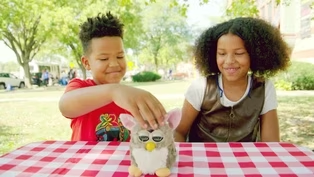 New
NewVideo has Closed Captions
We asked kids to review three vintage toys created in Chicago. (5m 13s)
Providing Support for PBS.org
Learn Moreabout PBS online sponsorship











Support for PBS provided by:
Chicago Stories is a local public television program presented by WTTW
Lead support for CHICAGO STORIES is provided by The Negaunee Foundation. Major support is provided by the Abra Prentice Foundation, Inc. and the TAWANI Foundation.