Chicago Tonight: Black Voices
Chicago Tonight: Black Voices, April 30, 2025 - Full Show
4/30/2025 | 26m 46sVideo has Closed Captions
Brandis Friedman hosts the April 30, 2025, episode of "Chicago Tonight."
Local stakeholders on the governor’s budget proposal and priorities they’d like to see the state make. And a park honoring the legacy of Chicago’s founder.
Problems playing video? | Closed Captioning Feedback
Problems playing video? | Closed Captioning Feedback
Chicago Tonight: Black Voices is a local public television program presented by WTTW
Chicago Tonight: Black Voices
Chicago Tonight: Black Voices, April 30, 2025 - Full Show
4/30/2025 | 26m 46sVideo has Closed Captions
Local stakeholders on the governor’s budget proposal and priorities they’d like to see the state make. And a park honoring the legacy of Chicago’s founder.
Problems playing video? | Closed Captioning Feedback
How to Watch Chicago Tonight: Black Voices
Chicago Tonight: Black Voices is available to stream on pbs.org and the free PBS App, available on iPhone, Apple TV, Android TV, Android smartphones, Amazon Fire TV, Amazon Fire Tablet, Roku, Samsung Smart TV, and Vizio.
Providing Support for PBS.org
Learn Moreabout PBS online sponsorship>> Hello and thanks for joining us on Chicago tonight.
Black voices.
I'm Brandis Friedman.
Here's what we're looking at.
A key City council committee debates expanding police curfew powers to control.
So home team takeovers.
The state's budget deadline is approaching.
We dig into the governor spending plan proposal and its potential impact on black families.
And how park 30 years in the making is finally becoming a reality.
>> And now to some of today's top stories, Mayor Brandon Johnson is pitching lawmakers in Springfield on a wish list.
He's calling modest.
Johnson has laid out his for priorities, including securing new revenue from amending the prepaid cellphone tax.
Extending the 9-1-1 surcharge.
It also includes investing in the one system initiative, a joint city state shelter system for migrants and homeless people as well as increasing funding for Chicago.
Public schools.
His visit comes as Governor JB Pritzker had previously suggested to reporters that the mayor should have gotten involved earlier in the state's budget process.
Johnson today commented on his relationship with Pritzker.
>> I bear no tension against anyone.
I don't.
You know, we have worked together a number of issues.
If anyone believes that politicians, all sit around thinking how we can beat each other's got children's parents.
It's not it's not reality.
Just because you have disagreement doesn't that that's an obstacle.
That's called Democracy.
>> The U.S. economy shrinks for the first time in 3 years as President Donald Trump's tariffs fuel fears of a recession, according to data from the Commerce Department, the country's gross domestic product, a standard measure of a country's economic growth contract ID at a 0.3% annual rate in the 1st quarter of 2025. the slowdown came primarily from a dramatic increase in imports which count against GDP as businesses stocked up on foreign goods ahead of Trump's promised tariffs a post on truth social, the president says in part, quote, This is Biden's stock market, not Trump's.
I didn't take over until January.
20th tariffs will soon start kicking in.
It goes on to say be patient.
However, many economists warn recession risks are rising and say Trump's tariffs will hurt growth in the 2nd half of the year.
>> Public health officials are confirming the first 2 cases of measles in Cook County this year.
In one case, a suburban adult sought treatment at a local hospital on Monday in the other case in adult Chicago and noticed a rash last week after traveling internationally through O'Hare airport.
Both Cook and the Chicago public health departments are working together to identify anyone else who may have been exposed.
Health officials say 2 doses of the MMR vaccine are 97% effective against measles.
And generally provide lifelong immunity.
If you don't have a passport and you plan to catch a flight in the U.S. you have one week to grab the real ID.
>> Passengers without a real ID.
After that date can expect delays additional screening and the possibility of not being permitted to add to the sterile area beyond the security checkpoint.
>> Tsa says starting May 7.
That's a week from today.
Agents at airport security will no longer accept a regular driver's license or state issued ID.
The real ID is issued by your Illinois secretary of state's DMV offices, but federally approved to fly domestically.
If you don't have a real ID, you can still use a valid passport.
Instead and don't worry, you can still get your real ID after May 7th.
And for more on what you need to get your ID and where you can check out our Web site.
Up next, city council members are considering a plan that would allow Chicago police to impose snap curfews.
We explain right after this.
>> Chicago tonight, he's made possible in part by the support of these don't use.
>> In effort aimed at stopping large teen gatherings from happening in the city failed to advance after intense debate at City Hall today.
The proposal would allow Chicago police officials to impose a curfew anywhere in the city with just 30 minutes.
Notice or Heather.
Sharon joins us now with more.
And Heather, this proposal was revised just before today's hearing, which lasted more than 5 hours.
What's changed?
Well, it ensure that it would take 2 people to declare these snap curfews.
Both police Superintendent Larry Snelling and deputy mayor for community safety carrying gate would now that was the subject of intense debate at today's hearings because some conservative, all older people worried that that meant that the mayor essentially could direct his deputy mayor to block these curfews from being called.
The mayor has repeatedly he sees no value in expanding the city's curfew law.
>> It just simply won't make the city safer.
He has OK, so several members of the City Council's progressive caucus, they raise some very serious concerns.
>> About this proposal, what are those concerns?
there be questions about how the city's police department will use this constitutionally?
Of course, the city is under a federal consent decree reform and several older people had big questions about why precisely these new powers where necessary police department can already order an unlawful gathering that he's either turned violent or has somehow violated rules to disperse.
Why declare a curfew that would only apply to teens.
We also heard from Alderman, Jeanette.
Tell who said why are we offering these teens something to do elsewhere in the city?
And, you know, enrichment in the parks or anywhere else rather than just sort of putting them back into the law enforcement system, which of course, we know can have serious consequences.
So what happens now?
Alderman Brian Hopkins who authored this measure says he's going to bring it back perhaps on Monday to try to advance that the full City Council Bend could consider it on Wednesday.
However, as I am fond of saying if you have the votes you vote and if you don't, you delay and this means that there is real concern that this powers should not be given to the CPD or it should be curtailed in some Alright, Heather, I know you'll keep us posted next week.
Well, thank you.
And you can full story on our website.
It's all at W T Tw Dot com Slash news.
>> Illinois lawmakers are finalizing the states but state's budget for the next fiscal year.
But it's not happening without some challenges.
Governor JB Pritzker is proposing a 55.2 billion dollar budget as watchdogs sound the alarm on the state's 3.2 billion dollar deficit.
Well, Republicans say the state needs to cut spending and lower taxes.
Democrats are raising concerns about cuts to services that they say families depend on here to share their thoughts on the budget are Adams lead fiscal policy director at the Illinois Black Advocacy Initiative, J Deal.
Budget Analysis.
Director at the Center for Tax and Budget Accountability.
And Ted Dabrowski president of Wire points, independent nonprofit research and commentary organization focusing on Illinois's economy and governments.
Thank you all for joining us.
Good to see you again.
I'm Jay, let's start with you first, please.
Governor Pritzker gave his budget address in February.
Bring us up to speed on the budget status right now.
Yeah.
So currently it's the proposed budget and it's just over 55 billion dollars.
>> And for Fy 2026, it's really a flat budget over Fy 2025, levels.
Governor Pritzker has mentioned that the revenue growth for Fy 2026 just under 2% over Fy 2025 level.
So that has resulted in discretionary spending at just under one percent for Fy.
22 6 and of course, right now in Springfield is the time when everybody's kind of like debating what goes where and how much before.
>> Before they take votes and sent to the governor.
Right?
Okay.
And they have until the end of May yet see get it all together.
Okay.
I'm Adam.
What has the Illinois Black Advocacy initiative been pushing for with this budget?
>> Yes, we recognize that it's a difficult budget year and would like to make sure that certain investments are protected to benefit all of Illinois families, but especially our black communities that often are very vulnerable to big budget changes.
And so we are looking to address some of the fiscal uncertainty brought around the federal administration around health and Human Service funding and education funding in particular funding for our our state colleges and universities.
Expansion of early childhood coverage for our families and getting closer to adequacy for 12 education in our school districts for our kids.
We are worried about the expiration of snap programs at the federal level and would hope the state can ensure that that will continue moving forward.
Maternal health for our are black women and Illinois particular and all women, mental health services.
And we also want expand economic access with housing, food security and transit funding as well.
And finally, we really want to make sure that criminal justice reform continues to improve and invest in things like the Fair Act for public defenders as well re-entry services for the formerly incarcerated and more changes in policies to make sure that black families can stay hole and can restore their and will most certainly come back to those direct impacts as well.
But did, of course, as we mentioned, you know, the state budget is.
>> It's 55 billion dollars.
But we mentioned that 3 billion dollar deficit.
What are your concerns with a hole that big?
>> My big concern is that the government trying to do too much and when it tries to do too much to spend too much, it's taxing too much.
And we have the highest property taxes in the The second highest gas taxes, maybe the highest overall state, local tax and that hurts every family in particular to minorities, right?
I think there they struggled.
They when economy's week we've got fourth-worst growth in the economy since Governor Pritzker took over.
We're spending a lot more than when he took office in 2019, 13 billion a 15 Billion.
More.
It's a lot of money.
And what happens is that with taxes so high with our debt so high on the pensions, Chicago, the same thing, but maybe worst with killing the economy and that's hurting people.
And when you when have a slow economy, you're not creating jobs.
People aren't getting paid well, you create more government dependence, which means the governor has to try to do more.
You get into a really bad, vicious circle.
That's where we are now.
We're in trouble.
>> Jane, what options does the state raise revenue to address the deficit deficit and fund services?
Yeah.
So it to we do have a report that will be coming out later this spring.
And so we do address 3 key.
>> Ways the state can increase revenue.
One is raising the flat state income tax rate.
Currently, it's 4.9% were proposing to increase it one and a half percentage points to 4006.4 5%.
The second option for the sea is expanding sales tax base to include consumer services.
Currently the state of Illinois does not tax does not consumer services at the rate at our name as our neighboring states do.
And if we did expand our our sales tax to include more consumer services.
We could see the net income that the state would definitely increase that would state with increased at the state level.
And then one of guests more aggressive measures to save funding for revenue to raise That is to re amateurs, the pension debt and so that's a really big one.
I don't think we foresee that happening at the current for the current current budget year, but do make down the road.
So Ted, what about a couple of things that that that you mentioned reason the income tax also raising the sales tax?
You mentioned that, you know, increasing taxes actually impacts.
>> the communities of color more or worse.
What are your thoughts on some of those ideas?
I think we have to start with the facts.
And, you know, these straight from the government that black poverty in Chicago, highs in the country among the 50 largest cities, unemployment rate for blacks highest in the country.
Among the 50 largest cities, the all the stats.
If you look at growth rates, Chicago dead last in economic growth.
Just Governor Pritzker took office.
We are really struggling not just overall but for the minorities and so for me to even think about more taxes, it's just punishment for the people.
And we know we lose people.
Chicago particular lost a lot of black people in the last 20 years.
Their their their path is to leave Illinois to find success.
And if we keep raising taxes, I wouldn't chasing companies out.
We're hurting the economy.
We're hurting our growth.
And I think that the suggestions I have good intentions actually do the opposite of what they that they tended to.
Adam, what are your thoughts and what is the impact, though?
If families aren't able to receive the funds or receive the services that they have come to depend on.
>> Absolutely.
Economic growth is important but providing baseline levels of service for all Illinois residents is the primary function of government and we have for way too long that invested properly across the state for the needs of all communities.
And we're still chasing basic adequacy and funding and school districts as an example.
And so I understand the fiscal position of the state, but we need to think about the outcomes that we are pursuing across the state to get to more healthy communities brace of.
And it just that when a place like Jacksonville cities like Columbus, they have half the unemployment rate that Chicago does.
So you can imagine if we cut that unemployment in half, how many more people have the basic incomes of basic services and you'll have much more economic freedom.
So it's really about getting that growth of not stumping economy, hurting the minorities that that that need help.
I guess Jade's sort of, you know, same question to you like how do you think, you know, belt tightening, Mike's might impact families that depend on services and mean it particularly like health care and education.
>> So what we do, one of the things that we do at sea to the A's to look back 25 years in the past to Fy 2000.
And we're looking at how much just has the state cut from the from discretionary spending than we did in Fy 2000.
So after adjusting for inflation, overall spending is down 8 and half percent and specifically his most notable in one of our core service categories and that higher education where it's gallon 43% over Fy 2000, which was under Republican Governor George Ryan.
We've already seen some services cut health care for undocumented people.
What if we start to see more cuts, especially as?
>> Adam, it come to you for this because it's the last question, but especially on as there are concerns, for example, about head start and some of the federal funding cuts that the state might be seeing.
>> It's absolutely communities across the state of Illinois are very worried that some of their core services will evaporate and they don't know what they're going to do.
And so even programs like Head start, if they go away, that will prohibit a lot of our families from getting to work because they depend on head start to drop their kids off so they can participate in the economy.
So there is connection with growth and public spending that sometimes gets lost in the political shuffle, but often investing in communities foundation.
Ali is investing in all of us black families in particular.
That is a good place to leave it.
Thanks to the 3 of you for joining us.
Adams Lage, a talented the basket.
you.
Thank >> Up next, news about the long-awaited discipline Park.
>> A lakefront park honoring Chicago's founder has been nearly 4 decades in the making.
But the greenspace commemorating the legacy of John Baptiste Point Sable is finally taking shape.
Developers have submitted plans to develop the 15 million dollar 3.4 acre Lakefront Park to be ready by 2027.
Joining us to talk about it all are Paul Mont as president of the DeSalvo Park Advisory Council and Zoom is Carol Ross.
Barney Design, principal and founder of Ross Byrne Architects.
Thanks to both for joining us.
Thank so prominent.
As let's start with you, this is this project is it's a family affair.
That is where take us back to the beginning where the idea to create a park and, you know, honor the city's history this way come from.
So the idea started back Harold Washington's administration.
>> When Harold Washington Doctor Margaret Ramon Price and my mother payment has came together and said we need something for Dusable for the founder of Chicago and they decided to dedicate a park 2 to stop.
So the location was identified.
The park was purchased and it was dedicated back in 1987.
>> Ok, what men tell us about the significance of that plot of land where the park will be.
>> So it's really the confluence of the Ogden slip.
Chicago River and Lake Michigan.
So it's the entrance to Chicago.
It is the premier spot for entering and seeing our wonderful city.
>> it might look a little bit different from the way it might have looked is is that like near where Dusable entered the city?
Is that where he found Chicago sort of?
So the settlement that they've identified for 2 Sable is actually where the marker is right now, which is actually on Michigan Avenue and >> basically the folks know that it's it's not showed up and was like 8.
Exactly.
Exactly.
So, Carol, what features can residents expect from this park?
>> it is a very small park and I think that because of its size and because of importance, designing can experience that will make you think that will make wonder about Chicago that will make you think about how you fit into Chicago's history in Chicago's landscape.
I know that just the last few days.
We that the Times published some the stations of park.
I hope people have had a chance to enjoy them.
Part of a series of them with our viewers right now as Okay.
park interpret it Disciples Night.
It help you understand the changes that were happening in Chicago when he arrived here and the ones that that he was party to that he was part of making.
And, Carol, how are you, including black designers in this process?
>> Since I am.
So please don't do this my of my very good friend, Ramona architecture.
In fact, we're working together in a joint It's called him Design partners, for example.
Designed in any case.
Look at moment.
I have been really looking for a project to do together.
She is a bike architect practicing Chicago for her entire career.
Now.
And we finally have this opportunity and we've had absolutely amazing partnership working for this job.
The Dusable Park Design Alliance also consist of other partners.
Other consultants and many of them.
Our for example, we've been working with actor Christopher Reeve, who is probably want to probably the top expert on hit and a sample and his and life his story.
And his insights have been invaluable to the design of this park.
>> It sounds like the perfect opportunity for you and your friend to work together on Paul.
Why do you think it took so long for this idea to become reality?
So combination of things that occurred at the park that were actually unforeseen first part was actually the land itself was actually toxic.
It had story and that had to be removed.
The state, the city and the federal government helped to secure funds to be able to remove that the seawall itself that surrounds the perimeter of the park had to be replaced.
So that too, had to be rebuilt over time and then unfortunately, the park itself was and still is attached to are connected with the development of a separate properties.
So it's kind of a public.
Combination to built the park.
Originally it was with the spire development that unfortunately went baby, although about yes, that whole continue to remain.
And then related Midwest then took over the site and are now the ones that are moving forward with the construction.
So with the construction of the 400 North Lake Shore Drive building.
The park gets funded.
So part of the funds that come from the part are from the city, which is about 5 million dollars.
And then the balance of the 10 million dollars as well as this construction will come from related Midwest.
Okay.
>> Carol, you're from presented an exhibit titled Parallel histories at the Chicago Architecture, biennial about the park.
How did that project informed the park's current design?
>> Well, when we got.
>> The exhibit you're talking about Palin histories was part of the Chicago architecture biennial we were asked to participate and we're working on the design of visible park at that time.
And we thought this would be a great opportunity to give sort of been advanced and notice that this park was finally coming and parrot histories actually consisted of 2 parks.
One installation that is still on the site.
Unfortunately, it's been graffiti recently, but it installation on the site then announces that the park will be will be there shortly.
It's actually.
3 D representation of the size of the samples.
House.
there was another part of Cairo histories that was in the cultural center.
we've set it up.
You can visit our website I am in my studio and will for this time.
>> just because they will make sure that folks can actually can access that kids were actually out of time.
5 seconds, Paul, the park needs more approvals.
What happens with the more approvals will go to the banks?
The ncpd I'm sorry, CDU party district.
President partisan will go.
Cdc for approval of the plans that they've completed.
And then the part once that one tower goes and hopefully 2027, 2027 days, actually how we write our component as Carol Ross Barney, thank you so much.
Looking forward to the park.
Thank you.
And that's our show for this Wednesday night.
Join us tomorrow night at 5, 30 10 now for all of us here in Chicago tonight, Brandis Friedman, thank you for watching.
Stay healthy and safe and have a good night.
>> Closed caption News Why lover a cliff and Clifford law offices, a Chicago personal injury and wrongful that serves the needs clients in
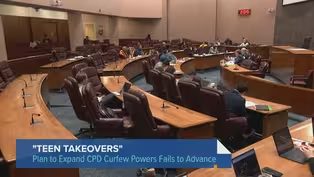
Chicago City Council Debates Expanding Police Curfew Powers
Video has Closed Captions
Clip: 4/30/2025 | 2m 26s | After more than five hours of debate, the Public Safety Committee took no action on the plan. (2m 26s)
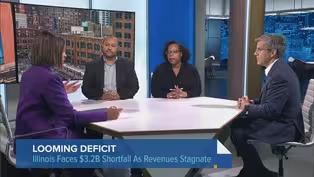
Local Stakeholders on Pritzker's Budget Proposal, Priorities
Video has Closed Captions
Clip: 4/30/2025 | 9m 34s | Lawmakers are finalizing the state’s budget, but not without some challenges. (9m 34s)
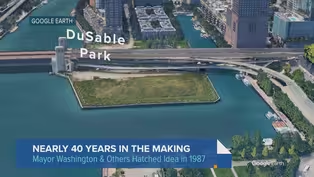
New Park to Honor the Legacy of Chicago's Founder
Video has Closed Captions
Clip: 4/30/2025 | 7m 11s | The park is 38 years in the making. (7m 11s)
Providing Support for PBS.org
Learn Moreabout PBS online sponsorship
- News and Public Affairs

Top journalists deliver compelling original analysis of the hour's headlines.

- News and Public Affairs

FRONTLINE is investigative journalism that questions, explains and changes our world.












Support for PBS provided by:
Chicago Tonight: Black Voices is a local public television program presented by WTTW