Chicago Tonight: Black Voices
Chicago Tonight: Black Voices, April 9, 2025 - Full Show
4/9/2025 | 26m 47sVideo has Closed Captions
Brandis Friedman hosts the April 9, 2025, episode of "Black Voices."
A new approach to building affordable housing in Chicago. And efforts to address disparities among Black students at CPS.
Problems playing video? | Closed Captioning Feedback
Problems playing video? | Closed Captioning Feedback
Chicago Tonight: Black Voices is a local public television program presented by WTTW
Chicago Tonight: Black Voices
Chicago Tonight: Black Voices, April 9, 2025 - Full Show
4/9/2025 | 26m 47sVideo has Closed Captions
A new approach to building affordable housing in Chicago. And efforts to address disparities among Black students at CPS.
Problems playing video? | Closed Captioning Feedback
How to Watch Chicago Tonight: Black Voices
Chicago Tonight: Black Voices is available to stream on pbs.org and the free PBS App, available on iPhone, Apple TV, Android TV, Android smartphones, Amazon Fire TV, Amazon Fire Tablet, Roku, Samsung Smart TV, and Vizio.
Providing Support for PBS.org
Learn Moreabout PBS online sponsorship>> Hello and thanks for joining us on Chicago tonight.
Black voices, I'm Brandis Friedman.
Here's what we're looking at.
>> I think this is a very innovative approach.
Just solving a long-standing problem in Chicago.
>> The city considers a new model for developing affordable housing.
firts to address a cheap in gaps among black students Chicago.
Public schools.
And celebrating the history and public housing in New Chicago Museum.
>> And now to some of today's top stories, the stock market surges to one of its best days in history as President, Donald Trump announces a pause on some of his tariffs after facing a global market meltdown, the Dow surged 2900 points or 7.9% today while the S and P rose 9.5% and the Nasdaq closed up 12%.
It comes after Trump announced a 90 day pause on his tariffs for most nations but kept in place that 10% baseline rate that went into effect on Saturday, which is lower than the 20% or higher tariff that some countries were facing.
A big exception.
Was Chinese imports, though, as Trump said he was raising the tax on those 2, 125% that we began people who took part in the January 6th attack on the U.S. Capitol may soon be blocked from working for the city of Chicago.
Members of City Council's workforce Development Committee passed the measure today which now heads to the full Council for a vote next week.
Backers say January 6th rioter should not be able to work for the government.
They tried to overthrow Alderman.
Nicholas Basado was the only committee member to vote against the ban, calling those who fought with the police, quote, despicable but says people who entered the Capitol without permission shouldn't be prevented from working with the city in January, Trump pardoned more than 1500 people who are convicted of attacking the Capitol.
And older people could be reconsidering a settlement payment to the family of Dexter read after a previous settlement failed to advance.
Dexter Henry was the 26 year-old driver killed by several plane closed.
Chicago police officers in March of last year during a traffic stop initial investigation by the civilian Office of Police Accountability showed that read first shot and wounded an officer before the other 4 fired 96 rounds in 41 seconds.
Hitting him 13 times.
The previous settlement agreement was for a million and a quarter dollars or dollar.
excuse me one and a quarter million dollars and would ban CPD from acquiring officers to make a certain number of stops.
It failed in committee.
The City Council Finance Committee will again review the deal Friday.
It could go to the full council next humid death advocates are calling for solidarity and resistance from North Western officials as the university faces investigations from Washington.
It comes a day after the Trump administration announced plans to freeze nearly 800 million dollars in federal funding earmarked for the university.
More than 1000 faculty members, alumni, students, attorneys and community members say they've signed letters expressing their support for the university's academic freedom and First Amendment rights.
Northwestern is facing investigations from the U.S. Department of Education and a congressional committee into its response to antisemitism on its campus.
You can check on our website for more background on this story.
And white supremacist extremism is a live in growing in Illinois, according to a new report that says the number of hate crimes reported in the state rose by 362% from 2019 to 2023.
We're talking about average of one incident every 3 days.
>> For the last 5 years.
This is included stickers and flyers targeting members of immigrant Muslim Jewish LGBTQ+ black API and Latino communities and women as well.
In other words, no one has been spared.
>> The new report from the Anti-Defamation League tracks.
Hate incidents by county in Illinois, including white-supremacist events and propaganda like Flyers anti LGBTQ+ incidents and even terrorist attacks in Cook County.
The report say as Anti-Semitic incidents increased from 46 to 209 between 2020 2023, the group says 68% of incidents in 2023 occurred after October 7th, the date of a Hamas attack in Israel.
Coming up, a new approach to building affordable housing in Chicago.
We explain how it would work next.
>> Chicago tonight, what he's made possible in part by the support of these don't use.
>> Mayor Johnson's newest effort to reduce the city's massive, affordable housing shortage, ran into a wall of deeply skeptical city council members today who delayed a planned vote.
But the proposal may still be on track for a final vote next week.
Here's Alderman Brendan Reilly, a frequent critic of the mayor.
>> The concept, the idea is a good one.
But my God, the devil is in the detail.
I think this could be a great tool for Chicago, but we have to get it right.
>> W t Tw News reporter Heather Sharon joins us now with more.
Heather.
So this proposal would create a city owned nonprofit housing developer.
How would that work?
Well, if you remember about a year ago, the city borrowed 1.2, 5 billion dollars by ending a whole bunch of tax increment financing district.
>> This plan would take 135 million dollars from that fund and use it to set up the city's own Housing Development Corporation, which would have the ability to sort of fund these projects in the place of private equity or other service banks or financial institutions.
The idea is that since the city's, you know, a public entity, they won't be as concerned about their return on investments, which will lower the cost to build these apartments and it will help chip away at the city's shortfall of nearly 120,000 affordable units.
So if approved Chicago be the first big city to try something like this.
What concerns did we hear from City council members today?
Well, since this is really untested in Chicago and really nationwide, the older people have a lot of questions about the board that would run this nonprofit corporation.
It would be made up of the combination of city officials and real estate experts.
They wanted to know who this board report to what the city council or the mayor can do if they think that the board has made that And what about the state's open meeting law and for yeah, our favorite state law that make sure we get the documents to know what the state officials and city officials are doing.
So there are a lot of technical Exactly whether this would work to sort of build these units or re have existing units.
But I think there was a consensus on the committees today.
It was a joint session of the housing in the Finance committee.
But the city had to do something because there is not going to be federal money for at least the next 4 years to fund these sort of projects like Alderman Brendan Reilly said the devil is details.
Details So what happens next?
What does this delay mean for the prospects here?
Well, they didn't have the votes today because of all of those concerns.
But this delay until Monday gives the mayor's administration for days and the weekend to sort you know, talk through some of these issues and then they'll come back on Monday and maybe they'll be the votes advance That could set up a final vote on Wednesday at the full City council.
If they can't get it done, it will have to wait another month.
Okay Sharon.
Thanks so much.
Thanks.
Brandis.
And of course you can read Heather's full story on our website.
It is all at W T Tw Dot com slash news.
>> Chicago Public Schools is pursuing a new plan to address inequities its black students face the Black Student success plan aims to bring in more black teachers, reduce suspensions and expulsions.
Remote teaching on black culture and history increase belonging and close opportunity gaps.
But it's also facing federal scrutiny from the Trump administration.
The national conservative advocacy group parents Defending Education, says the plan is discriminatory and has filed a complaint with the U.S. Department of Education.
So joining us now with more are 2 people who helped create this plan, Dakota or be a professor at the University of Illinois, Chicago and Duane Davis, president of raising expectations, an education consulting firm.
We also reached out to parents defending education, but did not receive a response.
Gentlemen, thanks to both of you for being here.
I know you are at least currently or previously CPS, dads as Well.
Dakota, I want to start with you because you also led community meetings to develop this plan.
Talk about why you think it's important to have in equity plan specifically for black students.
Yeah.
Well, thank you for for the question.
Thanks for having us on.
It's important because >> Chicago public schools has a huge black student population.
It serves a large number of black families and communities and it's very important.
We meet the education needs at this particular population because this is a group that has historically not had the same kinds of opportunities.
Other student populations for Chicago Public Schools is has to be a priority.
We've seen declining enrollment among its black students and families leaving the district.
So it's imperative to actually get this right.
Make sure students have access to educational experiences and opportunities give them the outcomes that lead to college and career of family sustaining a family sustaining careers.
So this isn't the first time the district has done this kind of work, though, on how did past equity efforts sort of inform the current way work of this black student success plan.
this can kind of traced back a committee that was formed that actually led to the opening of the CPS Office of Equity.
>> In 2018 and the CPS Office of Equity has been leading the charge to improve the black students experiences in a district amongst other student populations as well.
So it's really been their charge.
And this is also something that is codified and supported through Illinois public at 103, which created for the Chicago Board of Education, a black Achievement committee.
so there's a broad range of kinds of support behind this black student success plan.
Dwayne, Same question to you.
What you know, what makes this plan different from previous efforts?
>> So to piggyback on the coldest com, it I believe that as a lifelong Chicago as a public school graduate as a parent as person cares about our kids, we have to.
We've been working at this for a long time.
And one of that data points is super important to me is about young people getting access to college.
We've been on the kind of college pathway in our city for over 2 decades and the lowest performing set of young people in our city.
Our black girls and black boys to cause a tame at the college graduation because retention so if we think college is the access point, college is a way to change generational.
Well, colleges awaited decrease the racial wealth gap.
We have to get that right.
This is super important and we need to focus on the plan, worked the plan and figure out how to move students to move the metrics for families Chicago.
Yeah, I definitely want to get back to a little bit more about that.
That achievement gap in just a bit between.
Tell me a little bit, if you would about how this plan came together because I know you both lead, you know, some community What did you hear from the community and how all that work?
>> Yeah, so it was great to travel the city to travel the city as a listener.
So going to the west side of Chicago.
>> Sitting at elementary schools talking to young people parents, talking community activists going to the north side, go into schools and just hearing what they want, what they want for the young people.
There was some I don't know if this is going to work.
I don't know if we should do this this way.
We've talked before and things have happened.
But Illinois Public School Act that the Cole dementia the way it's codified in policy eat the way we're having national conversation, the local conversation about our students, I think gives us some breath and depth and communicates and coordinates the work that's going to be done our city.
So those meetings were just key hearing student voices, para voice of the community voices in those spaces.
So we know that black students have been struggling academically in comparison to some of their their black and Latino counterparts.
According to the 2024 Illinois report Card almost.
>> 60% of white students in CPS are proficient in English language arts.
That's compared to 21% of black students and 24% of Hispanic students in just for context of viewers to know, black students make up about 30 31% of the CPS student body >> the How will this plan address these disparities?
Get one of the priorities is adopt coaching responsive teaching in classrooms and it's exposed to increased by a certain percentage.
And that's for a teachers, including black teachers.
One of other key pillars of the plan is to increase the number of black teachers and retained by teaching but also provide teachers of all different backgrounds with the kinds of competencies that will allow them to engage in the teaching of black history as well as to engage in kind, of course, fully competent.
course, the response of teaching approaches, which we know from research for many years is demonstrated to actually improve students, academic outcomes.
as we mentioned, parents defending education.
They filed a civil rights complaint against this plan and they say, quote, >> CPS is failing students of all races and ethnicities, which makes this racially segregated program all the more egregious CPS is racially exclusive plan also runs afoul of this Education Department's own guidance, referring to the U.S. Department of Education's Wayne.
Are you concerned about, you know, what is first?
What is your response to that?
I would say that Chicago public schools has illegal office and they are going to pursue and if and do the work necessary to.
>> Protect the work as the policy in our state.
Guy, guys them.
And I would also say that wearing a blue state where we have a governor that is engaged in a different way.
So I think that just literacy person and Lucy expert will ban books a state.
I think our politics in the state of Illinois also give us some cover is some protection thinking about what we're going to be for students and families in our city as well.
>> That said to go, do you concerned about this sort of National Anti movement in these policies and the potential impact they could have on this plan for CBS?
I am concerned.
I think everybody should be concerned about what's happening nationally right now Dr Davis mentioned, we are in a blue state.
We have a support of mayor.
We have a supportive of board of education here, Chicago public school.
So a little bit less.
But overall, yes, I am concerned about the potential, you know, funding cuts, people being targeted on those sorts of things are definitely consigning.
But we have insulated from book bans from, you know, cut so far.
No source things, but it is concerning.
I think people should be concerned.
This is not this is not a time to sit on our hands and think that things are gonna blow by.
I think we have to be vocal.
I think that people need to be a adamant about making sure that students, black students, but students of all different specific needs get the resources opportunities they deserve.
All right.
We'll have to leave it there.
Best of luck to both the be and Davis, thank you so much during see you.
>> Up next, what you can expect to learn at the Newly-opened National Public Housing Museum.
Stay with us.
A museum to commemorate the history and community public housing has just opened in Chicago, but the National Public Housing Museum isn't just a museum.
There's also a workforce program recording studio and actual affordable housing units all on site.
And it's been nearly 2 decades in the making.
So joining us now to tell us more, at least the Yulee, the National Public Housing Museum's executive director and chief curator and Reverend Marshall Hatch, pastor of the New Mount Pilgrim Missionary Baptist Church whose childhood home is replicated in the museum.
Welcome back, both of you.
Thanks for joining Thank you.
It's so nice to be here.
So, Lisa, let's start with you.
Why do you think a museum for public housing is necessary?
Well, there's never been a museum that's more relevant to all the issues that we should be thinking about today.
>> But it's not just a museum about public housing.
It's about public education, public safety, public health.
It's about all the things that we value in commonwealth.
>> And so when people com, they're going to be in thrall, they're going to have their perceptions challenge.
going to learn things feel things and they're going to want to do things about housing in justice.
You explain that the museum was created by and for residents of public housing.
How does that principle sort of shape the exhibits and storytelling?
Yeah, I mean, from jump public housing residents were the people who imagined envision this museum.
Mister Veron Beverly, who was the head of the Central Advisory Council.
She had the brilliant idea for a museum where public housing residents themselves can participate in the narrative about what public housing is, what it's going to be for in the future.
And we amplify their voices, their stories and always, including and the apartments that we've restored in the museum.
Well, to that point, River Hatch, you grew up in the Jane Addams Homes on your childhood home is likely said replicated in the museum.
What memories kind of come back to you when you walk through that space?
Well, you know, it was surreal.
When we walked in, I walked in with my old assist as we live there for 14 years.
was a kid.
>> It was an ideal environment.
Really.
We had a lot of friends, lot of close and tight knit families.
And so we get to talk about really what it felt like to live in tight knit community to have what I would call family-friendly public policies.
We went to the neighborhood, public schools, state and public housing and it really family and gave us a great start.
You describe public housing in your youth as like you said, tight-knit but also economically integrated.
What do you think people misunderstand about life in those in public housing with this museum quest tells a story that originally public housing was built for European immigrants and this case at the Jane Addams for Italian American immigrants for Jewish American immigrants and then eventually African-Americans moved.
And so was a was a project that was to help families get a leg up.
And it really did that for our family.
My mom, you know, tragically passed away in that unit in the snow storm in 1967, my father finished raising us in in the community and it was it just tells a story of how we can do better than we've been doing in terms supporting families and helping them get a leg up.
We said they're playing pop culture or portrayals of public housing like good times with the Candyman movie.
>> And some of those show up in the museum.
But why did you want to also include those fictional depictions of public housing in the museum?
So much of what we do is challenge the stereotypes that we all live with.
When we hear the word public housing, it brings up of Israel feeling for so many people.
And so we do tell the Candyman story.
And you do understand.
>> So the history of good times.
We work with Cabrini Green residents to pick their top 10 favorite episodes in one of the exhibits.
But like Reverend Hatch said, you also will encounter that her of its family who moved into the Jane Addams Homes in the 1930's, a Jewish family when we asked them what in public housing mean to you, they said it means having our first kosher kitchen never touched by pork.
You also will learn from a beautiful exhibit that created by manual cinema and Taylor about the systemic injustices that change the demographic of public housing, the GIs bill and it's racism.
We will understand sort of the history of redlining and then also you'll have a gallery where you'll encounter the personal stories of people from Sonia Sotomayor who lives in public housing to George Floyd, who lived in public housing.
Also in the committee home.
So it's we always say never again.
Will single story be told us if it's the only one and when you come to National Public Housing Museum, you're going to account are so many compelling stories.
And of course, many of us we know the history of what happened many of those high-rise public buildings in Chicago then being demolished.
after that happened, Reverend Patrick, I kind of want to move on to.
>> You know, what you think was lost when those buildings were demolished, what you know, we had tight-knit communities.
And when I grew up there in the late 60's to mid to late 60's early 70's.
>> They were, as I've said, economically, integrated, like when my mother, those prices happen.
There was a nurse that live in public housing right across the lawn from us.
That was a policeman who live next to them.
So somewhere along the line, it was public policy.
Maybe inadvertent consequences that created narratives as pockets of poverty.
But it was not that in the beginning and we get to tell a different story about the how important it is to look at all of us living together, everybody having a right to a house.
>> Lisa, the back of the 15 units of public housing are attached the space.
Also doubles as a community center.
Why was it important to include housing in these programs in this institution?
Yeah, I mean, the National Public House Museum really example.
Excerpt case study for the future of civic institutions and the potential of museums to be cultural civic anchors.
I'm doing so much work to transform society.
So, you know, a museum is a mixed use space where you'll have beautiful art and history and artifacts.
But we're also creating spaces for housing and also for people to gather to imagine the future of housing.
And so that's the 21st Century Museum.
And we really believe that we exemplify that before we run out of time to have to ask Lisa, the Trump administration, of course, just announced these cuts to the National Endowment for the Humanities, which affects cultural programs and museums across the nation.
Does this concern you?
Yeah, this is a really big concern should be not just for museums and libraries, but for all Americans, you know, be need to challenge.
I think the legality of these cuts and we also need to hold government accountable for the people and its role in not just providing housing, but for providing vibrant arts and cultural and library libraries and types of institutions that serve all will have to leave it there.
Congrats on the opening of the museum.
Thank you for sharing it with us.
Lisa Lee and Reverend Marshall Hatch, thank you.
Thank you.
And us.
And that is our show for this Wednesday night.
Join us tomorrow night at 5, 30 10.
>> One-on-one with City Council's newest member Alderman Anthony about his priorities for the 35th Ward.
Now for all of us here in Chicago tonight and bring Friedman.
Thank you for watching.
Stay healthy and safe.
Have a good night.
>> A close caption was made
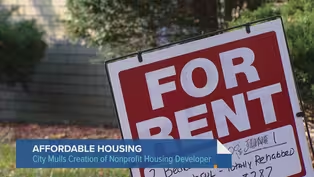
Chicago Mayor’s New Approach to Building Affordable Housing Faces Skeptical City Council
Video has Closed Captions
City Council members were unsure about Mayor Brandon Johnson's plan to build affordable housing. (3m 4s)
Chicago Public Schools Aims to Address Inequities Faced by Black Students
Video has Closed Captions
Chicago Public Schools is pursuing a new plan to address the inequities its Black students face. (7m 43s)
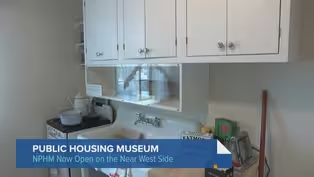
Chicago's New Public Housing Museum Was Two Decades in the Making
Video has Closed Captions
A museum that commemorates the history and community of public housing has opened in Chicago. (7m 22s)
Providing Support for PBS.org
Learn Moreabout PBS online sponsorship
- News and Public Affairs

Top journalists deliver compelling original analysis of the hour's headlines.

- News and Public Affairs

FRONTLINE is investigative journalism that questions, explains and changes our world.












Support for PBS provided by:
Chicago Tonight: Black Voices is a local public television program presented by WTTW