Chicago Tonight: Black Voices
Chicago Tonight: Black Voices, Dec. 18, 2024 - Full Show
12/18/2024 | 26m 48sVideo has Closed Captions
Brandis Friedman hosts the Dec. 18, 2024, episode of "Black Voices."
The city’s budget director on what’s in the 2025 spending plan. We tour the Greater Chicago Food Depository’s new facility. And plans to improve health disparities on the South Side.
Problems playing video? | Closed Captioning Feedback
Problems playing video? | Closed Captioning Feedback
Chicago Tonight: Black Voices is a local public television program presented by WTTW
Chicago Tonight: Black Voices
Chicago Tonight: Black Voices, Dec. 18, 2024 - Full Show
12/18/2024 | 26m 48sVideo has Closed Captions
The city’s budget director on what’s in the 2025 spending plan. We tour the Greater Chicago Food Depository’s new facility. And plans to improve health disparities on the South Side.
Problems playing video? | Closed Captioning Feedback
How to Watch Chicago Tonight: Black Voices
Chicago Tonight: Black Voices is available to stream on pbs.org and the free PBS App, available on iPhone, Apple TV, Android TV, Android smartphones, Amazon Fire TV, Amazon Fire Tablet, Roku, Samsung Smart TV, and Vizio.
Providing Support for PBS.org
Learn Moreabout PBS online sponsorshipBlack voices, I'm Brandis Friedman.
Here's what we're looking at.
>> We have now 2 years of critical investments in the ears of the people.
Chicago, a secure about.
>> Chicago finally has a new spending plan.
The city's budget director breaks down what residents can expect.
It's outside.
Neighbors may soon be getting greater access to health care services.
>> For black families, with children that numbers.
39% facing food insecurity.
>> And making hot meals for local residents.
An inside look at the Greater Chicago Food Depository the >> And now to some of today's top stories, the Chicago Board of Education has called a special meeting for this Friday before the newly appointed slash elected board is set to convene in January on the short agenda, a closed session to discuss.
Personnel matters.
The current 7 board members were appointed by Mayor Brandon Johnson in late October.
At the time the mayor was believed to be working to oust current schools.
Ceo Pedro Martinez.
But the only the school board has the authority to do that and it could be taken up behind closed doors on Friday.
Earlier this week, the mayor appointed 10 members to join the 10 recently elected members of the board.
All set to take office January.
15th also on the board's agenda this Friday, turning the several charter schools slated for closure into district run.
Schools.
After 9 weeks of testimony and more than 50 witnesses, federal prosecutors are officially resting their case against former Illinois House Speaker Michael Madigan.
Madigan is charged along with his long-time right-hand man, Mike Michael McClain.
The 2 are accused of orchestrating multiple corruption schemes.
Both have pleaded not guilty while the prosecution wrapped its case.
It is still far from the end.
As defense attorneys began making their case today to get caught up on the testimony.
Please visit our website.
The CTA is getting nearly 2 billion dollars in federal money to help extend the red line to the far South side, local and federal officials had been racing to finalize funding for the Red Line extension before the end of the Biden administration, the federal dollars will help fulfill a decades old promise to extend the heavily used to train line past 95th Street down to 100 and 30th street CTA officials hope to start construction in 2025. the total cost is currently estimated at more than 5.7 billion dollars.
The state of Indiana has carried out its first execution in 15 years.
49 year-old Joseph Corcoran was pronounced dead at 12.
44 this morning at the Indiana State Prison in Michigan City.
Indiana is one of only 2 states that do not allow media witnesses but Corker and selected a reporter with the Indiana Capital Chronicle to be one of his handful of witnesses.
Corcoran was convicted in the 1997, murders of 4 people.
His attorneys fought his execution for years, arguing that he was severely mentally ill Corcoran is the 24th person put to death in the U.S. this year.
Wrecking crews have begun demolition on the former eat to dance hall on Motor Row.
The sight of a 2003 stampede that left.
21 people dead last week.
The Chicago Department of Buildings granted an emergency demolition order saying the 114 year-old building constitutes an actual and imminent danger to the public.
In February 2003 security guards used pepper spray to break up a fight inside the crowded club.
Panicked patrons rush the main door which only opened inward the crush killed.
21 people and injured.
57.
The building has been vacant since new owner says he plans to redevelop the site has a 21 story housing complex for seniors and incorporate a memorial to the victims.
Inside this year's difficult road to a city spending plan.
Chicago's budget director joins us one-on-one right after this.
>> Chicago tonight, Forest is made possible in part by the support of these.
Don't use.
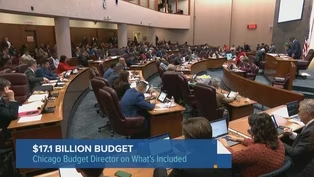
>> Chicago's 17.1 billion dollar spending plan is now in place for 2025, but it did not come easily forceful push pack push, push back from older people blocked property tax hikes.
But the budget still includes over 165 million dollars in additional taxes and fees to generate revenue.
Here to discuss what this could mean for residents, wallets and the city's fiscal future is and that Guzman direct budget director for the city of Chicago.
And that.
Welcome back.
Thanks for joining us.
Thank you for having me.
So last year's budget negotiations with City Council far less contentious than this year.
Why would this year so difficult?
You know, I think that.
>> You know, we are one of many municipalities states in this country that are facing difficult decisions that have to be made as we continue to emerge from the pandemic and a lot of the federal dollars that have really sustained and helped us recovery recover have started to expire.
And so as we look to what are the things that we want to prioritize for communities, one of the things that we need to expand because of threats that might be coming from incoming administration's these are the difficult conversations that the fortunately or unfortunately one of the first to have Mayor Johnson for said that when he first proposed that property tax hike that it was a very difficult decision made after an excruciating process.
>> He later said that his proposal was designed to get older people's attention.
Why not start the process behind closed doors?
Were some of that ugliness can be worked out rather than proposing publicly an unpopular idea.
>> You know, I think, you know, you know, hindsight is 2020 and a lot of cases.
And, you know, we did have a lot of conversations with Alders before the mayor introduced his budget.
You know, there are a lot of things that we have to hold in balance when having discussions about budgets, having discussions about services to provide to communities having discussions about priorities for not only next year, but you know, 5.10, years from now.
And, you know, with season that for me starts in January.
You know, those conversations start in earnest, but a lot of times because of the many things that we're balancing, it does take, you know, the introduction of the budget, sometimes to have some of those conversations earnest.
I will say that, you know, the the introduction of a property tax to begin with was one that was made based on what we're looking at, you know, out years as well.
You know, because we are mostly governed with revenues that are under state law.
We have a subset that we can put in place under home rule authority.
You know, we're always looking to, you know, the most stable of a revenue that in out years we can depend upon revenues that are gonna come in and property taxes are the most stable for municipalities to put in place.
So that said the budget did pass this week without that property tax, but an increase in multiple other fines and fees, for example, streaming and cable services.
>> Parking garages ride, hailing surcharges and then some cuts for some from some other places getting organizers of special events, for example, to pay the Chicago Police Department for over time, cutting 10 deputy mayors from the mayor's office.
Are you concerned that people will consider this array of smaller taxes in fee hikes just as difficult as one larger increase.
You know, when worked with Alders because these were identified through conversations with members of City Council to replace the 300 million Dollar property tax.
You know, we look all of our revenue sources to see when was the last time that we looked at.
It was the last time that we touched it.
And how is the economy changed since that time?
A lot of these had not been looked at over a decade and yet the price of goods and services has gone up.
And the city despite having 2, you know, administer a number of programs had not had its revenues grow at the same rate as some of the costs that it takes to actually administer those programs.
And so in conversations with members of City Council, they asked the question, you know, which ones are the ones that we haven't touched that we haven't looked at in a long time.
And is there room based on where the economy has has grown or changed for us to make some changes, whether small or to to bring in more revenue.
And so that's how this kind of slate of additional revenue sources came about.
Now the city is on watch list for credit rating downgrade.
How concerned are you about that?
I think I think any municipality be concerned about a downgrade because it goes towards how expensive your debt might be.
And for city of our size where we have a lot of infrastructure projects that are necessary to ensure that, you know, our communities are safe from public safety standpoint that, you know, we are able to develop our communities to incentivize businesses to calm you know, set up shop in and help that community thrive.
We're always concerned that we have the necessary resources to do that.
You know, we've we are talking pretty regularly with our credit rating agencies helping them to understand how so much of what we did is structural in nature, meaning that these are revenue sources that will be available to U.S. year after year and that these are not those one-time fixes that are delaying putting off costs into into the future.
And so those are the same arguments were going to be making to our rating agencies that, look, we did a lot be cut over 300 million dollars of expenditures out of this budget.
We raise over 400 million dollars, actually, you more than that in this budget of additional revenue so that we can make sure that these types of structural imbalances don't continue into the future.
The city Council narrowly passed this budget.
27 to 23.
What do you take away from that?
I take away that we have some additional conversations that we have have in the next year helping members of city Council understand where this where our financial trajectory is going helping.
Then have those conversations in their communities, especially helping our residents understand the value of government in their day-to-day lives.
You know, lot of people don't have a sense every day every single thing that the government is providing in their communities.
But once those things are not there, they realize how much they depend upon And so I think it's incumbent upon us whether it's the mayor's office or members of City Council to always help them and help our committees understand these are the things that we provide.
And these are things that we're happy provide.
We want to provide because we know how they contribute to the the thriving nature of our communities.
Just 30 seconds left.
How are you ensuring that you are not an even more difficult position this time next year?
I think it's beginning this process a lot earlier next year.
You know, we developed a forecast, its multi-year nature.
And so what we did this this year will help mitigate a lot of next year's budget gap as well.
Ok?
And then Kuzma budget director for the city of Chicago.
Thank you so much for joining us.
Thank you.
Up next, efforts to bring greater access to health care on the city's south side.
Chicago's South Side residents have a 30 year life expectancy gap compared to their Northside counterparts.
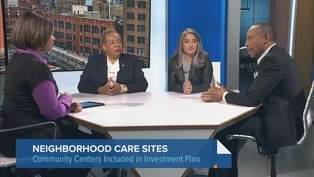
>> Advocate health care is working to address that disparity with a new billion-dollar investment plan that includes replacing Trinity Hospital with a new facility.
Stakeholders say the goal is to improve the health and well-being of residents by focusing on prevention, disease management and increasing access to care.
Joining us now are Michelle Blakely, president of Advocate Trinity and advocates south suburban hospitals.
So Jones, chief health and well-being officer for the YMCA of Metropolitan Chicago and 7th Ward Alderman Greg Mitchell representing communities like South Shore, South Chicago Avalon Park and Calumet Heights.
Welcome all of you.
Thanks for joining And I think congrats on what sounds like a big, very big announcement that you will need yesterday.
Michelle Blakely, how will this investment address health disparities for South Siders?
>> I'm so happy to be able to talk about this.
And so we have this product really bold vision to change how we approach health delivery and really create health and wellness as opposed to attacking just simply illness.
And so our investment, this 1 billion dollars.
I love saying one day you want is is very comprehensive in that 500 million at that will be specifically targeted around and la Torre services and access to him.
What Henri care.
We believe if we can get ahead chronic diseases and help people access health care where they live in a way that's convenient.
We will change the whole path around how healthcare looks.
200 million of that.
It's going towards chronic condition management and also the social drivers of health.
Part of what the solution is for health care is not related to what happens in the hospital at all.
It's around access to food, access to employment, access to opportunities, to exercise.
And so that's 200 million dollars of that as well attack on the Turtle Health and how we address pre and postnatal services.
So that 700 million of my billion dollars going towards very proactive strategy for health care.
And then should a patient need a hospital?
We are introducing a new state-of-the-art facility.
That's 300 million dollars of that investment to absolutely provide for that community.
A new state-of-the-art facility that is there to do things that you do in a hospital.
Should you need that access?
My hope is you don't ever need my those hospitals that that a little bit as So tell me about the YMCA and the role that it plays in this plan, I mean, this is such an inmate when when we heard that advocate was making this investment, it we couldn't have thought of him or values line organization to really accelerate our vision and our strategic transformation that's underway.
>> Which is thinking less about fitness centers are sort of this Jim and swim and more about how do we start to create facilities and community hubs that are dedicated to changing health outcomes right.
And that is a complete paradigm shift in how we think about our work and what's so exciting about this partnership is that you were just talking about this wave usually got health over here and well-being over here.
And this is the and right.
We're bringing them together and saying to people and you know what, if you're dealing with the chronic condition management or if you're trying to prevent a chronic condition, here's a place where you can find a community to build healthy habits, do it in a way that is fun and playful.
And I think what we're all sort of looking for and so that's why you know the why that is what we stand for, what we have stood for in the South side for 40 years and in Chicago for over 150 years.
But really just like an amazing Valley's only partnership that I think is is going to change health outcomes and keep people out of hospital beds in specifically the South Shore.
Ymca will be serving as the first of 10 that site.
That's science you has outside.
It will be serving as the first of 10 new community-based.
>> Helps.
All right, senators, right?
So we're calling these neighborhood care sites and it's through a partnership with like-minded organizations that our trusted partners in the community.
And so for a person who normally accesses the why and the fact that they can actually receive urgent care, visit their chronic condition management.
There.
It makes it easier for them to access services in a way that is so convenient that it's hard not to avail themselves of what we have to offer.
>> It's hyper local and it is designed to be both screening for social drivers and also providing an advanced practice provider in a virtual way.
So the new technology virtual way to receive that care.
So we believe it's an innovative approach over Mitchell, not leaving you out.
What does this investment mean for residents of the 7th Ward life?
>> So I get I'm getting a double double benefit from advocate.
Not only do we get world-class hospital, that's going to be world-class health care.
Also get 300 million dollar investment in my work.
And I'm humbled by that.
And I'm happy that I can bring that to the community.
Of what I what I anticipate happening is that this is going to spark discusses the catalyst.
This is going to spark more investment, more interest in the community and all those those negatives we can start addressing, we can attract businesses can provide goods and services to the community that they need and want I have a lot of vacant properties.
We lost home ownership.
I anticipate this catalyst is going to be white allies.
My community and those bills that we've experienced over the last 10, 15, 20 years.
We'll start to turn around.
>> So despite high rates of what we know about, you know, illnesses on the Southside high rates of hypertension, diabetes, congestive heart failure and others.
Hospital beds on the South side.
The only have a 40% utilization rate show.
Quickly, do we have a sense of why that is?
>> Well, they're probably multiple reasons for that.
Certainly one of the reasons is.
Health care is changing in general.
There's a move towards ambulatory care.
There's a move towards managing even surgeries differently.
So the link the state post, a surgical procedure used to be several days.
Now.
It's just a day or 2.
So when part health care is changing the other reason for the South side is we have older infrastructure and people are choosing health care in different ways and they're going to hospitals that are more modern that have different technology.
So when we did our community listening sessions, part of what we heard is your infrastructures old.
I'm not sure if I'm going to get the state-of-the-art care from your hospital that I would get from another hospital.
>> to be clear, so that this new updated hospital, then it is on shifting from currently a trainee, get 205.
That's gonna be a lot smaller.
52 beds.
you still feel confident that is enough to meet community needs?
Absolutely.
And let me talk a little bit about that right?
So right now people are using hospitals, particularly the emergency room for primary care.
Once we infuse the market with access to care and people can't access care in an outpatient space and we get ahead of chronic diseases and we create health and wellness.
You don't need a hospital.
>> 4, that level of care.
What you then use the hospital for us.
What we would desire.
You have an acute care episode.
You come in, you come in for an elective procedure.
You come in and your discharge, the kind of things that exactly what want to write Verrett.
We're almost at a time so in its and hopefully all the miniature back in here.
One more separate from the listening sessions that Michelle just mentioned.
The YMCA also get a comprehensive report from Southside neighbors.
Would you will find?
>> I think it's a lot of what's reflected in this, which is that we're looking for community-based care that the services really are inadequate and that we're looking for more more solutions that are community-driven and based on sort of what we're hearing.
And so I think yes, upgrading facilities, I think increasing access points to a diversity of services.
Right?
What we know across the board is that people aren't just thinking about their fitness over here.
They're thinking about fitness, mental social, all of those things connected.
And that I think was validated by everything.
We learned 5 seconds left alderman what is next, how we make sure that this all goes down at I have work to do.
I I I joked with president.
>> A lot of going somewhere joining.
We officially joined at the hip.
So everything that needs to happen on my set to make this that make this a reality I'm prepared to do.
He's on it.
Ok?
Alderman Greg Mitchell, Sony Jones, Michelle Blakely, thanks to all of you for joining Thank Thank you very much.
>> Up next, new efforts to combat hunger.
But first, a look at the weather.
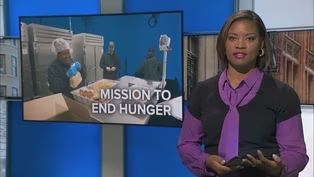
The greater Chicago Food Depository is a nonstop operation serving hundreds of organizations across Chicago with food insecurity on the rise, the food bank has opened a new facility focused on preparing hot meals.
Are Joanna Hernandez gets an inside look at their operations.
>> At the food Bank on the southwest side, the operation is all about teamwork.
From cutting vegetables to fruit.
To preparing impacting food trays to more than 800 food pantries, soup kitchens and shelters throughout Chicago.
>> We have pantries in every community.
I mean, that is the reality.
where to go away from uptown?
All the way to West Pullman.
Yeah.
Sometimes the repack team.
We'll tell them.
You know, you just read hacked 17,000 pounds of food today is likely to go to this community.
Are that community?
>> This year, the organization completed the expansion of its 38,000 Square Foot, Commercial kitchen known as the Project Chief Operating Officer Jill Dream on says it's a game changer for their mission to end hunger.
>> We might not have a kitchen.
You might have the capability to cook.
You might not have the in urging cookie.
Not that might not be well enough to cook.
And so we needed to build this facility.
>> To produce meals with more space for food production on says the goal of this new facility is to make and distribute 10,000 ready to eat meals daily.
>> We had to make food that was healthy and healthy needed to be defined by something that we can go back to and say it's not just our idea.
Healthy, we're committing to the dash diet.
So it's rich in fruits and vegetables.
It's rich in whole grains is rich in lean protein.
Low in dairy fat and low in sodium.
But because they make all the marinade, we can control the tape.
>> We'll see what happens.
But still 12 50's a lot executive chef Michael Goss is in charge of overseeing daily food operations at any given time.
We may have 18 to 20 different recipes in the works.
Chef gas transition from fine dining to collaborating with dietitians at the food bank to cook up meals from scratch.
Anything from chicken.
Fish soup in your occasional hot off meals.
>> The overall goal is to keep people.
We want them to eat the food that's prepared.
So it needs to be, you know, tasty and and really high quality.
And there's no reason that nutritious or or healthful foods, can't be those things.
>> I'll break one more rule here and take you guys into pack.
>> This is where's the meals to give a symbol?
>> Meals prepared here are distribute to 34 community partners throughout Chicago and Cook County, including 2 state run facilities for asylum seekers for months as their focus not providing groceries but meals cater to older adults who have disabilities or chronic health conditions.
So we have about 340 older adults.
>> That will get a mix box of meals.
So they'll get 5 to 7 meals, different entrees and a hot meal on that delivery.
And we delivered directly to their home.
>> The facility also grows its own herbs like growing parsley, basil and oregano using hydroponics our final stop of the tour is a room full of volunteers packing boxes to send out to local pantries >> this group of generous volunteers were giving us what is most precious, which is time army packing those potatoes into smaller bags and then they'll put them into boxes.
They will then go into inventory.
>> With one in 5 households experiencing food insecurity on says the number of people in need continues to grow since the pandemic.
>> While this is definitely the season of giving what we want to remind people is that this is a need that.
Those who are in need face every day, not just Thanksgiving and Christmas.
>> For Chicago tonight, I'm Joanna Hernandez.
And if you know someone facing food insecurity, the Food Depository offers a list of resources.
>> For assistance programs, you can visit our website to learn more.
And that's our show for this Wednesday night.
Join us tomorrow night at 5, 30 10, a crop of new tech apps connecting temps with jobs.
What it means for those workers and we hear about efforts to save the Illinois state insect local conservationists on what's being done to protect the monarch butterfly.
Now for all of us here in Chicago tonight, voices I'm branches.
Friedman, thanks for watching.
Stay healthy and safe and have a good night.
>> made possible by Robert a
Advocate Announces Plans to Invest $1B in South Side Care
Video has Closed Captions
Clip: 12/18/2024 | 8m 16s | The plan includes replacing Trinity Hospital with a new facility. (8m 16s)
Chicago Budget Director on 2025 Spending Plan
Video has Closed Captions
Clip: 12/18/2024 | 7m 18s | The city's $17.1 billion spending plan is in place — but it didn't come easily. (7m 18s)
Inside the Greater Chicago Food Depository’s New Facility
Video has Closed Captions
Clip: 12/18/2024 | 4m 3s | The organization estimates one in five Chicago households is food insecure. (4m 3s)
Providing Support for PBS.org
Learn Moreabout PBS online sponsorship
- News and Public Affairs

Top journalists deliver compelling original analysis of the hour's headlines.

- News and Public Affairs

FRONTLINE is investigative journalism that questions, explains and changes our world.












Support for PBS provided by:
Chicago Tonight: Black Voices is a local public television program presented by WTTW