Chicago Tonight: Black Voices
Chicago Tonight: Black Voices, Jan. 15, 2025 - Full Show
1/15/2025 | 26m 47sVideo has Closed Captions
Brandis Friedman hosts the Jan. 15, 2025, episode of "Black Voices."
City Council votes on an effort to weaken protections for undocumented immigrants. Why Black Illinoisans are experiencing homelessness at a high rate. And a push to wipe medical debt from credit reports.
Problems playing video? | Closed Captioning Feedback
Problems playing video? | Closed Captioning Feedback
Chicago Tonight: Black Voices is a local public television program presented by WTTW
Chicago Tonight: Black Voices
Chicago Tonight: Black Voices, Jan. 15, 2025 - Full Show
1/15/2025 | 26m 47sVideo has Closed Captions
City Council votes on an effort to weaken protections for undocumented immigrants. Why Black Illinoisans are experiencing homelessness at a high rate. And a push to wipe medical debt from credit reports.
Problems playing video? | Closed Captioning Feedback
How to Watch Chicago Tonight: Black Voices
Chicago Tonight: Black Voices is available to stream on pbs.org and the free PBS App, available on iPhone, Apple TV, Android TV, Android smartphones, Amazon Fire TV, Amazon Fire Tablet, Roku, Samsung Smart TV, and Vizio.
Providing Support for PBS.org
Learn Moreabout PBS online sponsorship>> Hello and thanks for joining us on Chicago tonight.
Black voices.
I'm Brandis Friedman.
Here's what we're looking at.
>> In the next 4 years, it's important more important, in fact than ever that Chicago remain a haven for people from around the globe.
City Council members reject a proposal that would weaken protections for undocumented immigrants in Chicago.
>> Why black residents in Illinois are experiencing homelessness at a higher rate.
And more than 100 million Americans have medical debt, push to remove it from credit reports could impact everyone.
>> And now to some of today's top stories, the Israel-Hamas war is being put on pause after more than 15 months of fighting officials from the U.S. and Qatar confirmed a 42 day ceasefire and hostage release agreement that will begin on Sunday.
The Israel government reports nearly 100 captives are still being held by Hamas in the Gaza Strip.
The Palestinian people, I've gone through.
>> Too many innocent people have died.
Too many communities have been destroyed.
This deal.
The people of Gaza can finally recover and rebuild.
They can look to a future without Hamas in power.
>> The devastation from the war has claimed over 46,000 Palestinian lives and displaced over 90% of the population in Gaza, according to local officials over 75,000 Israelis have been displaced since the attacks began.
Chicago public schools made history this morning, swearing in its first set of elected board members.
The new board members, half elected and half appointed by Mayor Brandon Johnson made a few remarks.
I sit before you humbled and deeply honored to take this oath of office for the Chicago Public Schools.
First elected school board.
>> Count on me to engage with all the families of district 3 and beyond.
>> I commit to listening and making decisions is centered.
The needs of our families.
>> We have the tools for a new era education.
I'm looking forward to communicating with District 10, name, board member, the shift to an elected public school board is part of a years long effort which will culminate with a fully elected board in 2027.
The mayor has already appointed the board's president.
Sean Harden and appointed member old about East a defeated elected member Jessica Biggs to become the board's vice president.
For more on who's on the board, check out our website.
Most it.
>> Chicago Transit Authority President Dorval Carter bids farewell.
Carter has served as president for nearly a decade and has been with the CTA on and off for more than a quarter century.
His tenure was marked by the upheaval of the COVID-19 pandemic criticism from riders over long waits, unreliable service and safety issues and major infrastructure projects, including the forthcoming Red Line extension in remarks to the CTA board, Carter called the leading called leading the agency the honor of a lifetime and called on state lawmakers to boost public resources for transit system, he says has long been underfunded.
Carter's chief of staff was appointed as acting president now falls to Mayor Brandon Johnson to appoint Carter's replacement.
Expressway.
Shootings have fallen for the 3rd straight year in Illinois from a peak in 2021, the Illinois State Police says there were 31% fewer interstate shootings in 2024.
Compared to 2023.
That's a 53% decrease.
Compared with 2022. and a 71% decrease compared to 2021, the agency says use of license plate readers and aerial operations have both been game changers and in catching shooters.
Isp says they also use patrol enforcement and special violent crime reduction missions to reduce fatal crashes and sees stolen vehicles.
Up next, a rundown of what happened at today's City Council meeting Tennis.
Your own joins us right after this.
>> Chicago tonight, Black Forest is made possible in part by the support of these.
Don't use.
>> Today promised to be another day of high drama at City Hall.
But 2 high-profile showdowns failed to materialize while a push to lower the city speed limit failed to get an up or down vote.
A super majority of the city council quickly rejected an effort to scale back protections for undocumented immigrants.
Here's Mayor Brandon Johnson celebrating Today City Council decision to not amended the city's welcoming city ordinance >> families can.
be assured that today's display of this broad coalition that beat back an ordinance that quite frankly, was just stoking the flames of fear.
And so we're already off to a stronger start than where we were.
You know, you know, you know, 8 years ago.
>> W t Tw News reporter Heather Sharon joins us now with the latest.
Header.
City Council voted 39 to 11 without even a debate to not even consider this effort to scale back the welcoming city ordinance.
Everyone expected some fierce debate didn't happen Well, I think that immigration advocates who spent the last several days really raising the alarm that had this amendment passed.
It would have made people who already feel very vulnerable looking to inauguration of President-elect Donald Trump, even more vulnerable.
Also, it helps that the Chicago Police Department said, hey, this would be illegal under state law because the only trust act prevents local law enforcement agencies working with immigration agents.
So >> in the end it seemed to them.
Super majority of City Council said this was a debate essentially about nothing that wouldn't have really done anything to make the city safer as its supporters said, but would only stoke as we heard the mayor say those fires sort of surrounding immigration and Chicago's thousands of undocumented resident.
And so where does this leave those thousands of Chicagoans who are undocumented as the second Trump administration begins next week?
Well, Mayor Johnson said he, you know, really believes that there's a great deal of fear out there in Chicago right now in 2017, we saw people really stop sending their kids to school because of concerns about immigration raids.
We saw families declining to call 9-1-1.
Are going to hospitals to get needed care.
So it's really not clear what's going to happen come next week.
It's also not clear that the president who will soon be now.
Now the president elect soon the president will make good on those threats to start that mass deportation effort here in Chicago City Council.
Also, though, or they didn't vote on whether to reduce the city's default speed limit by 5 miles an right at that ever hit a red light.
Well, if you don't have the votes, you don't vote.
And that's what happened today.
Al Durham and Daniel, the spot has been pushing this for many months and he sent Ali said, look, he didn't have the votes because of concerns that this would be used by the city to grab more cash from people, maybe a little bit of lead flooded on Chicago streets.
Instead, the city council nearly unanimously agreed to fall to form a working group.
They're going to try to make sure that if they do lower the speed limit, it doesn't come on the backs of Chicago's black and Latino respect.
And so then we'll that measure come back.
We'll either of these measures come back.
So they both could come back.
There is no end to the debate over undocumented immigrants in Chicago.
There is no end to the debate over how best to make Chicago streets safer.
This was just sort of an inflection point that didn't really do a whole lot.
But we'll be keeping a watch on and said, January.
Interesting Hetero, thanks so Thanks.
Brandis.
>> And you can read Heather's full story on our website.
It's all at W T Tw Dot com slash news.
The number of people experiencing homelessness in the United States on a single night was the highest ever recorded in 2024?
the overall rate increased by 18%.
And in Chicago, the number of unhoused people has tripled from 2023 2024. but black homelessness is seeing an even higher uptick in Illinois.
More than double the national average.
These figures are part of a report by the University of Illinois-Chicago in collaboration with the Illinois Office to Prevent and End Homelessness.
Here to talk more about this disparity is Christine Haley, the state's chief homelessness officer.
Welcome back, striker tonight.
Thank you so much.
why are we seeing this disparity, Christine, what is what's the cause So first, we have to understand what happens during a crisis.
>> So for many people who are homeowners its an emergency happens such as you lose a job or there's a medical emergency.
You can pull equity out of your home to be able to withstand that crisis.
If we look at black families in Chicago, we understand income winds, according to a report that the Chicago Department of Housing did a few years ago that the average income of a Chicago mean median income for an average Chicago families about $90,000 a year.
But for black families, it's about $27,000 a So that's income side.
On the asset side.
The Caller wealth study, which recently came out found that front liquid assets for white families in Chicago.
The average liquid assets for white families is about $27,000.
And for black families as $1000.
There's an emergency.
You reach out to your friends and family if they also are in the same economic situation that you're only have $1000 of cash on hand to address housing situation.
And then if we look at what our our formal ways to support folks, I'm at the time of crisis that the way in which people might access the Chicago and Cook County.
Homeless prevention call Center.
That's where you would call to say I'm behind on my rent.
I need some help.
The University of Chicago recently did a study that found that only one out of 8 people who call are able to access a resource.
So I think the structural issues that we're really trying to understand is we understand that if we look at home ownership, that's where you pull from how that has disproportionately impacted black households and not being able to access credit.
You look red lining.
You look at segregation history, course, yes, and some of the economics.
But then they're also you know, sort of the social factors that go into this disparity.
What are what are some of those?
>> So at that at the core of this, we understand that it's a lack of affordable housing.
That is the cause of of home of homelessness.
There are social factors that might make an individual Moore vulnerable such as you know, mental illness or substance use.
But that's not the true cause of what causes homelessness, what causes homelessness is that we don't have enough housing for everyone who needs it.
So the report that we really wanted to bring together stakeholders from across our state to create the racial equity round table on black homelessness that brought.
Leaders from the faith community from government, from people with lived expertise to help guide the report that the University of Illinois at Chicago completed to help us understand black homelessness in the state.
And that there are areas within the report that address evictions, for example, the impact that evictions has on black homelessness that the criminal legal system understanding child welfare and how family and how individuals and youth exit have child welfare systems.
So those types of system system involvement does, of course, have a role to play and how we can make interventions to catch people if if they fall through those systems.
But at the end of the day, we see higher rates of black homelessness because we don't have enough housing and because black folks don't have the same generational assets that can can help them.
That can help us during a crisis.
And you mentioned a couple of, you know, a couple of those factors, right?
People often think it's a matter of, you know, having made poor choices, more of that drug abuse, mental illness.
But those can be factors.
Right?
But you reference the sort of structural problems last year.
>> The Illinois Department of Public Health released the state's first health report for people experiencing homelessness what did that report tell us about the role of mental illness in homelessness.
The black community.
So the report found that the average age of death of a person experiencing homelessness is 18 years earlier than the general population.
>> So ill noise, homeless population is about 61% black.
So we look at the state of Illinois is about 14% black.
Those experiencing poverty is about 30%.
But those experiencing homelessness is 61% right.
>> of the of so we really need to understand that with if we look at mental illness, if we look pieces such as cold-related injuries, we understand from the report that people experiencing homelessness are 38 times more likely to die of a cold related injury.
Then from.
Than the general population, we understand is a cold related injury.
Me just common cold or doubts.
during the cold being outside.
So right now it is very cold.
Chicago.
I previously before being appointed to this role, I worked for Cook County Health and Hospital systems and this time of the year was a very difficult time of year because we compute Haitians, right?
So people lose their fingers.
They lose their toes.
receive below the knee, amputations become permanently disabled because of frostbite in the winter.
So I think that part of the reason why we did this report was to be able to provide the opportunity for our community to understand the impacts.
The health impacts that people experience.
Homelessness have.
And that really no one should become disabled because they have housing insecurity are living outside stations or something that you don't even consider a related to the cold.
I'm not a whole lot of time left.
Christine, a Governor Pritzker's office projects a 3.2 billion dollar deficit in the coming fiscal year.
>> While the Illinois Shelter Alliance is advocating for an additional 100 million dollars in state funding to prevent and end homelessness.
What is the likelihood that the state is able to allocate more than 290 Million.
That is already being spent on addressing this issue.
So in in 2021, Governor Pritzker signed an executive order to fight homelessness that created the infrastructure around state government to address homelessness.
>> It created our Interagency Task Force on homelessness where we have 16 state agencies that are really working towards understanding within their budgets with in there their purview.
How can they address homelessness?
We have increased funding for homelessness in the state of Illinois by over 156%.
In that we have invested in shelter, permanent housing employment Services, clinical Services and others.
So I think that we understand very clearly that we've have a need and are working towards addressing.
Okay, we'll have to leave it there.
You've got your work cut out for you.
Of course.
Christine Haley, the state's chief homelessness officer, thank you for joining us.
Thank you so much.
And we're back with more right after this.
>> If >> you're one of around 100 million people in the U.S. who struggle with medical debt help may be on the way the Consumer Financial Protection Bureau recently announced its plan to erase medical debt from credit reports.
An estimated 49 billion dollars would vanish from millions of Americans.
Credit histories.
But critics say the move will do more harm than good.
And a legal battle is underway.
Joining us now via zoom are Anthony Barr, director of research and impact of the National Bankers Association.
And Eva Stall.
The vice president of policy and programs at undue medical debt.
Thanks to you both for joining us.
Anthony Barr, let's start with you, please.
How does medical debt affect people's lives?
>> Absolutely so critical as it currently stands as something that any of us can experience at any time, really don't necessarily always think about that for a realty, but experiencing a medical emergency or having the high cost, you know, medical care that exceeds our ability to pay commanders with that medical debt.
And then in the status quo that shows up on your credit history and therefore it dampens your credit score, which then downstream from that can impact your ability to access capital and credit.
So you might be less likely to be proof that mortgage or that small business loan or that car loan or even if you are approved, you might end up paying more at terms for that loan that are less favorable.
And so it really is something is it is a significant challenge specifically for households that already experience of financial constraints or a lack of access to prior financial products in the banking system.
>> Eva Stahl, how does your organization medical debt?
How do you work to address these burdens?
>> Or so, first off, I would say that we're really excited about this.
Change.
Your medical debt is not the dead of choice, right into debt of city.
So we're national nonprofit that works with donors to raise funds to abolish medical debt in bulk.
We do this by flipping the script of what a debt collector would do.
So in other words, you know, if you if you approach a hospital or a big provider practice, they might use a debt collector or 2 try and collect on these debts.
Once they've gone through that process, they might sell that debt.
So that debt collection process can start again.
So that's where we intervene and say don't sell to a buyer or a debt collector rather than sell to us.
And so we pay pennies on the dollar and abolish the step with donated dollars and left our constituents know that they're free and clear of this medical debt.
And we do that in a way that we make sure that we have an opportunity to learn their stories to hear back from them about their experiences with medical debt.
And we know that the issue of credit is one that hangs over people along with a lot of anxiety and mental distress.
>> Anthony Weiner, black Americans disproportionately affected by medical debt.
>> Absolutely.
So nationally, it's really about what resources you have.
And so, you know, Brookings Report looking nationwide found 80% of medical debt is held by households with 0 or negative net worth.
So we're already in terms of the racial disparities talking about, you know, all things redlining You know, that has kind of led to huge disparities starting out in terms your network in their 40 bility to pay for medical care here in Chicago at 2024. caller.
Well, study found that 29% of black households in Chicago have medical debt versus only 18% white household.
And then thinking again about that credit journey, right, that deepening your credit score making it harder to access, you know, a mortgage or something like that.
We see some dumb down.
Stream effects there as well.
So in Chicago, White families have a home ownership rate around 72%.
According to that same study only 34% for black households.
>> Even Cook County has been a proactive player, medical debt relief use utilizing American rescue plan funds to eliminate 382 million dollars in debt for 200,000 residents.
How will this rule from the Consumer Financial Protection bureau affect residents in Cook County?
>> Sure.
So, you know, as Anthony Laid-out, it's really important to remove medical debt from credit reports because it doesn't really predict people's credit worthiness because it's not really a debt of choice.
So why have these debts that people don't anticipate really cloud their credit picture.
So I think for all people across the country, this will be a huge relief to have this removed from their credit reports, specifically for residents locally.
When we work with hospital partners in Cook County to relieve debt.
Part of our contractual requirement is that they remove any marks from a negative marks from a credit report.
So the way it works is that is whoever puts that bad credit mark on a credit report needs to remove it.
And so that is actually part of our process, which has been really helpful to residents.
But I think knowing writ large that medical that will be removed from credit reports just bring such a sense of relief and allows people to kind of take a deep breath and maybe think differently about their health care journey because really at the end of the day, what we want for patients is to return to care.
And we know from pull in study after study that one of the greatest fears people have in accessing health care is the death that they might accrue.
>> Not everybody's on board with There are opponents of this proposal who argue that will it will incentivize people to just skip paying their medical or and that it should be included in credit reports because if you're not paying your medical bills, maybe you're not paying your loans for your car or your credit card.
For example, House Financial Services Committee Chairman French Hill of Arkansas blasted this rule in a statement after the announcement saying, quote, instead of focusing on enhancing economic opportunity for all consumers, Chopra, he's referring to the director of the CFPB here.
Chopra's regulatory overreach will drive up costs to any American seeking medical care and have a devastating impact on consumers.
Access to health care, particularly in rural areas.
not a whole lot of time.
Anthony, I'm gonna come to you first on that one.
What do you say to that?
>> Yes, oversaw anticipated that there would be some pushback along these lines and so they come to study even before this rule is finalized.
Looked at, you know, is this a good predictive value for repaying loans found that it's not?
And in our experience in minority banking sector, which represents representatives, you know, who are organizations as community wonders, mission-driven lenders are used to looking past credit scores.
We actually have research on their mortgage lending showing that, you know, they're less likely to deny based on credit for example, because they're looking at other factors like rent.
History has an ability to repay.
So I knew I challenge that assertion that it's going you know, some help distort the credit market word or make it make underwriting reliable.
And I know is that and know there going have start why I was just going to chickens are out of time.
The Consumer Data Industry Association which represents debt collectors, they have filed a lawsuit about this.
Of course.
>> Their claim is that the rule violates the Fair Credit Reporting Act.
Some more to come on this.
Obviously.
We'll see how that plays out.
But that we'll have to leave it with if any of our deepest.
All.
Thanks to both for joining us.
And that's our show for this Wednesday night.
Join us tomorrow night at 5, 30 10.
And we leave you tonight with a look at the Dr Martin Luther King Junior Living Memorial in Marquette Park on what would have been his 96th birthday today.
>> Now for all of us here at Chicago tonight, Black Voices.
I'm Brandis Friedman, thank you for watching.
Stay healthy and safe.
Have a good night.
>> Closed captioning is made possible.
a cliff.
And the current law Chicago personal injury and wrongful death and proud sponsor programming properties place and
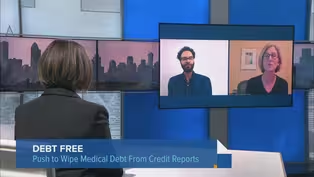
Biden Bans Medical Debt From Appearing on Credit Reports
Video has Closed Captions
Clip: 1/15/2025 | 7m 27s | An estimated $49 billion of debt would vanish from Americans' credit histories under the new plan. (7m 27s)
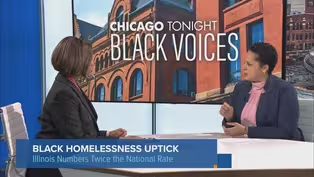
Black Illinoisans Are Experiencing Homelessness at a High Rate
Video has Closed Captions
Clip: 1/15/2025 | 7m 49s | A new report says homelessness among Black Illinoisans is more than twice the national average. (7m 49s)
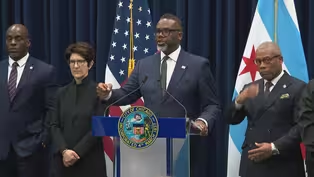
City Council Rejects Push to Weaken Protections for Undocumented Immigrants
Video has Closed Captions
Clip: 1/15/2025 | 3m 37s | After days of increasing alarm among advocates for immigrant rights, the showdown was anticlimactic. (3m 37s)
Providing Support for PBS.org
Learn Moreabout PBS online sponsorship
- News and Public Affairs

Top journalists deliver compelling original analysis of the hour's headlines.

- News and Public Affairs

FRONTLINE is investigative journalism that questions, explains and changes our world.












Support for PBS provided by:
Chicago Tonight: Black Voices is a local public television program presented by WTTW