Chicago Tonight: Black Voices
Chicago Tonight: Black Voices, Jan. 29, 2025 - Full Show
1/29/2025 | 26m 47sVideo has Closed Captions
Brandis Friedman hosts the Jan. 29, 2025, episode of "Black Voices."
The White House rescinds its memo freezing federal funding. And a plan to hold companies complicit in slavery to account.
Problems playing video? | Closed Captioning Feedback
Problems playing video? | Closed Captioning Feedback
Chicago Tonight: Black Voices is a local public television program presented by WTTW
Chicago Tonight: Black Voices
Chicago Tonight: Black Voices, Jan. 29, 2025 - Full Show
1/29/2025 | 26m 47sVideo has Closed Captions
The White House rescinds its memo freezing federal funding. And a plan to hold companies complicit in slavery to account.
Problems playing video? | Closed Captioning Feedback
How to Watch Chicago Tonight: Black Voices
Chicago Tonight: Black Voices is available to stream on pbs.org and the free PBS App, available on iPhone, Apple TV, Android TV, Android smartphones, Amazon Fire TV, Amazon Fire Tablet, Roku, Samsung Smart TV, and Vizio.
Providing Support for PBS.org
Learn Moreabout PBS online sponsorship>> Hello and thanks for joining us on Chicago tonight.
Black voices.
I'm Brandis Friedman.
Here's what we're looking at.
The White House is rescinding its memo that froze federal funding following confusion and legal action.
We built this news.
>> We got nothing back from it.
>> In effort to hold companies complicit in slavery to account.
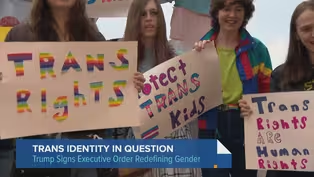
Advocates are pushing back against President Trump's executive order to scale back transgender protections.
And were you ever told to stay away from Chicago's south and West sides?
You're not alone.
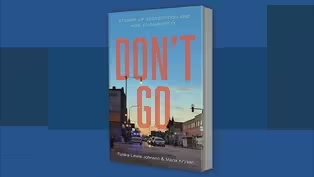
A new book explores the impact of that message.
>> And now to some of today's top stories, the Trump administration is rescinding a memo.
Freezing federal funding following massive backlash.
The White House Office of Management and Budget rescinded its memo.
Less than 2 days after calling for a pause on federal grants which sparked widespread confusion and legal challenges.
The freeze threatened to hold up trillions of dollars in funding for basic government functions like health care, infrastructure and support for children and veterans remarks made before the reversal was announced.
Illinois Governor JB Pritzker today reacted to the backlash the Trump administration was receiving.
>> I'm pretty sure that they received a message yesterday from across the country that this is a bad idea.
Fine review all the programs.
Let's make sure we're doing it efficiently and effectively but don't shut off the programs while you're reviewing them.
>> The White House says while the memo was pulled today, Trump's underlying executive orders targeting federal spending in areas like diversity, equity and inclusion and climate change remained in place.
The fate of former House Speaker Michael Madigan is now in the hands of a jury 113 days after the landmark trial began.
Madigan charged along with his long-time right-hand man, Michael McClain, with racketeering, bribery and wire fraud.
Prosecutors say the men orchestrated multiple corruption schemes wielding Madigan's immense political power to reward his loyal allies and enrich himself.
Madigan's defense team, however, argues he never solicited nor received any bribes related to his official office or his private law firm.
They have each pleaded not guilty.
If you're a homeowner in Cook County, your property tax bill is on its way.
It's the second time since 2021.
Cook County officials.
sending out the bills on time.
That means property owners must pay their first installment no later than March.
4th to see how your bill is calculated.
Please visit our website.
And the Lunar New Year is kicking off today.
Community members were celebrating the year of the snake with events across the city.
The year of the snake symbolizes rebirth regeneration and the pursuit of love and happiness.
The Lunar New Year parade is in Chicago's Chinatown.
Neighborhood is set for Sunday February night.
For more on the holiday and how it's celebrated check out our Web site.
Up next, new legislation addresses businesses, historic ties to slavery.
Right after this.
>> Chicago tonight, what he's made possible in part by the support of these don't use.
>> Evanston in 2021, became the first city in the U.S. to implement a reparations program for black residents.
While Illinois has a commission to study reparations, another proposed state law sets Illinois on a path to something similar.
and joins us now with more.
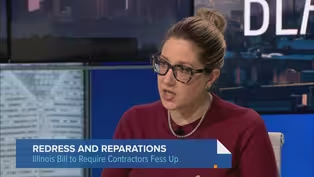
Amanda, U.S., Brenda State Representative Sonia Harbor is the sponsor of what she calls the enslavement era disclosure and redress act.
It's a way she says for companies that profited from slavery to help repair the legacy of harm.
It's cause for generations of black Americans.
Black Americans.
We have waited so long.
>> We have waited so long in vain for our communities to be may hold after hundreds of years of repression pressure on so many levels we've waited long enough.
>> what exactly would the bill do?
It would require companies that want to do business with the slaves state that participate in either slave holding or the slave trade to say so the it whether they transported enslaved people on trains provided loans for the purchase of enslaved people or otherwise profited.
They would have to file this information with the state when submitting a bid for a state contract as part of the companies would also have to provide a statement.
A financial redress.
In other words, the amount of money they're committing pay.
The bill says that it is a way for corporations to take responsibility for past actions.
And 2 demonstrate their commitment to fostering a more just and equitable society.
Backers say people, companies and governments got rich because of slavery.
Meanwhile, when slavery was abolished in 18, 65 enslaved, people were left with next to nothing and they're still trying to catch up.
>> You're not giving us a handout.
You're giving us what it deserved to those who are descendants of the enslaved and no policy that we pass in this building will never close the economic gap that went on for 400 years.
We will not close the educational gap that went on for 150 years before we even got access to education.
Amanda, how much companies have to pay.
>> That's not explicitly spelled out in the bill.
It's among the various details that have yet to be worked out.
But that money would be put into a special state fund used not for reparations, but for projects and economically depressed areas that were hurt by redlining or Jim Crow era policies.
So when one of the bill's chances, Amanda, that is hard to tell us really early in the legislative session.
But yes, it is going to get some pushback.
I did try to reach out to some likely opponents to not have any luck.
That includes Judicial Watch an organization behind the lawsuit arguing that has instance program is unconstitutional based on equal protection grounds, creating a slavery era disclosure Bill, however, is a lot by law.
That is one of the missions of the state reparations commission that was created in the wake of George Floyd's murder.
That commission has been on a statewide listening tour and it's next.
Stop is coming to the Chicago area.
It will be holding a listening tour hearing residents welcome to give their input in Evanston a week from Saturday.
That's February, right.
Amanda, thank so much.
And you can read them and U.S. full story on our website.
It's all at W T Tw Dot com slash news.
>> President Donald Trump's flurry of executive orders includes rolling back protections for transgender people.
Advocates are pushing back saying there could be a domino effect of widespread consequences.
Here with more, our Shannon Parker, CEO of Brave Space Alliance, Alicia Zammit Takis research, assistant professor at the Institute for and Gender Minority Health and well-being at Northwestern University.
And on Zoom, Precious Brady Davis, a commissioner for the Metropolitan Water Reclamation District of Chicago.
Ladies, thanks to all of you for joining us.
Shannon Parker.
Want to start with you.
Please.
Brave space alliance Blackledge Translate LGBTQ nonprofit.
How do you think this order will impact a federal funding that supports organizations like yours?
>> What a great question.
So again, thank you for having me today.
a devastating effect.
So many of organization with the organization similar to pray.
Space Alliance that provide affirming care life, saving care.
2, ginger expensive populations are heavily reliant on government grants, namely federal funding.
So when we have executive orders such as these, they strike at the heart, they cut off the life's blood of organizations that do this life saving work every day.
And I really want to be clear that this affects more than just LGBTQ are trained serving organizations.
effects organizations that serve marginalized populations across gamut.
So, yes, it has a detriments on the organization's precious Brady Davis.
Take us back.
If you would, a little bit to the history of policing of non gender, conforming people or gender nonconforming people.
>> When we look at the birth of our movement at stole received 2 brave brown and black trans woman.
We see Marsha P Johnson.
We see so Rivera who pushed back against the police up folks who wear gender variance for years.
The LGBTQ community in particular, the trans community have organized in the spear of authenticity.
This is not the first time that we have been policed.
We saw our our lives police during the Reagan administration when the Reagan administration did not stand up for for HIV to not fight for a cure we don't ask, don't tell.
during the Clinton administration and then on to the President Bush.
So I think that we lit it during these times before.
And I think that we as trans people, I think that we are result of resilient people.
>> That the trans community fairly small are making up only one percent of our entire population.
Commissioner, why do you think?
>> This administration sees sees this community is a threat.
>> I think that we as trans people that we make up one percent of the population, as you say, approximately 3 million Americans.
Does that mean that our lives don't matter?
Approximately 3 million people live in the state of Iowa and I find it as a distraction.
I think it's really a distraction about the one percent who this president is catering to.
We saw at the president's inauguration, the tech oligarchs, the folks who are going to benefit from the tax cuts of this administration and its an attack.
It's a distraction and we're going to be fighting back to that.
Now.
>> We've used attack.
Is Trump's definition of gender in this order is the biological were assigned at birth.
What do you think is wrong with that definition?
>> Yeah, I mean, not only is that accurate as to the understanding of ourselves as transgender people, but it's also scientifically inaccurate executive order Icu's that and now as someone with the promise on the material of them now at conception.
But we all have the chromosomal material up miles and females conception.
So by this definition, essentially, we're all males and females.
But I think the point really isn't to have sounds definition of gender within this order.
It has to lay the basis for these attacks.
as the commissioner said to provide and a mount, an immense amount of destruction and division among people that said, what impact could it have a legal documentation for trans people on your federal your passport, for example.
>> Yeah.
It ultimately prohibit transgender people from having access passports and other legal documentation that represents they're accurate.
Gender markers and names already transferred or people have had their passport applications either tonight or even how it at this time without even being sense.
Trump's executive order, this also make it more difficult for and already a precarious situation with documents.
Trance people often carry a driver's license with one gender a birth certificate with another and so forth because it's so difficult for us to get accurate documents.
This will only exacerbate that problem.
It also make it more difficult for us to actually know what's happening to trans people.
So one trans people are killed.
It's really hard for us to know how often that happens because there's a lack of data.
And now Deparments identified by by the authorities at the time.
Exactly.
Shannon, you work to the Cook County Department of Corrections, specifically populations in protective custody.
What's at stake for trans women who trans people?
>> Who are incarcerated so much is stake.
>> having worked in the Cook, a Department of Corrections as the first openly transgender woman.
I helped to shape a new form many policies that are still in place today.
2 create protections for such a vulnerable population.
This flies in the face of a federal mandate called Priya the Prison Rape Elimination And that.
Actually he's under Gary.
It's to protect the population that's now being attacked.
So what we see what we're going to see if we're not seeing it already is the movement of protected individuals who are right now detained are incarcerated facilities are in alignment with their internal reality being cents to mail.
Presidents jails where they could be.
In multiple ways if not killed.
>> Gray Davis will was impact any Illinois laws.
Any Illinois state laws that protect trans rights.
>> I'm so glad that we lived in that we live in the land of Lincoln LGBTQ rights reign, supreme here in Illinois, LGBTQ education is taught in schools.
My husband and I we we took this state to ensure that folks can be identified properly on birth certificates at the gender that they identify as we were the first couple in the state to do that.
I'm proud that we have a progressive legislature and we have a progressive governor.
I was the first black trans woman appointed to public office Cook County Herstory appointed by our governor.
And our governor has said that he's going to fight back and that you have to come through him to get to the people of Illinois.
And so my heart breaks.
But the people across the country who do live in a blue state, my heart breaks for the trans youth who won't receive gender affirming care.
And it's important that Illinois will become a beacon of reproductive justice and care during this time.
>> Yeah, of course, he mentioned the trans youth in their care because we know that Trump has signed another executive order banning teens and adolescents from accessing that health care.
Shannon, back to you or black trans women at higher risk of being targeted when their rights are threatened.
But that's absolutely.
>> You know, black trans women lived at multiple intersections race identity, some being more visible than others.
And what we see is carte blanche in bold Mont of individuals who when highest office of the land actually use.
A pass for individuals to thread.
And that means here down to humanity of another individual.
goes without saying that there is an emergency 4 trains, women.
>> before we run it, speaking of emergency, we've got about 30 seconds leave.
You have let you have the last word.
What is your advice to trans people and families right now?
Yeah, I think transgender people need to fight back.
We need to be organized and in the streets with sand with immigrant rights that we've been able to make it so difficult for them to be able to deport anyone because of organizing and spreading the word finding people willing to do the same with transgender people.
That's what we have to have to leave it.
Thanks to the 3 of you for for joining Shannon Parker.
Levy is attack is a precious baby.
Brady Davis, things everybody.
Thank you.
>> Up next, a book on disrupting segregation.
Stay with us.
Have you been told to stay away from the south or west sides of Chicago?
That was the question posed to local residents and responses poured in about times.
They were told don't go those start.
Stories are now compiled in a new book called Don't Go Stories of Segregation and how to disrupt it to better understand what can happen when people explore the ignored parts of the city.
Joining us now are the book's co-authors artist photographer Tamika Lewis.
Johnson.
And so she ala just Maria Kreis.
And thanks to you both for joining us.
Welcome back to Chicago tonight.
so this book starts with your own personal stories of growing up and then how you came together to write this book.
How does your story reflect the experiences of the people that you included Maria President, start with you.
>> Some not very much.
I think that's part of the interesting part of the story between 20 We had extremely different upbringings.
I grew up in a small town in South Dakota where there were 3 black people.
So we did not have the kinds of issues of segregation in small town.
So my upbringing with very different continue cause.
And that's kind of part of the point of the inclusion of the stories is that 2 people with very different backgrounds, but having very similar.
Other experiences.
We both love to read.
We both had family with artists.
you know, we had lots of similarities.
you are going to say and UK.
Same question to you.
How do you think it's important or what think is important?
>> To include that your own stories in this story.
>> Or I wanted, people who read this book to understand that this is what segregation and prevents you from being able to do it.
Keeps you from people that you have a shared passion with.
>> That you have common interests with.
And when you come together, you can create a book like Don't Go in.
So it was really important for people to understand that even though Murray and I have very different backgrounds, we have a shared passion and interest to help educate people on how to disrupt segregation.
And this was our way of demonstrating that.
So that's an example of what can happen when you disrupt segregation.
When you ask people to share their don't go stories.
Of course, he received a lot of responses.
Maria, what does that tell you?
>> That Tunica once again really struck a chord.
I tell people I'm a sociologist tonight for years have tried to get people to talk to me to do surveys and interviews and focus groups that I have to bribe them and control them and persuade them do So when I open the inbox that showed all of the responses that Tony Cuphead generated just by mentioning it on social media.
I was like, OK, well, this is a lot easier than anything I've ever done.
And it was the stories were amazing.
It's yeah.
Speaks to her following as Tenikka what's wrong with the don't go narrative when people don't go into that neighborhood was one with that.
>> especially when you're in a segregated city like Chicago people say don't go to the south side of Chicago and the south side of Chicago is majority black because of our history.
>> A red line E and when people say that it shows that they're not educated on how that came to be and how it perpetuates segregation.
So it's just a common rumor.
And businesses know that people who are interested in buying homes know that.
So you're literally stifling black neighborhoods by just saying something, just so calm and I don't go to the South side because it really does prevent investment.
It's also offensive to the thousands and thousands of people who call those neighborhoods home.
>> Personally offensive.
And that's the other part that I think we really wanted to show.
His book is the personal part of segregation.
It's not just that prevents economic investment.
It hurts people's feelings and it helps people leave fear.
And we wanted to offer an opportunity for people to understand how to disrupt that and how to not be offended offensive to people.
>> Maria, what are some of the themes that emerged from these stories?
>> So many I have through mayor.
Here was the predominant theme and it was fear of.
Being shot and killed.
You know, that's what we heard from many weight people that we talked to talked about, the message that they were got, that they were received either growing up from their parents or families or police officers sometimes or coworkers or colleagues or college student friends, things like that.
Everyone is.
Instilling the sphere.
So that was really that's kind of the motif that goes through all of it.
It's also fear being embarrassed to talk about these kind of things.
I think that's part of why we really wanted to do this book is to show people you can confront these fears the thought since and fears that you have our shared by others and people can see themselves in the book and say, oh, now I see they overcame their fears and did something and wants conquer that fear and maybe they do go to visit a neighborhood on the south or the West side.
What they learn.
That's beautiful part that I love about the book.
>> Is that this book in particular since we have a stories of white Chicagoans, black, Chicagoans, Latino Chicagoans.
It really does help people understand how segregation segregation impacts all of us and the fear that we're talking you know, a lot of white Chicagoans expressing the vulnerability of admitting they have been taught to be raised in that fear.
And so one of the revelations that they have is not what I've been taught and it is actually racist.
And then also we have people who are from neighborhoods that people are told to not go to it on a and her story is very much like mine.
She had to learn that that's what people thought of her neighborhood.
And that was eye-opening for her.
>> Why is this kind of storytelling important?
How does storytelling help disrupt segregation?
I think that as a sociologist who spent her career.
Crunching numbers analyzing tax reducing them to reports that academics and policymakers read.
I think the story is touch us in a way that tanika always talks about until we make segregation person.
All we're never going to break it down.
And I think what better way then through stories too.
Help people see that really what's going on the impact of of the messaging.
I just think stories are related.
Bill.
It seems to me to make it also sort people taking it into their own hands rather than waiting on.
>> Government to fix segregation.
Oh, yes, because politics and policies haven't gotten us to where we want to be.
And I personally believe.
>> Is because we forget that it's personal.
Racism is rooted in people to people and it's really personal.
And that's the part that we want to elevate and bring back good.
You can disrupt these large systemic issues by, you know, changing behaviors.
Your personal behaviors are just thinking about the history of all of these issues.
And really is how you treat people.
It just comes down to that.
>> All right.
Lessons to be learned.
Sounds like a good book to get to to get our hands on that.
That is what we'll have to leave it.
My thanks to Tamika Lewis Johnson and Maria crease in for joining us.
Thank Congratulations on the book.
Thanks.
Again.
The book is called.
Don't Go stories of segregation and how to disrupt it.
And that is our show for this Wednesday night.
Be sure to sign up for our free email newsletter.
The Daily Chicago in at W T Tw Dot Com Slash newsletter and join us tomorrow night at 5, 30 10.
We have the latest on how federal immigration raids are impacting local communities.
Now for all of us here at Chicago tonight, why Foye says I'm Brandis Friedman, thank you for watching.
Stay healthy and safe.
>> We have a good night.
>> Closed captioning is made possible by Robert a and a Chicago personal injury and wrongful and from sponsor program that offers finest
Advocates Push Back on Trump's Order Scaling Back Transgender Protections
Video has Closed Captions
Clip: 1/29/2025 | 9m 19s | President Donald Trump's executive order is likely to be challenged in court. (9m 19s)
New Book Explores Personal Stories on Segregation in Chicago
Video has Closed Captions
Clip: 1/29/2025 | 7m 31s | Have you been told to avoid the South and West sides? A book explores the impact of that message. (7m 31s)
Proposal Would Hold Companies Complicit in Slavery to Account
Video has Closed Captions
Clip: 1/29/2025 | 3m 23s | An Illinois state representative is sponsoring the Enslavement Era Disclosure and Redress Act. (3m 23s)
Providing Support for PBS.org
Learn Moreabout PBS online sponsorship
- News and Public Affairs

Top journalists deliver compelling original analysis of the hour's headlines.

- News and Public Affairs

FRONTLINE is investigative journalism that questions, explains and changes our world.












Support for PBS provided by:
Chicago Tonight: Black Voices is a local public television program presented by WTTW