Chicago Tonight: Black Voices
Chicago Tonight: Black Voices, Nov. 13, 2024 - Full Show
11/13/2024 | 26m 47sVideo has Closed Captions
Joanna Hernandez hosts the Nov. 13, 2024, episode of "Black Voices."
What residents on Chicago’s South Side think about reparations. An effort to document Illinois’ connections with the Underground Railroad. And a new opera explores a family’s grief and journey to healing.
Problems playing video? | Closed Captioning Feedback
Problems playing video? | Closed Captioning Feedback
Chicago Tonight: Black Voices is a local public television program presented by WTTW
Chicago Tonight: Black Voices
Chicago Tonight: Black Voices, Nov. 13, 2024 - Full Show
11/13/2024 | 26m 47sVideo has Closed Captions
What residents on Chicago’s South Side think about reparations. An effort to document Illinois’ connections with the Underground Railroad. And a new opera explores a family’s grief and journey to healing.
Problems playing video? | Closed Captioning Feedback
How to Watch Chicago Tonight: Black Voices
Chicago Tonight: Black Voices is available to stream on pbs.org and the free PBS App, available on iPhone, Apple TV, Android TV, Android smartphones, Amazon Fire TV, Amazon Fire Tablet, Roku, Samsung Smart TV, and Vizio.
Providing Support for PBS.org
Learn Moreabout PBS online sponsorshipBlack join Hernandez filling in for Brenda's Freeman who has the evening off.
Here's what we're looking at.
>> In order to repair something, we have to acknowledge that something is wrong.
>> South side residents take part in a study about reparations.
We discuss the major takeaways.
>> We deserve more than just a passing glance.
History.
An effort to document Illinois connections with the Underground Railroad.
>> A new opera exploring a black family's grief journey towards healing.
And we visit a south suburban Brew pub that serves as a tribute to the founders late son.
>> And now to some of today's top stories.
Welcome back.
That was a message from the Oval Office today as President Joe Biden sat down with president elect Donald Trump at the White House.
The nearly two-hour meeting was part of the transition process.
A formality that Trump did not extend to Biden in 2020 Biden called for a peaceful transition of power.
While Trump politics can be tough and in many cases, quote, not a very nice world.
Trump is set to be sworn in on January.
20th.
And nurses at the University of Illinois Hospital are striking once again this morning.
Hundreds of nurses from the Illinois Nurses Association walked off the job in join the picket line amid ongoing contract negotiations that have lasted several months.
According to the association, the nurses have been working without a contract since the summer.
They're demanding improve security, better staffing and higher wages.
In a statement you why health address the situation stating that the majority of you, I health nurses are currently paid 90% more.
other nurses in the Chicagoland area.
Quote, when it comes to the top issue that mattered to are you why health nurses, compensation and safety and security.
The university has made substantial offers that would lead to meaningful benefits.
The strike is scheduled to continue through next Thursday to next next Tuesday.
In the Chicago Transit Authority Board is approving a 2 billion dollar operating budget for 2025. it's the final year the transit agency can rely on federal stimulus money to plug a budget gap that COVID relief money will run out in early 2026. state lawmakers are currently debating how to deal with the fiscal cliff face in Chicago area.
Transit agencies and what reforms to demand exchange.
The board also approved the seat.
He's capital improvement plan for the next several years, including the massive red line extension to 138 street CTA.
President Dorval Carter anticipates federal funding for the project will be secured before the Biden administration concludes its term.
We have more on this story on our website.
And the food delivery company.
Grubhub will soon have new owners.
Just a takeaway announced today that it is selling the Chicago based business for 650 million dollars to a New York company called Wonder Group which is led by former Wal-Mart executive Marc Lore.
Just purchase grip of back in 2020 during the COVID-19 pandemic for more than 7 billion dollars.
The transaction is expected to be completed in the 1st quarter of 2025.
And up next, Brenda's Freeman and takeaways from a local reparation study in a conversation recorded earlier.
>> Chicago tonight like is made possible in part by the support of these.
Don't use.
>> The country's war on drugs launched in the 1970's was intended to reduce illegal drug use.
But instead it led to decades of criminalization and incarceration for millions of people and even increased levels of violence.
That so-called war is one reason.
Some Southside residents say they could to form of reparations.
It's laid out in a recent report from the Chicago Urban League.
And joining us now is Chicago Urban League CEO Karen Freeman.
Wilson, welcome back.
Thank Great be here.
So the study it focuses on 10 Southside community that folks can see on the screen.
But I will read them out.
Douglas Englewood, Fuller Park, Grand Boulevard, Greater Grand Crossing Oakland, South Shore, Washington Park, West Englewood and Woodlawn.
Tell us about these communities and why they are the focus of this report.
>> Well, the reason that the report focused on those communities brand is is that it was a part of the are 3.
Appropriation from the state of Illinois, which meant that it was only good for certain areas or it only be used in certain areas that I 3 standing We store, we invest.
>> And we commit either the cannabis dollars, the cannabis dollars.
And so while we focus on those areas, the report is not only relevant to those areas because we think that there are facts and you aspects of the report that we can extrapolate for other areas of the south and West sides.
It well.
>> So in the report are through to research.
What you learn about how residents view reparations?
>> we went into the report thinking this is something that could be done as a group or community effort and the main thing that residents say it was that reparations are for individuals, you know, and I think we went into the report.
We were thinking we want to make it somewhat more acceptable and easier to pass either at the state.
>> federal level at the local level.
>> But reality is that people feel that the harm has impacted them as individuals.
It has impacted their families.
And that's has impacted us.
And so to the extent that the harm has individually, we believe and the report tells us the repair.
>> be toward individuals as well.
>> A lot of people might look at this project and think, you know, Chicago's northern City, it does not have the same history of slavery and to some extent, Jim Crow, as in a lot of southern states, what folks need to know about why black Chicagoans should also be acknowledged in the fight for reparations.
So what we understand about Chicago is that >> the banks.
>> In Chicago benefited from slavery.
>> many of the institutions in terms of retail institutions that were the basis we're building Chicago benefited from slavery.
And so it's not a north-south thing.
This entire country was built on the backs of flames.
>> And even though you have more than cities.
>> You can trace the benefit of slavery as far north as Maine.
>> So black Americans, you've named a couple of things.
All right.
We can look back over the decades over the centuries and find multiple reasons that they think, you know, reparations for which reparations could be made slavery.
Obviously, Jim Crow laws, redlining and housing discrimination.
Why the war on drugs?
>> The war on drugs because it is simply an extension of the other aspects of our lives, reconstruction, lynching, Jim Crow laws, redlining contracts, the House station, a real estate contract.
And what we saw was when the war on drugs.
Was fought.
It was, you know, they'll does something that was meant to help people.
But ultimately the in equities inherent in enforcing that war and in waging that war.
Add a disparate impact in the black community among the policy recommendations from the report are guaranteed income programming.
A public acknowledgment and apology.
>> Integration of truth and reconciliation work that just names a few.
But why are some of these important and how it some of them work?
>> Well, these are important because in order to repair something you have to acknowledge that something is broken.
And to say that.
This war had a terrible impact on the community and not just on those who are incarcerated because they were arrested.
But because of the way that drugs left, the community in terms of the parents the South side neighborhoods.
And so you have that and then you have the fact that when you try to come together when you try to correct something, if you acknowledge that there is something wrong, then there may be more resolve on the part of those who benefited from that wrong.
And those who may have perpetrated that wrong if there's a resolve on their part, the you more likely chance of having it.
Correct.
>> Study also proposes adding lessons on civil rights and the war on drugs to the Chicago Public Schools and City college's curricula.
Why do you think that's necessary?
>> because it's important.
I think it's necessary so that people will understand that the violence that we see the challenges that we see, the blight that we see in our communities.
It just didn't happen.
It didn't happen because people are more violent and more prone to do certain things.
It happened because of a history of violence from the slave coals on history of violence, from the war on drugs, a history of really diss investing in our communities and using drugs as an excuse.
Karen, what's next?
How do you turn this report into action steps in to change?
Well, we're able to sell into work that's already been being done.
Can Howard, who's almost the father of reparations has come up with a set of actions steps that we would welcome people to take a look at consider things like supporting HR 40, which is the federal resolution to create a rest reparations commission.
We also know that the city of Chicago has begun work on creating task force so that we can study this issue and consider it the universal.
Basic income work that's being done both in the city and the county ways that we can also address this.
All of those are important and the Urban League we consider ourselves convene ERs or at least helping people to understand that there are concerted efforts that we can take together to get this done.
So it sounds like you think there's there's already some infrastructure there just needs more to be done.
Of Karen Freeman, Wilson, CEO of the Chicago Urban League, thank you so much for joining us.
Good to see you.
Thank you.
Grant us always great to be here.
>> And we're back with more right after this.
>> A state task force is releasing its findings this week on the important role, Illinois's plate in the history of the Underground Railroad.
The group estimates as many as 7,000 people traveled through Illinois to escape slavery.
Members of the task there could be at least 200 sites in Illinois that are part of that history and are not proposing a commission to organize the site's research them and work to preserve the history.
>> Across the country, some are tirelessly trying to prevent people from learning about our country's history of racism as well as fearless preservation of black Americans who fought to escape slavery through the Underground railroad.
That's why today I'm more proud than ever that Illinois's commitment to the shining light on our past.
Both good and bad parts and to celebrate our ancestors, commitment to fighting justice and freedom.
>> Illinois's role in the Underground Railroad is not well known or market.
There may be more than 200 sites that can be identified with the journeys of freedom seekers and the work of the Underground railroad in Illinois.
Most of these have not been fully identified and only relatively small numbers have been deeply researched.
>> Many in Illinois believe we need to travel to the East Coast to visit locations on the Underground railroad, unaware of the enormous activity that took place in their own backyards here in Illinois.
This talks about the story of these countless unknown unrecognized, underappreciated individuals that offered up their home to complete strangers at great risk to themselves and then those individuals as well that were brave enough to make this treacherous run to freedom with that.
The hope and dream that someday their lives would be better.
Those stories need to be shared.
There is an absolutely remarkable set of sites from historic houses, too.
>> Identify trails to store houses, all kinds of places where various people have found the evidence that that's where freedom seekers found some kind of assistance and the power of the commission to enable us to connect all those dots.
But all those places together.
>> And test task force members say they are unsure about what a network of sites would look like, but that it could open tourism and education opportunities while some of the sites remain on private property.
And a new production at the Lyric Opera follows a black family grappling with grief after they lose their son to police violence.
All while a father serves as a police officer, the opera is called Blue and the characters are all nameless in just referred to his father, father, mother and son.
The production explores injustice and finding healing through faith and community.
Hear from the cast are Kenneth Kellogg who plays the character known as father and Zoe Reams, a Chicago native who plays the mother character.
Thank you both for joining us.
I want to start Zoe.
The show is incredibly unique because we don't often see black full focus opera in that often.
How do you think the medium per helps shape the story?
think that being something on stage, it elevates what you can talk about elevates a story.
>> To the point where maybe you're able to remove yourself a little bit from it.
But at the same time, able to talk about things that you might not bring up in passing with someone or on the street or at a dinner table.
It might be awkward.
It might be too uncomfortable.
It may be too difficult.
And I think stage in general, especially after which is a medium that has pretty much everything you have music you have singing.
You have acting stage, directing lights.
will not so much camera but everything except amplification, which I think also gives a natural connection to the human voice.
I think it's a perfect way to amplify those stories and have more difficult conversations like this show.
Does we buy a case?
What are your thoughts?
tenant, Kenneth I think arts is that space to have these conversations, you know, opera.
>> It's heightened emotion.
You're living emotions at their highest level.
When you come to the opera.
And these are often stories you don't get to hear about and their stories that are put to the side.
So to put this story on the stage with the ability to enhance that emotion and expressing display emotions of the community that normally don't get heard.
really powerful in this piece week and talking about the you play the father who is also a police officer.
now being a black cop is an identity that comes with a lot of baggage.
>> Given you know what?
But from people's relationship with the criminal justice system is how difficult was it to showcase that duality for you?
>> It was it was difficult in the sense that I didn't know what it meant to be.
A police officer didn't know how it felt.
You know why someone who looks like me would choose to be a police officer being a father.
I knew I could easily dive in to that.
Tazewell.
The director had the brilliant idea me meeting with actual police officer was black.
So it was Frank and he consulted unit as well and developing the peace.
So I asked for things like why as a black man, why choose to be a police officer?
And his answer had nothing to do with division.
It was all about humanity and wanting to help better.
His community and everything team after that.
But he's intentions were pure.
It was too to help and to help his community and his neighborhood be better.
She had perspective.
Absolutely.
Absolutely.
And I found my way and through that, I don't.
Imagine.
Imagine, you know, being a police officer came certain level knowing and want.
It didn't come with the negativity.
I don't think that's a choice anyone would make going policing and not being a police officer could really even dive into that.
But getting to know a black police officer personally and understand his personal story, I was able to find the humanity and the choice that really interesting.
And so there's a scene in the show with the mother tells a group of women what her husband Let's watch that.
>> You may caught in >> And so putting yourself in those shoes and the wife shoes.
Why do you think that that a vote, that kind of response from this group of women?
Yeah, I mean, I think.
>> Unfortunately, our community knows too well about the horrors of what can happen to a community into a family when faced with something like what you might think is, you know, just being pulled over or, you know, just being stopped for something could and terribly.
We've seen it all too many times.
So I think in that moment just really hard for the friends to grasp why put herself willingly in that situation.
The next part after that, though, is this beautiful aria, that the mother sayings about how how she's loved by this man.
And I think that is super important, too.
The dichotomy of it's not perfect.
But I know this man loves me and for black love to be on stage.
I think that's so beautiful.
It's it is, you know.
It's hard to address a lot of the things that happen in our community because they are so heavy.
But I love that.
That dichotomy of I'm with this man because I love him.
And he loves me truly deeply unconditionally.
This beautiful to see now as explorers, many different concepts and things that people go through.
when we see the sign a position with the father arguing about how to properly present yourself, what are those 2 characters meant to tell us about, you know, how they come across?
I think that division between the father and the son.
I think it's generational.
The father comes from a generation of, you know, follow.
>> The law do things in the correct way.
Whatever the correct way is and you'll be safe in the world.
And it's been proven and we see that doing the right thing isn't always the And the song is from the generation of and I have do something say something for the system to change.
I don't do it and things won't change.
So I think there is that budding of had heads of generations.
And then that scene, it's a beautiful, beautiful cloud.
It seems like they're looking to different experience.
Absolutely.
Absolutely.
We are generation.
We are.
I mean, the first thing you often hear when no black body has been killed why didn't they do something like justification for there are murder or them being taken.
No matter what would lose your life should not be not be the result.
>> So your Chicago native, yes, you know, what does it mean to, you know, act in your hometown to be part of show.
Yeah.
We got like 50 people coming us.
Well, that's great.
I think it's important that.
I'm just happy that people are going to be able to see this people that look like us, people that look like the people that are on stage.
>> It's just a really cool And I hope for more opportunities like that to calm as as often as they can.
It's just going to be a special night for for my friends, family and community to be in the audience.
That's really great.
And Kenneth, want to go to you just piggyback what you said, opera, something that >> many people think as an upper class of people in blue is telling a very contemporary story that's felt by all classes of people.
How has blue change, what's possible in >> Yeah, I think blue is special in that.
And one of the things you mentioned earlier was about, you know, the characters not having needs.
I think Blue tells a universal story of love and loss.
A family.
And this just happens to be a black family in Harlem.
But those universal ideas being in love and having a child and that joy and beauty in that and losing someone to tragedy.
Those or universal stores.
But in specifically we're talking about this black family it's a story that I think people really attached because the awareness of what's going in society.
And it's it's on our and the front of our hearts and minds right credit can lead to CNN Open the opening.
Is this week rate.
Yes, one what does or until?
>> November 16th is are opening their December.
First is our closing Thank you both and good luck.
Break a leg.
Thank >> Up next, a look at what's brewing in Homewood.
But first we check out the weather.
>> Is brewing in the south suburbs, Homewood Brewing Company opened stores last month after 3 years in the making.
It's been a healing journey for founder Carmella Wallace who son Jared Hitchens.
The rapper known as Juice World died of a drug overdose in 2019 juice world was known for his candid and introspective lyrics about struggle with addiction and depression.
His mother says the brewpub is a way to give back to the community while paying tribute to her son's memory.
>> I just wanted to find a way to give back to a community that was special to Jared and I. I just get the idea just grew into this.
A beautiful project turned into something really special nationally in building this.
It was a way for us to heal.
project has been going on so long.
So the thought of a serving building, something impact for community was just refreshing.
We love.
would we?
We were looking for a high school.
We chose to move the because he wanted to go.
The whole lost a high school.
was very connected.
And once he became famous, he still came back home to home.
In a 50 year and wish to proceed of net proceeds goes to my foundation.
Wish we pour out to help other people.
We recently just gave a donation of $100,000 to various organizations for mental Health Awareness Day to support programs to support mental health substance dependence programs.
Jaren touched so many people through his music and his message was for that says suffer in silence to be alone.
So I felt like I needed to continue his message to help those who are struggling and just find a way for them to get the help that they >> Homewood Brewing Company is located on Dixie Highway near 100 83rd Street and Wallace's organization live Free.
9, 9, 9, supports programs addressing mental health and addiction.
You can find more information on our website.
And that's our show for this Wednesday night.
Be sure to sign for our free email newsletter.
The Daily Chicago and that W 2 D W Dot Com Slash newsletter.
You always find something.
They're interesting and stay connected with our reporters and what they're working on by following us on Instagram Www Chicago and join us tomorrow night at 5, 30 10.
City council members push back on the mayor's property tax hike proposal and Chicago's Board of Education demands a sterile keep its schools open or return public like Now from all of us here to Kabul tonight, I'm John Hernandez.
Thank you for watching.
Stay healthy in.
Good >> A closed track.
By Robert, a and Clifford a Chicago personal injury and wrongful death.
>> That is proud to recognize
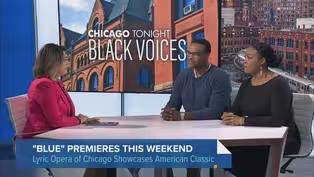
New Opera Explores Black Family's Grief, Journey Toward Healing
Video has Closed Captions
Clip: 11/13/2024 | 8m 29s | "Blue" follows a family grappling with grief after they lose their son to police violence. (8m 29s)
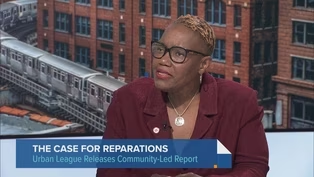
South Side Residents Take Part in a Study on Reparations
Video has Closed Captions
Clip: 11/13/2024 | 8m 9s | A new report focuses on 10 Chicago neighborhoods, seeking people's thoughts on reparations. (8m 9s)
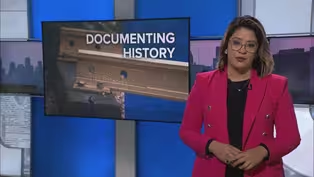
Task Force Releases Findings on Illinois' Role in Underground Railroad
Video has Closed Captions
Clip: 11/13/2024 | 2m 29s | There could be at least 200 sites in Illinois that are part of the network. (2m 29s)
Providing Support for PBS.org
Learn Moreabout PBS online sponsorship
- News and Public Affairs

Top journalists deliver compelling original analysis of the hour's headlines.

- News and Public Affairs

FRONTLINE is investigative journalism that questions, explains and changes our world.












Support for PBS provided by:
Chicago Tonight: Black Voices is a local public television program presented by WTTW