Chicago Tonight: Black Voices
Chicago Tonight: Black Voices, Oct. 2, 2024 - Full Show
10/2/2024 | 26m 44sVideo has Closed Captions
Brandis Friedman hosts the Oct. 2, 2024, episode of "Black Voices."
Efforts to improve access to mental health services. We explore the Austin community’s green spaces. And a deep dive into the hidden history of Black civil rights.
Problems playing video? | Closed Captioning Feedback
Problems playing video? | Closed Captioning Feedback
Chicago Tonight: Black Voices is a local public television program presented by WTTW
Chicago Tonight: Black Voices
Chicago Tonight: Black Voices, Oct. 2, 2024 - Full Show
10/2/2024 | 26m 44sVideo has Closed Captions
Efforts to improve access to mental health services. We explore the Austin community’s green spaces. And a deep dive into the hidden history of Black civil rights.
Problems playing video? | Closed Captioning Feedback
How to Watch Chicago Tonight: Black Voices
Chicago Tonight: Black Voices is available to stream on pbs.org and the free PBS App, available on iPhone, Apple TV, Android TV, Android smartphones, Amazon Fire TV, Amazon Fire Tablet, Roku, Samsung Smart TV, and Vizio.
Providing Support for PBS.org
Learn Moreabout PBS online sponsorship>> Hello and thanks for joining us on Chicago tonight.
Black voices.
I'm Brandis Friedman.
Here's what we're looking at.
Improving access to mental health services on the city's south side.
Learning the hidden history of black civil rights with the author of the book Before the Movement.
We actually have a retail store that we put in there answer the demand for fresh fruit and vegetables.
>> And Austin residents get a lesson in urban farming.
>> Now to some of today's top stories, the federal judge overseeing Michael Madigan's racketeering case refuses to toss out several charges just days before the trial is set to begin.
District Judge John Blakey tonight, defense attorneys motion to toss out a handful of charges including bribery counts after a U.S. Supreme Court rule ruling narrowed the federal bribery statute earlier this year.
The former Illinois House speaker is facing charges related to racketeering, bribery, wire fraud and attempted extortion his trial is set to begin next week.
The man charged in the Highland Park July 4th parade shooting is told he's upped her upcoming murder trial will proceed whether he chooses to be present or not.
Robert Crimo the 3rd who remains in custody at the Lake County Jail once again refused to attend a status hearing for his case today, Primo is set to stand trial in February on 7 counts of first-degree murder and dozens of other charges.
He was indicted just days after the 2022 mass shooting that killed 7 people and injured 50 others.
Mayor Brandon Johnson refuses to rule out a property tax increase as the city scrambles to plug a ballooning budget deficit while expanding services.
>> Everything is on the table.
All right.
I have to do with this deficit while also investing in people and investments are of 1.0, 2, 5 billion dollar investment for for, for for economic development, housing.
We're building affordable homes were still doing that.
So we're going to do everything in our power to, of course, too, fix this challenge.
But we also have to be very clear that the way to transform this city, this state, this country.
Rich and the ultra wealthy have to pay their fair share in taxes.
>> Johnson campaigned on a promise not to raise property taxes, but the city is facing a 223 million dollar deficit this year in nearly 1 billion dollar deficit for 2025. for more on the city's budget woes, please check out our Web site.
Chicago area doctors who spent 3 weeks working at a Gaza hospital earlier this year are calling for a cease-fire.
Emergency medicine doctor, Fair Ahmed spoke at a news conference today and said what he saw in Gaza was unlike anything he had seen before.
>> What we have seen over the last year has been a total 360 degree life in Gaza.
People are not able to earn a living children and not able to go to school.
People are not able to move from area to area unless they're running away from bombs living in makeshift tents.
And so I hope that there is the political will that is necessary to establish a cease-fire.
>> The cease-fire call comes just one day after Iran launched a barrage of roughly 200 missiles at Israel in response to the assassination of Hezbollah leader Hassan Nasrallah.
Israel has vowed to respond to the missile attack.
Up next, changing the makeup of mental health crisis teams right after this.
>> Chicago tonight, voices is made possible in part by the support of these.
Don't use.
>> Chicago will no longer have members of the police and fire departments on its mental health emergency response teams.
The crisis assistance response and engagement program also known as care is moving to a new staffing model with all public health workers.
It's part of Mayor Brandon Johnson's plan to end criminalization of mental health issues and help people get the care they need.
But advocates say there is still much more work to be done to improve access.
Joining us via zoom are Cheryl Miller, public health organizer for Southside together, organizing power, also known as Stop Chicago and on Money Treatment, not trauma organizer with the Brighton Park Neighborhood Council.
They're both members of the collaborative for Community Wellness, Coalition.
And we also invited the Chicago Department of Public Health this evening, but they declined our request.
We thank Cheryl and Ani for joining us.
I'm Cheryl Miller.
Let's start with you.
Please describe the state of mental health supports and services in the communities that you work with.
On the South side.
>> There is a dire need.
For mental health care.
>> On this all sign them the West Side.
>> Way the collaborative for community wellness is W and providers survey that showed that 3 quarters of the had less.
Then.
2 tenths of one therapist per 1000 people, whereas downtown and near North 4.3 providers.
Per 1000 persons.
So so the need is dire and absolutely.
need the public health centers.
they are barrier free in terms of cost terms of insurance in terms.
>> immigration status.
So that is that is why we fighting so hard to not just reopened the centers that were closed.
All of the senators that are close and also to expand.
It sounds like you're saying there's there's basically sort of desert there of access to services.
>> Ani who money?
The city recently announced its crisis assistance Response and engagement program would move forward with all public health staff.
>> First, tell us what this program is and how it works.
>> Yeah, thank you.
So basically, this crisis program is supposed to reach some that's in crisis.
particular mental health crisis.
Currently, working in certain parts of the city.
It not citywide.
However, these teams are are made up of mental health professionals no longer are there any cops and these teams, but there should be something that we're also advocating for is the community care corps, which the peer support workers to help prevent people pointed to crisis.
Essentially these provide support and the escalating situation or try to the athlete as much as possible.
So people in crisis on criminalized.
>> So so basically, if you know, it's a a call come into Chicago's dispatch rather than a Chicago police officer being sent.
If it is deemed that there's a mental health crisis happening, a cop is not sent a mental health professional professional sentenced.
Yes, they should be happy.
sure all the is.
You mentioned the collaborative for Community Wellness.
Coalition you'all analyze 9-1-1, behavioral calls from January 2019 to February 2022, what of that analysis show?
>> And at what were looked at and say there's several different studies.
So that particular study.
I wasn't a part of different time periods that I have looked at.
called patterns.
one one of the things that we we're able to dish see is that?
We're increasing number of calls.
mental health and behavioral health calls in communities that have formerly had I'm in a public mental health center.
So we can really see that these centers vital for people's.
Lives and health.
What else do we know about those communities that have the increased amount of calls?
>> Well, we know they don't you that they do not have providers.
In them and there are they're not clinicians.
They they don't have services.
They often are communities that.
divested from other types of needs.
So are communities that hello kind need and high stress.
So these very, you know, very important to be able bring start bringing in public mental health care services because that will serve the community it they will up here is is to be a hub for community wellness.
>> The city recently reported that the care team dispatches have resulted in 0 arrests and use of force was user replied in less than 0.1% So one tenths of a percent of incidents.
mean, now that, you know, this transition has happened.
What else needs to happen order to improve the way the city handles in response to mental health challenges.
>> Yeah, I think the biggest thing now it's building that bridge.
We got the first time to moving care into city Ph.
Now we want to build that bridge between the care teams but also the public mental health and fast to provide long-term care and hopefully preventing more mental health crisis along the way.
That is something that we'd like continually advocated for.
But also community can't core that we actually wrote about our white paper with peers apart workers, community members being employed by the city to support their own community members who are going through mental health crisis.
so I think the fact that would definitely be that bridge between crisis and a half and us to ensure people are getting the proper care crisis, but also hopefully long-term care to help them prevent future crisis.
>> But Cheryl is on.
He said right now the care team is only operational in certain parts of the What's the likelihood that it expands to other communities that also need it?
>> I think it will be highly likely.
this.
And this there.
Unlike previous mayors has make lane this issue a priority issue and also does understand why we need to have crisis response.
That doesn't resolved and further criminalization and for further trauma of people who, you know like Even if no charges ended up being pressed against someone.
You know, we have case of someone.
About Only so cheese.
Yes, Direction with the itself.
>> Can be traumatic director and like what you showed is that and what we've known in at the saying all along.
95% of mental health crisis calls are island.
They're not.
They do not involve a crime.
It would be like you would send somebody was having an asthma attack and could get their breathing it under control in the news sent a police car.
Not lot we about that going help that person, right?
We also know, of course, American Rescue Plan Act or arpa provided funding for nonprofits to provide.
>> Mental health services.
But we also know that funding is drying up.
So it's a conversation that will have to continue having with you all about how this problem is being addressed.
But out of time for now.
My apology, Cheryl Miller and money.
Thanks to both for joining us.
Thank you.
Up next, a look at black Americans and the law.
Stay with us.
African-americans were fighting for their rights through common law long before what we think of as the civil rights movement.
>> That's the conclusion.
Author Dylan pending Rauf came to after rummaging through county courthouse is in interviewing plenty of black Americans to explore civil rights story dating back to the 18 30's.
His book is called before the movement.
The hidden history of black civil rights and author Dylan pending Roth joins us now.
He is a professor of law and history at UC Berkeley and we'll be sharing this book with audiences at the Chicago Humanities Festival.
Thank you so much for joining us.
Thank you for having So you open this book with a family story that raises the question for you and like you to write this book.
What was that story?
>> It's a story of my great, great, great uncle Jackson Holcomb.
He was an enslaved man in Southside Virginia.
a place that I visited often when I was a small child.
There's a recording of my great, great uncle Thomas Holcomb talking about Jackson Hole coming on the tape.
He says the Jackson hole come while he was a slave, had a boat and in that boat during the closing days of the Civil War, when Confederate soldiers are running all through the woods, desperate for a ride across the Appendix River.
He gave them a ride.
And when they got to the other side, they paid him.
And I felt myself, they paid him real And I thought to myself, why would a bunch of heavily armed white men who are fighting to preserve slavery?
Pay a black man money who is in slavery without so much as a second thought.
And that's the question that began me on this journey toward the book.
I have so many questions about that story alone.
But I know, you know, we talk about in the book because not only.
>> You know, why they why were those Confederate soldiers willing to pay a man who was a slave?
But also the man who was a slave owned the boats and was in a position to receive money.
From Confederate soldiers from men who wanted to maintain his enslavement absolutely.
And I think that the important thing to recognize here, the point thing to notice is that >> they didn't think about it was so casual so taken for granted.
I think that's a clue.
The clue is that white people in the south in 18 65.
They were used to making deals with black people who are in slavery.
They were used to seeing black people on boats, cows, horses, chickens, things like that.
Black people like my great, great uncle Jackson.
Holcomb didn't have rights to those boats.
They didn't have civil rights, but they had privileges that were so widely understood.
By white southerners and they were part of the same legal system.
The same system of understandings that white southerners generally respected them unless there was something on toward happening.
So it's routine this of that interaction that I think is most interesting to me.
That means that when civil rights come.
That transition is a turning point in some ways.
But in other ways, it's not so much of turning point at all.
>> The premise of this book, it seems to be, you know, sort of about the history that may have been forgotten about how blacks engage with the law.
Well, before the civil rights movement that we know of, you know, over the course of the 400 years that we've been a part of this country.
What is that history that that's been forgotten?
>> So I think typically when we think of civil rights when I think of civil rights, I think of Martin Luther King, the march on Washington, I think of Rosa Parks and the Montgomery bus boycott.
It turns out that Martin Luther King, Rosa Parks, they are the heirs to 150 year long tradition of black people using thinking about and talking about civil rights, but they're not the civil rights that you see in the Civil Rights act of 1964, they're not about discrimination on the basis of race, Other categories there about the right to own property, the right to make contracts the right to go to Those are actually the original civil rights that are written into America's first national civil rights law.
Civil Rights act of 18, 66.
And so it's that tradition of black people using those civil rights that actually forms the foundation for the civil rights movement that we know so well.
>> You mentioned, you know that it was just sort of not necessarily taken for granted, but like whites were would use to regularly engaging in sort of making these contracts and deals with with black enslaved or freed at the time.
What was sort of engagement response or reaction to to making the sort of contracts and blacks, you know, going about their everyday lives.
Really?
Yeah, it's a really interesting question.
Why would white people I would wait Southern is in place like Mississippi, your Southside Virginia.
Why would they?
>> Allow counts.
Black people having civil rights.
And the answer is that it was in their interest.
And this actually is something barring from the great critical race theory Derrick Bell.
He had this theory of interest convergence.
That is to say that black people's rights will be advanced if and only if it also is in the interests of white people.
And you see this over and over again in my records.
If you think about what is a share cropping contract, it's a way of exploiting black people, not in spite of law, but through law.
They needed black people to have civil rights.
>> To do all this and all this research because we're going back several 100 years here.
You had to get off the beaten path.
As we said, you had to dig through some some court houses and some basements of some black people that you dig around in their basements.
What did you find in all of this?
Because the thing also fascinated by is that the these records still exist.
>> it is kind of amazing that they still exist.
A part of the reason is that they're considered by law to be permanent records.
And so in the states, the county courthouse is what I do is I would drive around get a rental car and I go to the courthouse and asked the clerk of the deputy clerk for permission to go in the back and is often is not.
They said fine.
No problem.
Also, what do you want back there?
We want hear exactly because, you know, they're ready traffic taking yes, actually, sometimes I got to talking with them.
And really interesting to talk with, but that what you find in the back there is number one, how often black people were actually in these court houses.
So it's often serve an impression that we get that black people came to court came into their rights for the very first time in the 1950's.
But in fact, they were there all along.
They just weren't arguing against discrimination.
And then the second thing that you find in there is stories.
These stories are stories that you can almost not get from any other source.
Their stories about black people's interior lives.
They're loved.
They're they're annoyances, their pettiness sometimes.
And these are really rich and deeply human stories.
That's the kind of thing that I was interested in finding in the courthouse and they are such precious documents of our nation's history.
Part 4 of your books dedicated to the movement era and in Chapter 11, you detail the importance, of course, of the Brown versus Board of Education ruling.
>> What did your research reveal about Thurgood Marshall's strategy in that case?
South are good Marshall.
It's really interesting.
Thurgood Marshall is considered today a civil rights lawyer right?
>> But most of the time, what lawyers like him tended to do was vague to property cases that to contract cases they represented churches.
That's the way that they had to pay the Bills.
Brown versus Board of Education, the remedy that they were seeking was an injunction ordering the Topeka School board to admit Linda Brown.
There was no money in it for him and to this day, civil rights lawyers have to face this dilemma.
They are engaged an enterprise that doesn't really pay and so often keep the lights on, they have to handle also the other kinds of things which actually turn out to be the kinds of things that black people in 1919, 50 cared about very deeply.
That is the everyday civil rights but their access to properties to their home ownership, their marriage contract.
Exactly.
So if you think about the church.
>> That Martin Luther King, that Dexter Avenue Baptist Church, it's a corporation.
The Montgomery boycott 1956.
They form a corporation.
Martin Luther King is the president that allows them to bring in money.
The people who are driving the car in Dylan.
We do want to give everybody to read the book.
You want to give it all away because we're actually gonna time.
Dylan pulling Dylan hitting rough.
Thank you again for joining us.
We appreciate it.
>> Again, the book is called before the movement.
The hidden history of black civil rights.
And you can catch Dylan pulling rocks at you.
I see on Saturday for an event with the Chicago Humanities Festival.
Up next, exploring healthy eating in the Austin community.
nonprofit group in the city's Austin neighborhood is showing off the area's green spaces.
One trolley stopped at a time.
>> Chicago Austin Youth Travel Adventures is hosting farm to table Trolley Tours where residents visit Community Farms and learn about healthy eating.
The area is still considered a food desert.
So increasing access to fresh foods.
It's something organizers hope their neighbors can get on board with 2, >> There are people in office then need to access to number one, improve their health.
I know so many people personally with different types his orders that, you know, from have fat food.
And so to give people the opportunity to learn, guess what, we have gardens here in Crystal Dyer is the founder of Chicago, Austin Youth Travel Adventures, which oversees the trolley tours that visit Community Farms.
>> One thing I'm out, myself, you know, live in my whole life is when people refer me to more likely go.
>> Pcc Austin Farm is one of the stops on the tour.
We actually have a retail store that we put in there to answer the demand for fresh fruit and vegetables.
>> We sell everything at an accessible price so that the community can come in there and they don't have to like get on a bus or get on a train.
I mean, I have 2 kids and I couldn't imagine having to bring groceries home on a train.
Dominique Stevens is the senior manager for health and wellness at Windy City Harvest.
The Chicago Botanic Gardens, Urban Agriculture Program.
>> She says healthy eating can be achieved by everyone.
I think using a lot of fresh produce is a really good way to sort of keep your culture alive.
So we sell a lot of like green.
So.
>> People come to our farm stand and they'll be like, oh, I collars any musters.
And they're telling us about the recipes that they're making with It is possible to keep your culture intact and it doesn't have to necessarily be, you know.
>> Super fried.
>> My favorite is habits with Oprah.
>> I can eat that also, Hala.
Al.
Yeah, I don't need any anything else because this the flavor the text or, you know, with a little spice.
>> A cooking demonstration is also included in the tour.
>> I like to ask everyone to buy something that I'm not familiar with cooking it.
How do you prepare that?
And then I see if I can prepared in the same way.
And that just helps me feed my kids.
Healthier feed myself healthier, but still be eating some of that culturally specific food.
>> And the trolley tours are running through the end of the month.
And that's our show for this Wednesday night.
Join us tomorrow night at 5, 30 10 early voting is kicking off in Chicago this week.
A rundown of what you need to know.
And we explore the retro weird and cool junk at an antique shop in Pilsen.
>> Now for all of us here in Chicago tonight, Black voices.
I'm Brandis Friedman, thank you for watching.
Stay healthy and safe and have a good night.
>> Closed caption made possible by Redford and Clint Football.
Chicago personal injury and wrongful that is proud to recognize its 20
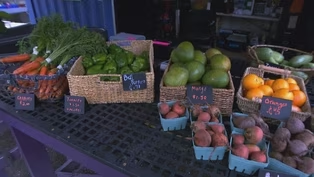
Austin Residents Get a Lesson in Urban Farming
Video has Closed Captions
Clip: 10/2/2024 | 2m 44s | A nonprofit is showing off Austin's green spaces, one trolley stop at a time. (2m 44s)
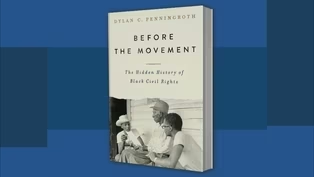
Author Explores Hidden History of Black Civil Rights
Video has Closed Captions
Clip: 10/2/2024 | 8m 34s | Dylan Penningroth wrote "Before the Movement: The Hidden History of Black Civil Rights." (8m 34s)
Improving Mental Health Care Access on the South, West Sides
Video has Closed Captions
Clip: 10/2/2024 | 9m 5s | Advocates say there's still much work to be done. (9m 5s)
Providing Support for PBS.org
Learn Moreabout PBS online sponsorship
- News and Public Affairs

Top journalists deliver compelling original analysis of the hour's headlines.

- News and Public Affairs

FRONTLINE is investigative journalism that questions, explains and changes our world.












Support for PBS provided by:
Chicago Tonight: Black Voices is a local public television program presented by WTTW