Chicago Tonight: Black Voices
Chicago Tonight: Black Voices, Sept. 10, 2025 - Full Show
9/10/2025 | 26m 47sVideo has Closed Captions
Brandis Friedman hosts the Sept. 10, 2025, episode of "Black Voices."
The latest on conservative activist and Chicago-area native Charlie Kirk, who was shot at an event in Utah. And how people who are homeless could be impacted if the National Guard is deployed in Chicago.
Problems playing video? | Closed Captioning Feedback
Problems playing video? | Closed Captioning Feedback
Chicago Tonight: Black Voices is a local public television program presented by WTTW
Chicago Tonight: Black Voices
Chicago Tonight: Black Voices, Sept. 10, 2025 - Full Show
9/10/2025 | 26m 47sVideo has Closed Captions
The latest on conservative activist and Chicago-area native Charlie Kirk, who was shot at an event in Utah. And how people who are homeless could be impacted if the National Guard is deployed in Chicago.
Problems playing video? | Closed Captioning Feedback
How to Watch Chicago Tonight: Black Voices
Chicago Tonight: Black Voices is available to stream on pbs.org and the free PBS App, available on iPhone, Apple TV, Android TV, Android smartphones, Amazon Fire TV, Amazon Fire Tablet, Roku, Samsung Smart TV, and Vizio.
Providing Support for PBS.org
Learn Moreabout PBS online sponsorship>> Well, thanks for joining us on Chicago tonight.
Black voices, I'm Brandis Friedman.
Here's what we're looking at.
Politicians on both sides of the aisle are condemning the fatal shooting of conservative activist Charlie Kirk.
What we know about the shooting.
We're advocates react to an increase in the number times.
Chicago police are pointing guns at people.
City officials and local organizations are preparing for a possible military deployment.
How that might affect those experiencing homelessness.
>> And advocates say federal funding cuts are putting local HIV prevention efforts at rest.
>> First off tonight, Chicago area native and conservative activist Charlie Kirk has been shot and killed a university event in Utah today.
Kirk was shot at an event on the campus of Utah Valley University this afternoon.
Mayor David Young says that local state and federal law enforcement are investigating, but the suspect remains at large Kirk's appearance was part of a series of events on college campuses across the country.
He was a prominent supporter of President Donald Trump and a founder of the youth conservative organization.
Turning Point USA, which confirmed the activists death today on social media, Republican and Democratic leaders condemned today's shooting.
>> First, I want to express my sympathy Charlie Kirk family into Charlie Kirk, political violence, unfortunately, has been ratcheting up in this country we saw the shootings, the killings in Minnesota.
We've seen other political violence occur in other states.
And I would just say it's got to stop.
And I think there are people who are fomenting it in this country.
I think the president's rhetoric often foment it.
Charlie Kirk was 31 years old.
There's more reaction on our website.
>> Immigration and Customs Enforcement says it's arrested at least 13 men in the city of Chicago as part of Operation Midway Blitz.
The agency says the immigrants are in the country illegally and have criminal convictions or pending charges ranging from possession of stolen property and EU.
Why up to rape and assault?
Attorney General Pam Bondi spoke about the efforts to address crime in Chicago during an appearance in suburban Bentonville today.
>> We have a government here that does not want to cooperate with President Trump and he wants to come in here and he wants to help the city.
He wants to clean up Chicago and its suburbs.
>> Meanwhile, Mayor Brandon Johnson again today calling out the lack of communication from the Trump administration over efforts to deploy law enforcement and or National Guard troops to Chicago.
>> Nothing has been communicated with us.
And that's what the problem has been, that this president was serious.
He would work to coordinate with our local police department to get illegal guns off the streets of Chicago that can actually help save lives.
>> This president is not interested in the full.
Vibrant, see of our city.
And this is about his own political aspirations >> the mayor spoke with reporters after welcoming new residents to their new homes at the Thrive.
Englewood, affordable Housing development.
The 6 story building houses.
62 new homes, 80% of which are affordable.
Downtown Alderman Brendan Reilly says he's challenging Cook County Board.
President Toni Preckwinkle for her seat.
The 42nd Ward Alderman criticized Preckwinkle in his announcement video today.
>> But those who say Chicago doesn't have a public safety problem lying to you were hiding behind an armed security detail.
Families here know the truth.
This past Labor Day weekend.
58 people were shot, 8 killed our county board.
President Preckwinkle her political allies claim Chicago is safe and doesn't help.
County state.
>> In his launch video, the 53 year-old says he strongly opposes President Trump's decision to send troops to cities without first coordinating with local leadership.
He also touted his record as an independent member of the Chicago City Council and vows to fight to protect Cook County's health care system.
The primary election where he'll face Preckwinkle as she seeks a 5th term is set for March 17th.
Beloved former Chicago Cub Anthony Rizzo is retiring from baseball and rejoining the Cubs organization Rizzo who was a key player of the 2016 Cubs championship team seen here catching that final out of that World Series Victory.
Rizzo began his career in San Diego, but after a year with the Padres came to Chicago and spent nearly 10 seasons with the North Siders before becoming a New York Yankee in the middle of the 2021 season.
The 36 year-old Rizzo's new role will have him serving as an official Cubs team.
Ambassador.
Up next, there's been an increase in the number of times.
Chicago police are pointing their guns at people.
Heather Sharon has that story right after this.
>> Chicago tonight, black voices he's made possible in part by the support of these donors.
>> The number of times Chicago police officers pointed their guns at people increased more than 44% since 2022, that's according to records obtained by W T Tw News.
Our Heather Sharon joins us now with more on that data and the latest on efforts to reform the Chicago Police Department.
Heather, you took a deep dive into what the department calls firearm pointing incidents.
Would you find?
>> So in 2024, Chicago police officers on average point their weapon and an individual 11 times.
Now, that is a significant increase since 2022. and 2023.
Now we don't have data yet for the first 6 months of 2025.
But just between 2023, 2024, saw a 13% increase in these incidents.
None of these incidents have been ruled unreasonable or unjustified by department officials.
Police leaders there in the process of revising how these incidents are review.
What's changing their well, the consent decree calls for a group of specialized officers highly trained and the tactical review and evaluation division to decide whether these point incidents are in line with department policy.
The problem is that division is woefully understaffed and faces a massive backlog to sort of chip away at that with the approval of a federal judge in the attorney general.
Now, Chicago police captains in 13 of the city's 22 police districts evaluate those incidents directly with their officers.
That has proved effective as part of a pilot program that is set to be expanded.
Citywide officials say early next So during a hearing on the consent decree, of course, that is the federal order requiring CPD to routinely or to stop routinely violating residents.
Constitutional rights.
>> Both the attorney general and a coalition of police reform groups.
They said that there are concerns about this change.
What are they worried about quality control if >> police captains across the city each get to make these decisions.
That raises the possibility that the standards will be different across the city.
It also means that potentially there could be officers who are being given bad feedback or poorly trained and they will subject Chicagoans to violence when they encounter them.
That's a big problem for a department that he's only complied with 16% of the consent decree.
More than 6 and a half years after it started Long Road remains ahead for Chicago Police Department had a shrimp.
Thank you.
Thanks.
Brandis.
And you can read Heather's full story on our website.
It's all at W T Tw Dot com slash news.
>> W T Tw News coverage of policing and police reform is supported by the Joyce Foundation.
>> Chicago's Department of Family and Support Services as well as local advocates for the homeless are preparing for possible encampment sweeps.
This follows news of an impending closures or closures on the Northside Legion Park and Golfers Park.
Meanwhile, the city shelter system is already strained and a looming federal threat is raising even more questions.
Joining us now with more our Duck Schenkel Burke, the executive director of the Chicago Coalition to End Homelessness and via Zoom, Cindy Soto, the city's chief homelessness officer.
Thanks to both for joining us.
doesn't want to start with you.
What are you hearing from advocates and members of the homeless community about their concerns for the unhoused population and possible encampment sweeps?
Yeah.
So there's a lot of concern out there amongst people experiencing homelessness and folks that work with them.
>> That the increased federal presidents, the enforcement mechanism.
So whether or not there's a National Guard presence that puts people at risk for whether it's an immigration enforcement action or 4 other types of attempts to enforce federal laws for folks in public.
So we're trying to make sure that folks understand what their rights are and understand how to keep themselves safe.
And Casey, things happen.
Cindy Soto, what are you hearing?
>> Yeah, we hearing the same thing that that the public is hearing this.
Well, we would like better communication from the federal government.
We've been asking for it in the interim.
We are working with our partners like the coalition, the state, the county, all Chicago that manages or continuum of care to ensure that we are going work with what we know.
I'm prepare for what could possibly be that federal deployment doing what with stated today by the federal government in terms of perhaps backtracking that for us does not guarantee that worst.
We're in the clear we can move forward as is, you know, they they are not planning to come here.
We are going to continue to address the needs are unhoused community and ensure that we have the resources and have pooled our resources with our partners on the ground.
>> Right.
And of course, you're referencing the president last night in DC saying that they would go into cities.
That one thing they're sounding as if he's sort of hedging or reversing course or his promises on on sending the National Guard into the city on.
But we know that there were definitely concerns in Washington, D.C., when the National Guard was deployed there.
There were more than 50 encampment clearing Ys.
Does the president even have the authority to do such a thing here?
Sunday, 30, that question is to, know, I was in you can see out of the both of you.
So yeah, let let me know if they find next but know that the president doesn't have the authority to administer local government laws and so we ordinances.
So we do not need him to come here and really disrupt the progress, the positive progress that under this administration, Mayor Brandon Johnson's administration, we've been making.
>> And so we do want to ensure that, you know what, what we what happens with encampments that we, you know, continue to address the various needs with our outreach teams, with our community partners can continue to happen because building trust with the residents of encampments is so critical to this work, ensuring that its a human-centered approach with compassion with a whole set of services can be done in a way that is compassionate and and it can be received with the kind of outcomes that we all desire, including what the federal government claims they are hoping to achieve this.
Well.
>> Doug, your organization along with the city created your know your rights as an unsheltered person, campaign to get ahead of any federal law enforcement in Chicago because it is a concern.
Ice agents could go into homeless encampments how what should unsheltered people now.
>> So a couple different things.
One, is there a greater risk if they're in a public space?
So if they have the opportunity to get into a private space, get into a shelter bed, stay with others.
That's going to provide the more protection.
So looking for those options.
And I know, you know, the city been working very hard to create more options for folks in that regard.
That if they are approached by a officials recognizing that the right remain silent, that they can say that they don't consent to a search that, you know, they have those protections regardless of their documentation status.
you know, there's places that they can reach out to for help.
We have a phone number on the rights information is being sent out around the campus of folks can call it questions.
We can answer those questions or get them to others that can as well.
It's also great groups like the Illinois Coalition for Immigrant and Refugee Rights who are to highlight specific to immigration for spending the can.
5 people help that way.
>> Sunday, the president also wrote a note signed an emergency order this summer deploying excuse me deploying the National Guard.
inspires but his other executive order.
It is aimed at homelessness by targeting funding for housing.
First programming as well as encouraging civil commitment.
And I want to be clear that emergency order deploying the National Guard in DC that expires today.
What is your reaction to the president's executive order encouraging civil commitment and going after those funding for housing?
First approach is.
>> Yeah, reaction is, you know, concerning because we have proven that housing first that approach which, you know, can look like many different, you know, variables, depending on the city or the jurisdiction that's implementing it.
But the one in the city of Chicago that also incorporates permanent supportive housing, rapid rehousing and meet the needs of that might be beyond just housing, but it addresses them in a way that prioritizes their housing housing for us is a homelessness assistance approach that prioritizes providing permanent housing to people experiencing homelessness and prior to the pandemic from 2015 to 2020, Chicago was seeing a gradual decrease in homelessness through the implementation of housing.
First housing for says, based on the understanding that client races that valuable part of the equation, housing selection in support of services are also included in this process.
And so with plan choice with that trust building opportunities that that our community members are constantly doing.
The current coalition is constantly doing housing first can help solve homelessness and make it ideally functional 0.
And so if the administration wants to go after housing first, they're dealy keeping people on house, which is against again of what they're claiming their end goal to be.
>> I'm Doug, some neighbors living near encampments in Legion Park Conference park.
They've expressed concern over the homeless encampments.
A flyer from residents simply identified as the Legion Park.
Neighbors, the the flyer reads, quote, Legion park.
Neighbors have been exposed to many negative conditions in Legion Park for the past 18 months posed by the unhoused building in living compound in the park.
Neighbors have had to endure many dangerous conditions, including garbage and pollution, fires, physical assault, verbal harassment, illegal drugs, crime, theft and trespassers in our yard.
At the same time, Park District CEO Carlos Ramirez Rossa today said that, you know, they can they can sweep encampments and they can, you know, clear out, you know, 60 or so encampments, they're going to turn out, turn up at another park.
And it's a it's a continuous cycle.
What is the solution here?
The solutions, homelessness is a housing problem.
And so >> what we see when we see and cameras, that's a manifestation of a deeper problem that we have to address.
So whether you're to protect Ramirez, Rosas point Cleary on the cam, it only means someone's going to have move somewhere else unless we have the permanent long-term housing supports that they need.
So I would hope that those residents around we should Parker Compras Park.
Who are concerned about the encampments and the impact on the community can focus on working on the true solution, which is getting resources available to create the housing that's needed because that's the only way that we really get rid of encampments.
It's to get people the opportunity to get into housing that they need to have stable housing.
Okay.
That's where we'll have to leave it up.
Best of luck and thanks for the work that you do to you both ducks Ankle Bird and Sandy Soto.
Thank you.
Thank you.
Thank you.
Up next, a look at inequities in HIV prevention funding.
Advocates say funding inequities are leaving black lead.
Hiv prevention group struggling to keep doors open and provide care.
>> They're pushing for more help from local lawmakers to prioritize black and brown people who they say are uniquely impacted by the virus.
Meanwhile, advocates a federal cuts to grants Medicaid and diversity initiatives are also threatening to weaken response to the disease.
Joining us now are crisp office, our Executive Director of Task Force Prevention and Community Services, a community-based organization in Austin and Timothy Jackson, senior director of policy and advocacy for AIDS Foundation, Chicago, thanks to both for joining us.
So Illinois Department of Public Health, their data shows that black and Hispanic people make up about 73% of HIV and AIDS cases diagnosed in the state since 2018.
That's a lot.
The U.S. Census data shows the state is only 14% black and 18% Hispanic Timothy Wire, blacks and Hispanics.
So disproportionately affected by this.
I thank you so much for allowing me to be here.
There are a litany of reasons.
One from access to care, access to prevention, medical mistress, stigma is a large part of it.
But oftentimes what we see is that the communities that are represented so disproportionately black and and led NE communities.
As you mentioned, it's at those communities.
Just don't have access to providers or community organizations oftentimes those community organizations just don't have the funding, the robust funding that they need order to take care of their own communities.
so that is really kind of the heart of what we're seeing that keeps inequities going.
Chris, let's expand on that a little bit more.
What are some of the barriers that black people with HIV and AIDS face in accessing care?
Absolutely.
I think it won't.
Some of the things that we hear commonly a task forces.
>> you know, access in terms of navigating insurance.
You know, it's not easy for young adults too.
And, you know, navigate complicated health care systems, including insurance, is but also finding the right provider and not all providers are prepped friendly or, you know, willing or able to provide treatment, you know, for HIV.
so, you know, those that's another challenge.
I think another challenge is a cost not knowing how what how much is going to cost?
What your code he's going to if you're going to get a bill, if this, you know insurance.
I mean, I'm sorry that this medical care provider accept your insurance.
And so these challenges, I think often times can be overwhelming and never come those challenges.
Absolutely.
Well, that's why organizations like task force exists because that's exactly what our staff are trained to do is to provide support with navigating health care systems as well as support with navigating insurance.
And so we can enroll individuals and insurance and we also help them provide, you know, be connected to medical care providers who can provide culturally specific care as well as gender affirming care.
And Chris, you've been pushing, of course, more equitable funding for black lead.
Hiv and AIDS prevention organizations would have been the challenges in getting that funding, especially for a smaller organization.
Absolutely.
Well, you know, as you by communities are disproportionately impacted by HIV and >> what we see not just here in Chicago, but even nationally is that black lead organizations are much more likely to be have smaller budgets.
you know, and I think that like, you know, to of these point that makes it harder for us to provide supports to our community in so some of the challenges that we see right now is especially, you know, with what's happening at the federal level.
a lot you know, it's harder to now allocate funding to address communities that are disproportionately impacted, right?
So, you know, being able to say, well, we're going you know, allocate these dollars to support HIV and black communities because they are disproportionately impacted or LGBT is gentle, loving communities because they are disproportionately impacting that's a talent.
Iit's can't do that under these new rules that Timothy, what changes would you like to see to help bridge that funding Yeah, absolutely.
making sure that we as as large organizations, AIDS Foundation, Chicago, part of our racial equity plan is increasing each year.
The amount of money that goes to Black landslide, a lead organization for good.
>> Making sure that we're not going end the HIV epidemic without community making sure that we're supporting those organizations.
So something simple that we can do make sure that most of our grant subcontracted organizations are likely Latinx laid in community, but also understanding to Chris's point.
Equity is not a bad It is not a bad word.
understanding that in order for us to end the HIV epidemic character, Illinois and across the country, we have to do it in the communities that are most.
Impacted.
so that's just simple.
Timothy can private grants donations make up for the gap that you all might be experiencing in federal dollars?
fortunately, I would love for it in >> but for so we and kind of like this.
breakfast of a kind of like things.
Its state, great dollars to be able to provide care to people living with the battle with HIV.
But with cuts that we're seeing Capitol Hill.
And that just makes it very difficult when you're talking about prevention or K here, you know, housing, all of these things are really, you know, endangered congressional Republicans and the White House.
Chris, how much of organization would you say how much of your budget relies on federal dollars?
>> So we've actually seen cuts.
you know, you just between 2024 2025.
Where >> we've seen about a 10 to 15% cut government revenue.
you know, and we are anticipating further cuts even for 2026.
What that means for you and the work you do, the people, the people you becomes more So we have to certainly be more creative with finding other revenue sources to help bridge in or fill in those gaps.
You know, and certainly, you know, being able be trying to expand support in the private sector, almost out of time.
But what is the state's role here?
And they step >> The state's role, if if they're going to roll up their sleeves going to have fill the void, we understand it.
The old adage is ounce of prevention is worth a pound of cure and understanding that if we can prevent HIV, could go long way.
But we need partners at state and local levels to be able to roll up their sleeves and get to in in this fight with us.
Push back on the federal government to make sure that we have all of the resources that we need in order to continue our work in the HIV epidemic.
someone who lives with HIV.
Are you concerned about losing ground on the progress that's been made over the years salute Lee between that the cuts to Medicaid that we saw and HR one in July.
And now these potential cuts were there getting rid of HIV prevention dollars and the federal government flashing Ryan White, which is a program that provides care to people they with HIV.
We are literally going to see people And really kind of the heart frightening place where we'll have to leave it right now.
Thanks to both crisp Office R and Timothy Jackson for joining us.
Best of luck to Thank you so much.
And before we go tonight, an update to a story we brought you earlier.
You talked Fishel say they have a person of interest in custody in the fatal shooting.
>> Of conservative activist Charlie Kirk.
You can check our website for UPS.
The updates on that developing story.
And that is our show for this Wednesday night.
Join us tomorrow night at 5, 30 10.
What the Supreme Court's recent decision means for racial profiling and future immigration raids.
Now for all of us here at Chicago tonight, Black Voices and Brandis Friedman, thank you for watching.
Stay healthy and safe and have a good thing.
>> Closed captioning is made possible.
Why Robert, a cliff Clifford law offices, Chicago, personal injury and wrongful death for it supports

HIV Prevention Groups Struggling Amid Federal Funding Cuts
Video has Closed Captions
Clip: 9/10/2025 | 7m 40s | How cuts to grants, Medicaid and diversity initiatives are impacting local groups. (7m 40s)

How National Guard Deployment Could Impact Unhoused Chicagoans
Video has Closed Captions
Clip: 9/10/2025 | 8m 23s | Advocates are preparing for possible encampment sweeps. The shelter system is already strained. (8m 23s)
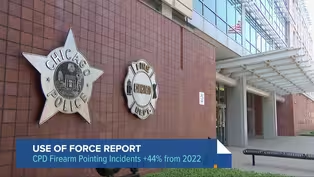
Number of Times CPD Officers Pointed Guns at People Increased 44% From 2022 to 2024: Data
Video has Closed Captions
Clip: 9/10/2025 | 2m 40s | CPD officers pointed a gun at a person, on average, more than 11 times every day in 2024. (2m 40s)
Providing Support for PBS.org
Learn Moreabout PBS online sponsorship
- News and Public Affairs

Top journalists deliver compelling original analysis of the hour's headlines.

- News and Public Affairs

FRONTLINE is investigative journalism that questions, explains and changes our world.












Support for PBS provided by:
Chicago Tonight: Black Voices is a local public television program presented by WTTW