Chicago Tonight: Black Voices
Chicago Tonight: Black Voices, Sept. 4, 2024 - Full Show
9/4/2024 | 26m 47sVideo has Closed Captions
Brandis Friedman hosts the Sept. 4, 2024, episode of "Black Voices."
The impact of Stateville’s closure on workers and those incarcerated. How some men in prison are hoping to change the way they can be released. And highlighting the history of Negro League baseball.
Problems playing video? | Closed Captioning Feedback
Problems playing video? | Closed Captioning Feedback
Chicago Tonight: Black Voices is a local public television program presented by WTTW
Chicago Tonight: Black Voices
Chicago Tonight: Black Voices, Sept. 4, 2024 - Full Show
9/4/2024 | 26m 47sVideo has Closed Captions
The impact of Stateville’s closure on workers and those incarcerated. How some men in prison are hoping to change the way they can be released. And highlighting the history of Negro League baseball.
Problems playing video? | Closed Captioning Feedback
How to Watch Chicago Tonight: Black Voices
Chicago Tonight: Black Voices is available to stream on pbs.org and the free PBS App, available on iPhone, Apple TV, Android TV, Android smartphones, Amazon Fire TV, Amazon Fire Tablet, Roku, Samsung Smart TV, and Vizio.
Providing Support for PBS.org
Learn Moreabout PBS online sponsorship>> thanks for joining us on Chicago tonight.
Black voices, I'm Brandis Friedman.
Here's what we're looking at.
State.
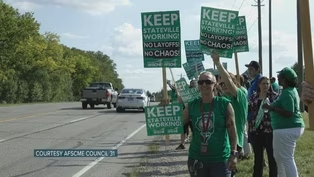
The workers pushed back on the prison's pending closure as transfers for incarcerated men are already underway.
>> You might actually not go home.
You might actually die in prison.
>> Plus, how men in prison are hoping to change the way they can be released before your sentence And highlighting the history of League Baseball in a new exhibit.
>> And now to some of today's top stories, Cook County State's attorney is calling the shooting deaths of 4 people while riding the blue line on the CTA, a, quote, horrific, heinous and inexplicably act of violence.
The man charged in the shooting 30 year-old Ronnie Davis was ordered to be detained during a bond hearing today.
Prosecutors say surveillance video shows Davis walking up to the victims on the train in west suburban Forest Park and shooting them in the head face or abdomen while 3 of them were sleeping.
Violence Interrupters say they're asking CTA to allow them to conduct outreach work aboard the trains.
>> Cta has a history.
A long history.
We have many, many assaults wait to have when we wait on CTA against on a regular basis on the CTA trains.
What we're saying we hire deploy 100,000 to work the strays and began taking some of high-risk individuals as high was clients and work with them and show them how to change the behavior when it comes down to violence.
>> Georgia officials say a 14 year-old boy is the suspect in a high school shooting that killed 2 students and 2 teachers.
It happened this morning at Appalachian High School in Georgia, about 50 miles east of Atlanta.
9 other victims were taken to hospitals with injuries.
Students were sent scrambling for shelter in their classrooms.
local sheriff Jud Smith became emotional when addressing reporters saying the shooting hits home for him as he's a product of the school system that his children attend today.
I went to school in the school system.
My kids go to school system.
I'm proud of this school system.
My heart hurts for these kids.
My heart hurts for our community.
>> But I want to make it very clear that hate.
not prevail.
>> The Georgia Bureau of Investigation says 2 school resource officers were able to take the suspect into custody within minutes.
He's being tried as an adult.
Advocates are calling on city council to address access to childcare by funding higher wages for workers.
Today's hearing comes after the closure of a center in Bronzeville.
>> We hear from childcare center workers and family childcare providers who can't afford to support their families who are stressed and saddened by seeing the consequences of turnover and under staffing.
Many of whom ultimately and or reluctantly make the choice to leave a job.
They love.
>> Seiu reports as low wages for childcare.
Workers are forcing centers to close classrooms and says the shortage leaves more than 78,000 children without access to licensed care.
It says the city would need an additional 16 to 19,000 providers to meet current needs.
Up next, how the state Ville prison closure is affecting people on the inside.
That's right after this.
>> Chicago tonight, black voices is made possible in part by the support of these donors.
>> Workers are pushing back on the pending closure of State Bill Correctional Center near Joliet employees rallied last week outside the facility which is slated to close by the end of the month.
The Illinois Department of Corrections has already begun transferring more than 100 men to other facilities.
Advocates are raising concerns about the location of these facilities and the impact it'll have on those behind the wall as well as the employees.
Joining us now with more are Anders Lindell, Public Affairs director at asked Me Council 31, which represents roughly 10,000 employees who work in Illinois prisons.
Jennifer Bollin Katz, executive director of the John Howard Association of Illinois.
And On Zoom, Christina Rivers, director of DePaul University's Institute for Restored of Educational Engagement.
Thanks to all 3 of you for joining us.
And Linda, let's start with you, please.
We know that see has already started transferring out of state bill to other facilities around the state.
What are your members saying about this expedited transfer process so far?
>> So hundreds of employees from state bill were out on an informational picket line last week and their message was clear.
No chaos and no layoffs.
But the headlong rush by the department into this process to empty out state bill to reclassify the incarcerated population to send them up to hundreds of miles away to medium security, even minimum security facilities.
He's actually causing the chaos and creating the disruption that should have been avoided more than 70% of the individuals incarcerated at Stateville are from the Chicago area.
They're now being sent 20300 miles away, making it much more difficult for visitation.
We're going to hear, I think about from Christina, how the great educational programming at staple is being undermined.
And of course, nearly 500 jobs for half members who are excellent work force that provides that rehabilitative programming, education, health care and more at Stateville is being threatened at those workers been given any sense or notification about where they will be located or transfer to as far as warning throughout.
There's been a sure an says from the department that there will be a employment available.
>> But they not offered a lot of specifics.
And they have often said, well, maybe it would be in Sheridan or maybe it would be in Pontiac, which is an hour or more away.
>> From state bill, the majority of state employees actually live in Cook County.
They don't live in will county.
So they're already driving.
45 minutes on a good day.
Chicago traffic worse than that.
Just to get to work than work 8 hours behind the wall and drive back home 16 hours.
If you have to work a double shift and if you're having to do that while driving 2 hours each that is not acceptable.
And 68 deal is the closest to Chicago.
Obviously anything that's not state bill, it's going to be longer than that hour and Jennifer, John Howard Association, you all have done numerous reports over the years in the past, outlining the conditions and state the what?
>> Your reaction to the decision to finally empty out to close state bill and rebuild it.
Well, I think the most important thing is the health and well-being of the people who are incarcerated in the people who work at Stateville.
>> And it's been made abundantly clear both by the John Howard Association reports and recently by the CGL report, the independent contractor that did a full infrastructure assessment of all of the Illinois State Prisons.
Steve Earle is not a safe place to be.
There is plaster falling from the ceiling.
There's bird excrement there.
The conditions are inhumane and unsafe.
And so while there is complexity to emptying out the facility, there's also good reason to be doing that and transferring people is something I do.
You see does every single day and reclassifying and reviewing where people should be.
What's appropriate is also something they do every day.
And I understand that state bill benefits from community resources and its proximity to Chicago.
And it has had the most post-secondary educational opportunities of any prison in the state of Illinois, which is wonderful.
But you don't keep people in unsafe conditions for that.
You expand programming to the other facilities.
>> All the IOC, they claim to rebuilding will take 3 to 5 years.
That's that's just a 5 Is that a realistic timeline to rebuild state Colin entire prison?
You knew I was thinking about it and I was trying to think about the timeline for the facility most recently built in Illinois, which was the Joliet inpatient treatment center, which was built do that, which is next door to staple.
It is it's close by >> And it looks to me if I peace the timeline together from the I do see announcement to shovels in the ground to opening the doors.
It looked to me to be about 4 years, 4 and a half years.
So 5 years may be realistic it's hard to now.
>> Christina Rivers, tell us briefly, if you would about the programming that you work to provide the men who are incarcerated in state bill.
>> So pomrenze, the inset out prison exchange program and we bring traditional campus pay students into cars, rule spaces, such a staple in Cook County Jail.
And we offer courses to combined groups of students there.
We've been doing this since about 2012.
I also supervise or coordinate a long policy think tank that grew out of the courses.
I teach their online politics that's been running very steadily since about 2016 or so.
We usually meet twice a month, sometimes once a week in the summer.
>> And what is see told you about the status of that programming?
Once the men are no longer in state bill and had been scattered to different facilities around the state.
>> Well, we've requested to keep our cohorts together.
Those who are in think tank because it's been an ongoing project for several years to our understanding they're doing their best to keep that core together.
But we have noticed that several the men in our cohort have been transferred to other institutions.
Some at the request of those folks who are in different programs.
But others were not sure why.
And the closest location that we've been offered is that he'll which I think is also Galesburg Correctional Center, which is about 3 hours away.
That would, of course, make it much more difficult for us to run our programming, particularly to recruit outside students who have the time in this schedule and faculty to basically do a 6 hour round trip course to take classes they were committed to making this work.
But that's what dealing with right now.
So obviously some to some challenges.
if this gets confirmed for you.
>> Anders, you all are advocating for a different plan rather than closing the facility altogether.
What is that?
>> We thought that all the >> building of a new state bill is a good thing necessary due to the years of neglected and deferred maintenance at the facility.
Jennifer made reference to some of that.
I'm not sure that the conditions are quite as bad as she stated.
Our members are working there.
24 7 and they would not want to be working somewhere.
That was a threat to their well being.
But the Department of said, look, it's going to cost 400 to 500 million dollars to build a new facility it would cost 12 to 30 million dollars to do the emergency maintenance that's needed now, that amount seems like a pittance.
Let's do that.
Emergency maintenance that's needed now we can keep state bill opens Christina can provide her services.
Members can have their jobs.
People can be close to their families and build a new state bill next door.
Then when it's completed, we can move over seamlessly without all this disruption building next door, your front of the 1000 or so acres that on the property are sitting empty.
>> Jennifer, is that feasible considering that a federal judge has said that the that the conditions are uninhabitable, move everybody out.
right.
It's no longer feasible.
This is no longer a calculation by the Illinois Department of Corrections.
A judge intervened in rule that it that the facility should be.
>> Andy, by the end of this month, so he doesn't really even the conversation about whether it should happen or not is a little because it is going to happen based on a court order.
But I disagree that the conditions are are not as bad as maybe I previously stated in the staff wouldn't want to go to work there if they were as bad.
Yeah.
I have talked to many people inside that facility over many years and it is a dangerous place to walking to simply based on the conditions of that facility.
And I've talked to many men in that facility who have told me that they would rather transfer to a different facility for their health and safety and well-being.
Then stay there because of the programming.
It's unclear how many unique individuals actually benefit from the programming it state Phil and something we need to consider in this conversation.
And want to give you a quick second to respond.
And then I went to Christina and before we run out of time just quickly, I do think we need to consider the impact on other facilities as well.
>> These receiving facilities are severely in some cases dangerously understaffed already.
What is the impact on the ability of those facilities to maintain safety for the incarcerated population and for the employees.
>> Cristina Rivers, if you would, we've got about a minute left the significance of being able to provide.
I apologize.
The significance of being able to provide the programming that the receive in-state felon.
Why that's useful to them.
Why you do that?
Well.
>> It's well documented that college and other types of programming reduce violence in prisons and that it reduces recidivism on the part of of those when they're released.
That's well documented.
I also want to add that stay feel is, you know, I have seen signs of that.
It is really to crafted.
So I do think it is a place that needs to come down.
I on the threat and the yield there.
It's it's hard to figure out how to do so without harming the positive programming that happens there.
You civic engagement there.
I often joke that for every one person is taking a class.
About 5 other people are taking one.
Family members have reported, you know, their kids being encouraged to go to college or to go back to school, said the Israeli Prime example people We sharing it with other people that they are in cars are a lot of their fans as well.
>> That's where we'll have to leave it.
A conversation that we will having.
Obviously, as this continues.
Christina rivers and a sled dogs cats.
Thanks to all 3 of you for joining us.
Thank Thank you.
Up next, more on what's happening inside State bill.
Stay with us.
>> Well, transfers out of Illinois is closing state Correctional facility are already underway.
There is an ongoing effort to be released from prison entirely and sooner than some sentences require.
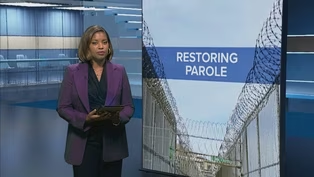
Advocates are working to bring back a widespread parole system in Illinois sense.
And most people don't know this.
The state is one of 16 that don't have one efforts to return to that system are starting from behind prison walls.
There at 46 years old, right?
Will draw.
Do is 26 years into a life sentence at Stateville Correctional Facility?
>> To the on honorable ignorance of dark.
>> Cold caves.
>> But that hasn't stopped him from learning or fighting against what he believes to be an inhumane system of mass incarceration.
>> All of us to form this nonprofit.
We all either had a life without parole sentence.
we had a defacto license or virtual life with which means that you have so much time.
They can't outlive your The nonprofit he's referring to is called Illinois, formed by men who were incarcerated in state prisons.
>> They're working to reinstate the parole system after it was abolished.
Illinois in 1978. just so inhumane to require people to grow old and infirm.
>> To have to die in prison when we got literally mountains of data to inform us that lengthy prison sentences yield nominal returns on public safety.
>> Here's how it works.
Current Illinois law calls for determinant sentencing.
That means if a defendant is sentenced to serve 6 years, they serve the entire 6 years.
They can shave time off that sentence for good behavior and by participating in classes and training once that time earned their release from prison on mandatory supervised release or M S R. Were they still have to follow plenty of rules and check in with a supervising officer regularly.
That part is still very similar to parole.
But the difference is the mechanism for release from prison under parole.
Once a defendant has served a certain amount of time in prison, they can make their case to the parole board rolled And other advocates refer to it earned re-entry.
>> What we're proposing is not a get out of jail car.
Where an advancing earned ranch.
You bill.
And it requires people to spend 20 or more consecutive years in prison before they're eligible.
And if the review process right after 20 years, you can present the best version of yourself before the Illinois Prisoner Review Board.
It'll be up to them to determine whether you can be safely released and successfully reintegrate into society.
>> Their earned re-entry Bill's House bill.
3373 and Senate bill.
2129 create a review process that after 20 to 35 consecutive years of incarceration, individuals are given the chance to make their case before the parole board.
The Illinois Sentencing Policy Advisory Council shows that as the bills are written, 438 people in see prisons would be eligible for release in the first year of effectiveness.
>> That number would grow to nearly 4,000 by the 3rd year.
Sure.
Republican State Senator Seth Lewis isn't opposed to the idea of bringing back parole but questions if it should be a priority for C. >> That whole system needs to be improved.
Before we go wholeheartedly into a parole system, it has to come together because giving someone the opportunity to leave prison and then not support them while they're here.
I think we're setting them up for failure to go back.
>> He argues the whole system needs other cures for long-running bills like root causes of crime and rehabilitation.
While incarcerated.
>> And we also have to bring in victims and victims.
Families making sure that their felt a part of the process or at least have a say they may not like the outcome of person who has been ripped ability to deny, want to provide forgiveness, but the same time they need to be a part of it.
>> One such victim was 11 year-old Jaden Perkins, a young dancer killed while protecting his mother from a man just released from prison on mandatory supervised release.
Dorado argues the public misuse of the word poor role in the case of the suspect hurts their efforts.
>> This man was not on parole.
He was an M S R if there was a parole system, he would have been forced to undergo.
This a transformational process, a personal growth before he would have been released.
>> Advocates even Reynolds is a victim herself world in her first husband was murdered 16 years ago.
suspect was never arrested.
>> Whatever it is that is responsible for my late husband's death.
I don't think they need to sit in prison for 30, 40 years just to realize what they did or caused to my family.
But also.
It's not going to make their family holy, they're right.
It's going to tear their family apart.
The same least one minor part.
How can we not advocate for second chances when we know that human nature, human beings by nature do they do change?
>> She married her current husband while he was incarcerated in an unrelated federal case.
>> He was convicted and sentenced to 20 years to life for nonviolent drug nonviolent drug offense in the federal system, albeit so he would have had to serve all that time.
He technically should not the home until 2029.
>> What?
He's out of prison now through a change in federal law with Reynolds argues a change in state law could do the same for men and women in Illinois providing opportunities like the ones she and her husband have.
Now.
>> And while we fight to reinstate pro system, Illinois.
In the meantime, role Dorado spends his time preparing for the day he gets his chance.
I'm on the gun that transformational personal growth and I gladly carry this heavy burden that I know down.
Just speak for myself.
I speak for every incarcerated person in ideal scene, not particularly speak on behalf of every person of more than 5,000 people who are sentenced to die in Illinois prisons.
>> Also rolled rado himself was just transferred to a downstate prison yesterday.
She even the Grenell's also points out how a parole system would create a safety valve for the wrongfully incarcerated.
If released on parole, they could continue fighting.
Your case is on the outside and serve far less time while in prison.
Up next, a look at leagues commemorative coins.
Stay with us.
The Leagues were in the spotlight back in May when player statistics were officially merged with Major League Baseball's record books and historic Black.
We get is once again being featured this time in an exhibit at the Federal Reserve Banks Museum in Chicago.
The exhibit showcases a series of coins that were made by the U.S. Mint to commemorate the one 100th anniversary of the founding of the week.
We stopped by and spoke with a black baseball historian who walked us through the exhibit.
>> The level of accomplishment that went into not only securing these objects, which I certainly found fascinating and looking at them from the vantage point of the contribution that they make not only to the city of Chicago, but also played baseball In general.
What they symbolize for me is the role, a recognition that it's given to play baseball in the commemoration of these beautiful More specifically allows us to peer into the life of a black baseball as was played in the city Chicago Andrew Foster certainly considered the father to point.
And especially fascinated with is the one with the bus on Certainly a tribute to the mobility, flexibility and comfort that was provided for black baseball teams at a time when Jim roles rather rampant in appears to have been a coincidence that this exhibit was launched at this time.
Woods definitely parallels.
And in the 6 with the integration of League Baseball statistics into the Major League Baseball It's a huge moment, certainly.
And they're been baseball historian, certainly before May for decades and has been working on this project.
finally come fruition and he's certainly will the exhibit is on display at the Chicago Fed's money museum through April 2025.
>> And that's our show for this Wednesday night.
Be sure to subscribe to our newsletter, the Daily Chicago when at W T Tw Dot Com Slash newsletter.
>> And while you're there, check out our website for the very latest from W T Tw News and Never Miss Chicago tonight.
You can stream us on Facebook, YouTube and our website and join us tomorrow night at 5, 30 10.
We break down presidential candidates plans for immigration reform and what's outlined in project 2025.
Plus a mid major food recalls.
A look at what's being done to help people access food locally.
Now for all of us here in Chicago Brandis Friedman, thank you for watching.
Stay healthy and safe.
>> I have a good night.
>> Closed captioning is made possible by Robert a cliff.
>> And for all are stuck on personal injury and wrongful death that is proud to give
How Stateville's Closure is Impacting Workers, Incarcerated People
Video has Closed Captions
Clip: 9/4/2024 | 10m 52s | Workers are pushing back on the pending closure of Stateville Correctional Center. (10m 52s)
Illinois Doesn't Have Parole. How a Group is Trying to Change That
Video has Closed Captions
Clip: 9/4/2024 | 6m 55s | The parole system was abolished in Illinois in 1978. (6m 55s)
Providing Support for PBS.org
Learn Moreabout PBS online sponsorship
- News and Public Affairs

Top journalists deliver compelling original analysis of the hour's headlines.

- News and Public Affairs

FRONTLINE is investigative journalism that questions, explains and changes our world.












Support for PBS provided by:
Chicago Tonight: Black Voices is a local public television program presented by WTTW