Chicago Tonight: Latino Voices
Chicago Tonight: Latino Voices, Feb. 13, 2025 - Full Show
2/13/2025 | 26m 47sVideo has Closed Captions
Joanna Hernandez hosts the Feb. 13, 2025, episode of "Latino Voices."
A push to require proof of citizenship when you register to vote. And love it or hate it — we explore the history of dibs.
Problems playing video? | Closed Captioning Feedback
Problems playing video? | Closed Captioning Feedback
Chicago Tonight: Latino Voices is a local public television program presented by WTTW
Chicago Tonight: Latino Voices
Chicago Tonight: Latino Voices, Feb. 13, 2025 - Full Show
2/13/2025 | 26m 47sVideo has Closed Captions
A push to require proof of citizenship when you register to vote. And love it or hate it — we explore the history of dibs.
Problems playing video? | Closed Captioning Feedback
How to Watch Chicago Tonight: Latino Voices
Chicago Tonight: Latino Voices is available to stream on pbs.org and the free PBS App, available on iPhone, Apple TV, Android TV, Android smartphones, Amazon Fire TV, Amazon Fire Tablet, Roku, Samsung Smart TV, and Vizio.
Providing Support for PBS.org
Learn Moreabout PBS online sponsorship>> Hello and thanks for joining us in Chicago tonight.
Latino voices.
I'm John that non this.
Here's what we're looking at.
What to know about a bill in Congress that would require proof of citizenship when registering to vote.
How Chicagoans, 2, 1, 1, health helpline is connecting residents with resources.
>> It is an implicit threat to your car will pay the price.
>> And since you may have had to shovel out your car this morning, we explore the history of Chicago's parking spot, saving tradition, dips.
>> And now to some of today's top stories, Robert F Kennedy Jr sworn in as the next U.S. Secretary of Health and Human Services.
His confirmation came despite strong criticism from Democratic senators including Durbin and Tammy Duckworth from Illinois.
Kennedy faced opposition for his long history of criticizing scientifically proven vaccines in his new role, he'll be responsible for vaccine recommendations, food safety and health insurance programs.
And Chicago's embattled public school leader is being considered for another job.
I think this is among 6 applicants vying to lead a school district in Las Vegas.
Mayor Brandon Johnson's handpick school board members voted to fire.
My thing is back in December.
I think this is still the CEO for the next few months under the terms of his contract, the school district in Las Vegas says it plans to make a decision next month.
The major snowfall we expected mostly Misha Khalil yesterday, but more is ahead.
More as a head our way.
A total of 2.8 inches of snow was recorded at O'Hare Airport falling short of the 4 to 6 inches that we predicted.
But meteorologists are forecasting burst of snow for Friday and Saturday followed by bitter cold temperatures on Sunday.
So maybe you want to stay home with your Valentine's this weekend.
And if you are Chicago property owner, a reminder to clear snow and ice from your sidewalks to ensure they remain accessible.
Otherwise you can receive a ticket with fines ranging from $50 and up.
And Humble Park is welcoming a new theater to the neighborhood today.
Artists and supporters gathered for the groundbreaking at the Kimball Arts Center.
The expansion is led by Calabro Action Theater company which plans to build a new theater.
A new student theater called House of belonging.
The Space aims to be a community hub for life theater, music dance films and special events.
It is set to be completed later this year.
And historic music venue.
Rivia is getting a revamp.
The North surveyed.
The north suburban site announced today that a major renovation >> of its 36 Acre Park will take place over the next few years.
The project will begin with the restoration of the pavilion where the iconic rueful remain in place.
However, the pavilion will receive upgrades, including a new stage seating lighting and improved acoustics in production facilities.
Other areas of the campus will also be renovated to learn more about the project and information and when and when they'll announce their 2025 season.
Check out our Web site.
Up next, new efforts to restrict voting.
That's right after this.
>> Chicago tonight, Latino voices.
It's made possible in part by the support of these donors.
>> The integrity of the American electoral process has been an ongoing debate since elections have existed.
However, conversations about it when it's a hyper drive after the 2020 election when President Donald Trump made false claims of widespread voter fraud and refused to concede he lost Republican lawmakers in Congress are now pushing for the safeguard American voter eligibility or safe act.
It would require voters to show proof of citizenship like a passport or birth certificate before registering to vote.
But critics say it will discredit disenfranchise U.S. citizens from voting.
Joining us, our Ed Young KO Communications director of ACLU of Illinois in Carol Davis, chairman of the Illinois Conservative Union.
Thank you both for joining us.
Thank Karen, I want to start with you.
There are already laws prohibiting noncitizens from voting is safe to act necessary.
>> Well, there's laws against assault.
There are laws against speeding.
There are laws against many things and we all know that people break the law so there needs to be some consequence when we break the law and we know people are breaking and have broken the law as far as registering and being noncitizens.
So yes, it's important to have that into the law.
>> And what are your thoughts?
I think this is a this is a solution in search of a problem.
The incidents of people being registered to vote are registering to vote when they're non citizens virtually nonexistent.
There's a one name to anecdotes that people can bring up and people are punished for that because is, is Carol observed.
It's against the law.
But what this does is threaten to carve out a whole group of people who don't have access to fundamental documents when they register or re-register and also threatened and, you know, unleash a whole set of voter purges right near election so that people will be driven from the voter rolls.
>> And at Illinois says been a leader in expanding voter access.
How might this measure affect us locally?
You know, joy, that's something that really does worry You know, you say Illinois has expanded early voting.
We've expanded online registration.
We've expanded, you know, automatic voter registration.
We digs and expanded early voting all in an effort to enable people to participate.
>> This would literally eliminate the ability for anybody to do any kind of online voter registration because they'd have produce the documents in order to the either a passport or birth certificate.
It would change, for example, that work that's been done all across the state by Both parties are are both political persuasions in terms of registering people to vote because those no longer could be checked under the save act that it would require registrars and and actually elections officials to do it and it would put pressure on election officials when they get the sort of last-minute purge request to deflect resources from trying to make voting safe and accessible for all of us.
And instead worrying about again, what I think is largely a conspiracy theory that they're somehow large numbers of noncitizens voting now want to bring Carolyn, what are your thoughts about assailant guarding non-citizens getting registered?
We over 500 cases just in early 2020 in Illinois made national news.
>> Through the DMV, non-citizens were going on to the voter rolls and it was only through the work of a whistleblower that that became apparent.
So it's not once in a lifetime thing we had over 500 noncitizens dumped into the voter rolls and discovered in early 2020.
And that's just the ones that were found.
So we don't buy into you know, the left always says, oh, it's such a rare occurrence study after study has shown that non-citizens are being registered and non citizens are being voted.
It was a recent congressional report from the speaker's office that actually document to the incident says several incidences of large quantities of non citizens that have been found on voter rolls all across the country and care.
I want I want to follow up with you in saying is election integrity, something that voters should be concerned about?
>> Yes, they should be because we as citizens have investment in our communities in our counties, in our nation.
So it starts at the local personal family level because we have elections every level of government.
And so the taxpayers, the citizens, they should not have their vote canceled by someone who has not been invested in America.
>> And that you touched on this a little bit.
But while this bill has been framed to protect the integrity of our elections, there are some possible barriers that affect individuals who have changed their names like many people, Mary married women are transgender people Hocutt these demographics be affected well, a number of ways.
Let me just say this study that Carol cited.
>> Has been questioned by a election officials who actually look at across the country.
I would remind you that the speaker of the House of Representatives can't say who won the election in 2020.
So I'm not sure that he's the person I'd look for do for expertise here.
But think about married per a married woman who changes her name when married doesn't have that name that matches her birth certificate is she hasn't gone through some other process.
She may be struck from the rolls.
Transgender folks often leave their dead name behind and in many situations and in many states they aren't able to update their birth certificate in the way that they're able to win.
Illinois.
Those people can be affected as well.
It's estimated that up to 20 million people across America are not as fortunate as some of us to have access to both our original birth certificate and a passport.
Those would be the kind of documents that people would mean.
And, you know, many people not only don't have access to them, but don't have the resources to going get that in order comply with this act again for what is a very limited set of circumstances and a trumped-up charge that's just being used in order to suppress votes across the country, Carol.
With that, is there a way to ensure election security without creating barriers to voting?
Well, there are no barriers.
My friend here sites, all these examples, but we're not living in the Stone Age.
>> We live in a wonderful, wonderful new age where technology is available.
>> Yes, the laws do have to make it easier and faster for people to get the documents that they need.
But it can be easily done.
I've recently been an executor for an estate and had to obtain all kinds of documents and it was quickly and easily done.
And those who don't know the system, it's a matter of going to your county clerk.
When you register, they will help you get what you need to register to vote.
We want people to vote.
We don't want exclude any legitimate voter from voting and we love the melting pot.
That is America.
It's what made has made America great.
But we cannot have legitimate citizens votes canceled and the polling is high on this where you pull citizens across the spectrum, they believe it's unfair to have someone cancel out their vote.
Who is not an American citizen.
What are your thoughts will I think a couple of things.
First of all, this idea that technology would make all of these documents available is the very same thing we heard.
>> When states after the Voting Rights Act was struck down by the Supreme Court, we're implementing voter registrar of Voter ID laws and we were told that people can get those ID's easily and then it turned out even in our neighboring state of Wisconsin that that was actually efforts to make it harder for those documents to be obtained.
You know, the other thing is, is that in order to serve this goal, what we've already seen in states like Kansas and Arizona and Virginia, Alabama, where these measures have been put in place at the state level.
United States citizens have been driven off of the polls and not been able to get back on in order to vote.
I think it's unfair to deny someone the right to vote because somebody else wants to serve a political agenda.
I want to follow by saying why do you think this measures being proposed?
I think this is part of a wide-ranging voter suppression, a campaign that we've seen over the last 20 years in this country.
I think there are people who don't like when people vote.
you know, I'm not saying that that's Carol, but I think there are politicians who don't like when people vote.
And I think these measures are on way in which to limit the pool of people who can vote in any election in Cairo.
Want to follow by saying, does this create, in your opinion, a chilling effect that could discourage even eligible voters from participating in elections?
>> Well, let me say I actually served on the front lines of elections for many years.
I've been a poll watcher, but I've also been a poll worker and the attitude, every polling place that I have ever work has been welcoming.
Let's do whatever we can to get you voting if we can.
if you don't have what you need, you in small local polling places.
You can easily run home and grab what you need.
Excuse after excuses used to just keep broadening and broadening and broadening the pool of voters without the vetting.
And the confirming that we need.
Plus, this is a disservice to people who are non-citizens who are being registered by third-party organizations.
Ngo's, non-governmental organizations, they're sweeping so many non-citizens into the voter rolls and it's doing them a tremendous disservice because there are penalties to pay.
And if these people, if English isn't their first language, they're going to be swept unknowingly sometimes into the registers and they may never be able to become a citizen.
What if that immigrant marries has a family and is settled in America and 10 years later, they discover you voted.
You shouldn't voted your being deported and you can never become a senator.
We're going to have to leave it at that.
Thank you both for your input.
Thanks to it.
>> Up next, how a local helpline.
It's connecting residents with resources.
the free hotline.
2, 1, 1, is connecting.
Cook County residents with everyday services from homelessness prevention to legal aid.
The organization is celebrating 2 years of operation and is seeing increased demand.
Joining was joining us with more Richard Le Pratt, executive director of 2, one metro Chicago and Jack Nicholson, vice-president of Strategic Initiatives for United Way of Metro Chicago.
Thank you both for joining Congrats on this big milestone that thank you.
So we have we know 9-1-1, we know for 1, 1, Now we have 2 on one, Richard.
You know, we mentioned a couple.
But what type of services can someone be connected when they call to 1, 1, >> really 2, 1, 1, is about all health and human services.
When you call to 1, 1, you can be connected with housing resources, legal assistance, any type of food resource.
We have a partnership with the Greater Chicago Food Depository.
We're all food resources in our communities uploaded into our database every 6 hours.
That means no person should go hungry in our community.
But more importantly, each day our database grows and that includes mental health services, any type of health and human service or any type of cap that we hear.
We're going to be looking to expand database to examine those partnerships with the greater with the Greater Food Depository DOT was in 2023.
We also having a new partnership with the American Red Cross after the flooding that occurred in 2023, both in the city of Chicago Austan suburban Cook are we helped hundreds of families get connected with disaster services.
And we continue to partner with them to making sure that we're staying ahead of issues that may occur in the community like apartment fires or maybe local disasters that are kind.
1, 1, is making it that important for individuals to get connected and making sure that no one should suffer, that we're looking to making sure that they're getting connected with essential services in the community.
And Jackie, let's go a little bit like a little further.
Were.
Can someone expect when they call?
Yeah, but that's a great question.
I think they can expect is a warm >> voice on the other end of call.
So I think that's really important to note.
It's we have navigators that are available.
24 7, they're trained.
You're getting a live person at the other end of this call.
That's very much trained to understand the need and often what ends up happening is you're calling for one social service and you end up getting connected to multiple social services.
And that's because our navigators are so well trained and understanding sort of a holistic approach to making sure that families or individuals in need receiving the comprehensive services that they deserve actually remember, visiting the call center think last year, beginning of January definitely got to meet some of the navigators and could see some of that passion.
Is that important?
Oh, absolutely.
I think it's also point out that our navigators are from Chicago and from suburban Cook County.
So not only are they trained to understand the need, but they're also.
Residents of our great city and county that are living and breathing every single day and understanding sort of the complexity of what Chicago social services have to offer and how has it been to get the word after 2, 1, It's been great.
I think we still obviously have more to go.
But I think that again and which can speak to this as well, I think having a very strategic outreach team that is able to coordinate with a social service partners on the ground, being able to get out to fares, being able to get out to, you know, resource information, Hobbs.
I think those are all things that are really important to get the word out beyond obviously the billboards.
But I think that if you go to like a resource fair and you see 2, 1, one tabling, that's that one on one individual sort of information sharing that makes people more likely to call 2, 1, 1, And I can imagine, Richard, from the beginning that Ed started to now, you know, what has a grown been like for the last 2 years?
Because, again, we're used to calling 9-1-1 one.
I think there's 3, 2, Yeah.
So what has that feedback been like?
So initially when we started in January, we really didn't know what to expect when we started this, we built a database.
>> Full of these essential services and kind of doing everything we could to reach out our first year.
We tended anywhere between 5 to 7,000 contacts and this past year in 2024, for handling more than 19 to 22,000 contacts month, seeing more than 100% increase year-over-year.
And we're already outpacing that by 50% this year coming into 2025. lot of their higher needs around housing, utilities and food has really increased where people are really looking at how they can get the basic services in our community.
But more to the point of what Jackie mentioned, it isn't so much about this just the essential need.
It's about asking about the secondary.
If I have housing need and I hear kids in the background, how can I get other services?
Do you have food to feed like a list of places?
Maybe they can go get out and not only that, but we're verbalize ING.
We're letting them know what services are available.
And then we also connect with a text or an email to give them the list so that way they can connect.
And then we'll follow up within 7 to 14 days to making sure that their service was well connected or if they have other issues that they to ask.
That is is it important, Jackie, to follow up because it's one thing calling absolutely.
And I think that follow-up is so important in terms of having people feel like the services are that, you know, they call it the closed-loop refer.
All right.
That not only are you being given the locations you can go to to receive the service.
But then there's a follow-up call with an individual that asked you how that went, which also helps inform our database to know what services are available.
>> What are at capacity?
How long did it take for you?
Put on a waiting list.
All of that information is really important for us as we think about how we're addressing people's needs real time.
offer Spanish speaking Kerr.
Absolutely.
Yes.
And I think that's something that's really important to note is that we're breaking down barriers by having multiple languages available.
So we do have Spanish speakers that are also on call.
24 7, because I think that's really important, right?
If if you can't speak the language, you're less likely to call and ask for help.
But if you know that there's a Spanish speaker on the other end of the line that that barrier right there is now taken down.
Rich, really have time for one last question.
But is there a story that's still a situation of somebody that, >> you know, still stays with you that use 2, 1, 1, >> I think there are many stories, but I think more importantly, we've got a story that sticks with me is really about an individual who had called over and over to many different places and couldn't get through.
But when took on the housing hotlines, this individual is able to get through with 3 kids in their home and really was able to work with our staff to make sure she was connected.
And then about a month or 2 later, we found out that she was actually able to get into housing with her kids because she was able to connect with the rental assistance program that we provide here throughout.
2 of Thank you both and congrats.
Looking forward to see what else you do.
Thank.
Thank you.
Up next, we did on a snowy tradition.
>> Well, Chicago snow total may have underwhelm yesterday as the area only saw around 3 inches.
But more is expected to come Friday and Saturday.
So keep those shovels ready.
Because with snow in Chicago comes parking headaches, which means the return of dips.
What exactly is dips?
When did it start?
It is illegal.
Those are among the questions we take on in our series W T Tw News explains hears Erica Gunderson.
>> Every Winter Chicago stands divided around a practice commonly known as when car owners use janky household objects reserve their precious shoveled out parking spaces.
The idea behind it is that taking your car out from the snow you exclusive rights to the spot?
>> And should you decide to let kids and parking space?
Someone else is marked with a folding chair.
Dubiously acquired traffic cones for a late Georgian.
Have to wait.
Sideboard.
There's an implicit threat to your car will pay the price So how did begin?
Well, Chicago is among a handful of American cities that have the conditions to create a perfect storm for Winter Park.
>> I part ownership, dense urban environment and the snowy climate to start snowfalls in 1967.
In 1979, were so catastrophic to Chicago Street and Shovelers Bakst that folks begin defending their spot with whatever junk was hand since then calling out the old milk crates or patio furniture after a hefty snowfall has become more la standard practice in Chicago.
Much to the chagrin of others who find the practice putting and a little a neighborhood.
It'll be are the biggest city to called or not.
The only one in Pittsburgh.
It's known as the Pittsburgh parking chair.
They also do it in Boston that they probably call it the packing check.
And if the term bids, which Chicago Tribune columnist John Kass point in 1999, isn't cute enough for you.
In Philadelphia.
College >> Bottom line is legal in Chicago?
Come on.
It's not a course.
It's You know, it's not.
But when Mayor Richard Daley was asked his thoughts on did in 2001, he echoed the feelings of many Chicagoans.
>> If someone spends all her time to get a car with drive into that spot.
So consider that fair warning.
Chicago into a city leader has enough snowballs force and no dips policy.
>> Park in somebody else's didn't spot it your own risk.
>> If you're from Chicago, you know, we take very seriously and visit our website for more of the W T Tw News explains series we tackle everything from why there are so many units of local government to how Chicago's Grid Street system works.
You can find them at www dot com Slash explains.
And that's our show for this Thursday night.
Give us a follow on Instagram at W T Tw Chicago to stay connected with our NEWSROOM and what we're working on.
You can also follow us some blue sky at W T Tw and join us tomorrow night at 5.37, for the weekend review.
Now from all of us here, Chicago tonight.
I'm Jonathan on this.
Thank you for watching.
Stay healthy and safe.
One has noticed.
>> Closed caption is made possible by Robert a cliff and Clifford law, offices Chicago, personal injury and wrongful death.
It is proud to be a

211 Helpline Connects Cook County Residents to Social Services
Video has Closed Captions
Clip: 2/13/2025 | 6m 41s | 211 is a free 24/7 helpline that serves as an information and referral resource. (6m 41s)
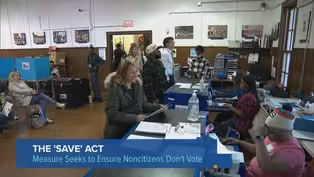
Bill Would Require Proof of Citizenship When Registering to Vote
Video has Closed Captions
Clip: 2/13/2025 | 10m 44s | Republican lawmakers are advocating for the SAVE Act. (10m 44s)
Providing Support for PBS.org
Learn Moreabout PBS online sponsorship
- News and Public Affairs

Top journalists deliver compelling original analysis of the hour's headlines.

- News and Public Affairs

FRONTLINE is investigative journalism that questions, explains and changes our world.












Support for PBS provided by:
Chicago Tonight: Latino Voices is a local public television program presented by WTTW