Chicago Tonight: Latino Voices
Chicago Tonight: Latino Voices, Feb. 20, 2025 - Full Show
2/20/2025 | 26m 47sVideo has Closed Captions
Joanna Hernandez hosts the Feb. 20, 2025, episode of "Latino Voices."
Schools are facing a deadline to cut diversity programs or lose funding — how it could change the education landscape. And inside a local organization helping teens tell their stories.
Problems playing video? | Closed Captioning Feedback
Problems playing video? | Closed Captioning Feedback
Chicago Tonight: Latino Voices is a local public television program presented by WTTW
Chicago Tonight: Latino Voices
Chicago Tonight: Latino Voices, Feb. 20, 2025 - Full Show
2/20/2025 | 26m 47sVideo has Closed Captions
Schools are facing a deadline to cut diversity programs or lose funding — how it could change the education landscape. And inside a local organization helping teens tell their stories.
Problems playing video? | Closed Captioning Feedback
How to Watch Chicago Tonight: Latino Voices
Chicago Tonight: Latino Voices is available to stream on pbs.org and the free PBS App, available on iPhone, Apple TV, Android TV, Android smartphones, Amazon Fire TV, Amazon Fire Tablet, Roku, Samsung Smart TV, and Vizio.
Providing Support for PBS.org
Learn Moreabout PBS online sponsorshipChicago tonight, Latino voices I'm joined on this.
Here's what we're looking at.
Trump's D I crackdown hit schools.
They're under pressure to cut diversity programs or lose federal funding.
A look at the potential impact.
Mass deportations could affect the local restaurant industry.
>> It's like our job to open the door and then hold it open for these other kids to come.
>> And inside a local organization helping teens tell their stories.
And now to some of today's top stories.
People who were shot the 2022 4th of July parade in Highland Park.
>> Will be allowed to attend the trial of the alleged gunmen.
That's after Lake County judge granted prosecutors motion today allowing any victim who is set to testify against Robert Crimo.
The 3rd to remain in court throughout the entirety of this trial.
Crimo is facing more than 100 charges including first-degree murder.
More than 50 people were shot at the parade, including 7 who were killed.
Creemos trial is set to begin next week.
He's pled not guilty.
A controversial pipeline replacement project is set to move forward.
The Illinois Commerce Commission today ruled the program by people's gas can continue after being halted more than a year ago.
So the ICC could determine how to move forward after the project was years behind schedule and billions of dollars over budget.
However, regulators are requiring the utility to prioritize high-risk pipes, create a safety monitor to track the company's progress and finished the work and 10 years last year, the consumer advocacy group, Citizens Utility Board released a report that the program could lead to consumers seeing.
>> Their gas bills double by the year 2040, people's gas announced the finding kuz riddled with false claims.
Today's decision does not have an immediate effect on consumers bills according to state regulators.
The deadline to get your real ID is less than 3 months away.
So here's what you need to know.
Beginning May 7th individuals who want to fly domestically will have to have a valid passport or obtain a real ID.
ID is not required to drive vote or prove citizenship to get a real ID.
You have to provide proof of identity like a birth certificate, passport or Certificate of naturalization.
You'll also need or social Security card or something with the full number like a W 2 are paced up.
Also required are to document showing your current residency like a utility Bill Bank statement or rental agreement.
And finally, you'll have to provide proof of signature like a credit card or current drivers, current driver's license.
You can make an appointment ahead of time at a DMV facility.
Up next, what college classrooms?
My look like without federal funding.
That's right.
After this.
>> Chicago tonight, Latino voices.
It's made possible in part by the support of these donors.
>> School systems and universities across the country are facing an ultimatum, eliminate their diversity programs or lose federal funding.
In a letter on Friday, the Department of Education gave school systems and universities 2 weeks to give it to get rid of programs focusing on diversity, equity and inclusion or known as D supporters of the orders say it's an effort to get schools to follow laws against discrimination.
But advocates worry that support for students of color could get cut.
Here with more with the potential impact, our in the mat on the Wolf.
See you at those.
The dei consulting firm and Jeffrey Schwab, senior counsel at Liberty Justice Center and Non partisan look at the litigation firm.
Thank you both for joining us.
I want to start off as mentioned.
The Trump administration is giving schools a deadline to eliminate These Dei dei programs.
Jeffrey, you know, what was your first reaction to this?
>> think in the main the letter just reiterate current law racial discrimination and universities is illegal and it emphasizes that the Trump administration is interested in enforcing it response to the 2023 Supreme Court case, students for fair admissions versus Harvard.
And that case held title 6 and the Equal Protection Clause made affirmative action programs illegal and unconstitutional.
So the in the letter just says that the Trump administration is going to make sure that that law is in and the the what are your thoughts?
>> Along the same lines, it is a broad and general statement.
And when we think about higher education institutions, they're really awaiting guidance on what will follow as a result of this letter.
So we have 8 days to see what this will actually mean.
But I think it's in keeping with what this administration overall has taken as its position, which is an anti DIA agenda and talking about that, what types of programs could be impacted under this order.
>> So if there, you're in closely to the Supreme Court ruling, we would only be looking at admissions when thinking about colleges are higher education.
But the letter its office much broader.
>> And encompasses everything from kindergarten.
2 middle school high school and state agencies that are in the education space.
So it could mean a lot of different things based on the language in the letter itself, it could mean multicultural programs that could mean mentorship programs.
That could graduation events that are targeted at specific groups.
It could mean a variety of access programs that are tied to racial identity, ethnic identity or national origin.
>> Jeffrey Research has shown students of color of color are often underrepresented in higher education.
You know, what are the potential issues with academic support program exclusively design for specific groups.
>> I think it's important to note that the goals of education inclusion are not necessarily mutually exclusive with the Supreme Court's decision in the students for Fair Admissions case.
If if we're concerned about people that are underrepresented in schools universities, that there's a variety of other avenues that we can take.
We can focus on people of limited means and people of limited means is over, represented in certain racial groups.
Then in theory that would help.
Focus that would help those racial groups.
also we can focus on things like school choice allowing kids that are K through 12 education to not be limited to their schools and have the opportunity have schools outside and that hopefully would allow them a better opportunity to learn and get colleges that they prefer.
>> only that would use it to some who think that grams should just be based or did not consider race.
So I think fundamentally ignores the other elements of being part of a campus environment or a school environment.
>> When we think about multicultural center is one of my colleagues in this space to know my thumb autos who studied at Loyola Law in terms of getting his PhD, looked up permanent residence.
And one of the things that he noted was that they were less likely to feel a sense of belonging on campus because of a lack of shared cultural identities.
And that programming that was specifically geared towards, let's say up and Hispanic identity, help them feel more integrated into the campus community and also give them access to resources and tools that they wouldn't have had available to them.
And I think when we are considering dental students in particular, we have to also consider that using lesser means are low income as a proxy ignores some really important challenges like language, for example, a lot of these programs that are supposed to be in this category race or national origin or ethnicity actually highlight language, make sure that materials are translated into languages.
Some of the arguments about these graduation events have been a challenge to because those have been done in a bilingual fashion, which has been important in terms of really bringing the community of the students into the fold.
Jeffrey, what are your thoughts on what she's saying?
>> Well, I don't think that I guess what I would say is it is unclear what the Trump administration, how they will enforce.
It did promise that sometime in the future they would provide further guidance.
And so it's not clear whether the enforcement mechanisms be against things like language based learning things like that.
doesn't seem to me that that.
Necessarily violates the Supreme Court's decision and students for fair housing.
But it also is important to note that this is the Supreme Court's Kate, the decision and students for fair housing.
That's the law.
That's how they interpret the law.
And I think many people can agree that recent response I think Vice President Vance that that we shouldn't get to pick and choose which Supreme Court cases we're going to follow based on whether we like the outcome and I want to bring feel something else report from the Latino Civil Rights Needles U.S. says.
>> The large number of students who at some point consider taking leaves of absence from school, demonstrates the impact of various barriers.
Our study found that's 66% of Latino college students consider leaving school at some point and that 34 actually did leave Jeffrey without program to support students of color in school.
How do we eliminate those barriers to entry retention, especially in higher education?
Would you say?
>> Well, I mean, I don't have all the answers, but I think there are ways that are not race-based that can focus on helping students that are having trouble.
I don't think that the race pace thing would prevent things helping people that speak late speak a different language to as first language.
I think that would be perfectly consistent with the Supreme Court's case.
So I think there's lots of ways other than just focusing on race and racial discrimination that can help people of all different backgrounds and that are struggling with their educational opportunities do.
What do you make of this main concern is that there are any precedent established.
So if we look at the University of Texas at Austin.
>> The response last year based on state law fall requirements met that their multicultural center closed and monarch, which was their center specifically focused on undocumented students closed and that avenue to access to resources to support which, by the way, both of those centers were not closed off to people of different groups.
But there was such a fear of losing federal funding and state funding.
And there is such a desire to align to a certain agenda that we had students who were counting on the support system that then was removed.
And so what I think about a letter like this is again, not sure that it's going to lead to everything that is broadly defined in the letter.
But that institutions are going to be afraid of losing their funding and pause programs that students are using right now and using to great effect.
So you're already seeing there's been universities are schools changing their wording?
>> We're seeing at least in U.S. we consult with a number of universities.
What we're seeing is that their programs pass.
So they're very concerned not knowing what's going to happen in the future.
And so our directors of, for example, one of our directors of multi cultural center has completely suspended the program encounter through the end of February, waiting for a February 28th roll around because there's also concerns about job loss and whether they're going to lose their staff if they take a wrong step.
And if only have a couple seconds, but I want to ask, do you think it's fair to put schools under such a tight constrained to comply with these new rules?
>> think it's worthwhile noting that it's in the under regulation that that's been the policy of the United States government to not immediately take away funding for violations, but to consult with hoping for voluntary, hoping for voluntary compliance.
And I would imagine that the Trump administration would follow those regulations.
Well, thank you both us.
Want to see what happens next.
Thank you.
>> Up next, the partition threats facing the restaurant industry.
The U.S. restaurant industry relies on the lever of undocumented immigrants.
But in the wake of President Donald Trump's mass deportation orders, some Illinois restaurant owners are raising concerns.
Joining us now with more Samson founder of 3rd Kohl's hospitality group and a board member of the National Restaurant Association.
And joining us via zoom is Hyman Apollo president and CEO of the Illinois Hispanic Chamber of Commerce.
Thank you both for joining us.
Jaime, I want to start with you straight off the bat.
Have you been aware of any restaurant raids in Chicago?
>> Since Trump started his term in office.
>> Well, that necessarily raise, but I but I've been aware of several restaurant owners of border a shift being deported from one of the while he was working.
>> What are your what are your thoughts about that?
You're talking owners.
>> Yeah.
Restaurant owners that they they would casualties, they were ice with order them Richard was another individual and they they happened to be there with that individual.
So they just took him.
So they were they had to shut down the business because they did not the documents in place so they can stay in business.
And that's reason why the league we spending too time.
There is lines that duo that King killed.
This is our is actually, you know, so they can operate the business from abroad, for example, a power of attorneys to make sure the signature the banks of the correct ones.
Make sure you get the proper legal advice and so on and so forth.
So this is a free tool anybody.
Even the restaurant business or is here in Illinois?
They need to protect themselves and be just in case something happens.
>> And talking about the 2 actually want to bring it up.
And you just as you mentioned, you launched a free program to help undocumented business owners and their employees be prepared in case they face deportations.
Some of the points are legal preparedness, including power of attorney, regulatory compliance, financial axes, axes employee preparedness.
You know, can you just continue to discuss this initiative and what restaurants can do to protect themselves in case they are facing, you know, these ICE raids.
>> Yeah.
For example, if a restaurant important get some rest of my deportation of that is the that come into play so they can live leave the restaurant to the spouse or a wife or husband or to the managers, they can operate the restaurant from We seen tools that can do that that we need before.
Give me example I want to they can literally operate the business from abroad.
People need to find proper banking institution.
He's to do that and this many banks and through that.
So this the kind a very simple But you need to be ready.
>> Sam, I want to bring you in.
What are your thoughts the program time and thank you.
And I'll tell you something, this pension recovers and make it a hunch over 140,000 business owners, Latino owned business owners in the state of Illinois.
So I mean, having that ability to be able transfer a the responsibility to manage a spouse or children or just a best friend to continue to run the business.
Then he added that the continue have the jobs available for community and that we don't lose out a been a the goes out of business in close as Fort.
The closed as jobs tax revenue loss.
So we do want to see that and the state we know that President Trump ran on inflation.
You start closing the restaurant and the start affecting patients that go to the roof.
>> talking about that.
You owns several restaurants in Chicago with your family.
You know, what are your concerns?
>> No, you know, I we talked about the meantime, the man with the a talk the often make sure we comply with the I 9 complaint law.
We've got to comply with you don't want comply with the requirements of law.
So we've done And we're hoping that everybody submitted documentation.
We hope that someone is not has a order of deportation.
That's what draws them into the restaurant to the edge up because that is where they live.
>> We're hoping that the ice, that counts stick to what they said.
Biden repeat offenders scenes.
Sometimes it hasn't been the case.
What has been your thought?
And that is great at said is this is going to bring us meet So we form a committee that is the N word over.
25 states right now.
>> We're best become are going to the fermentation collision with because she organize that.
>> commission for for what's the mission of the what number one is a bipartisan bill amid bipartisan group, group were over 118 members right now over.
25 state that we've got Republicans and Democrats bill to work together and come to the middle.
Okay.
The President Trump said it dozen Asian.
You want to bring common sense to the White House comments that immigration Congress has filed for 40 years for 40 years on both sides of the party.
But we know that not all the not all the Republicans want to pass something we need both parties to work together.
comments what that look like when you right now, our number one goal is the Dreamers.
The 1.8 million Dreamers, 6 or 600,000 registered for Dhaka.
>> We heard President Trump say it twice.
Maybe 3 times that the Dreamers should be citizens and the longer that the door he left open for us and that will work out.
We will be in the sea.
We have a conference on on March.
5th will be in DC on the 24th and 25th what hope and that 3 to 400 business.
Let the note Mexican business on a method looking a bit of that educated and ice cream and don't want to come back to the argument that we just want to bring a case.
The people have been here for so long for 30, 40 years.
I was going to mention that.
What about the people have been living here for decades and that current document?
that's the next step.
I are essential workers in industry.
People have family who have been paying for 30, 40 years.
if you look at some of the cases that we have here, I mean, people come here with nothing, a good sweat la, some limbs not.
you agree there should be something they should be something believe that President Trump is also because the business owner.
>> Yes, hotels, restaurants, golf courses in construction.
Our people and people have been in country for 30, 40 year work side by side hand, the hand what American citizen not knowing if documented undocumented Texas AM N get into country to move forward to a better cannot fix >> Sam, I want to ask you all one thing that we've noticed is when I headed to Little village, there were some restaurant owners who are saying that, you know, they're losing business because people are not coming here.
You know, what are your your thoughts on collateral arrests?
>> Maybe this Unfortunate loss of one point by 30% of losses, revenue losses, not just it just doesn't affect The owners, if thinks it will supply chain, if you mentioned.
you know, it's going because now listeners and that consuming whether you supposed to and keep in mind that was going on supply chain face affecting everybody.
You took recess is going to be a recess in the we have seen because the pandemic imminent and they used to thinking is appointed since they have.
Is that what you feel?
Is that what you're hearing from restaurant owners in the last couple weeks?
you know what what is one of their main challenges?
>> Well, the main challenges that these administration and instill fear in community, people may used to do big board people just going in there.
You know, I was making my knees just the food delivery companies the drive-thru companies that we don't hold.
Those companies say is affecting our business But at the end of day's affected, the whole supply chain system because we don't own supply chain.
You know, we buy fruits and vegetables, but some other groups are suppliers and Mexicans are that the nose.
And just to just to clarify one thing and that committee members come in all sizes and colors, not just Hispanics.
we feel they're singled out for this administration is just not fair.
>> Well, thank you both for your input and thank you for joining Thank you for the opportunity.
We're back with more right after this.
>> A local organization is empowering teens to change the narratives about their communities.
We met up with the founder of an anti-violence initiative who turned his life around.
It is now giving young people opportunities.
He didn't have.
>> now record.
Let you know, want to come in.
>> It's after school on a week night and a group of students are working on a script.
They're all part of the organization.
Love City, a film production operation focused on youth violence prevention on the West Side.
>> When you're ready, hit record and give them the signal.
>> Here students into the world of digital media warning about film production.
Photography and acting algae bloom known that most important mission to be inspirational.
A lot of the violence >> comes from hopelessness.
there's nothing to live for.
so now, you know, scared enough mount feeling pain.
>> You're going to feel pain.
So we need to start here with some of that pain and start let them know to some tough you live for.
>> And revealed that he also known as is the founder He says the organization was inspired by his desire to connect with his son after spending 10 years in prison and made me realize I need change who I was for us.
You know, like.
>> I spend the rest of my life in bad situations.
So I started thinking about what I wanted to do with the rest of my life.
>> After his release at 39 years old.
Really, he's became a mentor for an anti violence prevention program in Pilsen there.
He noticed how smartphones played a role in connecting with youth.
So long story short.
I taught myself how to make sure and had it music videos.
And, you know, once we started putting those music videos out young people.
From different neighborhoods reaching out, trying to work with me.
So that's when I knew.
I had something.
>> What started as an experiment grew into Love City in 2022.
That he received a state grant and move the program to its own space in Garfield Park.
They know what I hear.
They're they're heard.
We hear them.
We see what they're like.
What kind of stories I want to tell they see that develop.
>> Into a short film into a music video into a pocket giving participants like 16 year-old Isaiah Nieves opportunities to explore acting out, looking get inspired because, you know, he started off showing off iPhone.
You know, off of their iPhone.
I got this big We're big cameras or 14 year-old my guests to learn more about photography.
I also I'm not just talking.
He also we also did a design of clothing.
>> And I really like them getting to me, I never thought I would programming is offered throughout the year.
>> Exploring topics from the motions of a first date Yeah.
The struggles of drug addiction trying to go for And gang violence >> A part of our job here to make these kids realize that what they have to say doesn't matter that they have, you know, a lot of potential there projects, challenge assumptions, sort of Adidas says people may have on their communities.
>> And I started thinking to myself, but outside of myself as a kid feel bad for him.
wanted to help them.
That's the reason like I guess I'm like I got compassion other people are going through Cannes Film.
>> Great Guy.
An April 27th.
The organization will showcase several their short films that Siegel, what Theater in Austin from 02:00PM to 05:00PM to learn more.
Visit our website and that's our show for this Thursday night.
And are you planning your weekend already from a movie poster exhibition to a local book lot.
We've got you covered with 5 arts and culture picks to check out this weekend.
See the list on our website Www Dot com slash news and join us tomorrow night at 5.37, for the weekend review.
Now from all of us here, Chicago tonight, I'm joined on this.
>> Thank you for watching.
Stay healthy and safe when not just.
>> Closed caption is made possible by Robert, a cliff and Clifford law Chicago personal injury and wrongful
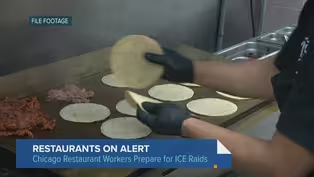
How Chicago's Restaurant Owners Are Preparing for Deportations
Video has Closed Captions
Clip: 2/20/2025 | 8m 3s | The restaurant industry is fueled by immigrant workers. (8m 3s)
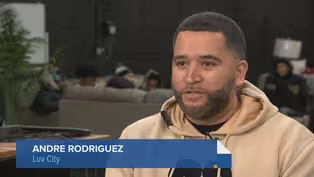
Inside a Local Organization Helping Teens Tell Their Stories
Video has Closed Captions
Clip: 2/20/2025 | 3m 44s | Luv City is empowering teens to challenge the narratives about their communities. (3m 44s)
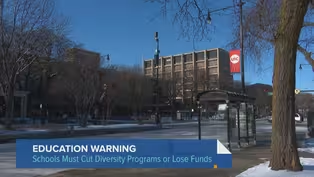
Schools Under Pressure to Cut DEI Programs or Lose Funding
Video has Closed Captions
Clip: 2/20/2025 | 9m 28s | President Donald Trump's crackdown on diversity policies is affecting schools. (9m 28s)
Providing Support for PBS.org
Learn Moreabout PBS online sponsorship
- News and Public Affairs

Top journalists deliver compelling original analysis of the hour's headlines.

- News and Public Affairs

FRONTLINE is investigative journalism that questions, explains and changes our world.












Support for PBS provided by:
Chicago Tonight: Latino Voices is a local public television program presented by WTTW