Chicago Tonight: Latino Voices
Chicago Tonight: Latino Voices, Feb. 6, 2025 - Full Show
2/6/2025 | 26m 48sVideo has Closed Captions
Joanna Hernandez hosts the Feb. 6, 2025, episode of "Latino Voices."
The Trump administration is targeting Illinois over its protections for undocumented immigrants. And how deportations could affect Illinois’ farming industry.
Problems playing video? | Closed Captioning Feedback
Problems playing video? | Closed Captioning Feedback
Chicago Tonight: Latino Voices is a local public television program presented by WTTW
Chicago Tonight: Latino Voices
Chicago Tonight: Latino Voices, Feb. 6, 2025 - Full Show
2/6/2025 | 26m 48sVideo has Closed Captions
The Trump administration is targeting Illinois over its protections for undocumented immigrants. And how deportations could affect Illinois’ farming industry.
Problems playing video? | Closed Captioning Feedback
How to Watch Chicago Tonight: Latino Voices
Chicago Tonight: Latino Voices is available to stream on pbs.org and the free PBS App, available on iPhone, Apple TV, Android TV, Android smartphones, Amazon Fire TV, Amazon Fire Tablet, Roku, Samsung Smart TV, and Vizio.
Providing Support for PBS.org
Learn Moreabout PBS online sponsorship>> Hello and thanks for joining us and to cover tonight, Latino voices.
I'm joined that non this.
Here's what we're looking at.
The Department of Justice is suing Chicago in Illinois and Illinois in an effort to invalidate local news, local law that protects undocumented immigrants.
President Trump pauses as planned for hiking tariffs on goods from Mexico and look at the potential impact if he follows through.
And the possible effect mass deportations could have an Illinois agriculture and food crisis.
>> And now to some of today's top stories, Congressional Progressive Caucus is calling for the firing of Elonmusk during a news conference today.
Members of the caucus criticized the billionaires motives for leading the so-called Department of Government efficiency.
They claim he has infiltrated multiple federal agencies, including the Department of Labor and the Treasury Department in order to implement cuts to spending and workers.
Illinois.
Congressman, to we've got to see a refer to Musk's agenda as an illegal power grab and for the people.
>> We are here to tell working families that we will not allow Miles to have access to your Social Security numbers to push out civil service workers or to launch an all-out assault against government agencies.
These moves are illegal and we're working with civil rights groups who are suing for these actions.
>> And a judge is temporarily blocking President Trump's plan offering federal workers financial incentives to resign.
It comes as roughly 2 million federal employees, including around 42,000 in Illinois, had been given a midnight deadline to decide the different resignation offer would allow them to leave their jobs and be paid through September.
The offer is an effort by the Trump administration to shrink the size of the federal workforce and warns layoffs or furloughs could come next.
But Wednesday, Illinois Governor JB Pritzker issued a statement warning federal workers to proceed with caution on the offer.
A new push to reform Chicagoland public transit without merging CTA, Metra and Pace.
State lawmakers filed a bill today backed by a group of labor unions.
The measure calls for big changes in transit oversight.
More coordination and a new funding formula.
The bill doesn't go as far as other proposals to merger CTA, Metra and Pace into a new agency.
And it doesn't have any specific sources of new transit funding.
It.
The proposal aims to tackle a 750 million budget gap expected next year.
When COVID relief funding ends.
It's almost been a year since Dexter Reed was fatally shot by 4 Chicago police officers during a traffic stop.
The lawsuit filed by Reid's mother now has a proposed settlement that includes a 1.2 5 million dollar payment.
His family and a ban on city police officers setting traffic stop code U.S. Cpd deny setting those quotas or using traffic stop numbers to determine promotions and bonuses.
The agreement will be renewed by the City Council's finance committee on Monday and the civilian Office of Police Accountability continues to investigate the shooting, questioning the legitimacy of the initial stop.
Supporters of gender affirming care are calling on you.
Why health to clarify its commitment to providing such care for minors?
It comes after advocates say you why health canceled in Illinois teen's chest surgery a day after President Trump signed an executive order seeking to end gender affirming care for minors.
>> I know there are in this crowd thank the way not be here today.
If they did not access to the same care that I did.
If you are health care, it's first the only health care they kit.
the moment.
The only health care that is affordable to them.
>> Uf Health did not respond to specific inquiries about the gender affirming surgery cancellation cited by advocates but says it is committed to providing inclusive care to community.
We will continue to provide gender affirming care to transgender patients in accordance with the law.
Now, Virginia McCaskey the longtime matriarch E of the Chicago Bears has died.
Mccaskey became owner of the Bears when her father, NFL co-founder George Halas, died in 1983. becoming one of the few women in sports to hold the position her late husband Ed McCaskey succeeded Helices chairman for the Bears together.
They had 11 children over her life span.
Mccaskey was around for 8 out of the team's 9 championships, including the team's only Super Bowl but made it clear she always wanted more.
Virginia McCaskey was 100 in 2 years old.
We're sending our condolences to her family.
Up next, we break down the Justice Department's new lawsuit against Illinois.
That's right after this.
>> Chicago tonight, Latino voices.
It's made possible in part by the support of these donors.
>> President Donald Trump is escalating his push to punish the city of Chicago in the state of Illinois for working to protect undocumented immigrants.
His administration today is asking a federal judge to overturn the city's welcoming city ordinance and the state's trust act.
The lawsuit filed by the Department of Justice makes it clear the president will directly target Chicago as it seeks to carry out the largest mass deportation in American history.
Our Heather Sharon joins us.
now with more.
Heather, this seems like a big battle now.
The lawsuit argues the city in this state sentry laws are unconstitutional.
My well, the lawsuit argues that the laws make it impossible for federal agents to enforce federal law.
And of course, under the Constitution.
>> Federal Trump state law and city law.
And that's why they're saying it should be overturned.
Now the city says that is, in fact, not the case that there is nothing in the city.
Lot of the state law that would prevent federal immigration agents from apprehending and deporting people here without authorization.
They simply say it's not the state or the city's role to help Now remind us what the city and state laws actually do and why Governor JB Pritzker and Mayor Brandon Johnson are defending Well, as we've talked about, they've been on the books since the Mid 1980's here in Chicago.
And it's designed to make sure that Chicagoans, regardless of their citizenship status or their immigration status can access services that they need like police protection, health care, shelter and all sorts of other services.
The city provides to all Rest Inc. Now the governor and the mayor say that that will make Chicago safer place.
That puts them at loggerheads with President Trump who says that all undocumented immigrants are criminals because they came here without authorization or overstayed their permission.
The governor and the mayor, of course, reject that characterization and how did the mayor and the governor react to the lawsuit?
So both said that they looked forward to defending the laws in court.
Governor JB Pritzker was a bit more direct than the mayor.
He said he looked forward to the state's day in court.
While the mayor said he would continue to defend Chicago's longstanding values and protect working people.
He's been very outspoken about that.
Why did the Trump administration Chicago instead of another century city like Denver?
Well, Chicago has long been in President Trump's crosshairs.
He see Chicago as the epicenter of all urban ills and has repeatedly attacked the city's leaders and incompetent.
I also think it has something to do with what we saw a few weeks ago.
Of course, we saw all of that reporting saying that the mass deportation would start here in Chicago.
That didn't happen because of leaks.
And then when ICE agents arrived in the city, they found as the border stars said a very educated population prepared to respond to protect as many people in Chicago as possible.
That clearly has thrown a wrench in Trump administration's efforts.
What happens next?
Well, litigation, as we all know, is a lengthy process, especially when you have 3 layers of government for including Cook County.
So this is going to take a long time to play out back in 2017, the city sued the Trump administration over a similar effort to strip the federal funding from sanctuary cities that wasn't resolved until 2020 when it went all the way up to the Supreme Court where the city won a total victory.
But thank you, Heather, for this report.
We'll have to see what happens next.
Thanks, John.
A and for more on this story, you can visit our website while you're there.
You can learn more about how Chicago became a century city.
>> Fears are heightening over the potential of a new trade war in its possible impact across the country.
President Trump has agreed to a temporary pause on the 25% tariffs he's proposing on goods from Mexico and Canada.
The country's 2 largest trading partners.
The administration is promising to impose tariffs if the countries do not take address Trump's concerns over border security and drug trafficking.
Here to talk more about what it could mean locally are Juan Gonzalez, senior research fellow at Great Cities Institute at the University of Illinois, Chicago and I was on pain at as men of consul general of Mexico in Chicago.
Thank you both for joining us.
The Dane, I want to start with you.
Not of these tariffs are implemented.
What impact will that have on the relationship between make eagle in the U.S.?
>> I was certain that it will have a major impact.
Just think about this, Mexico, the U.S. and Canada one of the most important, free trade agreements in the world just pray that a Mexican, the U.S. amounts for a billion dollars annually.
Can you imagine that?
And the word war there is 2000 miles long.
you know, witness of all wonderful attend is in for the economy.
the end of the day, if some measure Davis passes sort most ahead is going to be impacting the supply chain between the 2 countries, but also the pockets of millions of consumers in this country.
And of course, in Mexico.
>> And one, let's continue to break down those impacts.
You know, what could this impact have on the labor workforce?
Well, France is Brookings Institution just come out recently with a report that says that if they're implemented at least 177,000 jobs in the U.S. will be lost, possibly up to 400,000 Mexico and and Canada Reese, we tally it with their own tariffs for Canada.
It could mean as much as half a million jobs lost and for Mexico over 2 million jobs lost.
And if that many people from Mexico lose your jobs, where do you think many of them will going to end up going to they're going to end up coming to the United States.
So what Mexico has actually been in in improving economically, more Mexicans have been staying in Mexico as a result of the social changes.
This could have drastic effect of countering all that and forcing more Mexicans to migrate to the United States an interest.
Interesting perspective that we haven't been hearing and in locally, how could tariffs affect people's wallets here?
>> Well, for Canada.
She caught the state of Illinois is the number one consumer of oil and gas from Canada.
47 billion dollars in oil and gas imports and if their tires slapped, that's going mean a sharp increase in what people in Illinois pay for their gas in Mexico.
The biggest import would port Haitian from Mexico in Illinois.
is beer and alcohol and beverages about over 5 billion dollars a year.
So a slapping a tariff on that is going to mean the people here are going to pay more for their alcohol for their beer and for their other beverages.
And of course, that's going unduly affect the poor sectors of the Illinois community would just say for fresh produce as well because we know condos, right, fresh produce, of condos, especially about the largest segment of importation from Illinois.
Mexican goods is a They now want to bring you in.
Mexico said.
>> It will respond with tariffs of its own without detailing what specific products can you give us an idea of what products could be affected?
>> I think will win distress right now.
Is that agreement that was reached recently, can that the government's and that currently, both governments were able to set this boss in this measure that was about to come in for us is a very positive.
That's a very positive development.
But it's important right now is that the country start talking on how to move ahead.
And as president of Mexico now, this said, let's make this pass permanent because all that is is is what one just mentioned.
You know, just to give you an example, pretty sure that the view that strawberries for breakfast this morning or some sort of very that's coming from Mexico you know, is that the avocados on the end of the year and all those things, the agriculture sector you know, of course, sells a lot to Mexico soybean it another props.
So I think it's very important that we keep that in mind and that we make sure that this pass this permanent.
And I know you talked about the 2 countries being a positive that they're speaking.
>> You know, and mentioning that, what do you think discussions should be focused on in those conversations?
I have to and no, because the president of Mexico now sit in the it's been it's been out in the >> That we have specific groups to discuss.
Of course, great.
That is very important.
But also what's going on a big you know, we're farther.
We want to make sure that there is a cure for both countries.
nobody favors drug trafficking.
that's also something that was put on the table by President Trump, but is very important that we discuss what's happening first temple, the illegal trade, fired guns into Mexico and some of the things that were of concern for the Mexican for the Mexican people, sir, we're really happy all those on the table, though.
We are thinking in a very calm way to move ahead to try to figure out how to make this permanent.
>> You know what it?
What are your thoughts?
You know, what do you think both countries are prioritized?
Well, I think the whole issue of drugs that that all the President Trump has race is really a red herring.
The United States has had addiction to elicit drugs for over a century.
You start with the 18 90's cracking down on opium of the opium trade in the 1960's on marijuana and LSD.
In the 1970's on heroin.
In the 1980's and 90's cocaine and crack and then on meth amphetamines.
And now we're dealing with fentanyl.
>> clearly, United States has an addiction problem.
There are many people in this country who mental problems and depression and anxiety and they treated with drugs rather than blame someone from the outside.
Want to we start looking at the hemp mental health needs of our own people and trying to figure out what our society is doing wrong.
That causes so many people to be drug-addicted has nothing to do with trade has nothing to do with other countries has to do with the internal problems of our own country.
>> And, you know, Trump's response, I want to bring counted into Trump's response to Canada's trade surplus was we don't need anything they have.
We have a limited energy.
We should make our own cars have Earl number than we could ever use.
How sustainable is it for America to rely solely on domestic manufacturing and sales of products?
Typically source from other countries sit well.
The reality is that much of the manufacturing that occurs in Mexico and China even in Canada is American companies.
General Motors last year produced 887,000 cars in Mexico for over 300,000 stellantis over 400,000.
These American companies go to these other countries because they want to pay less in labor costs.
So it's really American companies that benefiting from the situation rather than playing.
But it's the Mexicans eating our lunch or the Chinese that are destroying the United States.
Look at what your own companies power companies are doing in these countries.
And then a last question, how or financial markets, businesses and consumers trying to prepare for the possibility of new tariffs.
He would say.
Well, there is a very strong team in Mexico working on this.
And of course, they have to bear.
>> As as as it was labeled Plan B and plan C if necessary, just waiting for kind of decisions we're going to be taking this, the U.S. government.
But the end of the day, I cannot stress enough the importance.
Now there is an open dialogue that they're open negotiations and that we need to keep in mind.
All that stake.
When we talk about trade and we talk about the bilateral relationship, we share a very long border there.
So there is no other way than cooperation to make sure that this partnership most and as the president corporation never soar the nation.
>> Well, thank you both for your input.
I appreciate Thank you.
My pleasure.
>> Up next, how the farming industry is holding up miss mass deportations.
Stay with us.
The Trump administration's push for mass deportations has major cities like Chicago on high alert, but some residents in rural areas are also expressing concern.
Specifically farmers.
We're worried about losing their workforce.
The U.S. Department of Agriculture estimates of 42% of farm workers are undocumented immigrants.
Joining us now with more on the potential impact our Rebecca.
She chief executive officer at the American Business Immigration Coalition.
And joining us via zoom is Stephen Door Lock professor in educational policy at the University of Chicago and the director of Stone Center for Research on Wealth and Equality and Mobility.
Thank you both for joining us.
Rebecca, I want to start with you.
How important is the immigrant workforce to the farming industry.
Thank you so much for having me.
Immigrants are critical to the farming industry.
Agriculture is a 3 trillion dollar industry and 72% of the AG workforce are immigrants.
You know, what do you say to those people who have, you know, many different opinions on what's going on with immigration, who should be no, who is legal and whos, not especially when it comes to such big workforce, like 4 main, right?
Well, we appreciate having egg seller shows.
mean, I'm having a hard time finding eggs right now.
And sure a lot of viewers are as well.
>> We appreciate having avocado is and milk and if you were to just remove a significant part of our farm workforce, we're going to start seeing $20 lettuce is $16 cartons of eggs or no milk because nearly all of the dairy farmers and farm workers here in our nation, including in Illinois, in the Midwest, are immigrants.
And Steven going to you what is what are the social logical and economic consequences at play here?
How do you break it down to someone was trying to understand?
>> Well, starting with the economy is already been pointing out.
Remove is 40% of the farmers.
The United States will inevitably cause substantial increases in food prices.
Nonpartisan organizations that have studied the effects of argued, I think credibility we had something on the order of a 10% increase in overall food prices.
This basic supply and demand.
In other there's really no controversy among economists that that's the consequence that one's going to face.
Now, the sociological facts more complicated to measure.
But nevertheless, there are profound you're thinking you know, the discussion of deportation is removed a million people, people from the agricultural sector out of the 2.2 million that work there.
And each one of those people has a family.
Each one of those individuals friendships are part of the communities.
And so one can talk about the effects in isolation on the food supply, the devastation of the communities because of the destruction of all of those social relationships to constitute communities is is a profound loss.
>> Rebecca, you did mention this.
But according to the USDA, nearly half of the crop workers and dairy farmers in the U.S. lack legal immigration status.
Why would mass deportations be detrimental to the agriculture workforce?
So currently we have over 400,000 open jobs in agriculture.
Our food processors along.
>> And so if you were to remove a significant portion of people that are already working, they're milking our cows.
Us 03:00AM in the morning.
And cows need to milk.
3 tied it 3 times a 365 days.
A week and if you were to remove people from this workforce, we're gonna see products that we love disappear from the shelves.
We're gonna see that we become a net importer of food and food.
Security is a national security problem.
so this won't just impact the immigrants in the communities which are extremely important, but is going impact the pocketbooks of every day Americans to find yourself having these conversations with people as of lately?
Yeah, absolutely.
And I think that is becoming clear to people because this isn't just a philosophical question anymore.
And we're starting to see workplace raids in North Florida, for example, I'm Barie Farm Citrus Farms.
We're seeing restaurants in Texas, for example, getting raided by ice.
So think people are gonna start really feeling the impact.
And Steven, with the domestic agriculture sector already struggling with labor shortages.
How would again deportations affect our economy?
>> Well, I think that the effects are clearly going to be negative.
The might, for example, that you're this specific one that you brought up agriculture, really losing a million workers.
Remember, these are workers that have skills and it's not a matter that those skills are going to replicate themselves and whoever might replace them.
That's going clearly caused a contraction.
There.
We're generally it is a myth to say that illegal or undocumented immigrants are somehow reducing the living standards of people.
There are citizens.
And the reason for that is undocumented.
People are not only.
They're both the producers and they're also consumers.
And so you think about the economy's in which individuals are buying things that producing things, their net for population as a whole studies of the effects of for to reduce the number of undocumented people in communities and systematically shown that anything, it harms the people that are left behind as lower demand, there's lower production and it's simply sinner economy in the center society.
>> Stephen, you talking personally from your experience, are there any frustrations when you are having these conversations with people?
similar question that asked Rebecca about, you know, who is a legal or not who should be deported or not?
>> I wouldn't say frustrations, but didn't on this specifically, but it's an example where.
Simply bad economics and bad social science particularly by, you know, people who policy community, our leaders.
>> And you know, perpetuate myths about the effects >> having undocumented people in the United States.
None of that is to say that there are not serious conversations to be had about the appropriate levels for society of of of legal immigration and kind of think about that.
What to do when you have 11 million people in the country.
But the claim these these that this somehow is harming the economy and the I think it's simply false.
>> Well, thank you will have to end it at that.
But thank you both for your input.
And that's our show for this Thursday night.
You can stream Chicago tonight.
>> I W Tw our YouTube channel every evening and catch up on any program you missed and join us tomorrow night at 5.37, for the weekend.
Preview now from all of us here, Chicago tonight.
I'm joined at 9 this.
Thank you for watching.
Stay safe.
>> And healthy one as Closed caption News made possible by Robert a cliff.
And law Chicago personal injury and wrongful death that supports
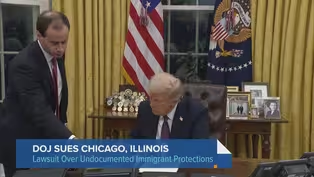
DOJ Sues Illinois, Chicago Over Protections for Undocumented Immigrants
Video has Closed Captions
Clip: 2/6/2025 | 3m 37s | Chicago’s Welcoming City ordinance is designed to ensure all residents can obtain city services. (3m 37s)

How Mass Deportations Could Affect Illinois' Farming Industry
Video has Closed Captions
Clip: 2/6/2025 | 6m 46s | The U.S. Department of Agriculture estimates that 42% of farm workers are undocumented immigrants. (6m 46s)

A Look at the Potential Impact of Hiking Tariffs on Mexican Goods
Video has Closed Captions
Clip: 2/6/2025 | 8m 30s | President Donald Trump recently implemented a 30-day pause on 25% tariffs on Mexico and Canada. (8m 30s)
Providing Support for PBS.org
Learn Moreabout PBS online sponsorship
- News and Public Affairs

Top journalists deliver compelling original analysis of the hour's headlines.

- News and Public Affairs

FRONTLINE is investigative journalism that questions, explains and changes our world.












Support for PBS provided by:
Chicago Tonight: Latino Voices is a local public television program presented by WTTW