Chicago Tonight: Latino Voices
Chicago Tonight: Latino Voices, Jan. 30, 2025 - Full Show
1/30/2025 | 26m 44sVideo has Closed Captions
Joanna Hernandez hosts the Jan. 30, 2025, episode of "Latino Voices."
The impact immigration raids are having on local businesses. And the stability of federal funding going forward for local nonprofits.
Problems playing video? | Closed Captioning Feedback
Problems playing video? | Closed Captioning Feedback
Chicago Tonight: Latino Voices is a local public television program presented by WTTW
Chicago Tonight: Latino Voices
Chicago Tonight: Latino Voices, Jan. 30, 2025 - Full Show
1/30/2025 | 26m 44sVideo has Closed Captions
The impact immigration raids are having on local businesses. And the stability of federal funding going forward for local nonprofits.
Problems playing video? | Closed Captioning Feedback
How to Watch Chicago Tonight: Latino Voices
Chicago Tonight: Latino Voices is available to stream on pbs.org and the free PBS App, available on iPhone, Apple TV, Android TV, Android smartphones, Amazon Fire TV, Amazon Fire Tablet, Roku, Samsung Smart TV, and Vizio.
Providing Support for PBS.org
Learn Moreabout PBS online sponsorshipjoining us in Chicago tonight.
Latino voices.
I'm John on this.
Here's what we're looking at.
>> And nobody wants to come >> How local businesses are feeling the impact of the Trump administration's immigration raids.
Plus, we hear from people on the tonight voices.
It's made possible in part by the support of these donors.
>> What the neighborhoods are on edge amid increased reports of immigration raids by federal law enforcement agents.
It's sparking fear in communities like Little village in back of the yards.
According to the Chicago Police Department, nearly 100 individuals have been detained by ICE.
However, it remains unclear how many of these individuals had criminal records.
We spoke with business owners in these communities about the impact they are seen.
>> So nobody wants to come out.
They want to be stuck inside van.
They don't even send the kids to school.
And I don't think that's They don't up.
It is a lifelong resident of Little Village.
>> And owner of Jesse's Flowers says sales have plummeted since President Trump took office says it's a drastic change she hasn't seen since the pandemic.
>> I walk on 2016.
I don't see people especially at night.
6 o'clock cops.
Not a lot of people.
>> As fears of I citing spread, Jennifer, a guy lot.
The executive director of the Little Village Chamber of Commerce says they are doing everything possible to mobilize and protect their community.
People expect the Navy branded ice trucks.
>> And now we're seeing that it's all sorts of federal law enforcement showing up in in cars that are have tinted windows and I rented.
So it's just new tactics that are being used that we didn't expect.
>> In the last 2 weeks, the neighborhood's 26 street known as the city's second busiest business corridor has been described as a ghost town.
A situation live says is impacting local business owners.
This is have been sharing that they have been seen drops.
>> In sales from about 50 to 60%, especially during the but weekends, which are the strongest days here 2016, have also been affected.
>> Those can be Lewis is one of the restaurants.
It's the intimate 5 in health field.
Letting them this is one of the owners she says lunchtime is typically their busiest time.
But recently they've only served a handful of customers that from if you So we have on the night of simplest of economy and >> If enough, if it will be the of a fee for paying for Yes, and they want to know kind vehicle.
>> It's a family business she says has been operating in the neighborhood for over 29 years.
>> local men able in for a typical that the name of the little think that one of want to be the CIA about us.
a night the hand I would my list people from back just time.
You something >> In the back of the yards neighborhood, the manager of soup admit goggles.
when we make equal shares the same sentiment off camera, he says, although sales have declined, he's noticed customers are coming in to purchase groceries in bulk to minimize the number of trips to the grocery store.
Now he worries that fear in the community would lead to chaos rather than unity.
It's a sentiment shared by others in the area.
Some of which have called Chicago home for decades.
>> It was for like, oh, we'll just come after the criminals help us out and then we'll leave everybody alone.
But to criminals are just people.
>> Well, may have completely clean records, but just the fact of being here without the documentation is enough to make them a criminal.
And I think that that's what's worrisome.
And that's what puts everybody at risk.
>> Just yesterday, President Trump's press secretary said anyone who enters the country illegally >> is a criminal to clarify being undocumented is not classified as a crime under federal immigration law in the United States entering the country without proper documentation is considered a civil violation, not a criminal offense.
And recently we spoke with 2 individuals whose family members have been detained and they share that their loved ones do not have a criminal record now, these families are now facing legal the legal battle to fight deportation.
Here with more on the local impact, our don't say the stump board, president of the Illinois Coalition for Immigrant and Refugee Rights and Executive director of Monroe Model Family Resource Center.
Now on immigration attorney and on zoom, we have 20th Ward Alderman Byron Sigcho Lopez whose ward includes Pilsen.
Thank you all for joining us.
I want to start with you as mentioned being undocumented is in a criminal offense, but a civil one.
Why is it possible for ICE agents to make these arrests?
>> The reality is that immigration law.
Though the warning of immigration law says that anyone could be detained.
Unfortunately, previous administrations wouldn't enforce that to the full extent.
But Trump will be and it's.
enforcing this law to the full extent.
So anyone who doesn't have a legal side is in the United States is a target for this policies.
What would you say that creates that creates more backlog in immigration court.
It creates more fear, more family separation and obviously more work for who are in the front of all of this, right?
Helping our clients advising them what to do, but obviously representing immigration court just to give you some statistics right now, there's about 3.5 million cases in backlog in the immigration court system.
So think about adding morning to that system, it's going to be out.
We don't have the resources to be able to manage all of You know, where these people stay.
The people who are detained.
So there's a legal process at people who like the teens have a right to fighting immigration court.
This doesn't mean that because you're the teen, you're going to be deported right away.
That's not the case.
People who don't have a the petition order or who haven't been deported before can still fighting operational court request and then be returned to their family members and then fight in immigration court.
But obviously still the in their communities.
>> And don't system immigration raids took place today.
Can you share with us?
What was that like today?
Yeah, that's correct.
Our organization receive some information from community members since one of the things that we're trying to do, you know, se community-based organization that empowers immigrant families along with a member being member organization of ICE are is allowing our community to attend.
Know your rights workshops.
In addition to that, obviously we're trying to build a rapid response team and what that entails is community members coming forth with information.
We know that social media, you know, things can get a little crazy and people can share.
Information that's not factual.
And so we received that this morning.
I actually was the one another team member that went to check it out.
And in fact, we did confirm that ice was in North Chicago, which is in Lake County and they did pick up a community member there where aware also that they were making traffic stops.
They did a stop.
One community member.
And and unfortunately, I don't know what happened if they did or not.
But again, just knowing that they were there, we alerted our community members.
We put it up on social media and people are fearful and for that reason, know your rights workshops are super important.
I mean, as you saw, people don't even want to come out of their homes.
I've me when I was out in the street yesterday, I mean, they're not sending their kids to school.
Now, I do.
You just mentioned you've been Oregon organizing, know your rights workshops and the Trump's administration border czar Tom Homan recently weighed in on them.
Let's take a listen to what he said.
>> Thanks us.
He was making very difficult.
To arrest the criminals.
France in Chicago very well educated.
They've been educated.
How that I would defy eyes.
How how the how the high for mice and I've seen many paying for 3 men who shares how you escape ice from arresting or here's what you need to do.
They called know your rights icon, how escape arrest.
>> Aldermen virus, which Lopez, what is your response to what we just heard from a home in?
>> We're looking kid and I'm thankful for their NEC shows neighbors that are still being during times of day in forming.
the rights of all residents, independent immigration status.
My thing is that I'm proud to be Chicago in a century.
See that respects human rights, human rights.
The concern right now, of course, is that that is not enough.
We have someone in the White House that he's threatening to bypass process.
larking why the act, for instance, to expedite deportations, learn recently that have talked about even sending migrants to one title.
I mean, what we've seen here is the criminalization of our immigrant community in despite or even to renatta being lower than the average population we are seeing father's mean taking away from their family.
Mothers.
I just we missing little village.
they shun of a father again had years of DUI back up 12 years ago.
We're not no criminal record and actually was ranked.
We knew his work permit.
I think what we're seeing here is unconstitutional.
I'm glad Attorney general is fighting.
I'm glad rise or anything the fighting in court.
But it's not enough.
We've got to do it on the ground on informing the rest but also mobilizing to protect our neighbors about the response teams being know president, but also the rallies and the mobilization of people to denounce atrocities of the persecution of the immigrant community.
>> Alderman Ru also seeing your war that people are rather they rather just stay home than going out.
Are you seeing that same sentiment in your neighborhood?
>> We're standing our inner enrollment in order and those 4 schools that have decreased for less than to attending schools.
In some cases we're seeing also in medical appointments.
Crews also significantly less than not all those appointments free clinics here.
We also that in church then those in that, Alex, we know business has the has a chamber of sense of what we're fighting not only of seeing what they're given.
We've got to be propped.
It took We're going to be a little village.
We're going to talk about know your rights for businesses for the were placed in the schools.
We legislators to more protections.
Denver's the ready, throwing the federal government attempting to schools.
We've got to do more and we ready to coordinate with other cities, other municipalities.
What we've seen is inhumane unconstitutional.
It is what the Gators that is not what presidents do.
Persecuting migrants making these and industrial prison complex to explode my dress that to benefit billionaires.
This is not the America that we want kids visit Russia.
He's I was become them.
>> And low to after, you know, want to ask after being detained by an agent.
What is the first thing an individual should do?
The first thing they need to do is they need to understand their location.
They need to know whether being detained.
>> They're going to be given a number that represents their Case number.
And then to be able to memorize a phone number of a family member, someone they trust, someone that can call and provide that information to this individual and that individual should know which immigration attorney to call so that they can start the process of representing them in immigration court.
>> And don't sit in these ice arrests.
We've also seen former reality star doctor Phil following agents as they make these arrest.
You know, what was your reaction to seeing this being broadcasted?
It was really atrocious.
As I said before.
And Mary communities being used as a form entertainment.
And this is really hurtful, you know, because you're seeing as the alderman said, we're seeing families being torn apart.
And you wear, you know, being broadcasted nationwide for this administration supporters, right?
Because this is the platform that he ran on mass deportations, anti immigrant rhetoric and the matter of the fact that this has ripple effects has been it has been said here, these families are human beings.
There are violations of human rights here and again.
This is being used as a form of entertainment because that's what the president And that's with our to feel is visions forms of entertainment.
And you know, very quickly, there's a lot of fear circulating.
What advice can you give those who are being targeted in those family members or people who've been living here for decades in Chicago.
>> My advice is if you are stopped by a police officer, you're you don't have the you don't have to say what you legal status you can remain silent if an immigration officer stops a door in the street, red traffic situation, you also have the right to cite anything serving.
Officer says we're going to put you.
I'm not gonna sign anything.
I have the right to speak to someone.
And so again, calling happy with that moment.
Yes, it can still get a new, but that doesn't mean you're going to get deported.
But that also means that you still have a fighting chance in this country still.
And that's what we need to remind community do not give up, do not sign anything.
Speak to a lawyer.
Find what options you have in fight for your case, but for your families will.
Thank you.
Thank you all for being here today.
Up next, how some local nonprofits are responding to federal funding concerns.
Stay with us.
local nonprofits are facing an uncertain future.
This after a wild week that saw the Trump administration pause.
>> Federal grants and loans and then reversed course 2 days after following widespread confusion in legal challenges, the freeze threatened to hold up trillions of dollars in funding for basic government functions like healthcare, infrastructure, and support for children and veterans.
While the order was reversed, nonprofits across Illinois are still dealing with effects and wondering how stable federal funding is moving forward.
Joining us to discuss them to discuss this.
Moving to look ahead, our of their luck.
mean, a senior director of training and community partnerships at Illinois Partners for Human Service.
It opened executive vice president and chief operating officer and bright point might sell the Co executive director of UN last it.
You've got goal and Cameron Zelaya, senior policy analyst at the Illinois, a collaboration of use.
Well, thank you all for joining us.
There's a lot to talk about here.
I want to start off as of yesterday.
We know the order was rescinded, but it still caused panic and confusion of Ala. Can you tell us what you heard from Chicago organizations during that time?
How would you describe that time?
It was absolute chaos and it was a very real reminder that health and human service organizations are undervalued, underfunded and >> that we need to speak up.
We need to act collectively.
Some of the stories we heard from our coalition partners which provide services like housing, child care, food and nutrition programs, services for people of all ages where that some organizations were planning to open programs to move into new spaces and they have to pause because they did not know if they would have enough funding to pay their staff to pay utilities to continue with the services.
It was absolute chaos.
We put out a call to action and within a couple of days over 200 organizations responded to share how concerned they were and calling on all of our elected officials to remember that the government relies on help community organizations to provide a guest services.
Mario, want to ask you was what communication did you get from the state and federal government?
If any?
Well, we received a lot of information like everyone else through news and social media that quickly translated up.
>> To our executive level team and we did a lot of work to really make sure we're communicating back to our community and to our staff.
And so you know, there's a lot of fear and a lot of panic in our communities and in our organization.
And so price point is a very large statewide organization surveyed 3,400 letting us across the state in rural and urban areas.
It's really important to acknowledge that this fear is very real, even though we're strong, stable organization.
>> And Cameron, we know that the program's organizations run depend on federal funding.
What would you say is at stake?
Yeah.
What is at stake is, you know, serving children the heart of our members is helping children thrive in succeed.
And, you know, within the state of Illinois, roughly 20% of Latino youth are living in poverty.
A 3rd of Latino youth are living in houses that are burdened that by high housing costs that are receiving public aid.
It's these families that were trying to help lift out of poverty, ensure that they don't come into contact with the justice system with the foster care system or with community violence.
I'm hearing from all of you that just like the impact that it would have my satellite of this trees were to have gone through.
How would have affected your organization?
>> And would have affected us in many levels we receive about 20% of federal passed through dollars through state and city agencies.
So it definitely put a >> put our services to at-risk.
I think what's going to be really important because even though the order was rescinded, I mean, we're still in danger of potential budget cuts across all of the work that everyone has mentioned.
And so I think what's going to be important is for all of us to come together and really plan and have scenario planning worst-case scenario, best case scenario anything in the middle to be prepared.
Uk's budget comes to comes through if free says for payments to come through there.
So a lot of agencies that have lots of dollars tied in waiting to be received reimbursable.
So I think planning is going to be very do expect that this would happen.
You know, I think we always we learned from the first 4 years of the administration, right?
And how about things are?
I don't think anything should surprise us.
I think what's going to be important us really being prepared 2, think of waves get ahead of ourselves.
But just be very prepared to be able to respond in the best way possible.
And Mario, as you mentioned, your organization serves many working families who depend on accessible child care services, families who are also undocumented.
What's the broader economic impact of these nonprofit services?
Sure.
I do.
You explain it to someone.
Well, first of you know, great play.
Our firm belief is that every child deserves a strong start regardless of their.
>> Genesis story and that we believe at our core, you know, at the end of the there's a lot of chaos and confusion that's caused.
And so we know from the prior administration that this is not a mistake.
This is a strategy.
And so I think as important as as this is its it's crucial that our community, which is under attack right now, ensure that we are not just focusing and reacting on what's occurring, but also looking over here to make sure that we are not missing some of the bigger systemic policy up like implications such as health care, corporate taxes, taxes on the wealthy LGBTQ issues.
And so those are really critical.
The last thing I'll say here is that the Latino, segment of our population is the fastest growing in the state and country and we are huge economic generator.
And so to not acknowledge that legislators and the criticism really ought to be doubling down their investment here.
And so I think by not doing that, we're probably sacrificing America's ability really compete globally.
>> And then they're you sure your personal experience that influenced your work glove, too.
So I know firsthand.
I know what it feels like to wait in line to receive food at a food pantry.
I know what it's like to worry that you're going to lose your home because your parents are too sick to work where they were laid off.
I also know what it's like to be afraid to ask for help from or the government because of your immigration status.
But I left firsthand the importance of a community-based organizations stepping in to provide those services and to help cover the no one, no person, no family should navigate those challenges alone.
And funding community-based programs.
benefits every community.
Every person in our state.
And whether that comes from federal grants or federal programs to get the community's need them all around.
And and I know the value and I'm committed to helping our coalition partners.
All of you present here to continue to advocate to be vigilant and to press for investment and health and Human Services and every community and Cameron there.
There are concerns that these programs could lose federal funding again due to the population.
>> That they assist.
you sharing that same experience?
A lovely.
>> I think in your previous segment you mentioned that we're seeing a rise in absences in schools.
We're seeing that on the Members are seeing that not only on the ground into schools but into the programs where they're offering services.
Children are not getting needed services families aren't sure if they should send kids to school and so they might not get school breakfast.
They might not get school lunches.
And then there's the matter of our is, is this going to be stable?
Is this going to be ongoing threat?
Is this going to that is weighing down on the capacity which is already relatively limited for nonprofit organizations that are operating on a shoestring budget.
So, yeah, very big concern and it's gonna create a lot of wariness when it comes to seeking additional federal grants to do additional programming for children.
>> I how does this impact undocumented people depending on the service, especially in Little village?
I mean it it it facts.
>> many ways right in the supports that they receive.
And the safety net works at created in the safe havens that they see in community-based organizations to have the support that they need and everything is on the line at this point in time.
>> Like and then a shared her story.
I think the other thing to look at it, too, is that our community, however, is resilient, right?
This isn't the first time that we've been through issues like this.
>> We did the prior administration.
We did it through the fiscal year 2015 budget impasse.
We did it through COVID.
And so I think that our community has shown a tremendous amount of resilience and creativity and coming together and supporting each other.
But it will have some significant impacts in their everyday lives.
Know.
I also attended one of those programs and I was a kid and that that have benefited tremendously from real, you know, what can people do to help you are watching?
What can they do?
>> Well, I really appreciate your story.
And, you know, we have a great alderman in the 25th Lord, which is look out of the as which as I mentioned, is a part of great point his chief of staff Alysia Moya was at below that of the known she matriculated through our program.
And so they came back to look at it.
you know, in January to read to children.
And so it's a very inspiring example of the kind of impact that we have every single day.
And I think what people can do continue to pay attention, making sure that we are just reacting but also making sure paying attention to some of the bigger systemic policy issues that are changing and that we are cognizant of those changes will thank you all for sharing the work that you Thank >> And that's show for this Thursday night.
You can stream Chicago tonight on or at www or YouTube channel every evening and catch up on any programs you may have missed and join us tomorrow night at 5.37, for the week in review.
Now from all of us here, Chicago tonight, I'm joined at 9 Thank you for watching.
Stay healthy and safe one as much >> Closed captioning is made possible by Robert a cliff and click call Chicago personal injury and wrongful death that supports free educational
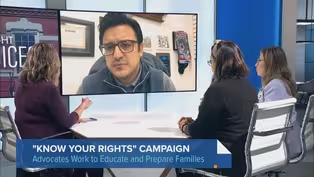
Chicagoans Share How Immigration Raids Are Affecting Local Families
Video has Closed Captions
Clip: 1/30/2025 | 9m 29s | Some local families are now facing the legal battle of fighting deportation. (9m 29s)

How Immigration Raids are Impacting Local Businesses
Video has Closed Captions
Clip: 1/30/2025 | 3m 50s | Many Latino neighborhoods are on edge amid fears of federal immigration raids. (3m 50s)
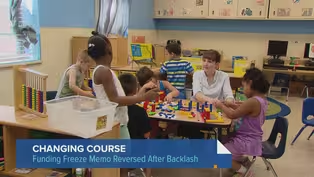
Illinois Nonprofits Concerned About Future of Federal Funding
Video has Closed Captions
Clip: 1/30/2025 | 10m 18s | Local organizations are facing an uncertain future. (10m 18s)
Providing Support for PBS.org
Learn Moreabout PBS online sponsorship
- News and Public Affairs

Top journalists deliver compelling original analysis of the hour's headlines.

- News and Public Affairs

FRONTLINE is investigative journalism that questions, explains and changes our world.












Support for PBS provided by:
Chicago Tonight: Latino Voices is a local public television program presented by WTTW