Chicago Tonight: Latino Voices
Chicago Tonight: Latino Voices, March 6, 2025 - Full Show
3/6/2025 | 26m 48sVideo has Closed Captions
Joanna Hernandez hosts the March 6, 2025, episode of "Latino Voices."
How businesses and consumers are reacting to Trump’s tariff plans. And a program aimed at improving fresh food access loses federal funding.
Problems playing video? | Closed Captioning Feedback
Problems playing video? | Closed Captioning Feedback
Chicago Tonight: Latino Voices is a local public television program presented by WTTW
Chicago Tonight: Latino Voices
Chicago Tonight: Latino Voices, March 6, 2025 - Full Show
3/6/2025 | 26m 48sVideo has Closed Captions
How businesses and consumers are reacting to Trump’s tariff plans. And a program aimed at improving fresh food access loses federal funding.
Problems playing video? | Closed Captioning Feedback
How to Watch Chicago Tonight: Latino Voices
Chicago Tonight: Latino Voices is available to stream on pbs.org and the free PBS App, available on iPhone, Apple TV, Android TV, Android smartphones, Amazon Fire TV, Amazon Fire Tablet, Roku, Samsung Smart TV, and Vizio.
Providing Support for PBS.org
Learn Moreabout PBS online sponsorship>> Hello and thanks for joining us in Chicago tonight.
Latino voices.
I'm John on this.
Here's what we're looking at.
President Trump is delaying tariffs for another month, but local businesses and consumers are still raising concerns.
A program aimed at improving access to fresh foods loses federal funding.
What it means for Illinois farmers and food banks.
>> Becoming and remaining the stage or in city has been a bit of mayoral tug of war.
And with sentry cities in the spotlight on Capitol Hill this week, a look at how Chicago got designation what it means.
>> And now to some of today's top stories, Governor JB Pritzker is pushing forward with his plan to ban cell phones from school classrooms.
Today he joined school officials at a high school in Champaign to announce a bill that requires all school districts in Illinois to implement a policy banning the use of phones during classroom instruction hours.
Pritzker says the change will create a better learning environment for both teachers and students.
Township going get.
>> Pew research study found that 72% of high school teachers identified cell phone distraction as a major problem in their classroom.
Other independent evaluations have shown phones increase, harms of social and mental health foster academic dishonesty >> Champagne is one of the school districts in Illinois that are ready has a no cell phone policy.
And city lawyers are recommending paying a woman assaulted by a Chicago police officer $280,000.
Mericle Boyd was an 18 year-old activist during the summer of 2020 when protests erupted across the country, including in Chicago following the police killing of George Floyd Boyd was at a protest in Grand Park recording an arrest on her phone when a police officer knocked the phone out of her hand, causing it to strike her face and knock out her teeth.
The officer has since resigned.
City Council is set to consider settling boys lawsuit next week.
Chicago taxpayers have spent at least 7 million dollars to defend and settle lawsuits tied to the 2020 summer protest.
And prepare for traffic delays.
If you're driving through parts of Logan Square starting today, the next phase of construction is underway along Milwaukee Avenue leading to some road closures and reroute there will be a permanent closure along Milwaukee Avenue through Logan Square Park traffic around the Logan Square Circle will be redirected to the outer lanes and no parking will be permitted in certain areas.
So make sure to keep an eye out.
This work is part of the Chicago Department of Transportation's 27 Million Dollar Project to upgrade the infrastructure of the Milwaukee Avenue.
Streetscape and Logan Square Circle improvements will include a variety of new upgrades like pedestrian crosswalks.
New street lights and off-street bike path into community spaces.
>> And the winner of the vote to redesign Illinois flag is the existing state flag.
A public vote was held as part of a design contest featuring 13 different flag designs.
But ultimately the current flag received the most votes.
Illinois Secretary of State's office announced today that the existing flag received 385,000 vote or 43% of the vote.
That was larger than the next 5 designs combined.
The results of the online votes are non-binding, but they will prepare a report that the Illinois Flag Commission is scheduled to release the General Assembly by April.
1st, lawmakers will have the choice to adopt a new flag or keep the old one.
The tariff whiplash means for you.
That's right.
After this.
>> Chicago tonight, Latino voices.
It's made possible in part by the support of these donors.
>> Businesses and consumers are bracing for a trade war with America's biggest trading partners.
President Donald Trump is pausing.
25 1% taxes on many goods coming from a vehicle in Canada.
Again after just imposing them on Tuesday.
He's also moving forward with 20% tariffs on Chinese imports.
This the change comes after companies voiced their concerns about cost.
The stock market tumbled and the country's responded with their own Connor tariffs.
Joining us with more our Indiana 5 ago, economics professor at DePaul University man.
It gotta owner manager at a college Western Wear.
A family owned business and West Town.
And is Evan Hull teen vice president of the Illinois Farm Bureau.
Thank you all for joining us now.
This has been a hot topic.
There's so much to talk about.
So want to start with you in a new update today.
As we just heard, the Trump administration is delaying tariffs for one more month for make go and Canada goods but still plans to impose a rep Rakell tariffs starting April 2nd, can you tell us what that means?
>> Well, to be honest, there has been a lot of confusion, especially then implemented these policies, Senate and very way without previous announcement.
he changing the decision.
So the latest West said deadly but no debt cancellation know if types and that he's also planning to impose return to Tory at tight their country.
So that have create a lot of insert uncertainty.
And even though you said DeLay is not a consolation and they still carry the about what will happen after April.
Second, as you just mentioned, delay, not a cancellation and and this is the second change that Trump has announced in less than.
>> 24 hours.
The first update gave the car industry a one-month delay for those tariffs.
What are your thoughts on these constant back and forth changes its video, fortunate that this president making this decision?
really creating lot of uncertainty.
>> Across the unfortunately, you know, violates to some extent they free trade agreement that was initially signing 2020 and reaffirm.
But these president in it was a region it in 1994, the first trade agreement.
Then it was reaffirmed by the same precedent in 19 in 2020 and now he is using a special provision that he argues he's related to national security violate the is free trade agreement.
Now the latest he said the consolation on the applies for the products that in accordance with their late this agreement.
So it's not the flu constellation old times.
It's on a delay on the for those products that are because he's done with agreement 2020.
But you're saying bring some confusion.
Exactly.
And this on the covers around 30% of the products coming from Mexico on may be around 50% or so from Canada.
So it's still remains a lot of impact in the short term.
>> And Evan, I want to bring you in.
Are you concerned that Trump's trade policies will make things even more challenging for farmers like yourself?
>> Yeah, I think, you know, uncertainty is is the proper term here, right?
farmers face uncertainty every year with weather.
you know, we expect some of that.
you know, we want consistent trade agreements Mexico and Canada are number one.
And number 2 trade partners.
And so consistency and certainty in that really makes it easier for us because American farmers to navigate an already uncertain business kind right.
>> And what with that?
Consistency look like.
What are those chats among other farmers?
What does that look like?
>> Yeah, I you know, just honoring current trade agreements, we have looking to build out new trade agreements with new partners.
You know, the U.S. is is just built to be a great exporter and products.
But in all products, right in utilizing our ability to be a net exporter steers and our ability to be profitable.
So just continuing to build on the work that's already been done to build the USMCA and other trade agreements has really what we're looking forward to have that consistency.
>> Are you hoping that the administration provide some type of aid?
>> Well, I mean, you know, historically trade agreements tend to culture and farmers, the artist and so we hope we wouldn't be forgotten if if it gets to that point.
But as I said, we really want rain and we want markets.
We don't want a system.
right.
want to sell the products that we're so good at producing just continue to build on on the work that's been done to get to where we are with the Strait things.
>> And many.
What are your concerns about these tariffs as a small business Our concerns are really when it comes to the consumers.
I think that's one of the biggest impacts that I think throughout different different industries are definite The last thing we ever want to do is have to raise our prices due to the cost of products being more expensive to get over it across the border.
But unfortunately with the officer and that he is like things are as they navigating through.
This is it's going to take some time.
But where excited will wear anxious to see, guess where things are headed.
Have you seen some impacts in terms of customers coming in?
What does that look like?
How would you describe that to people?
Yeah, definitely.
I think people are a little bit more cautious with their with their spending.
They're definitely gonna figure out what's more important to them.
businesses like ours are a little bit more nations smaller that rely on these consumers to come are.
I definitely feel it because lot of people are just going to be more cautious about where they're going to spend their dollars just a year, but disappointed on these on the more more uncertain, more than anything, you know, where pretty resilient family.
We can definitely pushed to a bow.
It definitely cause some some kind of concern Guess is that he 53.
63 is a time.
So it's a family-run business.
It is.
It is.
Grandfather started by father and his brothers and sisters made its where now myself, their generation and my cousins hopefully take it to the next level.
Yes.
Now.
>> Now I want to mention in this congressional address Tuesday, Trump reminded us that this isn't the first time he's launched tariffs.
Let's take a listen.
>> The tariffs will go agricultural product coming into American our farmers starting on April 2nd.
>> It may be a little bit of an adjustment period.
We had that before.
When I made the deal with China, 50 billion dollars of purchases.
And I said just bear with me and they did.
Probably have to bear with me again.
And this will be even better.
>> Evan, do you think farmers can bear with him for a second time?
>> Well, you know, I I think the real question is is, is how You know, do we have to bear bear the brunt of of You know, uncertainty.
>> Can maybe be For a short time.
as I said earlier, it's just, you know, we spend so much time and effort as a country as an industry building out these trade relationships.
And, you know, I mean, 40% of our corn goes to Mexico.
We taking a lot of time and effort by a lot of people to get us to this point to have that export market.
And so, you know, we just really want and hope that the president will honor the terms of the USMCA stick to fair and level playing field when it comes to trade relations and for us as American farmers, the opportunity to sell our products that we're so good at producing in a global community.
There's a big partnership.
They're living in a somewhat used to work for the Department of Commerce and make Equal.
>> You know, the Trump administration is also saying that companies should just move manufacturing.
>> Out of other out of countries to America to avoid Perry paying the tariff.
How realistic for companies to do?
>> Well, video is to keep you are just giving them one month to adjust again, there a lot of uncertainty in that area.
But yeah, you know, I just wanted to highlight there a couple graphs that I wanted to show that highlights.
Also the magnitude of the sea impact.
And I don't know if they have it.
There.
The pointed out what Kevin mentioned that Mexico is the first trade partner with United States and followed by kind of that and China and there is significant rain between countries and that what is called the supply chain to fit.
That goes back to your question.
These producers have constantly trading back up for and put in order to generate the final up with mission in mind affecting so outrageous times with Justice wrote that supply change.
Like I didn't mention, it's taken time to build a partnership.
Exactly.
will create a lot of disruption and that supply chains as well.
It's not just about and we'll be a particular physical plant this about restructuring, then tiger supply change.
And that would take at least a couple of years and many your business or says much of his live there from a key goal.
>> You know, why not just buy American?
And, you know, when it comes to quality goods, I think we expect them to come from here in the U.S.
But also they do come from Mexico as well.
a lot of manufacturers.
>> To get products from Mexico.
And I think that there definitely in a we always just shops shop locally, support your small businesses and definitely whatever it takes to get this economy going.
>> appreciate.
Thank you all for your input very important to highlight the magnitude of but for domestic consumers, you know, a type dementia.
said tax and there are some estimates that indicate that families will be impacted in the ranch.
1002 up to a 2000 initially for family per year in extra cost and it could be significantly higher if we could see there they supply chain.
Your pick.
And then just average car industrial.
So it's going to significantly affected.
You could expect to pay around 3,000 and up to 6,000 extra for a time you've got a really big impact there, right.
Coming up to leave it there.
Leon, thank you very much all of your input.
>> Coming up, how Chicago became a century city and what exactly that means.
We explain next.
Dangerous cities are under pressure from the Trump administration.
Mayor Brandon Johnson defended Chicago's history of protecting undocumented immigrants before a congressional committee in DC on Wednesday.
It comes as the Trump administration and Republicans in Congress are trying to strip state tree cities of all federal funding in tonight's Wbtw News explains series.
We explore how Chicago became same tree city and what it means.
>> for decades, Chicago has held the designation of a state city.
But what does it mean and how has Chicago status indoors, the term sanctuary city reverse any jurisdiction that discourages limits or denies cooperation with federal immigration authorities.
There are currently hundreds of sanctuary communities in America and 13 same jury states.
Where did they come from while Berkeley, California claimed the title of first same jury city in 1971.
The sanctuary city movement really began popping up across the country in the Mid 1980's as President Reagan focused on identifying and deporting undocumented immigrants, churches opened their doors to provide shelter in resources for Central Americans fleeing civil war and violence in Chicago becoming and remaining a stranger.
Every city has been a bit of mayoral tug of Mayor Harold Washington first declared Chicago a stranger every city in 1985.
Via executive order.
>> The order prohibited police and city employees from questioning residents about their immigration status and terminated cooperation with federal immigration authorities.
Some argued the policy shielded convicted criminals from deportation.
And in the 1990's, Mayor Richard Daley interpreted the policy to allow city officials to provide immigration information to the Fed's is the subjects were involved in serious crimes, Chicago, same tree policies when from executive order to a strong law with the 2006 welcoming city ordinance in 2012, Mayor Rahm Emanuel in the city council weaken the law, allowing police to work with federal officials in limited cases in 2016, President Donald Trump threatened century cities with the loss of federal dollars.
Nevertheless, Chicago City Council voted to reaffirm ordinance under Mayor Lori Lightfoot and expanded welcoming ordinance close the loopholes open by Daley and Emanuel banning all police cooperation with federal immigration authorities.
Chicago enters its 40th year as the same tree City Mayor Brandon Johnson has reaffirmed Chicago's commitment.
And today thousands of refugees and undocumented immigrants have found a safe haven in Chicago.
A point of pride for those who believe offering sanctuary is a matter of human rights.
The point of consternation for those see it as a hurdle for law enforcement.
And you can find the rest of our wbtw news explains series on our website.
>> And up next, the Trump administration ends reimbursements for Illinois food programs.
What that means for local farmers and food banks.
A local program aimed at improving food axis is in jeopardy as a Trump administration cuts off federal support.
The latest cuts and reimbursements to local food purchase assistance program from the U.S. Department of Agriculture, Farmers and Food Banks across Illinois now face uncertainty as planting season approaches.
Joining us is Capitol News, Illinois State House reporter Ben Solensky.
Thank you for joining us.
Ben, let's get straight to it.
Can you just explain how the local food purchases since program works and who is it aimed at supporting?
>> Yeah.
People probably know this program more commonly known as Illinois Eats.
And basically this is a program for both farmers and people who are in need of food.
People who struggle find food, especially healthy food.
So this program essentially provides reimbursements to state of Illinois to cover grant program for Illinois farmers to provide fresh food and vegetables to only food banks and other places where people can access food.
the real kicker with this program is it's designed to help people who have a hard time finding food.
They may not have a grocery store that's readily available to them and some of their best food options just aren't the most healthy options.
So this is a program that really supports Illinois farmers and providing fresh food and then it also supports people are hungry and in need of food.
>> So, Ben, are we talking about food banks?
Like food pantries?
Yes.
>> Yeah.
So this goes to food pantries the Really any place that distributes food to communities across Illinois.
So are places where people going very need of food.
Grocery store could be an affordable option for them.
It may not be a healthy option for them.
And sometimes they struggle to find healthy options at these sort of places.
And this was a way that the federal government and the state of Illinois, the greatest going to be a good way ensure that fresh food gets into those locations.
>> And has a U.S. Department of Agriculture given an explanation for this decision.
>> Now the state just found out about this earlier this week that this program basically being ended on the federal level.
The federal government is not going to reimburse the state for any cost incurred since Donald Trump took over as president.
So the state on the hook for 18 million dollars the federal the state for reimbursements as part of covering this program.
I didn't receive any response from the U.S. Department of Agriculture.
The state got no explanation when they were told this program is ending.
Illinois farmers got no explanation.
So we're really unsure exactly what happened here.
>> Have you been able to get some feedback on you know, some of the people who work at these food pantries, you know, what are they telling you?
>> Yeah, the farmer I spoke to down in Kankakee County, she told me that she's really concerned mostly about the people who depend on this program as a source of food.
She said that, you know, as a farmer show, she feels like she'll be okay with her business being able to continue selling food.
But she's really worried about people in Pembroke Township where she is located, which I think a lot of viewers probably know is one of the more poor communities in Kankakee County.
And she said there's no grocery store there.
People are.
Many residents are food stamps and the food that comes through this program and goes to locations that distribute food and Illinois.
It's really critical for a lot of people who participate in the Elm it its program.
And she's most worried that they're going to have a hard time accessing the fresh food that comes directly from her farm and goes to locations because there's no grocery store, other place that actually provides fresh food in that community.
>> Have state officials responded to this?
>> Yeah, the governor, he's been with virtually majority of Donald Trump's policies is very upset about this program.
He said that this is essentially just another slap in the face that the Trump administration has taken against poor people.
Other state officials who head up the Department of Human Services and the Department of Agriculture lamented how this program is very important for both the farmers and consumers and that this is really taking away a final human service that the Department of Agriculture has been reimbursing the state of Illinois for.
There's a lot of frustration.
I think one of the things we're going to be watching for going forward is does the Pritzker administration plan engage in any more lawsuits against the Trump administration?
Because they're our reimbursement that the state of Illinois submitted to the federal government and now they're not going to get them.
So that could be a legal argument here that the state this money and this program needs to be seen through its fulfillment.
That and the state and federal government have already agreed to.
>> And then talking about moving forward to these cuts mean that the program has officially ended.
>> Yet the hope really, from folks who I've talked to who are part of this program, they hope that this is a pause because we have seen so many changes to the Trump administration's policies.
Things have been paused they said they're going to do things and then they changed mind about what exactly they're going to do.
So there's hope that eventually this program may be brought back.
But right now for all purposes in the state of Illinois, the state can't really carry out this program because they're not getting the funding from the federal government to actually cut the program.
So therefore, the state's not going to be putting forward more class and they're at for this program.
So right now it's what people hope is paused.
But it's unclear how long that caused blast that could last for very long time.
We're gonna have to wait and see.
thank you, Ben, for breaking that down for us.
>> And that's our show for this Thursday night.
Join us tomorrow night at 5.37, for the weekend review.
Now, before we go, a note of congratulations.
What do studs Terkel Tokyo, Koko Taylor and Roger Ebert have in common.
They're all recipients of the University Club of Chicago's prestigious Culture award.
Now tonight's Wdw zone.
Jeffrey Baer joins that group.
Jeffrey is receiving the honor for his many contributions to Chicago's culture, historical landscape through his work on programs showing off the cities I could out beautiful neighborhoods in history.
The University club calls Jeffrey, Mister Chicago.
And we sure know him for that.
We call him our friend and colleague Jeffrey Kahn.
Graduations.
Now from all of us here, Chicago tonight, I'm joined 9 this.
Thank you for watching.
Stay healthy and safe.
>> When not >> Closed captioning is made possible by Robert a cliff and good for a Chicago personal
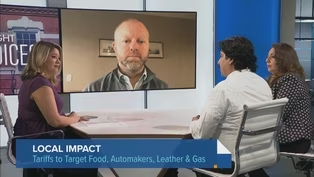
Local Businesses, Consumers React to Trump's Tariff Plans
Video has Closed Captions
Clip: 3/6/2025 | 10m 58s | President Donald Trump is again pausing tariffs on some goods from Mexico and Canada. (10m 58s)
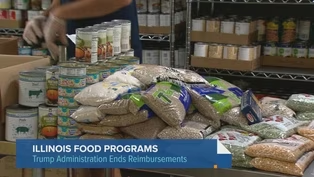
Trump Administration Ends Reimbursements for Illinois Food Programs
Video has Closed Captions
Clip: 3/6/2025 | 5m 33s | A local program aimed at improving food access is in jeopardy amid federal funding cuts. (5m 33s)
Providing Support for PBS.org
Learn Moreabout PBS online sponsorship
- News and Public Affairs

Top journalists deliver compelling original analysis of the hour's headlines.

- News and Public Affairs

FRONTLINE is investigative journalism that questions, explains and changes our world.












Support for PBS provided by:
Chicago Tonight: Latino Voices is a local public television program presented by WTTW