Chicago Tonight: Latino Voices
Chicago Tonight: Latino Voices, Oct. 10, 2024 - Full Show
10/10/2024 | 26m 46sVideo has Closed Captions
Joanna Hernandez hosts the Oct. 10, 2024, episode of "Latino Voices."
Outrage and confusion over potential charter school closures. And we’re one on one with Johnson’s chief of staff on funding for Chicago Public Schools.
Problems playing video? | Closed Captioning Feedback
Problems playing video? | Closed Captioning Feedback
Chicago Tonight: Latino Voices is a local public television program presented by WTTW
Chicago Tonight: Latino Voices
Chicago Tonight: Latino Voices, Oct. 10, 2024 - Full Show
10/10/2024 | 26m 46sVideo has Closed Captions
Outrage and confusion over potential charter school closures. And we’re one on one with Johnson’s chief of staff on funding for Chicago Public Schools.
Problems playing video? | Closed Captioning Feedback
How to Watch Chicago Tonight: Latino Voices
Chicago Tonight: Latino Voices is available to stream on pbs.org and the free PBS App, available on iPhone, Apple TV, Android TV, Android smartphones, Amazon Fire TV, Amazon Fire Tablet, Roku, Samsung Smart TV, and Vizio.
Providing Support for PBS.org
Learn Moreabout PBS online sponsorshipvoices.
I'm John that mount this.
Here's what we're looking at.
More than 2000 students may have to find new schools as a charter operator plans to shut down 7 locations.
We sat down with Mayor Johnson's chief of staff to talk about Chicago public schools, fundings.
In new Chicago stories, documentary dives into the history of the young Lords of Lincoln Park.
>> I wanted to honor my father.
Going through the process.
>> And how organ donation impacted a local family.
>> And now to some of today's top stories.
Parents and teachers are feeling blindsided this morning after finding out about potential school closures.
That's after a settled charter schools announce its plans to shut down 7 of his campus is impacting more than 2000 students.
The board of directors last night adopted a resolution that allows for what it calls a strategic reorganization of school operations.
It would lead to the closures of produce K through 12 gas se settles went this possum, Diego and the Mayo Elementary schools.
A settle says the plan was spurred by declining enrollment and increasing personnel in facility cost the closures which are finalized yet.
What happened next June.
Also slated for closure is a migrant shelter in Little Village.
State officials say the shelter which opened in January at the height of the crisis, now houses 146 people.
Officials say they will be offered spaces.
And one of the 14 migrant shelters, the city will continue to operate and the effort will be made to keep children close to their schools.
It's the 4th shelter to be closed by state and city officials since the beginning of October.
The shelter is set to close November 3rd.
While Chicago and its school districts are grappling with deficits and possible property tax hikes.
Cook County's budget plan has no new tax fees or fines or fees board President Toni Preckwinkle is proposing a nearly 10 billion dollar budget that she describes as a good news budget per Pringle says the budget plan in the county's financial situation are the product of smart policy over the years.
>> We avoid using one-time revenues for recurring expenses.
>> We don't borrow more than we need.
We don't spend more than we have.
We don't do quick fix us.
Instead, we've committed ourselves to finding structural solutions to balancing our budget.
>> Arrieta proper angles plan includes investments in opioid addiction initiatives, community violence, intervention.
>> And adding employees says at the assessor's office to help with property valuations.
However, next year will bring a temporary hiatus of the Guaranteed Income Program.
Foot per Pringle says the plan she plans to bring it back.
A final vote on the budget is scheduled for November.
21st and joins us and joins us Monday night when Tony per Pinkle joins us to break down the proposal to and posh Chicago is helping animal shelters in Tennessee that were impacted by Hurricane Helene volunteers this afternoon returned to Chicago and brought back more than 20 dogs and puppies that we're ready in shelters before the storm storm hit spokesperson with pass as by taking in the animals.
It allows local teams to focus on rescuing and reuniting displayed displaced pets in communities that were impacted.
The dogs will be available for adoption in a few days with the puppies in a few weeks.
Keep an eye on PA Chicago's website and social media for updates.
Up next, the mayor's chief of staff joins us in studio with the latest.
Some funding for Chicago Public Schools.
That's right after this.
>> Chicago tonight, Latino voices is made possible in part by the support of these donors.
>> All eyes have been on Chicago Public schools this week.
A quick recap.
Mayor Brighton Johnson named his new picks for the school board after the entire seven-person board announced their resignation.
This as tensions are still flaring between the mayor and CPS, CEO who he wants out and maybe the most pressing question.
How will the city's solve the district's financial crisis?
And joining us here to tell us more is Mayor Brandon Johnson's chief of staff, Christine, up a C on science.
Thank you for taking the time for being here.
So I want to start.
We had Mayor Brandon Johnson on Tuesday show where he maintained that those who oppose his vision also pose progress.
Let's take a listen.
>> Once upon a time black children was stuffed in Willis wagons because the school district refused to invest in them once upon a time, you know, we had black teachers in particular, black women overwhelmingly have been laid off.
That's what's being proposed right now.
The people who oppose my vision, the vision that the people of Chicago voted for.
They want to take us back to cuts and closures and privatization.
>> And as a state senator, you push for more state funds for education.
Why hasn't the mayor's office been able to convince state lawmakers and the governor to help Chicago Bridge the gap?
Well, I would actually have to say that we've been working closely with the governor's office, our financial team, as well as the governor's office financial team.
>> Are in close communication and coordination looking at not just a situation where we're bailing out CPS and we're bailing out Chicago.
We have some structural issues that we have to address.
Covid dollars are expiring.
We have a diminishing returns on revenues such as the personal property replacement tax.
And that's because Trump had lifted the caps and corporations are able to write off more and not put money into the this the revenue stream, which is basically now creating the deficit that we have for 2024 and some of the forecast of 2025, these 2 teams are working on strategies that will assist all municipalities across the city to deal with both of these issues.
as we also will see, Omar Co Martinez spoke with our colleague friend is Freeman last night.
He detail some of the private conversations between himself >> and the mayor.
Let's take a look at them.
>> We were very disappointed by this that we got back was even though the South we can make any more cuts.
You may know the cause you can make.
You should really think about because eventually borrow and we took the position of okay.
Maybe they don't understand the history or the risks.
The CPS has some borrowing because we went through this path before back in the years of 15, 16 17, the district took out 2 billion in loans and refinancing means and today man is in my deficit.
I am paying 194 million dollars and interest-only payments.
So we put that in the memo.
Sure they would share with the mayor even share with privately that really didn't feel he was getting the best counsel.
He listened came back, so insistent on the lawn.
My board said we cannot.
>> Now is it possible for the city to use more than 30300 million in funds which are now reserved for tips to fail.
Cps, budget deficit.
So the mayor and the CEO did have a conversation about tips or place.
There was always a commitment.
>> To meet that obligation per statute with that have surplus, though, what we also have to understand those dollars also go back into other taxing body, such as the parks such as the libraries, city colleges and in this whole budget cycle, we are working out the analysis to figure out how much actually can go and to the school budget.
But I think what's important to note is that the budget that was passed back in July did not include all of the expenses that CPS actually has to account for.
That is inclusive of settling the contract with teachers and sell it, settling the contract with principals.
This is the first year that principals are actually collectively bargaining.
I actually participated in the process of establishing that particular bill.
They also didn't include a pension payment for the employees that are non teachers.
So what was presented in July was not even a full picture yet in past budgets, we have been able to get CPS to make a commitment towards their pension payments, which they should because as they move into an independent school district, they have 2 independent.
We cover the costs of their expenses.
No other sister agency expects the city to pay for their pensions.
And yet in this particular case, CPS just seems there's just so many layers.
So many opinions.
I have to ask if the nicest pushed out.
>> What's the likelihood you'll be considered for the job?
No, I'm the chief of staff to the mayor.
I'm not going anywhere.
>> Would you do something differently in that role?
You were considered for job?
The advice I would give any CEO is to adapt and to effectuate the vision that the mayor has laid out.
I think the mayor coming from Chicago, Public schools as an educator, both in middle school and high school as a parent who has children in those schools as an organizer who constantly fought for full funding for schools, who better to be articulating the vision and enforcing that it needs to actually manifest.
I think he knows the visceral reaction when you go into a school and you are asked to literally make lemonade out of lemons.
I think he knows when he dropped his children off at school and how he has to take his kids all the way to the South side to get the types of resources that he wishes they could afford on the West side.
But they're not available.
And so those types of things are not radical.
All we want to make sure is that young people and children are wrapped around able to live up to their fullest potential in the adults around them have what they need to do that.
You know, this seems very complicated.
But for parents who are watching right now in seen this public rift with Pete with CPS, would he want to tell?
Parents were trying to understand?
>> I think the vision of the mayor's simple.
All right.
We want to transform the Chicago public school system for too long.
We have been living in chaos for too long.
We have accepted subpar standards for too long.
We have adopted.
>> Status quo which is closing 50 schools.
We have allowed previous appointed boards to do a no-bid contract for a former employer of the CEO.
We have allowed the books to be cooked in terms of graduation rates.
We have privatized services and paid more money but receive less quality.
Olive that is disruption and chaos.
I can tell you I have 2 children in Chicago, Public Schools, one in a neighborhood school won a magnet school.
>> I walked to my son to school every day this week.
There was no chaos.
There was no disruption.
Teachers were teaching support.
Staff were wrapping around.
My principal assured us that he was there as the instructional leader, our local school councils are making sure that our schools are following their school improvement plans.
This is really about transformation.
And we're at a turning point in the mayor is not afraid to make those decisions.
And, you know, we only have a couple seconds behind.
Would you say to those parents, again, how is this tome turmoil going to affect their school or or their child?
Day-to-day operations have not been affected.
I actually served on the state Board of Education.
And when you are a board member, you are making policy decisions at a 30,000 foot level.
And what I can tell you is that day-to-day operations are functioning and this site based management teams, your local school councils really have the deepest impact on how those schools are run.
Plus the principles and as I said, principles are showing up.
Everyday teachers are showing up every day.
Children are learning.
Let us work out these details because this is really the brink of educational transformation.
Well, thank you for taking the time for being here.
Thank you.
And if you're looking for more content on the complicated issues that are facing our city, sign up for our e-mail newsletter, the Daily Chicago in.
>> Visit Www Dot Com Slash newsletter to have it in your inbox tomorrow morning.
Up next, meet the young lords of Lincoln Park.
The young Lords of Lincoln Park went from street gang members to revolutionaries organized and fought against several injustices, especially gentrification in a new Chicago stories, documentary outlines their entire story.
Let's take a look.
>> And the turbulence streets of 1960, Chicago, a fierce struggle unfolding.
They driving a They're killing us.
And then we want to kill On one side.
The city of Chicago.
In effect, the federal government was about to devastate their community.
On the other side, the people.
>> It was a perfect storm.
Communities were ripe for a Batman.
>> And here to talk more about the history and current activity of their work organization are lot about this.
original member of the young Lords and executive director of and Palm Yanis, the deputy chairman of the new era Young Lords.
Thank you both for joining us.
You know, I got a chance to watch some of the documentary and it's just remarkable to see that piece of history that took place in that neighborhood and no more.
I want to head back to the 1950's at that time.
Lincoln Park was known as one of the poorest neighborhoods in Chicago.
The population was mostly white until Puerto Rican started to arrive in the area.
Tell me a little bit more about your story, how you got involved with the young lords.
>> I got because obviously teenager at the time and we had communication inside live Humble Park.
And we had communications with the games and income part and that's how we became you know, we came up a point each other.
This how we started.
>> And so we were aware of what's going on in both neighborhoods.
Lincoln Park in Humble Park at the time.
But it would concentration of Puerto Rican families was really And at that point in Lincoln Park, this where everything was going on.
>> And when you started to, you know, be more involved with the young lords.
What was your role?
>> I became the minister of information for the young that simply meant that I was in charge of all the communications that were coming out of the organization slogans than most people putting out leaflets, things like that.
But, you know, we were also involved the programs, but those with a specific task that I had with that with the young lords.
>> are you officially joined the new area, young lords in 2021 and help build the Illinois chapter and through that process.
you had conversation with previous young lords, including Omar, how has your history help shape how you organize the community today?
>> So their history has helped in many different ways.
I've used it as a stepping stone to understand the systematic issues that they faced back in the 60's.
And how that relates to the work that we're still doing today.
And in many cases will say like the actors and the worried around certain havs changed.
But for the most part of the systematic structures are still there and still present in our community.
So when I look back at how the young lords had to move then and what we need to do now, it's still relevant.
We still have a food desert and food disparity.
We still have housing issues and prices.
They're still police terrorism.
I will go a little bit beyond just common police brutality because terrorism affects the mind and how you react every day.
And so it's it's a lot more complicated than just speaking out about it as brutality.
And Paul, you you mentioned that you were in high school when you learned about the young lords.
>> What attracted you to them?
So I actually went to grade school in Lincoln Park.
I went to Abraham Lincoln Elementary.
>> Which is only a couple blocks away from the old Stone academic building that was taken over in the documentary.
Going to school there.
from first grade to 8th grade I had no idea that there was Puerto Rican.
Instead, just in that community a decade earlier Sunday that looks so different.
Yes.
And so this is 85 86 around there.
>> And so when I got into high school as I got older, that's when I started to look at how.
Puerto Rican issues and and Mexican and Latino issues and also how they overlapped with a lot of the black issues and in the black community.
And so that's kind of where I started today.
try fill that connection.
Yes.
>> And are the documentary touches on several significant moments.
One in particular was a killing of an with mulls.
Another member of the young lords.
He was shot by an off-duty officer.
This tragedy led to forming alliances with other groups like the Rainbow Coalition.
With that, that moment bring forth for the young lords at that time.
Well, the killing of Monroe time was Prince was pivotal in the development of the organization because at the beginning, our chairman was having a hard time convincing the members.
>> Over the of the owners to become political, they wanted to remain in this social club, petty crime, that type of thing intention wanted to move forward.
of course, he told them why, you know, because of police brutality, terrible housing.
It wasn't until 9, 0, was killed on.
Fortunately, that's point in which the rest of the members that we're assisting change, she added, Yes, you know, this is what we have to move.
We have to move forward.
We have especially because the field they had no recourse after minor was shot and killed.
They didn't see any any action against the off-duty policeman to kill them.
So that was pivotal in the to the organization.
I think from remember being scared at that time would would you feel?
>> You know, when you leaving that situation is not this end of the year.
New not scared.
You know, you're developing ways of navigating, you know, all of That violence.
>> I think if you think back then can see we just racing, you >> But you did it.
I mean, you created health clinics fed the community.
I mean, how important was after the people in that neighborhood absolutely necessary.
We did that because there was a need for The families who are not getting adequate health care.
>> They were not having decent housing and that was it all responds.
You know, once we can political, that was a response to the needs of the community.
Will we said sure the people.
And those were the things really the young I well known for.
That was the confrontations with police, but program.
So what they did, you know and we don't have time for one other question.
But I want to go to you, Paul, what do you think the legacy of the young lords did for not only Chicago but the country?
>> The legacy for me.
It inspired a new generation.
We see that with the new era in the work that we're doing.
But it also like I said before, you could give us that stepping stone.
It allowed us to understand certain things.
And it was unique in the way where they did start off as a social And then through a series of circumstances eventually did go political.
And when you look at that and the significance our communities now in state Chicago, now you see that there is a need for that.
More young people getting politically and involved in active.
So think you're going to have to leave it at that.
He'll definitely recommend people.
>> To go watch Thank you for both of you.
Thank you.
To learn more about Chicago's history with the young Lords of Lincoln Park.
Be sure to catch the new Chicago stories documentary.
>> Which premieres tomorrow night at 08:00PM.
Now back with more.
>> Just in a moment.
Stay with us.
>> a local organization is urging residents, especially Latinos to become organ donors.
According to the gift of hope organs and tissue donor network, 95% of people in the U.S. support donation.
But less than 60% are registered donors.
We visit a family with long roots in Chicago as they share how organ donation touched their lives.
>> This is 70th 70th birthday for a home full of memories and a family missing their fathers.
My dad was the patriarch of our family.
>> He was a a kind person.
He and a warm smile.
And he was very loved.
>> Out sentiment goal was 78 years old when he died from heart failure earlier this year.
>> I grew up seeing him as like a superhero, you know.
Nothing could hurt him.
>> For Medea Soleimani, a losing her husband in travel partner, a 56 years is a process, you know, come assist.
That I know is get out.
And we've got, so Google.
>> It was that I let So but he a student?
>> His family describes him as hard working in giving when he died.
The family received a call from the organization Gift of Hope asking about the possibility of a donation to help others.
He donated tissue from his body bones from both arms and lives.
>> And It It should.
O de Leon was a registered owner.
>> That's a beautiful thing that you keep some leading, by example, even though for Latino, the such a taboo right to talk about genital Mingus from gift of Hope says.
>> She's been working to dismantle the myths surrounding organ and tissue donation.
She developed a state-wide.
He's spending program for the organization.
She just it is hard for someone understand that one individual can actually help safe.
>> Up to 8 lives and enhance the lives of all.
They're 25.
>> Dominguez says the Latino community is one of the groups with the highest need for organ transplants.
Yet.
>> We are at the group to donate well known to register and it is important because I know we can make a difference.
>> coffee >> Missy I'm going see that the do that.
see that bundle up.
But it took build it.
You can say given us that Hiroki.
Seed, this impacts on that.
But I want some.
>> But on that line, >> as they look through photos, the family shares what life was like for them in the early 70's selling tacos in Humble Park, something they did for more than 40 years while owed.
And you'll also was in the midst of a long career with the CTA.
>> He was raised by a single mom and the ports neighborhood of Mexico City.
And coming here and giving us this life and opening up all types of doors for us is unbelievable.
>> A father of 4 with 13 grandchildren.
>> Him being the registered owner and giving back.
It's something that.
Everyone should consider.
>> And they get the hope to use cause donation may help more than 75 people.
What a beautiful gift.
And that's our show for this Thursday night.
Join us tomorrow night at 5.37, in 10 for the weekend review.
Now from all of us here in Chicago tonight, I'm joined on Thank you for watching.
Stay healthy and safe.
>> When >> Closed caption made possible by Robert a cliff and Clifford law.
a Chicago personal injury and wrongful death.
That is proud to recognize it's turns
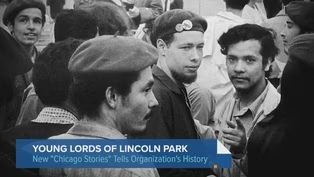
Documentary Dives Into History of the Young Lords in Lincoln Park
Video has Closed Captions
Clip: 10/10/2024 | 7m 55s | The Young Lords of Lincoln Park went from a street gang to revolutionaries. (7m 55s)
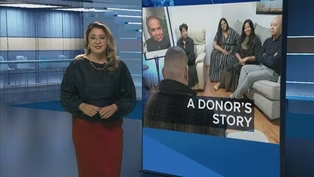
How Organ Donation Impacted a Local Family
Video has Closed Captions
Clip: 10/10/2024 | 3m 54s | The Gift of Hope Organs and Tissue Donor Network is urging people to become organ donors. (3m 54s)
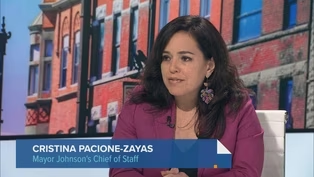
Mayor Brandon Johnson's Chief of Staff Talks CPS Funding
Video has Closed Captions
Clip: 10/10/2024 | 7m 52s | All eyes have been on Chicago Public Schools this week. (7m 52s)
Providing Support for PBS.org
Learn Moreabout PBS online sponsorship
- News and Public Affairs

Top journalists deliver compelling original analysis of the hour's headlines.

- News and Public Affairs

FRONTLINE is investigative journalism that questions, explains and changes our world.












Support for PBS provided by:
Chicago Tonight: Latino Voices is a local public television program presented by WTTW