Chicago Tonight: Latino Voices
Chicago Tonight: Latino Voices, Oct. 24, 2024 - Full Show
10/24/2024 | 26m 45sVideo has Closed Captions
Joanna Hernandez hosts the Oct. 24, 2024, episode of "Latino Voices."
Chicago has a new shelter plan for migrants and unhoused residents. And are efforts to save monarch butterflies doing more harm than good? A new study suggests that’s the case.
Problems playing video? | Closed Captioning Feedback
Problems playing video? | Closed Captioning Feedback
Chicago Tonight: Latino Voices is a local public television program presented by WTTW
Chicago Tonight: Latino Voices
Chicago Tonight: Latino Voices, Oct. 24, 2024 - Full Show
10/24/2024 | 26m 45sVideo has Closed Captions
Chicago has a new shelter plan for migrants and unhoused residents. And are efforts to save monarch butterflies doing more harm than good? A new study suggests that’s the case.
Problems playing video? | Closed Captioning Feedback
How to Watch Chicago Tonight: Latino Voices
Chicago Tonight: Latino Voices is available to stream on pbs.org and the free PBS App, available on iPhone, Apple TV, Android TV, Android smartphones, Amazon Fire TV, Amazon Fire Tablet, Roku, Samsung Smart TV, and Vizio.
Providing Support for PBS.org
Learn Moreabout PBS online sponsorshipLatino voices.
I'm joined on this.
Here's what we're looking at.
And effort to streamline the city shelter system to include both asylum seekers and longtime Chicago residents.
Warren House.
In local nonprofit says it at risk of losing their state funding.
What it could mean for their community.
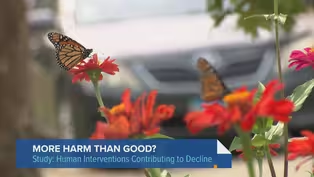
Are people living monarch butterfly to death.
A new study suggest human efforts to save them is contributing to their decline.
I would say just vibrant in color and sound.
I think that what we're really going all out to stimulate all of the senses.
>> And details on our free puppet show celebrating Indiana's with those.
>> And now to some of today's top stories.
Chicago has 7 new school board members.
They were all sworn in at today's Board of Education Committee meeting.
It's the first time the new board has meant since the prior board resigned amid ongoing tensions between Mayor Brandon Johnson in Chicago, public schools seal pit my theme.
might be in a school is also at today's meeting has said in recent weeks the mayor him to resign his position, but he has refused to do so.
Johnson is not able to fire.
My thing is that decision can only come from the board There's more on the new board members on our website.
And the train in a crash on the CTA yellow line had alcohol in his system.
That's according to a new report by the National Transportation Safety Board.
The train slammed into a snow plough on the tracks last November, injuring more than a dozen people.
The NTSB has not yet issued its final report.
And backers of a referendum on the Illinois ballot say lead to property tax relief, even though the question is just advisory, the question asked voters to weigh in on whether the Illinois Constitution should be changed.
So millionaires pay higher income tax to fund property tax relief.
Former governor Pat Quinn and Congressman has We've got are among supporters urging a yes to vote.
They say even though the results are not legally binding, lawmakers will consider the results when crafting policies in the future.
For more on what's in the November ballot.
Check out voter And advocates for afterschool programs are urging the state to release 50 million dollars in grant funds the grant money is set to support student programming throughout the city and state advocates say organizations have already have to cut youth programming across Illinois with more to come by the end of the year.
These programs.
>> Provide that beacon of light and communities to keep kids safe by Christmas.
This number will be 2000.
People have lost their jobs and 27,500 students.
We'll be with out programming.
>> And coming up, changes to how the city will house new arrivals and longtime on House residence.
A local leader joins us next to explain how it would all work.
>> Chicago tonight, Latino voices.
It's made possible in part by the support of these donors.
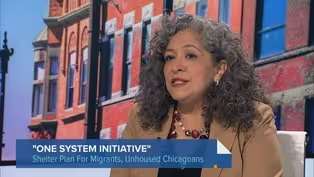
>> Chicago is set to overhaul its migrant shelter system in the new year limiting beds to asylum seekers who have been in the city for less than 30 days.
The new unified approach known as the one system initiative aims to streamline services for both migrants and longtime on House residence.
But concerns linger over the potential potential overflow in the city's ability to support both populations.
Amid rising demand for shelter.
Joining us now with more is Beatrice, Ponce de Leon deputy mayor of immigrant migrant and refugee rights.
Thank you for joining us.
So let's start off.
Can you just explain the one system initiative and how it will streamline the city's approach to sheltering will rival some longtime on House residence.
thank you for having me.
Appreciate the opportunity.
>> You know, when we started the arrival shelter system, it grew very, very quickly point.
We have 15,000 people in that system and we just knew that that was not sustainable.
We also heard loud and clear from community that they were concerned about our shelter capacity for other on how Chicagoans.
And so we began to partner with the state to move towards a unified system, which is the one system initiative.
What we just announced this week is that we will be closing the new arrivals mission.
And in January that one unified shelter system will be in operation.
The way to work is that some of the beds from the new arrival system, those shelters will remain in place into the new year.
All of the policies, though, that will manage this shelter system will be the ones that the traditional shelter system has.
So there will no longer be term limits shelter, stay limits and people will still be it separated families with children adults in separate spaces over time.
The populations of, you know, new arrivals and other Chicagoans.
We'll come together.
But that transition will take some time.
>> It seems to the big initiative, you know, why is the city moving to the system?
>> Well, like I said, it is something that we've been planning for.
We knew we needed a more equitable system for years.
Chicago has only had 3,000 beds in our homeless DFS U.S. operated system.
And that was just never enough.
And so we we try to work together again with the state financial commitments for both city and state to to make this combined system.
It aligns with our new fiscal year.
So it's kind of a clean break.
But also we have budgetary constraints like the reality is that we were not able to maintain the level of capacity that we have had a given our budget across the city where we're having to look at ways that we better manage the budget or, you know, make some cuts to help us get to a balanced budget.
And this is one of those ways.
under the new system, only 3 >> 1800 beds will be made available for asylum seekers.
How does the city plan to, you know, address potential overflow, especially during those winter months?
>> We put a couple things in place to try to bring down the number of people that that will need shelter.
>> One of them is the limit to who is eligible for the first time placement.
So the very first time that people come to Chicago and asked for shelter if their asylum seekers, we will only be providing shelter for people who've been in the U.S. for 30 days or less.
Our hope is that by getting that message out and we've already started to communicate that at the border in other ways is that people make choices before they come here about knowing understanding what the limitations are.
We have had the most expansive shelter, policy and shelter system of any U.S. city to city up until now.
And I am proud of the fact that we've all come to about 50,000 people.
We have prevented all of those folks from becoming unsheltered and connected them to many, many resources in partnership with the state and others.
We have to not make a shift as we go into this new year.
>> I can imagine not everyone's happy about the shift.
Yes, it's it'll be a challenge for I can.
But the landing zone, you mentioned that that that will also be closing and which is a location where asylum seekers would arrive via bus.
Now, what would that look like if there were people to arrive?
We haven't had a bulls in Chicago since in the Chicago area since June.
>> But people do come on their own about a 3rd are coming directly from the border border states.
And so we know that there will be some folks who will still come.
And as we phase out the landing zone November.
First, the landing zone will go to instead of being overnight to 08:00AM to 08:00PM and then by December 15th, the landing zone and the state's intake center will both be closed.
We are working towards as part of the one system, new physical access point that anyone who needs shelter can go to.
And that is a collaboration, state and city to have a new place that you can go to requests shelter for whatever reason have an assortment of supports and resources to meet your specific needs.
We can't guarantee a shelter bed for everyone.
We will have 68 beds available starting in January, but people will be given the opportunity to request shelter and be, you know, if there's a space available, be placed shelter and talking about homelessness.
I mean, this is something that Chicago has talked about that advocates have talked about.
>> You know, how do you go about when advocates say, no, there's not enough spaces are shelters for people who are ready living out.
How does that work in combining everything together?
>> Well, I think the goal of this system was to have a bigger, better system for all.
And we are going from 3,000 beds to 6800 considered permanent beds.
These are guys that will now be part of Chicago's homeless services system.
What we anticipate will happen is that new arrivals?
We'll start to move out the way they have.
They now have community here at the beginning of this.
You know, people were new to the city.
There was no community.
Venezuelan Colombian community are Haitian community large enough to really help each other.
But that is different.
We now have again over 50,000 around 50,000 people and we are working with the state to connect people again through rental assistance, connecting them to other nonprofit resources, helping people in their journey for work permits, hopefully getting them to a point where they don't need to be in shelter and they can be moving out.
It will be a challenging time.
I'm not going to sugarcoat that.
And we are doing our best to support people and prevent people from becoming unsheltered.
We will need to, you know, also see in the past and people still are doing this churches and others that have stepped up to support.
And I think Chicago demonstrated at throughout this whole crisis that folks have been able to to come together.
She kind a generous.
And when you talk about, you know, a challenging time, what would you say is the biggest concern?
>> The biggest concern is that being able to provide shelter for everyone that needs it?
We are again to our best to connect people to resources.
But I think that we will see through this and hopefully in this coming year we'll have a better system.
>> That is able to serve more people and do it.
Well, linguistically culturally with wraparound supports for anyone.
>> Now there is concerns and integrating migrant shelters, shelters for longtime Chicago residents might create tension or strain resources.
How is the city addressing those concerns?
We are the have no rivals in some homeless services shelters and those shelters to figure out the right balance >> but part of the one system initiative in the recommendations that came to us from providers in the working groups is to have additional training to provide, you know, bringing in organizations that know how to work with different populations.
And I think that as that work continues, it will make it will build the capacity of our shelter system to do that.
Our chief homelessness officers in DeSoto will also be launching a plan to create a five-year plan for addressing homelessness and part of the that work will be to look at those one system recommendations and to look at how to strengthen the system as a whole.
>> thank you for joining us and for that update.
Thank you so much.
Up next, our efforts to save Monarch butterflies doing more harm than good.
We explore that right after People have an infatuation with Monarch butterflies and that's especially seeing the Mexican culture as monarch symbolize a connection between the living and the dead.
Those fun connections to the beloved species have resulted in efforts to bring the butterflies back from the brink of extinction.
But a new study from the University of Georgia suggests we may be doing more harm than good to our when good friends.
Our own Patty Woodley joins us now to tell us more.
Patty had to tell on a butterfly's or one of my favorites the season.
You know, I talking about a Under Barr flies annually migrate to Mexico.
What did the study find about their migration?
>> Well, if found it took like 17 of data of observations of their recce, which is how they kind of all hang out together in trees when they're resting in the size of those routes.
>> Gets smaller and smaller and smaller.
The further they get toward Mexico.
And so the question is, why are we losing so many of them along the route?
Are they stopping?
Their migration?
Are they dying?
Did they lose the ability to migrate?
So those are the concerns as they're seeing the numbers drop off.
They start off strong and then so many of them don't make it to Mexico.
What did you find so interesting about the study?
>> Well, one of the culprits, as you mentioned, seems to be what's called tropical milkweed.
That is a non native milkweed.
Everybody's been told Plant Milkweed milkweed milkweed.
There's native kinds but tropical milkweed.
>> Is not native.
It's bad because has this parasite in it that does all sorts of things to the monarch at in terms of being either deadly.
They can't reproduce is well, they can't fly as well but also kind of messes with their ability to judge when they should migrate because it stays flowering so much longer in the north, they could miss their cue that they need to head south.
Another issue is everybody wants to cap to rear their monarchs.
They want to bring in those caterpillars and make them safe and then release them.
And those have been proven to not be as fit to make that trek south.
So we might be thinking we're planting milkweed.
That's great.
We're keeping them safe and then releasing them great.
But those things could actually be leading to declines in numbers.
So interesting.
I had no idea.
I know.
But that's what I'm here for that we're hope we can continue to keep the monarch safe.
We all Thanks.
And you can read patties full story on our website.
It's all at W T W Dot Com Slash news.
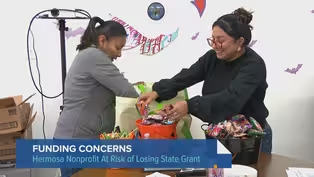
Residents on the city's northwest side may be losing access to programs provided by a local community organization.
That's because the nonprofit at Most a neighborhood association says it's set to lose or state funding in June.
The state awarded to Hunt too 244 million dollars in grants using funds generated from taxes on cannabis sales to support and invest in underserved communities.
As a grant and state approaches, community organizers are working to figure out what comes next.
Joining us now with more our Jim it.
But chuckle president of Neighborhood Association and now my cruiser.
The group's founding member and vice president.
We also invited the Illinois Criminal Justice Information Authority that handles a grant, but they declined to join us.
They did send us a statement and we will get to that later.
Thank you both for joining us.
I want to start off with organization was launched from a conversation about the community between UN residents.
Can you tell us briefly about the Neighborhood Association?
>> I Share, of course.
So unable station started back in group neighbors met in 2014.
>> It was 5 members Kahlenberg being original president and we are super grateful to him for done all the work and to be where we are And and we got our nonprofit status in 2015 and we were a virtual up until like 2 and half years ago when we get the grant, what was the motivation to open the overall vision?
Just, you know, we all agreed at community community needed more.
Services, more attention.
So we just did everything.
Virtually we had a community meetings to bring more information to our community, whether that the information on comment where they low low income nation to our residents, bringing in free life.
All anything like that.
And tonight you saw the need in your community.
>> Well, all the need is great, especially for the use where having a safe place for myself raising 3 children where resources are very scarce when needed to make sure that not only do we provide a safe space for youth teams from 12 to 19 to have somewhere to go feel safe but also have some skill building things that are necessary with our generation's nowadays that some of them may lack some of the social skill.
So we've seen them come flourish, have a safe space.
it was really a labor wants to together and can you tell us about the organization's current financial status for the 2 ation?
Yeah.
So I see, Joe, we're very grateful to them.
We have a three-year grant that is going to expire in June of 2025, we are an all volunteer board.
So we have been able to hire some staff to run the program on a daily basis.
But we are not grant writers by any means.
So we have a struggle just like other organizations in our neighborhoods that we need people to walk us through guide us through some of that.
When we do receive the funds, what are some of the things that we need to do in order to have those timelines set where, you know, we need to, you know, get additional funds.
What do we do to get that guidance collaborative process.
It's a very tedious process.
And hours and hours and something we don't have and where small organization my one out to go to you.
What would you say at the opportunities at the are 3 grand create for the organization?
>> It's it's huge.
the opportunities to bring children given, giving the children a space to go to having spent a lot of time at the office lately.
I've seen what it has done to our children.
The started with the program.
Florish.
I mean, they came in quiet, not speaking to one another to now.
They come in.
They just walk in after school conveyed come in, do their homework and just hang out to see a completely.
And I do want read I do want to read a statement from the Illinois Criminal Justice Information Authority.
They say in part hundreds of community organizations across Illinois have initiative innovative ideas for rebuilding neighborhoods torn apart by so-called war on drugs.
Our 3 was designed to bring grant funding equity, fairness and opportunity to each one of them.
We strongly encourage organizations to develop a sustainable plan over their three-year grant period to ensure continued service provision.
>> Where there are 3 grand ends now to was enough done by organization to create a long-term sub stena bulk plan.
>> While longer receives a funding, we're very grateful to our former board members who actually wrote the grant and that a fabulous job.
I myself, I'm not a great writer.
I am more of our compliance person.
I'm a private business owner.
So having all the complaints from reporting has taken up a lot of my time and we've had to adjust and make sure that we can do that to keep the boots on the ground going every day.
So, you know, I've attended whatever I can as far as training is concerned as far as anything that they need me to do.
I've done.
What's your message to them right now?
First of also shows that we're very grateful for the opportunity.
The the funding means so much and we've done the work, the boots on the ground.
We've done the work and you see the success stories.
They've had the opportunity to visit our office and see where we've applied all the funds to see our 3 printing to see our cricket makers to see the sewing programs where kids just need some basic You don't want that to end.
We don't want that to end.
And we have children that have actually started small businesses.
And that's the that's the thing that wanted to talk about.
The small businesses.
you mentioned, that one of your students who completed one of your programs >> was able to start their own business.
What has a grant provided for the community?
So what have a grant provided?
It will kind of businesses you It's he I think he and his mother created cart.
>> That they take 2 events and they sell.
They fell there.
I think like 2 adult life, I'm not mistaken, but it's it's a beautiful And he created everything through our program, including the stamp is the So it's amazing.
I just I wish that we have some photos to share his actual business.
So the thought of losing, yeah, this 20 you sais is crucial.
It's crucial.
I mean this.
And that's just an example of what could happen.
And then using him all the kids can look to him say I could do that.
What can I do?
You know, rather than hang out of the street, you know, being more productive may be thinking ahead, peek into the future.
What what they can do Internet, what support are you looking for from the community?
We're looking for support anyone that has time to volunteer instructors that could come in and maybe help with different programs are the programs that we have now.
>> We're looking for the businesses that are in Hermosa to help us.
Because not only is this providing a safe space for the youth is also providing us a safe space for their workers to come into work every day and to help with Hermoso were saying which between these amazing other neighborhoods and we need someone to just look our way.
Well, thank you for joining us.
And I hope continue to find the funding que for having us.
Up next, a colorful performance ahead of and the other one those.
We share the details right after this.
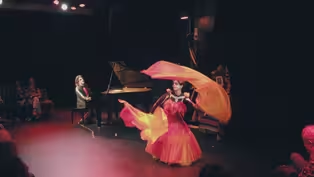
>> A puppet show is celebrating India those with those the Mexican holiday where people honor their loved ones who have died.
Traditionally families gather in the cemetery during the celebration to welcome the soles of their loved ones.
Others prepare alters known as a foot in the U.S. filled with photos, flowers, candles in sugar skulls.
We got a sneak peek of the show coming to the Harold Washington Library.
>> I would say just vibrant in color and sound.
I think that what we're really going all out stimulate all of the that need to show us.
They have a Inspiration.
>> The idea was to do serious of concerts Friday and well inside Mexican American heritage.
But Mexican heritage and lend them a little bit with some European muck diabolic precinct for Halloween.
>> It's a day where we celebrate and they can often too people from the past people, not with us anymore.
Maybe in family, maybe, you know, friends of ours.
And it's just an opportunity to remember them and know that their spirits are always with us.
>> All of the I little vignettes that tell different stories.
So there outcome of which that's when all the revolutionaries come in because it was like a revolutionary song.
So the characters in it include the Revolution.
It I just like feel like I know supporting this in the kuz later muralist it will be right out school.
>> This can do we have to I'm the musician.
>> So I am bringing all this music to life.
But with an incredible team.
>> Around the >> in moment, there's if a strong negative feelings about immigrants.
And I just want to make sure that everybody remembers that immigrants sharing of culture.
>> Enriches all of our lives.
I was that.
>> Very lucky to grow up in a Mexican-American family.
My mom was born and what a lot of she's at so I know that it's making a lot of my family happy that I'm doing this project.
But it just it's been an opportunity for me to explore part of my so much to >> The family-friendly show will kick off at the Harold Washington Library for opening night on Tuesday and will run through Friday from November.
1st now there will be shows in English and Spanish.
We have all that information on our website and I can tell you it's a beautiful celebration.
And that's our show for this Thursday night.
Join us tomorrow night at 5, 37 10 for the week in review.
Now from all of us here, Chicago tonight, I'm John Madden on this.
Thank you for watching.
Stay healthy and safe.
>> Good night.
>> Closed caption made possible by Robert a cliff and Clifford law, offices Chicago, personal injury and wrongful That is proud to recognize its
Are People Loving Monarch Butterflies to Death?
Video has Closed Captions
Clip: 10/24/2024 | 2m 36s | A new study suggests human interventions to save the insect may be doing more harm than good. (2m 36s)
Chicago Set to Overhaul Migrant Shelter System
Video has Closed Captions
Clip: 10/24/2024 | 8m 9s | One on one with Beatriz Ponce de Leon, deputy mayor of immigrant, migrant and refugee rights. (8m 9s)
Free Puppet Shows Celebrate Día de Los Muertos
Video has Closed Captions
Clip: 10/24/2024 | 2m 31s | On the Mexican holiday, people honor their loved ones who have died. (2m 31s)
Hermosa Nonprofit Says It's at Risk of Losing State Funding
Video has Closed Captions
Clip: 10/24/2024 | 7m 19s | Community organizers are struggling to figure out their next steps. (7m 19s)
Providing Support for PBS.org
Learn Moreabout PBS online sponsorship
- News and Public Affairs

Top journalists deliver compelling original analysis of the hour's headlines.

- News and Public Affairs

FRONTLINE is investigative journalism that questions, explains and changes our world.












Support for PBS provided by:
Chicago Tonight: Latino Voices is a local public television program presented by WTTW