Chicago Tonight: Latino Voices
Chicago Tonight: Latino Voices, Sept. 5, 2024 - Full Show
9/5/2024 | 26m 48sVideo has Closed Captions
Joanna Hernandez hosts the Sept. 5, 2024, episode of "Latino Voices."
We explore Donald Trump and Kamala Harris’ immigration plans. And amid some major food recalls, a look at what can be done locally to access healthy foods.
Problems playing video? | Closed Captioning Feedback
Problems playing video? | Closed Captioning Feedback
Chicago Tonight: Latino Voices is a local public television program presented by WTTW
Chicago Tonight: Latino Voices
Chicago Tonight: Latino Voices, Sept. 5, 2024 - Full Show
9/5/2024 | 26m 48sVideo has Closed Captions
We explore Donald Trump and Kamala Harris’ immigration plans. And amid some major food recalls, a look at what can be done locally to access healthy foods.
Problems playing video? | Closed Captioning Feedback
How to Watch Chicago Tonight: Latino Voices
Chicago Tonight: Latino Voices is available to stream on pbs.org and the free PBS App, available on iPhone, Apple TV, Android TV, Android smartphones, Amazon Fire TV, Amazon Fire Tablet, Roku, Samsung Smart TV, and Vizio.
Providing Support for PBS.org
Learn Moreabout PBS online sponsorshipChicago tonight.
Latino voices I'm joined on this.
Here's what we're looking at.
Well, presidential candidates have plan for immigration reform and what's outlined in project 2025.
For Apple juice to deli meat.
There's been some major food recall sleekly.
A look at what's being done to help people access food locally.
>> The city's recycling rate has been stuck below 10% since 2016.
>> And we explain the history of recycling in Chicago.
And now to some of today's top stories.
The community is mourning to us.
deaths of 2 students and 2 teachers fatally shot at Apalachee High School in Georgia, 14 year-old Christian Angulo and Mason Sherman Horn were killed in yesterday's mass shooting.
Meth teacher, Christina Eyre me as well as math and football coach Richard Aspinwall were also among those fatally shot at least 9 others.
9 other people were injured and taken to the hospital.
Police say 14 year-old called Gray used an assault-style weapon in the shooting and was taken into custody within minutes, Gary has been charged with 4 counts of murder and will be tried as an adult.
And homicides in Chicago are down in August.
But the number of people shot is up slightly in its latest crime stats.
The Chicago Police Department reports there were 51 homicides in August compared to 58 people killed last August.
But there were 301 shooting victims last month compared to 270 for the same month last year.
However, CPD reports homicides, shootings and shooting victims are all at their lowest level since 2019 year to date.
And residents in West Garfield Park once again have access to a grocery store.
That's after a save.
A lot had its grand reopening today, 2 years after the store was shut down for a rat infestation.
Now yellow banana, the company that operates the store works to gain back trust from the community community amid an ongoing lawsuit filed against them by suppliers and recent financial issues.
The location is the first of 6 yellow banana on stores across the south and West sides slated to be renovated and reopened this year.
However, there's been numerous delays reopening the stores.
The company has received 13 million dollars from the city to reopen the locations.
Up next, what project 2025 could mean for immigration reform?
That's right.
After this.
>> Chicago tonight, Latino voice.
It's made possible in part by the support of these donors.
>> For mass deportation to a pathway to citizenship, immigration has been a defining issue in this year's presidential campaign.
And while Donald Trump has attempted to distance himself from project 2025, the concert of of Blake Playbook written by some of his key allies outlines recommendations like increasing detention facilities and terminating DACA status for Dreamers.
Kamala Harris has advocated for the bipartisan immigration reform bill that was proposed this year but never made it to a vote.
Joining us to dig deeper into this topic are Chuck in on this chairman of the Chicago Republican Party and former detective of the Chicago Police Department and the southeast president of the Illinois Coalition for Immigrant and Refugee Rights and executive director of Mano Mano Family Resource Center.
Now.
Thank you both for joining us.
There's a lot to get to Chuck, I want to start with you.
It's no surprise that immigration is one of the country's most complex issues.
What is the Republican Party saying the U.S. needs when it comes to immigration reform?
>> We need to number one, secure our border.
That's the main issue we're having a flood of illegals coming into our country.
Some would say upwards of 10 Million.
And this is just unsustainable financially.
it's just it's just we cannot go forward like this.
We need to start enforcing the border.
>> talking about that, we know for President Trump, President Trump has stated he has nothing to do with project 2025. some of his former advisers like Stephen Miller helped draft the document.
do you think of some of the ideas outline for immigration in the document like mass deportation to terminating several programs.
>> Some of these issues he's talked about himself on the campaign trail.
Obviously he's not embracing project 2025.
So I'm not familiar lines and project 2025. what what we like to call it is America first agenda.
That's what it's called.
And so we're going to get back to protecting the American citizens.
And right now under Biden.
American citizens are not safe with his name.
But what what do you mean by saying America's worst agenda?
What does that look like?
Yeah, protecting American citizens following the law in our country.
>> Which means enforcement of our immigration laws.
We have immigration laws on the books were not enforcing And that's why we see a lot of chaos in our cities.
>> And those who go into your organization's mission is to empower immigrants so they can become active participants in the communities.
What reforms do you think they're needed?
>> Well, obviously what we've been asking for for a long time with ice or a member organizations like mine all its a pathway to legal citizenship, stopping deportations and also not making it difficult for people are coming to the borders that are seeking asylum because they don't feel safe in their country sending more.
Unfortunately, we've been working very these issues on the federal level, sadly to no avail.
But at least here in the state of Illinois, we have been able to make Illinois a welcoming state for immigrants.
And what concerns you about project 2025.
There is a lot of concern.
I believe that this is blueprint to terrorists also to punish people that are not white-supremacist pretty much was just named it what it is.
I believe that using the military to help with mass deportations militarizing the southern border, making it harder for individuals to find a pathway to legal citizenship.
Let's remember trying to this country is made of immigrants and the rhetoric that is being used by the Trump campaign saying that they have absolutely no idea where project 2025 is that they were not involved.
Well, let's just state the facts that 28 Trump loyalists that serve under his administration out of 38.
Where are the ones that worked on this project?
And so for me, obviously, you know, those are the facts.
We know that Trump has talked about it, even Mister Hernandez mention it and the campaign trail.
So obviously, this is a blueprint for Trump.
God forbid he becomes president so that the what happened in the 2016, his transition process was very chaotic.
So this time around there being some smarter about it.
But again, I feel that this these policies, again, there's just to terrorize black and brown communities and it instill fear.
We know what our community members went through when Trump was president.
And so again, this is just reinforcing what we've seen from him, all of and took.
What are your thoughts on what to say is commenting?
you know, she's advocating for sanctuary city.
>> And all this.
But we've seen with sanctuary city has done to Chicago this call caused a lot of chaos in our city.
We don't have the financial resources to take care of these people.
So it's just really horrible that were advertising come into our country coming to our city will welcome.
You will give you free.
Health care will give you free.
Education will give you free housing.
The word is out and people are coming here and we can't afford it.
We can't afford it.
It's pushing up the price of housing in our communities.
We got in some of the black communities and and our city and even in a span of communities, you've got these outsiders coming now, these migrants that are guaranteed housing with money from from the government that is pushing up the cost of rents in these inner city neighborhoods.
So that's hurting people that have been here in our country and live.
Here are some citizens that are paying taxes.
The merits, of course, the is coming from person expands, use anywhere.
Former cop for these things that you would see.
>> And the field, well, the things I've seen in the field are also the flood of narcotics coming across the border.
I seen fentanyl.
I've seen the overdoses I've had.
I've had to investigate.
>> Overdose deaths and I've had to go and drive out to a young person's house and knocked on the door form their mother.
I'm very sorry.
Your son has died of a drug overdose.
These are the kind of things that we need to secure our border.
We need to get back to being serious about the law in this country and enforcing our law.
>> And I want to talk about ice part of 2025 minutes.
It mentions a stronger presence of ice.
What role do you think, Chuck?
They need to play well, part of ICE's.
>> Enforcement write the E stands for enforcement and we have not complied with ICE here in Chicago.
We have not complied with enforcing immigration and we need to get back to enforcing that.
So so it we need.
We do need to deport.
We are going to have to deep or especially the criminal element that is here that not everybody comes here with the purest intentions.
Some people do right.
They come here to work to have a better life.
But there are some that come here that have a criminal background.
stories coming out of and as way love the jails are being emptied and they're being allowed to come here are being encouraged to come here to the United States.
We need to put police our streets and no one is here and deport those era criminals to to what?
What are your thoughts?
What your approach that I should take.
>> Well, first, I would like to interject on the comments, Mr. Hernandez speed about how seeing and how a new rebel side making it.
>> Difficult for others to find housing and how the rent retired going up.
Has he has been an issue for many years way, way before that.
Your rival started coming to this country.
There's a lack of inventory.
There's a lack of equitable way to So that's what we can attribute to new housing prices not being affordable right now, even someone that's a middle income individual can even afford to buy a home.
And that's because of the high interest rates.
So I think that we need to state the facts.
In addition to that, I believe that ICE has served more of again just to instill fear in immigrant communities.
I don't believe that event that helps keep community safe because if community members are afraid to call law enforcement when a cop when a crime is being committed, that doesn't help anybody at the at the end of the day, it increases crime rates because there is no trust between community and law enforcement.
And when we have forced cooperate with ICE, then obviously community members are not going to want to have anything to do.
There is no trust there.
And so that actually makes it even harder to keep communities safe.
The other fact is that we know for studies have been made that actually people born in the United States commit crimes at a higher rate than immigrants.
Newly arrived immigrants.
So I'm just stating the facts here.
I feel I I fear that, you know, giving more power to ice is just and a week of communities, safe.
>> And I want to talk remain in Mexico policy that would keep asylum seekers in Mexico until their case is approved.
Chuck, what is your take on this?
Yeah, I thought there was a successful.
>> Policy that was implemented under Donald Trump.
That was very successful and that that help too, to make the Border Morse able we're able to figure out who was coming in, look at their case and determine whether they would, you know, should be allowed in the and into the U.S.
So those are kind of commonsense policies that American people are looking for.
You know, we we try to turn immigration into a real partisan issue.
But, you know, it's about the protection of our country in the protection of the American citizen and under under.
But Biden and Harris, the American citizen, is that safe?
We can't afford.
This administration for 4 more months.
Let alone 4 more years.
What would it mean to question is what would it look like?
What changes need to be made about the process to become citizenship?
What about people who >> are in line waiting to become citizenship?
would that look like?
Yeah, it should be like it is for everybody else that wants to become a citizen.
They go through the process.
They fill out the paperwork.
They do everything the right way.
We should not be giving any kind of a.
Any kind of it for us for somebody that violates our law.
We cannot give them the benefit.
You know, they they need to do it like everybody to.
What are your last thoughts?
>> Well, I'd like Mister Hernandez Icer and a delegation of member organizations and faith leaders.
We did go to the border and the motives when remain in Mexico was put in place.
And we saw just the dehumanizing mothers and children and living in squalor.
You know, some LGBTQ community being taken advantage of sexually assaulted.
it was a pretty horrific scene.
Again, we have keep in mind that the United States have has played a big part in foreign policy and wine.
These people are coming to the United States because of the negative, you know, sanctions economics has got all the that we certainly have leave it at that.
Thank you for your input.
Thank you.
Up next, health food recalls are pushing people to shop in the local.
Stay with us.
>> For many in advocating how to lead a healthy life can be challenging.
And after numerous recalls and reports of black mulls leaky ceilings and flies at a boar's head plan that led to a listeria outbreak.
People are rethinking where they get their food from efforts to encourage local food sourcing is creating broader opportunities to address health equity.
Joining us now with more are Westland, Ashton, the co-director of the Food Systems, Action Lab at the Illinois Institute of Technology and Rookie, a curvy Johnson, the vice-president of community, health, equity and engagement at Rush University Medical Center.
Thank you both for joining us now.
This is a really interesting conversation.
Nobody wants to talk about food recalls and West Linn.
I want to start with you.
Although many recalls are for undeclared allergens.
Does the increasing awareness of things like listeria, outbreaks and poor production facilities say something about mask food, productive production.
Yeah.
So our food system is really dependent on these long supply chains.
>> All right.
So our food is coming from all over the country and really all over the world and contamination can happen at any point in that And so there is real awareness about contamination.
Possibility along the supply chain and is increasing people's awareness and interest in more local sourcing to say that something that people should be more concerned about.
>> Well, it's I think in general, our food system is very safe.
All right.
So the Food Drug Administration has really developed a system where we can identify where contamination happened.
What batches were contaminated and where those shipments go whether it's in grocery stores and whatever part of the country.
So from a tracking and transparency perspective that the FDA does a great job of understanding where contamination happens.
I think, you know, like that the challenges that we caught control when that contamination happens and because of the length of our supply chains.
It likely to happen anywhere from the processing plant to that the storage facilities to biggest into the grocery store.
>> In as some hospitals like rush are also working to directly address things like food, insecurity as part of the safety a staying healthy.
How do you engage with the community to find out those needs?
>> So one of the things that we do first of all is understand that via focus groups be being out in the community, working with community organizations working with partners in the city and the county is such to just understand where needs are.
And then the other thing that we do is screening patients when they're in the hospital.
So when they come in, we find out from patients.
If they are food, insecure, basically asking the question trying to understand if they have access to food over the next couple of weeks.
And if we find that they are food, insecure, they are giving a prescription to our Veggie Rx Pantry and our food is medicine program.
So they're able to get a prescription for healthy produce proteins shelf stable food.
And then we also connect them with a community health worker who can follow up with them, who can also work to connect them to benefits.
And I want to talk about the hospitals on new initiative.
>> The conversation that started, there's a a billboard right that says who gets the chance to be healthy?
We all want the chance to be healthy.
But what is what is that reality?
What would you say is the concept of them?
Yeah.
So that really came out of a desire to spark a conversation.
We knew with the Democratic National Convention just being a couple blocks away that there be a lot more attention on Chicago and particularly the West side.
And and so when we think about the need to have front and center, this ongoing conversation about who gets the chance to be healthy.
We wanted it to be big and bold.
>> And up there and continue to track conversation with elected officials with businesses with a community partners as well as community members and to think about how we can continue to engage with each other and think through new ideas and approaches to making finding a way to help people become help as healthy as possible.
>> And was Lynwood.
You say it was can you would you say that can locally sourced food to be a way to help slow this problem and protect people?
Yeah, definitely.
>> Traditionally our our food has sourced from very large produces.
And I think that pandemic really highlighted the fragility of that system and created more awareness and opportunity for locals are saying so here in Chicago now we have local produces from African-American communities from the Latino communities who really stepped up during the pandemic to provide emergency food to their community.
And with that include also getting into schools.
What does that said?
The pandemic kind of like opened up this box to say there are these local produce says who are the business of growing food, not just for profit, right?
I mean, everybody wants to be able to support their families, but also to feed their communities.
And so since the pandemic, there has now been an infusion of more investment by the U.S. Department of Agriculture by the Illinois State Department of Agriculture into local food and really supporting our local farm eyes who are, you not necessarily in the city of Chicago, but in suburban Cook County as well as the color counties to help them grow their business is that they can feed call, not teaching people how to eat healthy.
You would say And we talked about, you know, there's a program that some of local 4 sources, food goes into public schools.
What would you say is importance of having locally sourced food?
>> At schools?
>> I think there's, you know, sort of 2 positive sort of outcomes from that one.
It is the way in a means to help young people, children get a closer look at food.
Sources.
It is a way to bring it to life for them.
I know one of the things that we try to do is we actually have educators who will work with teachers to develop lessons to think about growing food, but also how healthy food can contribute to strong bodies and strong winds.
And so again, having local food producers helped to bring all of those pieces together.
Well, think you'll be following the foodstuffs system learning more thought.
Interesting topic.
Thank you both for joining us.
Thank you.
>> Up next, the holes in Chicago's recycling system.
Stay with us.
>> The world is creating 57 million tons of plastic pollution every year.
That's according to a new study from researchers at the University of Leeds.
The study examined plastic that goes into the open environment, not plastic.
That goes into land filled or is burnt.
But what about local efforts to recycle that plastic RW Tw News explains series explore Chicago's tortured relationship with recycling.
Here's Patty.
What Lee with more.
>> Chicago may be a world-class city when it comes to recycling.
Let's just say it isn't winning any The city's recycling rate has been stuck below 10% since 2016.
How bad is that?
Well, places like San Francisco and LA Clean their way set of landfill.
So what went wrong here?
Let's take a deep dumpster dive flashback to the 1990, Chicago's first try recycling was the bag program along with the usual charges of corruption in the program had a serious image problem when people saw blue bags recycling collected in the same trucks, trash.
>> Chicago and smelled a rat.
Was anything actually being recycled.
>> Backs were scrapped and fast forward to 2007 when the city pulled up and only to residences with 14 hits or fewer.
Tough luck fire risers first blue cart.
Recycling seemed easy instead of separating paper or plastic, aluminum glass.
Everything goes into a single This method is called single stream where the sorting happens on the back end single stream is popular because it's simple, but it has some major flaws.
For starters, some people everything goes a little too literally tossing like bowling and lumber into their carts, for the record are not recyclable.
Another problem with single stream is contamination.
Contamination an entire load recyclable.
That's where the most successful programs separate waste when the city tried to stop contamination, recycling got more complicated.
Lots of things can go in the cart.
>> Chicagoans smelled a rat again.
Is anything actually being recycled?
>> The city is trying to take this runaway recycling train back on track.
>> Including 2017 back to basics campaign and a new vendor contracts.
But is it too little too late?
The market for recyclables plummeted and the future of waste management is looking more and more like composting.
Maybe this time Chicago will get right.
>> Hopefully we can get her right.
And you can see more of our Emmy award-winning series.
Wbtw News explains on our website.
That's Wtta W Dot com.
Slash News explains.
And that's our show for this Thursday night.
Be sure just to subscribe to our newsletter, the Daily Chicago and at Www dot com Slash slash newsletter.
And while you're there, check out our website for the very latest from W T Tw News and Never Miss Chicago tonight.
You can stream us on Facebook, YouTube and our website and join us tomorrow night at 5, 37 10 for the weekend review.
Now from all of us here Chicago tonight at the Nueces, I'm Jon Huntsman.
This thank you for watching.
Stay healthy.
Stay safe.
When has not >> Closed caption was made possible.
I Robert a and Clifford Should Congo personal injury and wrongful death that is committed to supporting diversity.
And inclusion
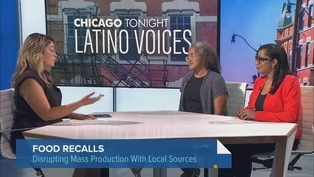
Recalls Have Some People Rethinking Where to Buy Food
Video has Closed Captions
Clip: 9/5/2024 | 7m 4s | A look at what's being done to help people access food locally. (7m 4s)
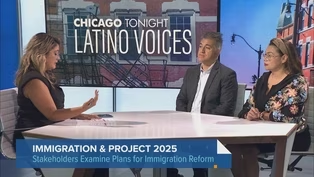
What Presidential Candidates Have Planned for Immigration Reform
Video has Closed Captions
Clip: 9/5/2024 | 11m 22s | Immigration has been a hot topic of discussion for both presidential candidates. (11m 22s)
Providing Support for PBS.org
Learn Moreabout PBS online sponsorship
- News and Public Affairs

Top journalists deliver compelling original analysis of the hour's headlines.

- News and Public Affairs

FRONTLINE is investigative journalism that questions, explains and changes our world.












Support for PBS provided by:
Chicago Tonight: Latino Voices is a local public television program presented by WTTW