Chicago Tonight: Latino Voices
Chicago Tonight: Latino Voices, Sept.11, 2021 - Full Show
9/11/2021 | 26m 48sVideo has Closed Captions
Alex Hernández of Univision guest hosts the 46th episode of “Latino Voices.”
Federal pandemic unemployment benefits end, what it means for Chicago’s labor force. Plus, a new law aimed at helping local immigrants. And La Villita’s iconic arch is up for landmark status.
Problems playing video? | Closed Captioning Feedback
Problems playing video? | Closed Captioning Feedback
Chicago Tonight: Latino Voices is a local public television program presented by WTTW
Chicago Tonight: Latino Voices
Chicago Tonight: Latino Voices, Sept.11, 2021 - Full Show
9/11/2021 | 26m 48sVideo has Closed Captions
Federal pandemic unemployment benefits end, what it means for Chicago’s labor force. Plus, a new law aimed at helping local immigrants. And La Villita’s iconic arch is up for landmark status.
Problems playing video? | Closed Captioning Feedback
How to Watch Chicago Tonight: Latino Voices
Chicago Tonight: Latino Voices is available to stream on pbs.org and the free PBS App, available on iPhone, Apple TV, Android TV, Android smartphones, Amazon Fire TV, Amazon Fire Tablet, Roku, Samsung Smart TV, and Vizio.
Providing Support for PBS.org
Learn Moreabout PBS online sponsorship[ ♪♪♪ ] >> Chicago tonight, Latino voyageses made possible in part by all state.
>> Good evening.
Thank you for sharing part of your weekend with us.
Federal pandemic unemployment benefits ended for millions of Americans this weekend.
We check in with Chicago's current labor force and the impact Covid has had.
They will be able to represent immigrants and we have the details and the iconic arch that welcomings visitors has got.
gotten a status and we hear more.
>> A new American Legion post with a distinctly Latino identity.
It's one of the moments you remember where you were.
Today Americans across the country are remembering the 20th anniversary of the September 11th attacks, 9/11 was the deadliest terror attack, and some 25,000 people were injured and yesterday, the governor spoke about the lives lost at an event honor fall be first responders in Illinois.
>> 20 years ago tomorrow, the heroism of our nation's first responders became understood by everyone American.
Thank God for our first responders, many of whom gave their lives that day.
>> The federal pandemic unemployment benefits ended on Labor Day, cutting off benefits and federal data shows the unemployment rate in Illinois to be one of the highest in the nation, 7.2% reported in July and join us to discuss unemployment benefits ending and how the labor force is doing worker center director and the program director at Chicago cook partnership.
Thank you for joining us today.
I want to start with you with the federal unemployment benefits ending and what does this mean and who do you see being most impacted by this?
>> Yes, it was a large number of people that were receiving Covid-related aid from unemployment and I think I read that in Chicago, the zip codes that were related to people receiving unemployment were in the black community and we know that the Latin community, Latin X was affected and although we might have some number of people undocumented, there are a large number of families in the house households that will be affected.
>> How have you seen the communities impacted?
>> Chicago services, mainly immigranted and what we've seen, they couldn't even act with unemployment, so you imagine unemployment is there to catch you when you need it, to sustain your families, by know it's not long-term and in the Latino community, they were not able to act if you did not have documents and they had to figure out a way to keep their households going and people sacrificed.
sacrificed.
I have known families where their kids worked and they were able to provide food or other resources, but there were communities where the pandemic has had it adult.
>> Going back with you, what is have you been hearing from seekers returning to the workforce?
>> We know there's a large number of people who are very, very hesitant to return and especially in the Latino communities, they're afraid and this definite past year and a half changed a lot of lives.
We have individuals who were affected and family members where there were deaths and a lot of the kids were not back to school and now we're dealing with, are my kids going to be safe and what will happen now that the schools are back in?
The other thing, I think a lot of people had a change of heart, you know.
Maybe I was doing this job for ten years and now I don't want do that anymore and I want something more fulfilling.
There's a lot of reflection happening now whether or not I might have a change of career, I might be a little hesitant because I'm afraid and all of those things are affecting the job force.
>> This is making it harder for businesses since reopening and what have you -- have businesses found it difficult to find employees what have you been hearing from these employers?
>> Yes.
Personally have done a couple of job fairs and be have seen a big demand of employers and employers are now having incentives and they are given bonuses for people taking the jobs, for keeping the jobs for three months and we've seen a lot of employers changing their pay, increasing the pay.
I always tell people this is a great time to negotiate a better career path and people are looking for people.
>> Laura, what do you think some of the reasons for the worker shortage in.
shortage?
>> People are putting safety first and?
Crucial to remember.
I know there is a lot of debate on shortages, but the reality is people are putting health first and it's about time employers pay for money and they should have done that a long time ago.
In Chicago, workers are telling us they've been there 20 years and the newcomers are making more money than they are and offering benefits and that has forced employers to make sure they're doing better for all employees and I hope this is a trend that will continue and it's about time to make good benefits to sustain families.
>> Will unemployment benefits make a difference in potentially increasing the label force?
>> You know, that's a good question.
I think there is data that exists that some states have cut their Covid-related aid unemployment and there wasn't a bigger change in the job market and it's hard to answer that question and I know that it might put families and communities on alert, but yeah, it's hard to answer a question like that.
>> I'm going go with you, what do you think are some ways you've noticed Covid-19 to affect different industries in Chicago?
>> Well, we're seeing the fact that, again, people are putting their health first and shortage of workers continues to be an issue and I want to raise the point that it is about wages and benefits and so, until that changes and until the employers providing a safety net for workers we're going to continue to see this and we're still in this pandemic.
The Delta varient is one of many and so the employers have to take responsibility in making sure they're providing safety for the workers and provide good wages and benefits.
>> And the same to you?
>> A lot have left the state and have moved to other states that may not have been shut down or they've gone to other countries and, you know, like Louda says, this is nowhere near ending.
>> Thank you both for joining us.
>> Thank you.
>> Up next, details into a new law aimed at helping cook county's immigrant community and that's a conversation recorded earlier with brandy freedman.
Stay with us.
[ ♪♪♪ ] >> Immigrants facing deportation in cook county, a bills by the governor provided not only legal council but also public information so they will know their rights and joining us to discuss the impact and what it means for the community are head of the immigration unit at the cook county office and the state represent.
Thank you to both of you.
So representative, you were a sponsor of both of these two bills and why did you think they were necessary?
>> Well, these pieces of legislation, both of them, are fundamentally at their core about ensuring fairness and you cannot exercise rights that you don't know that you have and the consequences can be devastating.
And with respect to access to representation, everyone deserves representation in the courtroom, especially when the stakes are as high as they are.
Immigrants are vulnerable and may struggle with English and training with the American court system and it can take years for a trained attorney to master the skills necessary to handle a complex immigration case and we're asking individuals threatened with deportation to defend oftentimes, you know, the equivalent of a death penalty case in traffic court-like setting.
>> Hena, how does the public defendser bill impact the way your immigration unit can operate?
>> It was launched in the fall of 2020 with a goal of providing representation to the noncitizen clients that our office has and this is assisting them in criminal proceedings and then the second part of that is being able to continue representation of those same individuals when they are placed in removal proceedings.
So our goal is to be able to provide a more holistic approach to representing individuals who may have criminal causes arising in cook county and the two systems are closely intertwined and criminal cases have a grave impact on individuals, immigration options and immigration status can, of course, affect what they are able to do and how they may encounter the criminal justice system.
So we thought that we really needed to have a holistic approach towards taking care of these clients.
>> Representative, in your opinion, how does having this facing someone with deportation?
>> Traumatic.
I found among detained immigrants, the difference between representation and not having representation came down to a matter of almost two times being more likely to succeed if somebody had access to counsel.
In days where an immigrant was not detained, the study found that success was almost five times more likely when somebody had access to counsel.
It's not dependent on the mayor.
The difference is your ability to articulate the merits of your case.
>> How have you elemented this right to representation in your office?
>> We're in the process of staffing our unit and we're working on interviewing in the next month or so and you know, you've been considering what it will look like so that come early 2022, when we're able to go into court, we'll have a model set up to know how clients can get in touch with us to seek our representation, et cetera.
>> And this public defender bill came out hand-in-hand in high traffic area.
Do you believe there's a lack in immigration areas until this point.
>> I worked in immigration for over two decades and always devastating to see somebody waive their right because they didn't know how to assert them and if know he had rights and oftentimes were presented with documents and information in a language they could understand.
I had cases where somebody had signed their own removal order, which in immigration cases is incredibly hard to overcome and couldn't understand what it was they were signing and didn't know they had the right to obtain counsel and have something explained.
The consequences where not having your rights is critical.
>> Thank you both for joining us.
Back with more Chicago tonight Latino voices after this.
>> Since it was built in 1990, countless people have been welcomed into the lull village e village.
And now the two-story stuckco arch has been granted preliminary status and it will become the first symbol of Chicago's Latino community to receive that honor as well as an architect of dissents has had a structure landmark.
This is why they believe the arch deserves a a landmark designation.
>> This is where people peace rally for the independence parade and many other things and it's very welcoming and making this a landmark will protect the maintenance of the clock and this begins to highlight prominent architect of color.
This is a landmark moment where we will appreciate the diversity of the architect in the city.
>> And they didn't stop at 26th street.
In 2020, the WTTW, the great quiz show explained the mark it made on our city.
[ ♪♪♪ ] >> The murals and Mexican art celebrate the neighborhood's culture and to the west, a traditional arch explains the little village and one man connects them all.
Mexican-born architect pained this at hull house when he was 20 years ol and designed this little village arch in 1989 in Mexican style who wanted a symbol of pride for his neighborhood is one Mexican president donated a clock for the arch and another rode in a parade.
They added iconic Mexican motifs for Mexican art in the country.
Lazanno died leaving a proud legacy for generations to come.
>> I even knew about the arch way before moving to Chicago many years ago when I was in Texas and definitely a symbol of the Mexican community here if Chicago.
More details on our website.
And well, the American Legion was chartered in 1919 as a veteran's organization serving those ha fought in World War I.
The American military has become more diverse, the Legion post has given this a persistent image for white male veterans and now a Chicago man has decided it's time to change that but make this a place for Latino veterans to find a community.
Here is the story.
>> When I joined the United States Army in 2007, when I arrived for basic force in Oklahoma, which we arrived in Oklahoma city, they had Legioneers there and they gave us snacks and fed us, sign this paper and you're in the American Legion now and good to go.
>> The American Legion counts all who servinged and any of the branches of the American armed forces as members and even though they were members, for young Latino veterans, it didn't seem like a place for veterans like these two.
>> I knew they were a veteran social club for, you know, specific unicats and I thought they were an older generation of veterans.
>> Once it was done, they forgot the brief encounter with the American Legion.
After a few years, Torez visited the post 973 and inspiration struck.
>> Everybody was amazing and so I started asking questions, like, hey, where do I find my Latino brothers and where do I find my African-American brothers and where are they and we make sure they're spoken for.
>> Brent Webb helped Torez get a new Legion post chartered and in 2019, the post became official.
>> What they're doing is something remarkable and it's something that will bring together a part of the community that felt disconnected and I'm here to support that 100% because Icouldn't of think more patriotic than wanting do good for neighbor.
>> It's an intentional identity.
Torez lead the honor guard that laid Jason Vasgez to rest.
>> We shared a ton of similarities and so, I knew that easily, his story could be mine.
>> What a wonderful thing that Jason would have a name or be a part of a Legion that would be in our community and it would be like, hey, we're Latinos, too, and we wear uniforms just like any other career and somewhere to celebrate and come together.
We're just grateful and honored.
>> Even the post's number is la Latino.
>> The 939 is one of our trademarks and it's language after we leave.
>> It's a distinct Mission, supporting the mental health and representing.
>> There's a big phrase in the military, suffer in silence.
If you asked for any mental health, you were ineffective and you weren't doing your job and helping your buddies out and that's something, I think, going alone with the culture of veterans and something we can change.
>> With regards to the community, we're at higher risk for suicide, hopelessness, unemployment and underemployment and so it's our job, our responsibility as an American Legion post to attack systematically these issues one by one for all veterans, but particularly, we would like to address the Latino population, as well.
>> As a Latino veteran, our music is different, our food is different, is we're known as the culture that always wants to dance and have a good time, but at the same time, we want to share the experiences we have as veterans and share our history, the Puerto Ricans that served in Vietnam.
If you go to a post, you don't see pictures of this male recipient or that talks about the ten thousand Mexican Americans who fought in the union Army, fighting against slavery because when we come back, it's important to keep on seeing those things so that we can thrive.
>> These are scouting location for a home base in Logan square or Humboldt park and until that, they're meeting here in Lincoln square and they're recruiting.
>> So it's a welcoming space to come and laugh and they can joke and it's reel healing to a lot of veterans.
>> Post 939 is on the march and looking for people that want to be a part of this Mission with us, as well.
>> For Chicago tonight, this is Eric a Gunderson.
>> The 939 meets every Thursday and you can find more details on our website.
That's all for tonight and tune in every weekday morning and I'll be back here in the host chair next week.
From all of us here, thank you for chairing part of your week with us.
Buenos Noches.
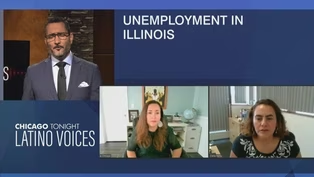
Chicago’s Workforce After More Than a Year Into the Pandemic
Video has Closed Captions
Clip: 9/11/2021 | 7m 2s | We check in with community members on Chicago's labor force and the pandemic's impacts. (7m 2s)

Little Village Arch Granted Preliminary Landmark Status
Video has Closed Captions
Clip: 9/11/2021 | 3m 2s | The iconic arch that welcomes everyone to La Villita has preliminary landmark status. (3m 2s)
Providing Support for PBS.org
Learn Moreabout PBS online sponsorship
- News and Public Affairs

Top journalists deliver compelling original analysis of the hour's headlines.

- News and Public Affairs

FRONTLINE is investigative journalism that questions, explains and changes our world.












Support for PBS provided by:
Chicago Tonight: Latino Voices is a local public television program presented by WTTW