
Chicago's New Public Health Commissioner on His Plans for the Future
Clip: 8/25/2026 | 10m 26sVideo has Closed Captions
Dr. Garth Walker was appointed by Mayor Brandon Johnson and unanimously confirmed by City Council.
Dr. Garth Walker has served as chief medical officer at Rush Health and deputy director at the Illinois Department of Public Health. He was a White House fellow with the U.S. Department of Health and Human Services during the Biden administration.
Problems playing video? | Closed Captioning Feedback
Problems playing video? | Closed Captioning Feedback
Chicago Tonight is a local public television program presented by WTTW
WTTW video streaming support provided by members and sponsors.
Chicago's New Public Health Commissioner on His Plans for the Future
Clip: 8/25/2026 | 10m 26sVideo has Closed Captions
Dr. Garth Walker has served as chief medical officer at Rush Health and deputy director at the Illinois Department of Public Health. He was a White House fellow with the U.S. Department of Health and Human Services during the Biden administration.
Problems playing video? | Closed Captioning Feedback
Where to Watch Chicago Tonight
Chicago Tonight is available to stream on pbs.org and the PBS app.

WTTW News Explains
In this Emmy Award-winning series, WTTW News tackles your questions — big and small — about life in the Chicago area. Our video animations guide you through local government, city history, public utilities and everything in between.Providing Support for PBS.org
Learn Moreabout PBS online sponsorship>> The Chicago Department of Public Health has a new leader, Dr.
Garth Walker officially assumed the role of Cdph commissioner this month after he was appointed by Mayor Brandon Johnson and unanimously confirmed by City Council.
Dr.
Walker's experience includes positions like chief medical officer of Rush Health, deputy director of the Illinois Public Health Department and White House fellow with the U.S.
Department of Health and Human Services under the Biden administration.
He now inherit a department that is responsible for managing infectious disease outbreaks, food safety, environmental health, and more throughout the city.
And joining us now to discuss his goals for the health and wellness of Chicagoans is Doctor Garth Walker.
Welcome back.
Congrats on the new gig.
Thank you.
Thank you for having me.
Appreciate it.
So you describe this role as the culmination of your life's work.
How's that?
>> Well, what I described in that manner, I was thinking about all my life's experiences.
I am a lifelong Chicago growing up in Chicago.
My whole life to the Chicago Public schools and one of the most transformative experiences that I had was right after college to Americorps and I worked with DC public schools because I wanted to think about the social and economic barriers that make it hard for this invest in communities to get great resources.
But after that, I pursue medical school and I knew the exact position that I wanted to be.
One that thinks about those issues that those barriers and make it difficult for people to get great health care and throughout that time weather be for my academic standpoint, working at the state level, the federal level as well as for academic medical centers, I tried to make sure that that was important part of how we think about our communities and how create healthier community.
>> So let's talk about some of, you know, what will be your public health challenges in this role?
Chicago has significant disparities in life expectancy depending on where people live throughout the city as well as their ethnic background.
Even though improvements have been made in recent years, for instance, as of 2024 black Chicagoans life expectancy is 73.3 years compared to 81.8 years for their white counterparts.
82.8 years for Latino Chicagoans and 86.9 years for Asian residents, would you believe is driving this gap?
thank you for asking that.
I will.
A lot of is a testament to Mayor Van Johnson and his leadership.
>> In terms of centering health equity thinking about the communities and their lived experiences.
But when I take a step back, I was here last year we were discussing about where COVID-19 is after 5 years and we're still having a lot of the similar challenges and what it takes is leadership.
Many of the leaders within my department focused on where those communities have the largest social and economic barriers and how that relates to their ability to be able to remain healthy.
And in many cases, that means thinking about meeting people where they are, whether be vaccinations, whether it be thinking about our air quality and how we monitor different communities and organizing our department to be able to make sure that they can remain healthy during some of the most difficult circumstances to it.
Sounds like you're saying there's sort of a combination of factors that can influence this.
This age gap of of almost 10 for black and white Chicagoans.
Absolutely.
Where you live the economic opportunities that you have the environment you live in.
But you can walk in the community whether >> you're experiencing violence on a regular basis.
But there you live in a desert or a pharmacy desert.
There's a throughline throughout that and I think public health oftentimes our map to show the level of humanity that our governments able to deliver on.
And I think being able to marry science, people, data in community organizations were able to create healthier communities in that manner.
What do you think your office can realistically do to bridge that gap?
Well, I think one great example is the wellness grants we just put We put out $600,000 to be able to.
Create community wellness activities some of our most marginalized communities to be able to think about those social determinants of health, as well as healthy activities that will be able to spearhead from from those different communities.
I think if you look at our most recent example with the burning from Canada.
We go is the largest as the largest air monitoring system in the nation, the second largest in the world.
But what does it mean for individuals?
that means is communities that may be structurally disadvantaged it in high pollution areas.
They're able to look at the Air Quality index make decisions for their family, their neighbor in terms of how to remain healthy and avoid having any type respiratory issues such as asthma conditions and the like.
Cdph is buzz budget dropped by 68% between 2023 26 records because of that precipitous drop, of course in a >> funding federal funding after coach after the COVID-19 pandemic waned and the return of President Donald Trump to the White House.
What has been the impact funding cuts like that on services that your office provides Significant?
And I think that's part of the reason why I decided to to join at this time.
>> I often times.
Public health is the invisible safety net and people can take it for granted.
And we have to be up to show all the activities that we're doing to be able to make sure that people understand how we're keeping people healthy.
And when you have funding drops, that drastic, the first communities are affected.
Are those from the less means?
And I think we're learning in real time how weather catastrophes are affecting some of our most marginalized communities and our neighbors.
You look at Gary, Indiana.
So what we want to do is have a public health infrastructure that's so resilient.
So strong that we can protect those with the lease when these type of catastrophes occurs.
And when there's a reduction in funds, it you can compromise is quite quite a bit.
>> Cdph recently released a preliminary report HIV and AIDS diagnoses in Chicago showing that they are declining with 540 new HIV diagnoses, the lowest level since the early 1990's.
But there's been some recent criticisms over your department's handling of funds related to HIV AIDS services.
And here's what a protester had to say about that just last week.
>> 5 average 40 million dollars Again, the federal government that was meant to be for HIV.
services and type of when there so many organizations could abuse at 40 billion dollars over last 5 holes by critical care service outside it.
>> How do respond to those concerns about how funding is being given out?
Well, first off, I think it's important to highlight the importance of community leaders and the way that they show up in the way that they're able to advocate for their communities.
>> So I empathize exactly with what is occurring 2 weeks in the role.
So I'm exploring how we're able to be able to make sure that our communities continue to remain protected.
I think the improvement that we've been able to see in terms of HIV and a diagnosis, particularly amongst our most marginalized communities.
It's a testament to the learnings that we've had from the health equity sounds and the public health infrastructure that was invested in over the years.
Because it speaks ensuring that local organizations are the ones to be able to lead a lot of that work.
So I'll continue to listen to so many of the organizations that working so closely with those affected by AIDS, HIV looking to figure out how we can continue to keep Chicagoans healthy as we move forward.
>> The crisis assistance response and engagement or care program has expanded to all 77 community areas this year on it, of course, provide support to individuals experiencing a mental health crisis or social emotional distress on Even though it's technically expanded citywide, it is serving fewer people.
And I know you're 2 weeks into the job.
What we know about why that is and what you can do to change Sure.
Well, I think I'm going to lean a lot on some my operational background and work with from different health systems and >> at the federal and state level, this is an important program and it's important program for a couple of reasons.
One is that we're able to deliver mental health expertise as well as first responders, to individuals and some of their most lowest moments traditionally that could be presented 2 law enforcement and sometimes you can have mixed reactions in terms of what occurs by being able to add this humane approach able to keep Chicagoans healthy and link them to the social determinants of health issues that we weren't first discussing, but also the expertise that is needed to de-escalate those issues.
So that's a testament to this administration and the many organizers and the city council members that have supported this work that to go for as part of Chicago's expansion of public mental health Previously shuttered clinic has also reopened in a couple of new spaces have launched lake.
>> The pills and South Ashland Health hub, the Roseland Health Hub and mental health operations at the Legler Regional Library in West Garfield Park.
Are there plans to reopen additional shuttered clinics or do you think will probably continue to lean into the sort of hub library model for the future mental health systems in Chicago.
I love the Health Library library model.
I still have to examine where the resources are at and how we want to expand.
But I will say this, I've been able to view health care from the state level.
The federal level private perspective and from many different venue points and behavior.
Health continues to follow up.
Come short in terms of >> convening people that deliver the care that we need for those that need it.
The most.
And we're going be able to show up for Chicagoans that are dealing with mental health
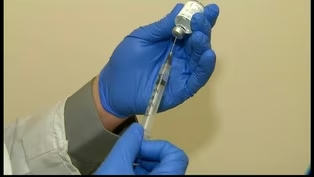
Doctors Sound the Alarm After Trump Recommends Changes to Childhood Vaccines
Video has Closed Captions
The administration recommends fewer vaccines and splitting the MMR vaccine into separate shots. (8m 51s)
Providing Support for PBS.org
Learn Moreabout PBS online sponsorship New Episode
- News and Public Affairs

Top journalists deliver compelling original analysis of the hour's headlines.
 New Episode
- News and Public Affairs

Today's top journalists discuss Washington's current political events and public affairs.
 New Season
 New Episode
 New Episode
 New Episode
 New Episode
 New Episode

 New Episode
 New Episode
Support for PBS provided by:
Chicago Tonight is a local public television program presented by WTTW
WTTW video streaming support provided by members and sponsors.