One-on-One
Chief Vincent Mann; Danielle Gletow; Sandra Ramos
Season 2021 Episode 2388 | 26m 26sVideo has Closed Captions
Chief Vincent Mann; Danielle Gletow; Sandra Ramos
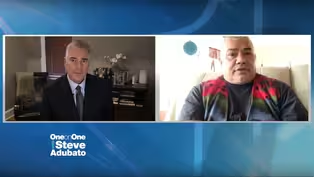
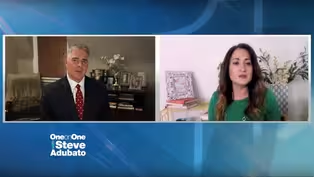
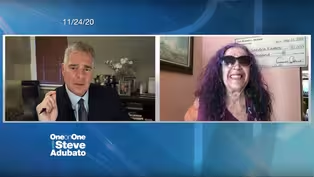
Chief Vincent Mann shares his tireless advocacy for a cleaner environment and being a 2016 Russ Berrie Award honoree; Danielle Gletow discusses her connection to the foster care system, the impact of COVID on the kids they serve and being a 2017 Russ Berrie Award honoree; Sandra Ramos talks about providing supportive services for homeless women and being a 2001 Russ Berrie Award honoree.
Problems playing video? | Closed Captioning Feedback
Problems playing video? | Closed Captioning Feedback
One-on-One is a local public television program presented by NJ PBS
One-on-One
Chief Vincent Mann; Danielle Gletow; Sandra Ramos
Season 2021 Episode 2388 | 26m 26sVideo has Closed Captions
Chief Vincent Mann shares his tireless advocacy for a cleaner environment and being a 2016 Russ Berrie Award honoree; Danielle Gletow discusses her connection to the foster care system, the impact of COVID on the kids they serve and being a 2017 Russ Berrie Award honoree; Sandra Ramos talks about providing supportive services for homeless women and being a 2001 Russ Berrie Award honoree.
Problems playing video? | Closed Captioning Feedback
How to Watch One-on-One
One-on-One is available to stream on pbs.org and the free PBS App, available on iPhone, Apple TV, Android TV, Android smartphones, Amazon Fire TV, Amazon Fire Tablet, Roku, Samsung Smart TV, and Vizio.
Providing Support for PBS.org
Learn Moreabout PBS online sponsorship- [Narrator] Funding for this edition of One-On-One with Steve Adubato has been provided by The Russell Berrie Foundation.
Making a difference.
RWJBarnabas Health.
The Robert Wood Johnson Foundation.
The Healthcare Foundation of New Jersey.
New Jersey Sharing Network.
NJM Insurance Group.
Serving New Jersey'’s drivers, homeowners and business owners for more than 100 years.
The North Ward Center.
United Airlines.
Connecting people, uniting the world.
And by Fedway Associates, Inc.
Promotional support provided by BestofNJ.com, all New Jersey in one place.
And by New Jersey Monthly, the magazine of the Garden State.
Available at newsstands.
- This is One-On-One.
- I'm an equal American just like you are.
- The jobs of tomorrow are not the jobs of yesterday.
- Look at this.
You get this?
- Life without dance is boring.
- I don't care how good you are or how good you think you are, there is always something to learn.
- Do you enjoy talking politics?
- No.
- People call me 'cause they feel nobody's paying attention.
- Our culture, I don't think has ever been tested in the way it's being tested right now.
- That's a good question, high five.
(upbeat music) - Hi, I'm Steve Adubato.
We are honored to be joined by Chief Vincent Mann, who is Turtle Clan chief of the Ramapough Lunaape Nation.
He is the 2016 winner of the Russ Berrie Making A Difference Award.
Chief Mann, it's an honor to have you with us.
- It's an honor for me as well, Steve.
- We met a few years back at the Making A Difference Award and, the Russ Berrie Making A Difference Awards and so many wonderful people making a huge difference, unsung heroes if you will.
Tell us about the Lunaape Nation, what is it and what are you facing as we move into 2021?
- The Ramapough Lunaape Nation are the descendants from the original inhabitants of New Jersey, northern New Jersey, southern New York, western Connecticut.
A Munsee-speaking people.
Today we have about 5,000 enrolled tribal members.
And as we look forward to 2021, you know, the Turtle Clan itself is still struggling with residing in a federal Superfund site but as 2021 comes forward we're very hopeful that through some of the programs that we're working on that we're able to bring some help ourselves, you know, to self-help us, if you will.
- You know, Chief, people hear Superfund site and the term I believe came about in the 1980s, late seventies and eighties.
People go, "Oh, Superfund site."
But I don't know if people know what that means.
So make it clear, Chief Mann, what exactly we're talking about and why it's so potentially, not potentially, but is dangerous on so many levels and causes whole range of medical and health issues for you and the other folks at the Ramapough Lunaape Nation.
- Yeah, so a federal Superfund site was, there was a law created called CERCLA and that was to hold accountable those corporations who dumped toxic waste.
And in our case, the Ford Motor Corporation dumped toxic waste for seven years on open ground and mine shafts with the approval and support of the town of Ringwood and as well as the state of New Jersey, you know, issuing a permit for a year for them for the toxic waste to be disposed of there.
This all sits above the Wanaque Reservoir and there's a recharge area for that that actually feeds four to 6 million people.
And one of the issues that I have had, and the struggle that I have is seemingly not having a large enough voice, because even though it has affected us directly, it has also affected four to 6 million people who have no knowledge of where their water comes from and no potential that water has been toxic, you know?
And like Newark, now they have a problem with their water.
I wonder why, you know, it's the same thing with Flint, Michigan.
When they switched the water source and the chemicals that were in the water began the leaching of the lead.
So the issues that we have in Newark and Paterson, Jersey City, Passaic, and even places that are, you know, affluent communities like Franklin Lakes.
- Hey, Chief, has the site been cleaned up?
- Absolutely not.
It is, there is a record of decision.
The record of decision, as it stands, the town came in at the very last second of the very last day and put forth a, one area that was supposed to be totally remediated and returned back to a forest of old land for our people is actually going to be turned into a recycling center by the town of Ringwood, and then leaving all of the toxic waste there and just cleaning up minimal stuff.
So it's going to forever be a toxic waste dump.
Our people, 48, 46 homes, about 300 or so people are actively still living there.
Actively still paying taxes on their homes that have no value.
Actively playing and hunting around the general area.
And, you know, there seems to be, 56 years later, you would think that somebody somewhere would hear that call and come to bring that help to the people.
- But it hasn't happened.
- Absolutely not, no healthcare, no act of engagement to remove the community to another community, you know, to create another community.
You know?
And so even to the people that are in Newark, right?
Hundreds of thousands of people.
When I asked the EPA to have a citizens advisory group meeting so that the people that are in Newark who are stakeholders could have a voice whether or not they think that that stuff should stay there.
Why has four to 6 million people in the state of New Jersey, the most populous state in the country, not have a voice in whether or not that toxic material should stay there or not?
- Let me ask you this, the responsibility you have as chief, as it relates to what we're talking about right now in this very serious health, medical, environmental crisis.
- So my responsibility is an inherent responsibility as a chief, to protect our families, protect our children, protect our elders, the few that are left to the environment in which we rely on.
We rely on that for our cultural survival, right?
Our cultural way of life.
And so the responsibility that falls upon me is the responsibility of literally protecting their lives.
Literally burying over 80 of our people over the last couple of years, you know.
That's a very, super intense, emotional, spiritual experience that most humans couldn't deal with.
You know?
- Excuse me, Chief.
Has Covid made it worse?
- Covid made it worse, but what I will say about this is that for 56 years, if people want to take a look at COVID-19 and how everyone's scared, our people have been living with that same thing for 56 years.
And now we have communities who were compromised because of that and the acts of other people, municipalities and state, and wrongdoers to add this on top of that.
So we've been actually going out, creating food drives, getting donations to be able to bring food into the community, which we did a 200-family food distribution on this Sunday.
Right, to keep them out of the grocery stores because they're compromised, right?
And so, you know, COVID-19, yes.
Has it, is it affecting us?
Yes.
Is it affecting our other communities?
Some more than others.
We just recently over the last, yesterday, we lost three of our people, an elder, a brother and a nephew.
And so we can't and haven't been successful in bringing help to our people because it's a political bomb, right?
- Yeah.
Chief, I wish we had more time but I want to ask you this.
You won the 2016, you were one of the winners of the 2016 Russ Berrie Making A Difference Award.
What did that, what does that mean?
- Well, I mean, you know, being recognized for being an unsung hero, and as I said back then when you were interviewed me, Steve, I'm not that person.
The unsung heroes are those people of my family who've lost their lives, who struggle every day to survive and to keep their culture alive.
And, you know, being recognized in that way, that has given me the strength, because I look at it as I just spoke, you know?
And we created Munsee Three Sisters Medicinal Farm, that is to be able to grow food to distribute to our community, but not just our community, to other people who are in need, right?
Food sovereignty is a real thing.
Food justice, protecting the waters.
That is all the responsibility of this person who's sitting in front of you, you know?
And it should be the responsibility of a lot more human beings.
With the money that came in, I helped put my nephew through school, became an engineer so he could come back to his community, right?
And so, you know, it has given me that internal boost of strength to continue forward.
We've created a nonprofit to also assist in that as well.
- Chief, I want to thank you for joining us and sharing an incredibly important story that clearly is not getting not even close to the attention it deserves.
Chief Vincent Mann, I wish you and everyone up at the Ramapough Lunaape Nation all the best.
Thank you, Chief.
- Thank you, Steve.
Bless you.
- I'm Steve Adubato.
We'll be right back.
- [Narrator] To watch more One on One with Steve Adubato find us online and follow us on Social media.
- Hi, I'm Steve Adubato.
This is part of a series called 25 for Twenty-Five in which we feature winners of the Russ Berrie Making a Difference Awards.
We've been doing this programming for many many years, and it's the 25th coming up on the 25th anniversary of the Russell Berrie Making a Difference Awards.
And we have the 2001 winner of the Russ Berrie Making a Difference Awards with us right now.
She is Sandra Ramos, Founder and Executive Director of Strengthen Our Sisters.
Sandra, it's so good to see you.
- Same here.
- Tell folks with Strengthen Our Sisters is and why it is so important?
- Strengthen Our Sisters is the first shelter that was started in my Hackensack home in 1970.
And it's a shelter for mothers and children and also single.
And it's with a heart, we're a little bit in my opinion, which mostly I agree with, it's a shelter that really goes out of the way.
We've gone through many many struggles and we take people, except people where we don't get welfare vouchers from social service vouchers.
But in the last years, 55 years, particularly the last five years, we've had a lot of money issues.
But a miracle happened couple of years ago, we were in foreclosure.
Our houses were in foreclosure.
And then we got a miracle from Columbia Bank.
One of the members is on our board.
And we have all our houses and they're all full.
We have two daycare centers, a group home, and we're struggling but doing good and changing.
We're trying to change the world and saving lives.
- Well, let me ask you this, domestic violence during the age of COVID, you know, just ridiculous even saying it, that expression.
We're taping this at the end of 2020, it will be sent after that.
To what degree has the problem of domestic violence and the victims of domestic violence, how are they suffering differently or even more during COVID?
- I don't think that they're particularly suffering more, but there are some logistical issues.
One of the things of course, is that people don't like to share with the COVID.
And we have five units and we're working on getting kitchens and bathroom, well there's bathrooms and kitchens there so they can do cooking and have their own bathroom in these units.
So that's good.
But domestic violence unfortunately doesn't change.
It comes from insecure people that wanna control and are jealous and it's very difficult.
And now, because we are a lot more flexible than some, a lot of it is touched economically, 'cause as we all know people are starving and it's very difficult and they're losing their homes and their jobs.
- But Sandra why are you so passionate about this?
- I don't know.
When we were in foreclosure and the man from the bank called, Todd, he said, "I'm calling you about your houses."
And I said, "You better not try to take our houses."
And he starts to laugh.
He said, "you're still passionate."
So I guess you're the second one that said... Not the second one-.
- But you're passionate, and those houses are shelters for women and their families, their children to try to protect them as best one can.
And so you are passionate.
I saw when I met you back in 2001 when you won the award, but 19, 20 years later, you're just as passionate, because.
- Well, I say thank you.
Some people would say, "You're kind of a troublemaker and we don't like it."
but I guess I am passionate.
You know they say revolutionaries are born not made.
And I guess I just feel that it's my mission in life.
I didn't plan to do it.
I'm not paid now.
I was paid after 77, from 70 to 77 I wasn't.
And then we got funds and I was paid, but I was only paid 775 every two weeks.
Wasn't a big salary obviously.
But after that when we lost a lot of money, 13 people stayed with me and we kept it going.
And we're just doing it because it's what needs to be done I believe.
- Well, let me ask you this right behind you is a check, the $50,000 check from May 23rd, 2001.
Again I remember I met you, you won the most significant prize that year, the Russ Berrie Making a Difference Awards.
What did that award mean?
What does it mean?
- The award was meant, and I gave the money to the shelter and we bought the Berrie House and we named it after her- - They called it the Berrie House?
- Yeah, and in fact if you want, Sherlock who was doing the logistical film thing, she's wonderful, I don't even use a computer but she can send you the pictures of the letters where it says Berrie, the big wooden letters.
- We'll make sure we show that, but what did it mean to win that award that year?
I remember meeting you that year.
- It meant that we would have money to get another house.
- It was a big deal, wasn't it?
- It was a very big deal and I'm very and we are very appreciative.
We're very appreciative to Russ and his generosity.
And Angelica came, and she and I walked down the stairs and we had a party and it was really nice and we gave her a picture of Russ with his little dog, the poodle, made by this woman, Tiwalade.
She was an oil painting, she made from his photo.
We presented it to Angelica - Angelica Berrie.
Well listen, Sandra, keep doing what you're doing.
Keep going with the passion you have.
When it comes to the issue of domestic violence, you're out there everyday fighting the fight.
So Sandra Ramos, I wanna thank you so much for joining us.
- Thank you for doing this and keeping this fight on as well.
- It's our honor.
I'm Steve Adubato, we'll be right back.
- [Narrator] To watch more One on One with Steve Adubato find us online and follow us on Social media.
- We're now joined by Danielle Gletow who is Founder and Executive Director of an organization called One Simple Wish.
Danielle, great to have you with us.
- Thank you so much for having me - Describe One Simple Wish.
- One Simple Wish is an online platform where anybody can go and make a simple wish come true for a child or a young adult who's been impacted by foster care, trauma, neglect, or child abuse.
- How'd you get so committed to this not just professionally, but more importantly, personally.
- So back in 2005, I got married, my husband and I decided we wanted to become foster parents with a goal of adopting a child.
And we learned really quickly that the foster care system was really a mess and something that a lot of people didn't talk about.
And when we decided to foster to adopt we also wanted to make sure that we were becoming really strong advocates in telling the stories of the children not just that we were encountering but the children that we were learning so much about.
And what we found was that there were so many kids that were missing out on those childhood experiences that growing up most of us enjoyed.
And, you know for us being parents was the most incredible thing ever.
And we just adored the children that came into our home and shower them with love and attention.
But we knew that there were so many other kids out there that were lacking that and had that feeling like they weren't sure they mattered.
And so we wanted to launch this program as a way to encourage everybody to just join together and do something loving for these kids.
- Now back in 2017, we're taping this program at the end of 2020, be seen and after that.
When you got the call that you were one of the winners of the Russell Berrie Award for Making a Difference, Making a Difference Award.
And I say this all the time, I'm honored to, been honored for many, many years to be hosting, moderating that event, meeting so many extraordinary leaders particularly leaders of not-for-profits.
Did you expect that award?
- No, no honestly, I never expect awards.
and that might sound cheesy because maybe people who get awards say that but I don't expect awards.
It was really amazing and humbling.
And quite honestly, when I was there in that room listening to all of those other people, I just kept saying to myself, like, "How am I, how am I one of them?"
Because I don't think people who really give a lot of themselves and do the work that we do look at ourselves the way maybe others do.
And it's always inspiring to be surrounded with people who just give so much of their time and energy to making other people feel better.
- And, you know, it's interesting, this is part of a series we're doing we do series within series and they're more than just graphics on the bottom of your screen.
This is simply called "25 For Twenty-five".
It's the 25th anniversary of the Russell Berry Foundation.
We've been working with them for many years as part of our series, simply called "Making a Difference".
And we're featuring 25 winners of the Russell Berrie Award for making a difference of, I think the number is 300. in that range 350 plus.
Millions and millions of dollars have been awarded to people, they're non-profits that are making a difference every day.
The one thing I wanna ask you about is this.
And I remember talking to you when we were at the event the kinds of wishes that come from these children who happen to be in foster care are extraordinary and talk about them.
- They really are just as unique as the kids who make them.
They represent childhood joy, They represent the innocence of growing up and figuring yourself out.
And that's what I love about them.
I love that you can get more you can get closer to who this child actually is than you would ever get reading a statistic.
And that's what I love is we let these kids show who they are, what they dream about, what they, you know what makes them happy and that makes them feel seen.
And in this world, I think that's what everybody wants.
Everybody wants to know they matter.
- Danielle how has COVID made it even more challenging?
- The good thing for One Simple Wish is we didn't have to pivot much when the pandemic hit, because we've always been contact-less giving, that's the plus.
The tough part is, we have seen a 300% increase in need this year.
And around this time, around holiday where we were seeing gifts- - We're taping this around the holidays I just wanna make it clear, go ahead.
It will be seen later but go ahead.
- Okay so I won't mention that.
- No, no, no, no, you did.
Listen, no, we always say when we're taping, we're taping around the holidays.
What makes the holidays even more challenging and difficult for these children?
- So it's more challenging because their needs and their wishes are pretty much more essential items than just the fun stuff.
- Such as?
- So most of the wishes that have come in have been for laptops, tablets, and other devices that let our kids stay connected to either school or family or siblings.
You have to remember when pandemic hit and everything shut down.
And all these restrictions came into place.
Children who were removed from their homes either before that, or during this time didn't have sibling and family visits anymore.
So now the only way that they're seeing their constants and they're the people that grounded them the things that are familiar are through a screen.
There's no more school.
There's no more, you know, going to a weekly visit with mom or dad or brothers or aunts or uncles or grandparents.
They have seen isolation and felt isolation that I don't think compares to anything else.
They're not in their homes with the people they know and love most.
- So, hold on, our kids who complain and I'm not just really thinking about our kids but there are a lot of kids complaining.
And it's understandable, who are living with their birth parents who are in the home they grew up in.
It's hard enough for them.
Now we take a step back, talk about empathizing and trying to imagine what it might be like for these other children, it's extraordinary.
- I don't think any of us can possibly imagine.
Before the pandemic, I used to say to people, Imagine somebody came to your home tomorrow and said, "You can't live here anymore.
Get up, grab whatever you can in the next hour half an hour or whatever, throw it in this bag come with me," and then made you go live with people you've never met before and said, "This is your life now."
I mean, even without a pandemic that's impossible to imagine, now with a pandemic I don't even get to once in a while reconnect to what I knew.
- Danielle, let me ask you this.
I wish we had more time but before we finish the show, tell folks how they can help.
We'll put up your website as you describe exactly how people can make a difference and help.
- You can go online anytime of day anytime of night, OneSimpleWish.org.
And you can either grant an entire wish or you can donate towards a wish on our homepage.
And we pool all that money together to make the larger wishes come true.
- Well, how would someone know what the wish is?
- Well you can read them all.
So you can go to the site.
- Are you-- - Yeah.
(both laughing) You just guess.
(Steve laughing) You go to the site and you can browse through things based on lots of different parameters.
So you can choose the gender.
You can choose the state they live in.
You can choose, you know, if it's a fun thing or if it's an essential item or an educational item there's lots of ways to make it so that the wishes you see or things that are personal to you, or things that resonate with you.
- Hey Danielle, thank you.
- Thank you.
- Thank you and everyone at One Simple Wish for making a huge difference.
We're honored to feature the work that you and your colleagues are doing every day.
Thank you, Danielle.
- Thank you so much.
- You got it, I'm Steve Adubato.
Thank you so much for watching.
We'll see you next time.
- [Narrator] One-On-One with Steve Adubato has been a production of the Caucus Educational Corporation.
Funding has been provided by The Russell Berrie Foundation.
RWJBarnabas Health.
The Robert Wood Johnson Foundation.
The Healthcare Foundation of New Jersey.
New Jersey Sharing Network.
NJM Insurance Group.
The North Ward Center.
United Airlines.
And by Fedway Associates, Inc.
Promotional support provided by BestofNJ.com And by New Jersey Monthly.
- [Narrator] If you need to see a doctor, RWJBarnabas Health has two easy ways to do it from anywhere.
You can see an urgent care provider 24/7 on any device with our Telemed app, or use our website to book a virtual visit with an RWJBarnabas Health medical group provider or specialist.
Even as a new patient, you've taken every precaution.
And so have we.
So don't delay your care any longer.
RWJBarnabas Health.
Let's be healthy together.
Advocating for a Cleaner and Safer Environment
Video has Closed Captions
Clip: S2021 Ep2388 | 10m 3s | Advocating for a Cleaner and Safer Environment (10m 3s)
The Impact of COVID on Children in Foster Care
Video has Closed Captions
Clip: S2021 Ep2388 | 9m 28s | The Impact of COVID on Children in Foster Care (9m 28s)
Providing Supportive Services for Homeless Women
Video has Closed Captions
Clip: S2021 Ep2388 | 7m 43s | Providing Supportive Services for Homeless Women (7m 43s)
Providing Support for PBS.org
Learn Moreabout PBS online sponsorship
- News and Public Affairs

Top journalists deliver compelling original analysis of the hour's headlines.

- News and Public Affairs

FRONTLINE is investigative journalism that questions, explains and changes our world.












Support for PBS provided by:
One-on-One is a local public television program presented by NJ PBS