
Childcare/Respite Care
Season 49 Episode 33 | 23m 55sVideo has Closed Captions
Childcare/Respite Care | Episode 4933
An online resource that helps families find affordable childcare options. Getting the details and talking about the state of childcare during the pandemic. Plus, solutions for stressed caregivers who need a respite. And, promoting diversity in the nation’s orchestras. Episode 4933
Problems playing video? | Closed Captioning Feedback
Problems playing video? | Closed Captioning Feedback
American Black Journal is a local public television program presented by Detroit PBS
Childcare/Respite Care
Season 49 Episode 33 | 23m 55sVideo has Closed Captions
An online resource that helps families find affordable childcare options. Getting the details and talking about the state of childcare during the pandemic. Plus, solutions for stressed caregivers who need a respite. And, promoting diversity in the nation’s orchestras. Episode 4933
Problems playing video? | Closed Captioning Feedback
How to Watch American Black Journal
American Black Journal is available to stream on pbs.org and the free PBS App, available on iPhone, Apple TV, Android TV, Android smartphones, Amazon Fire TV, Amazon Fire Tablet, Roku, Samsung Smart TV, and Vizio.
Providing Support for PBS.org
Learn Moreabout PBS online sponsorshipJust ahead on American Black Journal, an online resource that helps families find affordable childcare options.
We'll get the details and talk about the state of childcare during the pandemic, plus solutions for stress, caregivers who need a respite, and promoting diversity in the nation's orchestras.
Don't go away, American Black Journal starts now.
NARRATOR: From Delta Faucets to Behr Paint, Masco Corporation is proud to deliver products that enhance the way consumers all over the world experience and enjoy their living spaces.
Masco, serving Michigan communities since 1929.
NARRATOR: Support also provided by the Cynthia and Edsel Ford Fund for Journalism at Detroit Public TV.
NARRATOR: The DTE Foundation proudly supports 50 years of American Black Journal in covering African-American history, culture, and politics.
The DTE Foundation and American Black Journal, partners in presenting African-American perspectives about our communities and in our world.
NARRATOR: Also brought to you by AAA, Nissan Foundation, Impact at Home, UAW Solidarity Forever, and viewers like you.
Thank you.
(upbeat music) Welcome to American Black Journal.
I'm Orlando Bailey of BridgeDetroit, sitting in for Stephen Henderson.
Finding quality and affordable childcare is difficult for many families, and it has become even more challenging during the pandemic.
United Way For Southeastern Michigan has a free online resource that's now available throughout Wayne county.
It's called Connect for Care Kids, and it was launched last year in Detroit.
This comprehensive tool provides a one stop option for parents searching for early childhood education, childcare, and financial assistance.
Stephen spoke with Jeffrey Miles of United Way about this valuable resource.
Jeffrey Miles of United Way, welcome to American Black Journal.
Thank you for having me.
So let's start by just talking about the Connect for Care Kids resource that United Way offers, what it is and why it's so important right now.
Yeah, no, thank you.
You know, the pandemic has really highlighted some issues with the early childcare system.
And even in the best of days, it was difficult to really understand eligibility, understand where all these providers were located.
And so Connect for Care Kids really tries to bring all of that information, all of those resources into one spot.
And now from the safety of your own home, from your phone or from your computer, you can check your eligibility for a variety of programs, like Headstart and the state's GSRP, or Great Start to Readiness Program that the governor has been talking about so much.
You can find locations right there on your phone as well, and then you can take the first steps in the enrollment process.
And so the information that you give to us, we then share with providers who reach directly out to parents to complete that.
And so we don't ask for any overly sensitive information, but enough to make sure that providers have an actionable lead.
And the acute needs that people have right now, as we end the pandemic and people go back to work, I think are kind of getting overlooked.
I mean, we're talking a lot about people, maybe not wanting to work because unemployment benefits are pretty good right now.
We're talking about people who wanna quit their jobs just because they don't wanna go back to in-office work, but childcare plays a big part in those decisions and maybe a bigger part than some of those other factors.
Yeah, no, and I think if there's a silver lining here in early childhood is that it's really shown a light on the importance of childcare in our economic system.
If you have an infant at home, you really have to make sure that you're meeting those needs before you think about things like return to work or adding hours.
And so the ability to make those decisions with the information that is available is incredibly important.
And that's really something else though that we really wanna highlight, these are not babysitters, these are small businesses and often women owned and women of color owned businesses.
And so we think this is really giving an opportunity to shine a light on that, and make sure that they've gotten the same types of resources and support that other small businesses have had.
But yeah, absolutely critical to make sure that we have enough adequate childcare for families as they return.
Yeah.
And, the choices that families have aren't just restrained by costs.
They're also restrained by quality, and we, like other communities, still have a challenge in making sure that there are enough quality options available and that people know about them.
Yeah, no, and Southeast Michigan United Way is actually the early childhood support network.
And so we have a partnership with MDE, and we are actually the quality rating and improvement arm in a 10 county region here.
And so our whole mission is to provide access, but access to quality childcare.
Nobel Laureate, James Heckman, points out the return on investment there is about 13 to one for every dollar spent, because a quality start in life really sets you on that trajectory to enter kindergarten, ready to learn, to hit the third grade reading that we know has been a hot topic in education here as well, and then ultimately graduate and matriculate onto college or a career.
And so a strong start with quality early childhood education is absolutely critical.
And we have teams dedicated to working both one-on-one with providers, as well as trainings that we've moved all virtual so that providers can be sure that they're getting their certifications and their licensing credits to maintain that quality.
Yeah, and it's tough as a parent, I think, sometimes to know what things you're supposed to be looking for that identify quality, what is a quality childcare facility, and what's one that's not?
Yeah, no, I'm a parent myself.
I have a one-year-old and a three-year-old, and so my wife and I have been thinking deeply about this and we made a decision to go back to care.
But that's a deeply personal decision, and all providers should have a plan right now, as far as what they're doing to address COVID.
I think that's probably top of mind for everybody, as far as quality.
Safety is job number one and so you wanna make sure that you talk to your providers about what their plan is, but quality can mean different things to different people.
You know, you wanna make sure that you have both the curriculum that you know is helping kids develop, but also getting those social emotional supports.
And so if you go to Connect for Care, we have a great list of questions that you can ask your provider.
And if you ever have any questions about those safety things, make sure that you're talking to your pediatrician as well and getting all of the information.
But again, connectforcarekids.org can really help you figure out some of those questions that you may wanna look, and figure out your own definition of quality.
But the state has a very robust system, and predominantly a lot of the providers are above that three star.
And that's really important as well, as we think about the expansion of the Great Start to Readiness Program, we need to make sure that there's enough providers that are meeting that minimum threshold and going above and beyond so that we can facilitate the expansion.
Yeah.
And what about the idea of connecting quality early care preschool with the K-12 system?
We've been working for a long time here in Michigan to improve that early end of things, and open up access to it for more families.
But connecting it to quality education is another goal.
Yeah, no, and I think that's one of the things that's been highlighted by the pandemic is really the lack of infrastructure in 0 to 5 space.
K-12 has a very robust data infrastructure.
We know where kids are at any time.
We know how they're doing based on test scores and all of that.
And that really doesn't exist.
It exists in packets, but not in a coordinated way.
And so when you talk about the pre-K to K transition, really being able to transfer that data, that information along with those students from their preschool experience into kindergarten is quite critical.
And we've been fortunate to partner with the Office of Early Learning and Wayne RESA here in Wayne County, and really trying to figure out how can we do better at helping parents not only understand what their pre-K options are, but then what are those local options for kindergarten?
You know, we really want kids to stay, or families to stay where they want to have education, and making sure that those options are readily available for them to explore.
And you touched on this a little bit before, but I wanna talk a little more about the role that childcare facilities play in the small business community.
You talked about the number that are owned and operated by African-American women in African-American communities often.
That's another really critical part to try to think about in terms of sustainability and growth as an economic driver in our region.
Yeah.
You know, at it's core, early childhood education is a public good, and it's often subsidized by these private businesses.
And so that often keeps wages down, and we really can't have a conversation about these small businesses without addressing the issue of wages.
We need to do better as a community in supporting these small businesses.
When you're competing with a fast food restaurant that can offer half again or twice as much as your hourly wage, you know, the average wage for an infant care worker in the state is about $10 an hour.
We've all seen the signing bonuses that are being given out.
And so, now we're not only competing for people that are passionate about this, but we're competing for wages that far exceed what the sector can offer.
And so, we need to pay very close attention to a lot of the bills that are coming down now to make sure that we can start to address those wage inequities.
Yeah.
So I'm gonna ask you to give us an overall grade when it comes to childcare and early learning in Michigan.
And I'm gonna assume it's not an A, so I'm gonna also ask you - It's not an F either.
It's not an F, right.
But I'm gonna also ask you to tell me what will move us closer to an A. Yeah.
No, I think I would mark it as room for improvement.
There has been an incredibly passionate group of individuals from the governor's office on down, and these providers have maintained their operations throughout the pandemic.
And so first and foremost, they get an A plus, as far as their ability to keep their doors open.
We were able to help facilitate essential workers getting care when they were the only ones that were eligible.
And so, A plus to the providers.
I think at the systems level, we do need to focus on again, wages as the number one issue to get people back in, so that we have the workforce to meet this growing need.
Infrastructure, again, we have to do better with understanding the data that we have.
There's a lot of areas that are moving to universal enrollment, so we'll start to be able to see how kids move through.
But supplemental supports around marketing, like connectforcarekids.org, and really facilitating those connections is also critical.
And so I really think if we can focus on the infrastructure, the data systems that need to help us make those informed decisions, that would be a huge step forward.
Okay.
Jeffrey Miles of the United Way of Southeastern Michigan, it was really great to have you here for American Black Journal.
Thanks so much for joining us.
Turning now to caring for the elderly.
An estimated 53 million Americans are providing care for a loved one.
If you are a caregiver, you know it can be a rewarding but difficult responsibility.
Unfortunately, many caregivers don't take the time to care for themselves, because they don't know where to turn for help or how to find affordable respite services.
Today, in a report for the New York and Michigan solutions Journalism collaborative, One Detroit's, Will Glover takes us to an Adult Day Program that is providing some relief for stress caregivers.
♪ You would cry too if it happened to you ♪ Hey, good girl.
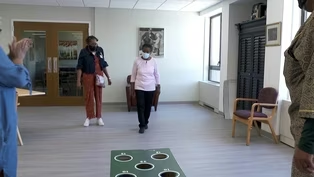
NARRATOR: Here at the Hannan Center in Detroit, a program called Daybreak offers older adults with dementia a chance to socialize and take part in activities that stimulate their minds.
For family caregivers, Daybreak provides a much needed short-term break to focus on their own needs and obligations.
Respite care for the caregiver, as well as the person who's living with dementia is just absolutely vital.
One of the reasons why it's so vital is that often the person who is taking care or supporting that other person are oftentimes sicker than the person that they're trying to help, or they're neglecting their own health in the process, just because they're not able to do all the other things that they do.
That's kind of why we call it Daybreak.
I've been a caregiver about 12 years.
I took care of my father when he went to a nursing home, and then I started taking care of my grandmother and then she went to a nursing home.
Now I'm taking care of my mom, and I've been taking care of her for about five years after my father and my grandmother passed.
So it's been a journey.
It can be kind of rough.
It really can.
I'm not gonna sit up here and sugarcoat it.
It has its ups and downs, you know, but at the end of the day, I'm glad that I can do it.
NARRATOR: A survey conducted by AARP and the National Alliance for Caregivers shows only about 14% of family caregivers are using respite services, although 38% believe it would help relieve stress.
So why aren't more caregivers taking time off?
Cost and transportation are two major factors.
Transportation's a huge issue for the families that we're targeting.
Some of them use MetroLift, others have their care partners that drive them there.
But, when we first did our research in the program, that was one of the key things that we found, was that people did not always have a way to sort of get to the place or to that day program.
One of the good things about Adult Day Programs, it's an affordable alternative to say, placing someone in a nursing home or an assisted living facility.
And we try to keep our costs really low.
We have some awesome partners.
We have the City of Detroit that's provided funding for the Adult Day Program, along with Detroit Area Agency on Aging.
So that helps to defray a lot of the costs, so it can range from $5 an hour, up to $8 an hour.
Whoo.
(hands clapping) Look at you.
All right, good job.
Daybreak offers several different types of activities during the day for our older adults.
We have a Tai-Chi instructor that comes in once a week.
We also offer exercise program, where we have an exercise fitness person comes in twice a week.
I have an art therapist that comes in once a week as well.
We are looking at different options for musical people to come in.
We have several people that are really gifted in music, and they come in and play the piano.
We had a participant to play the piano for us, as well.
As a caregiver, it helps me because they do things with my mom that I don't do.
Like, you know, we do walking and she does light work around the house, but as far as the speech and game playing and stuff like that, I don't do that at home.
She wants someone else to talk to besides me.
She get tired of hearing my voice, you know.
And then she's in her own communities when she's there.
You know, they get each other.
You know, I can't fully understand what she is going through, but other people that has dementia fully understand each other.
And that's a blessing right there.
And also it gives me a chance to get a little breather.
When people come to the Adult Day Program, they don't have to come for a full day.
They can come for four hours, or they may come two, three times a week.
We try to be very flexible, and I think that's one of the things people ought to look at when they are looking for an Adult Day Program, is sort of what are the hours, how flexible they are, what does it look like in terms of late pickup or late drop off, looking at the cleanliness of the facility, the experience of the staff.
There's all these things, that as you're trying to find this place for your loved one, you want them cared for in a certain way.
NARRATOR: The Daybreak Program had only been open for about six weeks when the COVID-19 pandemic shut down the in-person activities early last year.
When the pandemic hit, one of the things that we were able to do was to immediately start sort of what we call this sort of telephone reassurance.
We began calling our caregivers, our care partners, and to the extent that we're able to talk with the participants as well, that's what we did.
During the course of the past year, I'm in contact with my caregivers weekly.
I speak to each and every one of them.
My calls can last from three minutes to an hour and 10 minutes.
It doesn't matter.
I'm there for the caregivers.
We talk about any resources they may need.
I do whatever I can for them.
NARRATOR: Adult Day Services have resumed at the Hannan Center with the COVID safety protocols in place, such as deep cleaning, limited capacity and vaccinated staff members.
The mission remains the same, to preserve the quality of life for participants and provide peace of mind for caregivers.
I love the Daybreak Program.
It really helps.
It stimulates my mom's mind.
It keeps her busy, and overall I would recommend that people will put their loved ones into a day program or adult program.
It's just a good program all the way around.
And, finally today, diversity in the arts.
Musician and founder of the Sphinx Organization, Aaron Dworkin sat down with Saxophone as an Educator, Steven Banks, to discuss how orchestras can promote diversity in their organizations.
Here's part of that conversation from his Arts Engines interview series.
So for those who might feel like, I would love for our repertoire to be more diverse, but to be frank, like, we're not sure where to start or you know, what to do.
What would be your recommendation for orchestras or large ensembles that are looking to try to diversify what they perform?
Well, I think the first piece of advice would just be to start.
Regardless of all of those things that might set you back, just start.
Even if it's maybe right now, it's one piece, and then you start realizing, "Oh, well maybe just one piece is not really the best way forward."
And then you do an entire concert and then you say, "Well, that's probably not enough either."
And then you start realizing more of the nuances of how to do this in the best way possible by diversifying your board and diversifying the conductors that you bring in, and diverse.
You know, because they will all have different areas of expertise, diversifying your musicians.
And those things sort of happen as maybe a snowball effect.
As you get your feet wet, then you learn more and you continue learning more.
So as long as you come at it from a perspective of humility, and knowing that your first steps are not gonna be your last steps, then I think that just going ahead and starting with whatever's in your mind, "Okay, I can do this, I can do this."
So let's start there, and see where it leads.
Awesome.
Great.
So as you kind of look at, you know, it seems like a lot of people are like, it's impossible to plan now with all of the things going on in our society and especially the pandemic, kind of, you know, where are things gonna be for me?
Do you have kind of a plan for this next year?
What's coming up?
What's your sense of kind of some of those key things that you want to make sure you accomplish for this next year?
Well, for me personally, I think a lot of it has been related to learning really how to use technology, because so many things are possible.
I can keep performing as long as I have good microphones and a good camera and things that make it all look to a level that I'd like for it to, and if I learn how to package it in a certain way.
And my students can keep having a meaningful experience as long as we're all able to hear each other, and things like that.
So I think at this point, I've sort of settled in to the pandemic lifestyle.
And I realize now I still have a need to share music.
I still have a need to advocate.
I still have a need to write music, and I can still do all of those things.
I can still collaborate with other musicians.
I recently started a vlog series called Curious Dyads, and it's sort of a cross between a vlog and a podcast and a performance outlet.
So I interact with other musicians that I really, really admire, and we have a conversation.
And then we also do a collaborative performance at the end of each episode.
And so things like that have just been really keeping me feeling expired, inspired, not expired, (laughing) feeling really inspired, because some of those people, I wouldn't have had the opportunity to collaborate with otherwise, and being new to the young concert artist roster, in a way this sort of levels the playing field.
So those people that I might've been nervous to interact with before, and now I can just say, "Hey, let's do something.
You're not doing anything.
So let's do it."
Awesome.
Awesome.
That's gonna do it for us.
Thanks for watching.
You can find out more about today's guest at americanblackjournal.org, and you can, as always, connect with us on Facebook and Twitter.
Take care, and we'll see you next time.

Video has Closed Captions
Clip: S49 Ep33 | 10m 11s | Childcare | Episode 4933/Segment 1 (10m 11s)
Video has Closed Captions
Clip: S49 Ep33 | 6m 24s | Respite Care | Episode 4933/Segment 2 (6m 24s)

Video has Closed Captions
Clip: S49 Ep33 | 4m 6s | Steven Banks | Episode 4933/Segment 3 (4m 6s)
Providing Support for PBS.org
Learn Moreabout PBS online sponsorship
- News and Public Affairs

Top journalists deliver compelling original analysis of the hour's headlines.

- News and Public Affairs

FRONTLINE is investigative journalism that questions, explains and changes our world.












Support for PBS provided by:
American Black Journal is a local public television program presented by Detroit PBS