
Childhood Trauma and COVID-19
3/18/2022 | 26m 46sVideo has Closed Captions
The pandemic has been full of uncertainty and stress. For children, it can lead to trauma.
The COVID-19 pandemic has been full of uncertainty and stress. Children are among the most impacted with distance learning and isolation. Experts say there’s reason to believe traumatic stress for children is on the rise as millions of families have lost loved ones, lost jobs and faced constant fear over the past year.
Problems playing video? | Closed Captioning Feedback
Problems playing video? | Closed Captioning Feedback
ncIMPACT is a local public television program presented by PBS NC
Childhood Trauma and COVID-19
3/18/2022 | 26m 46sVideo has Closed Captions
The COVID-19 pandemic has been full of uncertainty and stress. Children are among the most impacted with distance learning and isolation. Experts say there’s reason to believe traumatic stress for children is on the rise as millions of families have lost loved ones, lost jobs and faced constant fear over the past year.
Problems playing video? | Closed Captioning Feedback
How to Watch ncIMPACT
ncIMPACT is available to stream on pbs.org and the free PBS App, available on iPhone, Apple TV, Android TV, Android smartphones, Amazon Fire TV, Amazon Fire Tablet, Roku, Samsung Smart TV, and Vizio.
Providing Support for PBS.org
Learn Moreabout PBS online sponsorship- [Brown-Graham] Coming up on "ncIMPACT," COVID-19 has been challenging for many of us.
For some children, it's been traumatic.
We explore some innovative ways communities are helping children to build their resilience.
- [Male Announcer] "ncIMPACT" is a PBS North Carolina production in association with the University of North Carolina School of Government.
Funding for "ncIMPACT" is made possible by... - [Female Announcer] Changing the course of people's lives, that's the impact UNC Health and the UNC School of Medicine work to deliver every day.
Our 40,000 team members across the state of North Carolina are committed to caring for you, our patients and communities, as well as educating the next generation of healthcare professionals.
Individually, we can do a little, but collectively we can do a lot to create impact.
- Hello, and welcome to "ncIMPACT."
I'm Anita Brown-Graham.
Some children were already struggling with unaddressed mental health issues.
The social isolation and uncertainty caused by the pandemic have only made matters worse.
Numbers from the Centers for Disease Control and Prevention reveal a startling statistic.
Emergency department visits for suspected suicide attempts among adolescents increased 31% in 2020 as compared to 2019. ncIMPACT's Evan Howell introduces us to an Edgecombe County man who experienced trauma as a child, but he now uses his experiences to help children deal with trauma caused by the pandemic and other life factors.
- So, this is how the peanut brittle looks.
- [Howell] Byron Hall says he's learned a lot these past few years.
Not only has he learned how to manage a peanut brittle business since around 2018, but he's also learned how to manage his anger.
- The anger came with lifestyle.
The anger came with me waking up being mad because I couldn't afford things.
Couldn't afford breakfast for my family.
- [Howell] Hall says his struggle to control his temper was a result of childhood trauma.
Growing up in the Bronx, he experienced multiple adverse childhood experiences, including divorced parents, abuse, neglect, and incarceration.
- Crime, alcohol, drugism, people getting beat up, people getting mugged, people getting shot.
Those things were becoming the norm to me.
- [Howell] Childhood trauma can be profound and long-lasting, the effects of which hall says he only realized later in life through the help of the Rural Opportunity Institute.
- I didn't know what it was traumatic as I was going through it.
These was just the norm as I was going through it.
So, until I got older, until I had kids, that's when the word trauma came up, and then I had to really look at the word trauma, and, you know, feel the effects of it on me and see what it done to me.
- [Howell] Hall now mentors low-income teen parents and helps them overcome trauma through resiliency training.
He says on top of the childhood trauma they've already experienced, most of his students are wrestling with the trauma brought on by the COVID-19 pandemic.
One student suffered because he couldn't afford taking online classes at home.
- And he was going to school off his mother's phone and using that as a hotspot, and then their cell phone bill got so high, the kid stopped going to school for the rest of the year.
- [Howell] Hall says traumatic events like these can drastically affect a young person's future.
- It made me become a bitter, cold person, non-empathetic and non-caring.
I didn't care about myself because I was fighting invisible holes in the system that I didn't know I was falling into, but I had to climb my way out because I didn't have no role model, you know, just to guide me.
- [Howell] Hall says his work helping others has given him greater strength to make a difference and helped his family at the same time.
- It's changed my life.
It has gave me a relationship with my daughter that I didn't have.
Trying to crack the brain of 13-year-old girl is hard, and me being a young man, I grew up so rough, I didn't know how to talk to my daughter.
I didn't know how to communicate.
- [Howell] Hall launched a podcast in 2020 to help kids cope with trauma, and he's hopeful the more communities identify signs of it, the brighter many futures will be.
For ncIMPACT I'm Evan Howell.
- Joining me now is Dr. Benny Joyner who is the chief of pediatric medical care at UNC Children's Hospital.
Benny, what is trauma?
Define that for and help us understand how it relates to adverse childhood experiences.
- Yeah, thanks for that question.
You know, trauma is really just defined as an experience or an event that really overwhelms an individual's ability to cope, so as we think about it in the continuum of adverse childhood experiences, it's any one of those experiences, whether it's a physical experience or a mental experience, that overwhelms a child's ability to understand, to cope, to deal with that particular situation so they end up developing maladaptive coping strategies.
- Huh.
So, let's talk about the pandemic for a moment.
What is it that children are experiencing during this pandemic that results in trauma?
- Yeah, I think children are experiencing a wide variety of different events during this pandemic.
I think one of the central things is the social isolation that occurs as a result of the pandemic.
So, not only is the physical distancing, the public health measures that we have necessary to protect kids, but also the absence and the isolation from friends, the disruption of their particular social schedule, the inability to connect with other individuals on a very human level, I think all of those have really created these individuals that haven't developed, especially at a crucial in their childhood, an ability to socialize.
- So, we heard in the story the immediate impacts and the long-term impacts of trauma.
Help us understand how these adverse childhood experiences are gonna impact our children right now and what we might expect in the future.
- Yeah, and I think adverse childhood experiences will impact children right now in the immediate effect by developing, you know, these maladaptive coping strategies, this inability to handle typical stressors that we might encounter, and so they may either act out, lash out, develop behavioral problems, develop worsening mental health problems, anxiety, any of those other issues that may manifest eventually into intentional harm, self-harm, or self-injurious behavior.
Long-term wise, we know from a real, a seminal study done in the '90s the ACEs study that there is gonna be long-term health effects, chronic hypertension, medical effects, you know, and really a lot of the leading causes of deaths can all be tied back to those individuals that've experienced adverse childhood experiences or ACEs.
- So, when you hear a father say, I'm trying to get past my trauma so that I can be there for my 13-year-old daughter, what does that say to you about the potential to get beyond whatever experiences we may have experienced as children?
- Well, at first you, you think about it.
So, you have a father saying that about their relationship with their daughter, so there's that one area to unpackage, right?
How they're gonna develop that relationship, how they're gonna build that relationship.
But it also speaks to, again, this is a father who experienced this trauma long ago, right?
And so now they're trying to not only deal with that, understand that, but then also how are they gonna relate so that hopefully that they can pass on to their daughter, like, how we can develop strategies to cope, to not sort of have this experience later on in life?
- So, this is how we break the cycle.
Thank you so much for of this.
- Absolutely.
- Traumatic events can have a profound impact on young children, Columbus County is taking a community-wide approach to helping children and their families.
ncIMPACT's David Hurst joins us with more.
- Anita, in the past few years, Columbus County has dealt with flooding from two deadly hurricanes, compound that with a global pandemic, and children in that area have had to deal with a lot of emotional distress and fear.
But the community is leveraging the power of collaboration to give those who have experienced trauma an opportunity to thrive.
When Andrea Jacobs Rofail and her family lost their home due to Hurricane Florence in 2018, it had a significant impact on their son.
- Your home.
It's your safe place.
It's where you take your family, you have your meals, you have your time together.
And then all of that, you come, and it's gone.
- [Hurst] Rofail says Noah, their only child of the time, struggled with this traumatic event, losing the structure and routine he was used to.
- Noah didn't have toys.
He didn't have books.
He didn't have a place to sleep.
- [Hurst] The family hopped around staying with family and friends for eight months before being able to move back into their home.
But then a year later, shortly after having their second child, the COVID-19 pandemic hit.
- One minute, your world's this way, and the next minute, your world is a different way.
It's turned upside down.
- [Hurst] With her children facing more uncertainty and stress, Rofail participated in a resiliency training course.
The Reconnect for Resilience training gave her a set of practical strategies to promote wellbeing in the midst of ongoing stress and adversity.
- Having those sessions with the Resilience, the webinars and sessions, that's how I was able to stay strong for my children, for my family, and to lead them, and to show them how to survive and how to get through a hardship or difficult situation.
- [Hurst] The training was made available by Resilient Columbus, a coalition of more than 50 agencies working to bring awareness to adverse childhood experiences.
Selena Rowell, executive director of the Columbus County Partnership for Children, says the coalition came together in 2019.
It ended up being a pivotal part of dealing with some of the childhood trauma that came about during the pandemic.
- When children don't have stability, that can be a point of trauma for them.
- [Hurst] Rowell says it's still too early to tell the full impact the pandemic has had on children, but she believes it's created or intensified many adverse childhood experiences.
- The body goes through so much when it's young, and there's one doctor who says that your body remembers.
You may forget, but your body remembers, meaning that these things that we endure as children can really impact us for the rest of our lives.
- [Hurst] And for Rofail, Resilient Columbus has helped give her the framework to lead her family through difficult situations.
- I know that what they're doing, they are changing lives and they're planting seeds.
And I support them 100%.
- And Columbus County is also home to the first tri-county regional community prevention action plan in North Carolina.
Columbus, Bladen, and Robeson counties are working together to improve the coordination between counties, all on an effort to enhance care for children who have been impacted by adverse childhood experiences.
The goal indeed is to build resilience throughout the whole region.
- I love that.
Thank you, David.
Joining me now is Michelle Hughes.
Michelle is the executive director for NC Child.
Michelle, the word resilience is a pretty popular word these days.
Well, what does it mean?
And why is it so important as we think about child wellbeing?
- Sure.
Resilience is defined really as our ability to adapt well in the face of adversity or stressors or hardships, so these are things, skills and supports and connections, that we can use to sort of buffer stress and to bounce back from times that are hard.
It's important because all of us as human beings in our lifetimes are going to experience adversity, but for some folks, particularly children during their sort of childhood, adversity, particularly if there's multiple adversities, can overwhelm a child.
It can overwhelm their coping abilities.
It can harm their health and their development.
And so we really wanna make sure that we are providing supports to kids and families so that they can build their resilience skills and really lead a successful life.
- So, we've known each other for some time, and you know my favorite word in the whole dictionary is collaboration.
We just heard in that story, that more than 50 agencies are involved with Resilient Columbus.
How important is this aspect of bringing everyone to table through community collaborations when it comes to tackling this issue of adverse childhood experiences?
- It's really important, and I think the way to think about this is that kids don't come by themselves, right?
They come through a package deal.
Kids come in families, and those families are in community, so if we wanna sure that children are healthy and they're thriving, we really need to make sure that they're growing up in families and communities that are healthy and thriving.
And the challenges that communities and families are facing, particularly during this pandemic, can be overwhelming.
So, there is no one institution, no one community group that alone can solve this problem.
But by coming together and really having a shared vision of community resilience, a community in which every person feels safe, feels valued, has agency, every child has connections and is nurtured, that is something that we can achieve, and across North Carolina, we're seeing communities do really magical work when they come together.
- Offer some advice to our viewers, please.
What can community leaders do if they want to see the same sorts of collaboration in their own communities?
- That's a great question.
You know, I think lifting up, really, the excellent work that's already happening in North Carolina is a great way to answer that question.
What we're seeing is community leaders really understanding that children are 22% of the population, but they're 100% of our state's future.
And so starting with a shared vision of what we want for our children is where community leaders are starting.
They're also really increasingly centering the voices of families and youth and impacted community members in their discussions and in their collaboration.
The folks that are most impacted by some of the challenges in the community are the folks who really are the most experts in that, and they need to be identifying the challenges and driving the policy solutions and the community solutions.
- Thank you, Michelle.
School districts across our state are working hard to help children cope with trauma.
ncIMPACT's Melody Hunter-Pillion introduces us to one school district embracing what's called trauma-informed learning.
- Lee County Schools is one of the first school districts in the state to build a system-wide team that provides mental health services inside the schools.
Their latest initiative during the COVID-19 pandemic is providing social and emotional learning for their students.
The school district is one of the participants in the North Carolina Resilience and Learning Project.
It's an initiative by the Public School Forum of North Carolina.
We visited B.T.
Bullock Elementary School to see how it works.
- [Spahr] Thank you for being silent and being ready.
Excellent job.
- [Hunter-Pillion] When Kelly Spahr was in the fifth grade, she had a teacher who changed her life.
- I came from some childhood trauma myself, and she recognized that in me.
And she took the time to get to know me as a human, and she took the time to support me and help me grow, and I knew I wanted to do that for others.
Hmm, let's make it a little tougher, then.
- [Hunter-Pillion] The third-grade teacher at Bullock Elementary says that work is even more important now following a school year of remote learning and the uncertainties of a pandemic.
- The more we've learned and the more we've really gotten into children, how they work, how they tick, what's really good for them, the more we've realized that we need to pay closer attention to that social and emotional piece.
It's not just academics.
- What could you do, Kamani?
- [Hunter-Pillion] Lee County Schools is one of 14 district partners of the North Carolina Resilience and Learning Project.
The Public School Forum of North Carolina program began in 2017 prior to the pandemic, but program leaders say COVID-19 has only emphasized the importance of this work.
- We were all enduring a collective trauma, you know?
Everyone felt a sense of helplessness, powerlessness.
- But are you getting close?
- [Hunter-Pillion] The program is meant to help schools better support children who are dealing with trauma.
Teachers and staff go through training to understand trauma's impact on learning and strategies to build student resilience.
One of those strategies is a practice called zones of regulation.
It's a simple way to help students recognize their feelings and use tools to self-regulate.
- We talk about zones here at B.T.
Bullock.
When we're in the red zone, we're very angry at that time.
What can we do?
What are some strategies?
How do we use our words to let other people know what we're feeling?
- [Hunter-Pillion] Administrators emphasize that trauma-informed learning does not excuse student misbehavior, and there are still consequences.
- When you hear kids taking responsibility for their actions, using the language of, like, emotional self-regulation and then making amends, I mean that, you know, we wish that all adults could do that, right?
[laughs] So, it's very rewarding when you see the children directly benefiting from this way of thinking about how we treat one another in school.
- [Spahr] Mm-hmm, now's your perfect time.
Bye, bud.
- [Hunter-Pillion] Teachers at B.T.
Bullock Elementary say the culture shift is also having a positive impact on their mental and emotional health.
For Kelly Spahr, she's excited about the potential of the program as her students get older.
- As we have come into this in the last year or so, our kindergartners are gonna become fifth graders, and they're gonna have six years of this practice in place, and I think it's going to help them long-term to become better citizens, to become better people, and to help one another.
- The Lee County School District is also part of the Lee County Community Resilience Collaborative.
The initiative is run by Partnership for Children, Families, and their mission is to educate the community about trauma and adverse childhood experiences.
They gather many different stakeholders to the table to address this important issue.
- Let's go ahead and bring back our experts, and joining us for our ncIMPACT round table is Ernestine Briggs-King, who's the director of research at the Center for Child, Family Health.
Ernestine, I'd like to start with you, if I might.
Talk to us about some of the challenges that school districts and communities at large face as it relates to providing mental health services for children.
- Thank you.
Schools have an amazing opportunity to teach our children.
That's their main job, and in their doors are coming children with a myriad of experiences.
Many of them have experienced trauma and other adversities, and so becoming a trauma-informed community, becoming a trauma-informed care place for our kids is important to really responding to all their diverse needs while also attending to their primary job of learning.
If you don't attend to the trauma, kids can't learn, and so it's really important that we figure out ways, and to bring this not only into our schools, into our systems, our child welfare, juvenile justice, into our communities.
We all need to become trauma-informed so that we know how to support healthy, productive kids in the future.
- Michelle, let's pick up on this point that Ernestine makes.
I don't remember social and emotional learning being a thing when I was going through school, but it is real, and it's hard to do the ABC-123 learning if you aren't attending to the social and emotional learning.
So, talk to us a little bit about how this shift in thinking about young people is benefiting our children.
- Sure, it's a great question.
You know, one of my favorite sayings is you can't do one without the other, right?
So, children's development and learning is all integrated.
So, the focus on math and reading and writing is really important, but integrated in that is social-emotional development and social-emotional skills.
So, you can't do reading and writing and learning without also attending to social-emotional, and that's sort of a core for all of our children and their learning.
What we're seeing with schools and with early education, even, is that a real attention to focus on how can we support children in building skills, resiliency skills, social-emotional skills, so that they can weather all the things that they're going to be experiencing throughout their life, and the trauma-informed schools is a great example of some wonderful initiatives that are happening, but schools across North Carolina need things like more school nurses, school social workers, folks who really are on the ground in classrooms working with children and with teachers to really support children's learning and development.
- So, Benny, we've got viewers from all over the state.
What are some of the unique challenges for rural communities where mental health services for everyone, but particularly for young children, aren't as widely available and families may lack transportation or insurance to access the care that does exist?
- Yeah, I think that's a real challenge.
You know, I think that as we think about these rural communities that don't have those access, you know, you talked about not knowing, recognizing that curriculum that existed, you know, when you were in school.
I think it's that unwritten curriculum, right?
So, now what we're doing is we're sort of leaving these children to their own devices to try to navigate this world on their own, and I think that becomes problematic, right?
You know, I think there's some benefit to that, but also if you are a child who has suffered trauma and recognizing that, you know, children all respond to trauma differently, perceive trauma differently, and I think those situations in which you're in a smaller community in which, you know, you don't have those resources, then those children are going to be put at a disadvantage later in life because they won't have those access to those resources.
- Yeah.
So, Michelle, how do you respond if you're one of these communities?
What are some of the solutions you've seen implemented at the local or state level that show promise in overcoming these challenges?
- Sure.
I think a lot of school districts and communities are really looking at how they're building out their social-emotional supports within their community and their mental health services.
One of the things that we're hearing, and you all mentioned it earlier, is that we are seeing skyrocketing numbers of children with anxiety, depression, suicidal ideation.
In 2020, 56 young people took their lives in North Carolina due to suicide, so this is a mental health crisis across our country and in our state, and communities are coming together to identify from prevention to treatment what are the services that we need in place?
How do we partner with pediatricians?
How do we partner with insurance companies?
How do we partner with clinicians to really make sure those services are available across North Carolina and particularly in rural communities that are often under-resourced and don't have access to those kinds of services.
- And I think that, especially in light of COVID, you know, right?
Like, what you're talking about, that aspect of prevention is going to be really critical, you know, to keep from these children sort of coming into the emergency departments, you know, with these challenges.
- I think one of the things that you said that's so important is collaboration, and it's key to, really, our success.
Thinking about how do we as community partners, whatever role we play, can make a difference, and thinking about all that we can kind of share with each other, learn from each other, and really kind of help our children, I think collaboration has gotta be key.
And becoming a trauma-informed community is one way for us each to learn how to bring our different aspects, whether it's a pediatrician or a psychologist, a social worker, a nurse, a teacher, all of us have a role to play.
- I can't thank you all enough for the important work you're doing for the 100% of our future.
And of course, thank you to the local leaders who allowed us to share their stories today, all inspirational, collaborative work.
And thank you to our amazing audience for watching and engaging.
You know solutions are out there if we work together.
Tell us what your community is doing or how we can help you.
You may email us at ncimpact@unc.edu or message us on Twitter or Facebook, and be sure to join us every Friday night at 7:30 on PBS North Carolina for new episodes of ncIMPACT.
Coming up on ncIMPACT, local economies benefit when companies invest and hire more employees.
We explore how some communities are getting creative in attracting big business.
[energetic music] ♪ - [Male Announcer] ncIMPACT is a PBS North Carolina production in association with the University of North Carolina School of Government.
Funding for ncIMPACT is made possible by... - [Female Announcer] Changing the course of people's lives.
That's the impact UNC Health and the UNC School of Medicine work to deliver every day.
Our 40,000 team members across the state of North Carolina are committed to caring for you, our patients and communities, as well as educating the next generation of healthcare professionals.
Individually, we can do a little, but collectively, we can do a lot to create impact.

Building resilience through social and emotional learning
Video has Closed Captions
Schools use social and emotional learning to help children cope with trauma. (3m 2s)

How childhood trauma taught this NC man to help others
Video has Closed Captions
Byron Hall uses his own childhood trauma to help children who are struggling. (2m 29s)
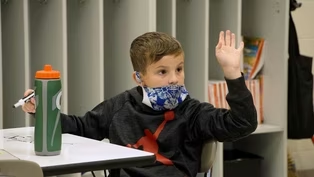
Preview | Childhood Trauma and COVID-19
The pandemic has been full of uncertainty and stress. For children, it can lead to trauma. (20s)
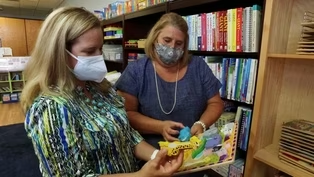
“Resilient Columbus” helps children navigate their trauma
Video has Closed Captions
"Resilient Columbus" program helps children and their families deal with trauma. (2m 40s)
Providing Support for PBS.org
Learn Moreabout PBS online sponsorship
- News and Public Affairs

Top journalists deliver compelling original analysis of the hour's headlines.

- News and Public Affairs

FRONTLINE is investigative journalism that questions, explains and changes our world.












Support for PBS provided by:
ncIMPACT is a local public television program presented by PBS NC