State of Affairs with Steve Adubato
Chris Widelo; Jeffrey Boscamp,Melika Behrooz; Shavonda Sumter
Season 8 Episode 26 | 26m 34sVideo has Closed Captions
Chris Widelo; Jeffrey Boscamp,Melika Behrooz; Shavonda Sumter
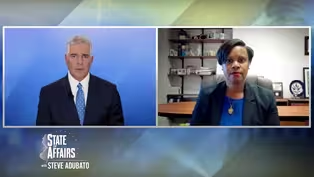
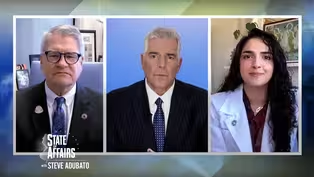
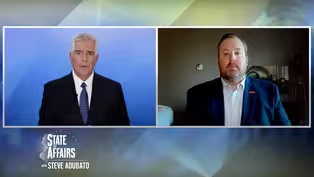
Christopher Widelo, State Director of AARP New Jersey, talks about challenges facing older residents. Jeffrey Boscamp, MD, Dean & President of Hackensack Meridian School of Medicine, and medical student Melika Behrooz, talk about the physician shortage. Asw. Shavonda Sumter, Chair of the Community Development & Women's Affairs Committee, discusses the impact of the 2024 Presidential Election.
Problems playing video? | Closed Captioning Feedback
Problems playing video? | Closed Captioning Feedback
State of Affairs with Steve Adubato is a local public television program presented by NJ PBS
State of Affairs with Steve Adubato
Chris Widelo; Jeffrey Boscamp,Melika Behrooz; Shavonda Sumter
Season 8 Episode 26 | 26m 34sVideo has Closed Captions
Christopher Widelo, State Director of AARP New Jersey, talks about challenges facing older residents. Jeffrey Boscamp, MD, Dean & President of Hackensack Meridian School of Medicine, and medical student Melika Behrooz, talk about the physician shortage. Asw. Shavonda Sumter, Chair of the Community Development & Women's Affairs Committee, discusses the impact of the 2024 Presidential Election.
Problems playing video? | Closed Captioning Feedback
How to Watch State of Affairs with Steve Adubato
State of Affairs with Steve Adubato is available to stream on pbs.org and the free PBS App, available on iPhone, Apple TV, Android TV, Android smartphones, Amazon Fire TV, Amazon Fire Tablet, Roku, Samsung Smart TV, and Vizio.
Providing Support for PBS.org
Learn Moreabout PBS online sponsorship- [Narrator] Funding for this edition of State of Affairs with Steve Adubato has been provided by EJI, Excellence in Medicine Awards.
A New Jersey health foundation program.
Kean University.
Where Cougars climb higher.
The Turrell Fund, a foundation serving children.
Newark Board of Education.
The Port Authority of New York and New Jersey.
Moving the region through air, land, rail, and sea.
Robert Wood Johnson Foundation.
Working for a more a healthier, more equitable New Jersey.
Wells Fargo.
The Fidelco Group.
And by The Adler Aphasia Center.
Promotional support provided by The New Jersey Business & Industry Association.
And by New Jersey Monthly.
The magazine of the Garden State, available at newsstands.
[INSPRATIONAL MUSIC] - Hi everyone, Steve Adubato.
We kick off the program, first time guest, I'm sure he'll be back again.
Chris Widelo is the state director of AARP, New Jersey.
Chris, good to see you.
- Good to see you as well, Steve.
Thanks for having me.
- You got it.
Got the website up.
Tell everyone what AARP is, as if some of us don't get stuff in the mail.
- Sure, so AARP is a social mission organization.
We are a nationwide organization and here in the Garden State we have over 1 million members.
And our goal is to help people age with dignity and live the best life they can as they get older because we are all getting older.
- Yeah, last time I checked that's true.
Chris, the most, two to three most pressing issues for 50 plus people in New Jersey, and then we'll talk about the nation in a second.
- Sure.
You know, I think there's a number of issues that really come to mind.
I think one of the big ones, especially for New Jersey, is around property tax.
You know, far too many people are feeling like they cannot continue to live here in the Garden State and want to, so we're fighting hard to make sure that people can access property tax relief, and stay in their homes, in their communities.
Other issues around fraud is a really important issue.
You know, often older adults are targeted at a much higher rate when it comes to frauds and scams.
You know, I think there's no, I think everybody knows somebody that has been a victim in one way or another, or has been at least approached.
And, you know, the other issue that I think AARP really focuses on is around caregiving.
Making sure that people can have the care that they need as they age.
You know, the majority of care that is given in this state and across the country is done by family members, right?
They're not compensated.
They do it because they love their loved one, but it's often a hard road for many caregivers and we're always trying to make it better for them so they can continue to do that work.
- Chris, lemme ask you this, nationalize this for a second.
We're doing this approximately a week after the presidential and congressional elections.
That'll be seen a little bit after, the date will come up.
Question, how concerned are you about the new Trump administration, Republican Congress, both Houses as we speak right now, that's the way it looks, making real changes to Medicare and Social Security?
- Sure.
I think, you know, we're concerned because we know that social security in 2034 will experience some issues if nothing is done.
And I think what we learned from this election, and, you know, looking at the past a week ago, the majority of voters were 50 and older.
They carried the election as they do in almost every election in the last two decades.
And I think what we know from our members and from older voters is that they care about the issues of social security and Medicare very deeply.
And it doesn't matter if they're, what party they're from.
Their expectation is that Washington will take action to make sure that Social Security can continue to pay out 100% of this benefit and that Medicare is strong, because those are pillars of retirement for many older adults.
- Well, Chris, hold on.
If something has to be done with Social Security, as many argue, to keep it solvent for the future, and some have argued, "Yeah, we need to cut benefits, we need to raise the retirement age before you begin to collect" whatever, do you believe any substantive changes need to be made in the formula and the distribution of dollars in social security or leave it the same?
- We need to have a conversation.
I mean, that's the starting point, is there has to be a national conversation that is free and clear of all these other issues, the debt ceiling, you know, you name the different issues that are floating around Washington that they often want to tie social security to.
This is the bedrock of people's retirement.
They have worked their whole lives, have paid into the system, and they are expecting their benefit when they retire.
And so, we have to have a national dialogue where we have all parties sit down and think about what are some realistic solutions to keep this program as strong as it has been for the last 80 plus years.
So, without that conversation, we can't even speculate as to what the solutions need to be, but we have 10 years, we've known that this date was coming since the '80s.
And it's time to, you know, for everybody to sit down in Washington and address this important topic.
- Chris, bring this back to New Jersey again.
The Stay NJ Program.
Tell everyone again what it is and why it relates to people 50 plus.
- Sure.
So, the Stay NJ program is a new program that was passed this year, signed into law by Governor Murphy.
And we worked, you know, closely with the legislature and the governor.
It will streamline the property tax relief efforts in the state.
It will make sure that if you, you know, qualify based on age and income that you can access the different property tax relief measures.
Currently we have the Anchor Program, and then also the Senior Freeze Program.
- Chris, before I let you go.
Most common misconception about AARP is?
- I think it's that it's just for seniors.
I think that people think about it as, you know, "Oh, that's for people that are older than me."
We're really about helping people as they age throughout their process.
And so the things that we work on are often good for people of all ages, but we're really focused on making life better for people as they age.
And, you know, we engage a lot of folks to volunteer in our state to help run the programs that we offer and give back, 'cause often people want to be involved and give back to their communities.
- Hmm.
Chris Widelo, state director of AARP NJ.
Their website's been out, find out more about the work they do every today.
Chris, thank you so much for joining us.
We appreciate it.
- Thank you very much, Steve.
- I'm Steve Adubato, stay with us.
We'll be right back.
(grand music) - [Announcer] To see more State of Affairs with Steve Adubato programs, find us online and follow us on social media.
- We're back, folks, talking about tomorrow's physicians.
We're joined by Dr. Jeffrey Boscamp, Dean and President of the Hackensack Meridian School of Medicine, and Melika Behrooz, who's a third-year medical student at the school.
Jeff, good to see you, my friend.
Melika, good to meet you for the first time.
- Great to see you, Steve, always.
- Hey Jeff, let's do this.
You and I have had many offline conversations to disclose.
I've done significant amount of leadership coaching for physicians within HMH.
Question, where are we today moving into 2025, as this will be seen, in medical education just compared to 2000?
- Wow, apples, just apples and advances way, way beyond the oranges.
So, you know, it's pretty amazing, Steve.
You know, since that time, there been you know, we've had a significant doctor shortage in the country, so the number of new schools has really blossomed and come up.
But I think the biggest change, honestly, is in how we teach and how our students learn.
So, you know, there were very orthodox ways of teaching in medical school, two years of in the classroom, no patient contact, no community involvement, just sitting there learning pharmacology and anatomy, you know, basic science things, not really being taught by clinicians who delivered healthcare and often having difficulty in seeing the relevance of what you're being taught.
Then all of a sudden in your third year, you got thrown into a hospital with an operating room and wards and were expected to just absorb that.
Things are completely different, and Melika will tell you that from her first day it was different.
And she can tell you the way that we teach and she learns.
- Let's talk about that.
This again is part of our ongoing series we're kicking off called "Tomorrow's Physicians," it's really the importance of medical education.
Melika, let ask you first, why medicine, and did you make that decision during COVID?
- Hi.
(laughs) I did not make it during COVID, but I was more motivated than ever to continue applying to medical school.
That's when I did my medical school applications.
But I don't know if your viewers might not be aware, it's a multiple-year process to even get up to the point of applying to medical school.
So for me, it started back in like high school.
I was volunteering at my local hospital in Jersey City.
I went to college as a pre-medical student, and I really wanted to be in a field where I could give back and serve my local community that I grew up in but in a way that kind of melded like art and science.
I think medicine is that kind of field where you have the scientific knowledge, but you also have to bring a level of humanism to it, and think there's an art to that.
So I really wanted to be in that field.
- Dr. Boscamp, let me come back and ask you this, listening to Melika.
And I know there are a whole range of reasons why people go into medicine, but post-COVID, do you think it is harder to recruit young talented people into this profession, and if so, why?
Or is it going the other way?
- So what a great question because I think a lot of people might think that.
They saw healthcare workers that were dying, that were giving up their life for their patients.
And some people run to the fire, Steve, and some people run away.
And I think what we've seen is just as you described it, the opposite.
Our application numbers are way up, and I think our students that are coming to our school are really motivated to get involved and to give.
So we look for that level of empathy in their past.
It's not just their board scores.
It's not just their admission test or their GPAs.
We're really looking for people like Melika who have come to us, have already been involved in the community, and wanna come to medicine for the right reasons.
And we are getting really good applicants.
- Melika, in listening to the dean, I wanna follow up on this because I know you're aware of it.
In my physician leadership coaching, I've learned about the quote-unquote "human dimension track."
There's a human dimension track within the medical school.
What is that track, and how will it prepare you to be a more impactful physician in the community, please?
- I think it's a great question, as the human dimension track is what really attracted me to the school of medicine.
I was reading about it online, and it really fit the idea and the vision of a doctor I always had when I was younger, which was someone who was there to treat you for clinical symptoms and illnesses that you had but was also like acutely aware of the challenges that you went through in your social life, in your work life, in the environment- - Melika, hold on one second.
People don't know what the human dimension track is.
I mean, I don't wanna...
Explain to folks, you actually are in the community.
Talk about that.
- Yes, so the school puts us in the community from our very first year.
They pair us with individuals in the community that surround the medical school as part of our Voices program.
So not only do we work one-on-one with individuals that live in the surrounding area and get to know them on a more intimate level of like what are the challenges that they face in being healthier versions of themselves, but we also, at the end of that first year, participate in a community health project with local organizations, health departments, schools.
And throughout the time that we're doing these two activities, every couple of weeks we come into the classroom, and we learn about all of the drivers of health and social determinants of health, so to speak, in like lecture format.
So it's a combination of multiple different settings.
- So, Jeff, let me ask you this, and P.S., we'll be talking to in this series, "Tomorrow's Physicians," the importance of medical education.
We'll be talking to medical school administrators, medical students, young physicians, older physicians, talking about this challenge of tomorrow's physicians with the physician shortage.
A lot of people are asking this, Jeff, and you've dealt with it as well.
Melika deals with it in real time, the cost of medical education.
Please, Dean.
- Huge.
I mean, you know, a lot of students come to us with tremendous undergraduate debt, so it's not even like they're coming in and accruing new debt.
They already have a lot of debt.
Medical school's really, really expensive, and, you know, to do the things that we wanna do cost a fair amount of money in simulation and hiring actors to come in and play patients and so many other things.
But we're acutely aware of how difficult this is.
So one of my jobs as dean and probably very high, if not job one, is to find ways that we can relieve that debt.
And so I'm always looking for people that wanna sponsor scholarships.
We've had great help from the state of New Jersey in helping with that, but one of the new programs that I'm really excited about is the incredible need for primary care everywhere.
People say that to me, "I can't find a primary care doc.
You must have somebody who can get me in."
So one of Hackensack Meridian's plans and it's an incredible joint venture with Hackensack Meridian Health and the medical school is to grow our own primary care docs.
So we have a brand-new program we just launched which I'm so excited about, and it's called our Primary Care Scholars.
If you come into our school and say, "Hey, I wanna be a primary care doc.
I wanna do family medicine.
I wanna do pediatrics or general internal medicine," we'll say to you, "All right, commit to that."
You can come to our school.
We have a three-year program instead of four.
It's for everybody.
Do the three years.
Go to one of our residencies in one of our hospitals or one of those specialties.
We'll guarantee we hire you at the end.
You work for us at Hackensack Meridian for three years, no debt.
- No debt?
- Medical school is free.
And by the way, people have to live while they're in medical school.
We'll pay you $2,500 a month for your expenses while you're in school.
You come out zero debt.
Just work for us for three years.
Become a great primary care doc, and we will allow you to get out.
And we are, with Bob Garrett's leadership, our CEO.
we're expanding that program again next year, and we've had great student interest already.
I'm very excited about that.
- Two things, one, make sure you check out the website at the medical school.
Second, full disclosure, Hackensack Meridian Health is in fact an underwriter of the healthcare program at the CEC, the Caucus Educational Corporation.
Dean, thank you.
Melika, thank you, and Melika especially to you.
Jeff, my good friend, you know already how I feel.
But Melika, wishing you all the best in your future because we're confident that you're gonna make a difference in the community as a physician of tomorrow.
Thank you.
Thank you both.
- Thank you.
- Thank you, Jeff.
Thank you, Melika.
- Thanks so much, Steve.
Always a pleasure to chat with you.
And thank you, Melika, for being here.
- Of course, it's an honor.
- Yeah that’s coming from the dean, so that's good.
Stay with us, we'll be right back.
(grand music) - [Announcer] To see more State of Affairs with Steve Adubato programs, find us online and follow us on social media.
- We're now joined, once again, by State Assemblywoman Shavonda Sumter, who is chair of the Community Development and Women Affairs Committee in the assembly.
Good to see you Assemblywoman.
- Good to see you, Steve.
- All right, gotta go there.
We'll talk about a whole range of legislative issues in a minute.
We're doing this after the 2024 election.
Passaic county, where you hail from, went for Donald Trump.
A significant number of Hispanic and African-Americans voted for Donald Trump.
Help us understand.
- I'm trying to wrap my mind around it as well, Steve.
It hurts to think- - Why?
- All of the hard work.
I know and understand now as we're having postmortem conversations, partly the economy, part a distrust of the work that has been done, not feeling connected to the Democratic Party.
It was a smart voter, 'cause we won our county line for the Democratic Party in Passaic County.
We won the sheriff's office, we won the county commissioners, but we lost the Presidential to Donald Trump.
- What do you think this means, a Trump presidency with Republican Congress?
What do you think it means from a policy perspective for most of the people in Passaic County in your legislative district?
- So, I think it means that we're gonna have to double down on the work.
We're gonna have to double down first on communicating and listening, right?
Hearing what voters are feeling disenfranchised with, hearing why folks did not vote at all.
That's the other concern that we have.
We also have to deal with the elephant in the room, which is the misogyny that comes with it.
The sexism, because we had a woman, Latina running for congress in Passaic County, Senator Nelly Pou.
- Nelly Pou, now Congresswoman Nelly Pou.
- Yes.
- Who barely won in a largely democratic district, formerly represented by long time, the late Congressman Bill Pascrell.
- With 48- - Go ahead, I'm sorry.
- 48% Latino community.
- But why do you say Assemblywoman, respectfully, that there's misogyny involved?
- Because she was a woman candidate, Latina, who did not receive the full support of the Latin community.
- What if someone says, yes, she looks like me.
She's Hispanic.
But policy wise, I'm more aligned with the Republicans now.
Why can't it be a policy difference?
- We didn't hear policy, Steve.
I would love to think it was a high level conversation on policy, on affordability in the state of New Jersey - What about on immigration?
- Immigration I think was a real issue.
But what does that mean when we are a country built on immigrants?
Let's not forget that.
So in having a pathway to citizenship is something that Donald Trump has blocked in its first term as presidency.
So a clear understanding of what that means for community as a whole, especially our Passaic County district that's made up of over 90 different dialects when you look at the school district, it's concerning and alarming that immigration was on the ballot for this president who has hired the border czar, the former ICE director, to head up his policy on immigration.
- What do you think, sorry for interrupting Assemblywoman.
What do you think, quote/unquote, "mass deportation" means?
- To me, it's scary.
It means families being separated and we saw this playbook before.
It means that we are gonna have to, as a community, be the safety net for those families and come up with ways we were sanctuary state.
What does that mean?
Are folks supportive of that?
Creating a pathway for citizenship for work as well as for a means to become a citizen.
Those are the details, the nuances that we have to work through.
Not sure how the community feels, but we're gonna have to double down on that in a very short window of time to see what that means to protect humanity.
- You know, I know when we booked you Assemblywoman, it was to talk about the New Jersey disparity study.
- Yes.
- Okay, so let's try this.
Diversity, equity, and inclusion.
Many who argue, and by the way, the New Jersey diversity study is important because it was released earlier this year, talked about the number of state contracts going to minority owned firms, women owned firms, ridiculously low.
That being said, do you think, again, politics, elections have consequences?
Do you think the DEI agenda has been crushed because of this election?
And if not, what needs to be done, particularly given the results of that disparity study?
- So, couple things.
The disparity study is economics at best.
New Jersey has some of the worst disparities for minorities and women in the country.
- That's right.
- So my hope is that it's economics, if we talk about that being on the ballot nationally, which it was as well, we still have to address it.
The work doesn't change for us because we have the data.
So it's a matter of being focused, we're talking about eligible businesses being able to do state contracting, so that makes the state better as a whole.
So I'm hopeful for that work that we will continue to do as a democratic legislature, democratic governor, policy, hands down.
What does it mean for DEI?
- Yeah.
- It's on the chopping block, however- - Okay.
What does it mean on the chopping block?
- It means that it will no longer be viewed based on the remarks from the president-elect, Donald Trump, that there's no value.
There's no value in diversity, equity, inclusion.
There's no fair start.
There's no opportunity to find the strings for the bootstraps that they want you to pull yourself up by.
We're talking about educational systems being on the chopping block with the abolishment of the Department of Education on a national level.
We're talking about making sure that the diversity brings a voice to the table to support actions instead of just being one that's an exclusive environment for the rare air of trillionaires and billionaires.
So for us, as the African American Community Chair of the Legislative Black Caucus, we'll continue to fight.
No matter what form is in, our diversity is what makes us stronger.
So as we work through this term of a presidency, we're gonna fight and I'm committed to doubling down in that space.
- Shavonda, I've known you a lot of years.
I've always known you to be an optimist.
- Yes.
- The church matters to you.
- Yes.
- Your faith matters to you.
One minute left.
Are you optimistic?
And if so, why?
- So I am optimistic because my faith teaches me to do so.
There will be a swing, there will be a governor's race and an assembly race in the state of New Jersey that will also show the strength of the Democratic Party in the state of New Jersey, and give us an opportunity to hear from voters on what the work is that they want done in their state.
There's also midterm elections, for the federal government that usually is a marker, if you will, for the President's approval rating.
Joe Biden's, 60 billion jobs, 60 million jobs, excuse me, a strong economy is what he's turning over to President elect Donald Trump.
So there's work to be done.
I haven't lost all hope, but yet we're wounded a little bit today.
- State Assemblywoman Shavonda Sumter is not only the chair of the Community Development and Women's Affairs Committee, she's also the chair of the Legislative Black Caucus.
As always, Assemblywoman, an honor to have you with us.
Thank you very much.
- Thank you, Steve.
- You got it.
I'm Steve Adubato, that's the assemblywoman.
We'll see you next time.
- [Narrator] State of Affairs with Steve Adubato is a production of the Caucus Educational Corporation.
Celebrating 30 years in public broadcasting.
Funding has been provided by EJI, Excellence in Medicine Awards.
Kean University.
The Turrell Fund, a foundation serving children.
Newark Board of Education.
The Port Authority of New York and New Jersey.
Robert Wood Johnson Foundation.
Wells Fargo.
The Fidelco Group.
And by The Adler Aphasia Center.
Promotional support provided by The New Jersey Business & Industry Association.
And by New Jersey Monthly.
- Hi, I'm Abbie.
You might see me as an ordinary person, but I've been living with a brain injury since 2018.
Opportunity Project gave me hope and I've gained confidence through job skill training and helping my family.
Despite my challenges with memory, I see a possibility to keep improving.
- [Narrator] If you have a brain injury, you don't have to face your road to recovery alone.
Learn more about Opportunity Project and its partnership with Children's Specialized Hospital.
Asw. Sumter discusses the local impact of the 2024 Election
Video has Closed Captions
Clip: S8 Ep26 | 9m 24s | Asw. Shavonda Sumter discusses the local impact of the 2024 Presidential Election (9m 24s)
Shaping future doctors & addressing the physician shortage
Video has Closed Captions
Clip: S8 Ep26 | 10m 56s | Shaping future doctors & addressing the physician shortage (10m 56s)
The significant challenges facing older residents in NJ
Video has Closed Captions
Clip: S8 Ep26 | 7m 6s | The significant challenges facing older residents in NJ (7m 6s)
Providing Support for PBS.org
Learn Moreabout PBS online sponsorship
- News and Public Affairs

Top journalists deliver compelling original analysis of the hour's headlines.

- News and Public Affairs

FRONTLINE is investigative journalism that questions, explains and changes our world.












Support for PBS provided by:
State of Affairs with Steve Adubato is a local public television program presented by NJ PBS