
Christie McIntyre, School of Education, SIUC
10/27/2022 | 26m 46sVideo has Closed Captions
Christie McIntyre, School of Education, SIUC
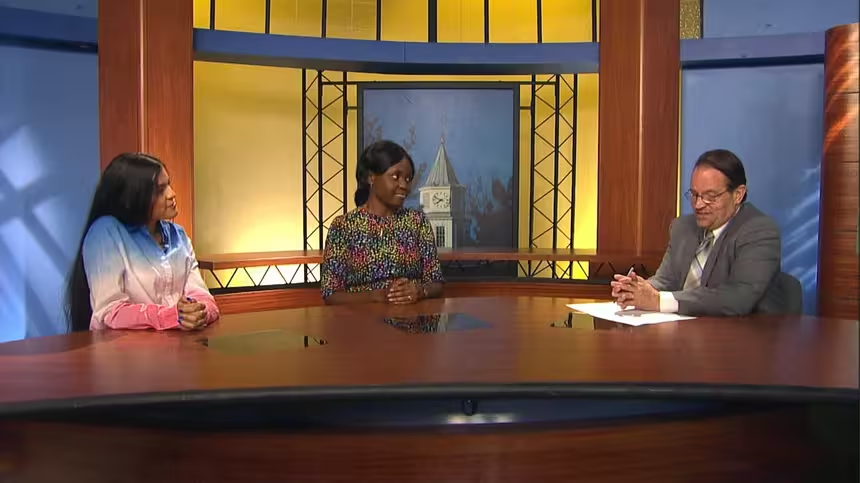
Fred Martino speaks with Christie McIntyre, Director of the Office of Teacher Education at Southern Illinois University Carbondale. SIU’s Teacher Education Program is adapting to address the needs of students and to fill workforce gaps across the region, such as forming the Southern Illinois Future Teachers Coalition, working with the Illinois Tutoring Initiative, and developing partnerships.
Problems playing video? | Closed Captioning Feedback
Problems playing video? | Closed Captioning Feedback
Eye on Education is a local public television program presented by WSIU
Christie McIntyre, School of Education, SIUC
10/27/2022 | 26m 46sVideo has Closed Captions
Fred Martino speaks with Christie McIntyre, Director of the Office of Teacher Education at Southern Illinois University Carbondale. SIU’s Teacher Education Program is adapting to address the needs of students and to fill workforce gaps across the region, such as forming the Southern Illinois Future Teachers Coalition, working with the Illinois Tutoring Initiative, and developing partnerships.
Problems playing video? | Closed Captioning Feedback
How to Watch Eye on Education
Eye on Education is available to stream on pbs.org and the free PBS App, available on iPhone, Apple TV, Android TV, Android smartphones, Amazon Fire TV, Amazon Fire Tablet, Roku, Samsung Smart TV, and Vizio.
Eye on Education
Eye on Education features interviews with people making a difference in all facets of learning. From Pre-K through higher education, we highlight efforts to prepare students to become the world's future leaders in every discipline.Providing Support for PBS.org
Learn Moreabout PBS online sponsorship(authoritative music) (camera shutter clicking) (electronic beeping) (authoritative music) (dramatic music) (dramatic music intensifies) - "Eye on Education."
I'm Fred Martino.
Across the nation, schools are reporting a lot of openings.
Listen to this.
At the start of the school year in August, the Illinois State Board of Education reported more than 5,300 unfilled positions statewide.
That's five thousand three hundred.
And some states that pay less have an even bigger problem.
Leaders in higher education are working hard to address the challenge.
Today, our guest is Christie McIntyre.
She is the Director of Teacher Education at Southern Illinois University Carbondale.
Christie, thank you so much for being here today.
- Certainly.
Happy to be here.
- Good to have you with us.
I'm gonna get to the teacher shortage in a moment, and talk about some of the things that are being done to address that.
But I really wanna start with some of the basics, and I know that the nationally recognized Office of Teacher Education at SIU focuses on accountability, collaboration, and a lot more to build great teachers.
There's a lot involved in teacher training, so tell me about that and the things that stand out most to you.
- Sure, I think one of the greatest things that, as it relates to accountability that we've been engaged in, is a continuous process of looking at what works in our program and what does not work, and so, we focus a lot on assessment.
We focus on feedback.
We look at how we're supporting our candidates and our future teachers.
We support them in many different ways, informally and formally, to make certain that they are developing the knowledge, skills and attitudes that they need to become effective teachers.
And that does require a lot of collaboration, as you mentioned, as well.
Collaboration among the College of Liberal Arts, the College of Agricultural Sciences, Sciences, Art and Music, because our teacher candidates are being prepared to teach birth through 12th grade, and we partner with faculty from all over the campus.
Not only just the faculty on the campus, but also faculty in our community school districts.
We have over 300 teacher candidates placed in over 100 schools throughout the region, so there's a lot of collaboration going on in teacher education - And I think that's so important and so great to hear.
Getting that student teaching experience must be absolutely critical, getting in front of the classroom.
- It is.
- Tell me how you got into the teaching profession.
- You know, a lot of people come in because they wanna make a difference, or they wanna do it better than what they experienced.
I had had several experiences in education that I thought were wonderful, and I had a few that I questioned, and so I came out of my bachelor's degree knowing that I was going to teach a few years, but also knowing that I wanted to go on and get my PhD because I wanted to make a difference.
Now, at that time, I wanted to have "the perfect school."
I wanted to create a model school.
But since then, I've learned that my greater impact is in preparing teacher candidates for their roles in the classroom.
- You know, we've heard a lot in recent years about people getting out of education, teachers and others.
What motivates you to be a leader with increased responsibility, when education, we have to admit, is getting more complex, difficult in some ways, and challenging, including the labor shortage that I mentioned at the top of the program?
- It is challenging, but as, in a leadership position, I have opportunities to hear, to listen, and respond with programs that I'm familiar with across the nation, that could improve the situation for our teachers in this region, or our teacher candidates going out.
And so, being able to bring programs from New Mexico, or from Virginia.
I'm thinking about friends of mine in different states.
Texas, that I collaborate with in different professional organizations.
Being able to bring those programs to Southern Illinois and look for opportunities, and see how they can meet our needs, I think is what inspires me, is what keeps me going, and it's all about the children, it's all about their learning, and making sure that we focus on getting teachers out there that are prepared to the best of their ability.
And so I just wanna make sure that the quality of our programming is what it needs to be, but that we're also meeting the needs of our community.
- Okay.
And let's talk about community.
You have engaged students in a lot of community service.
Tell me about that.
You're lighting up talking about that.
- Yeah, I do because when I first came here to SIU, I came about 21 years ago, and it was right before Hurricane Katrina and Rita hit in New Orleans.
And our students in my classes were wanting to put together a student organization, and they were wanting to do something in New Orleans to help.
And so within the span of about six months, the students raised enough money to not only get themselves to New Orleans for a spring break trip to help the schools and childcare centers there, we also took down a trailer, this is how I met Beth Spaja, of 2,222 books from everybody in the community that came together to take books down to the schools and to the childcare centers there.
We did that trip three times, just to help rebuild the infrastructure there, to work with the schools that were trying to open up, and, that was a large focus.
And through that, I saw how much our teacher candidates learn from seeing other contexts and having those experiences in other states.
And so it's, it is a part of what I think is critical for teachers, which is to understand the communities that they serve in, to understand the families that they're working with, and to know what needs they can be meeting.
Because teachers are called upon not just to meet the academic needs, they're called on to meet the social emotional needs.
They're probably the ones that find out if somebody's struggling to, you know, provide food or other, you know, needs within the household.
And as such, we need to prepare our teachers for those moments as well.
And so, getting them out in the community early, getting them engaged in the community, teaching them, and it was a, it was one of the courses I taught, "Child, Family, and Community Engagement," so, I am passionate about that part.
- Yeah.
And of course, around the nation, there's the community schools movement, so right in the schools, that connection to the community is becoming more and more common, offering services to students who may not have enough food at home, who may not have other advantages that many of us take for granted.
You know, I wanna have you walk us through the process for a student to become a professionally licensed teacher because, to be honest, part of my goal in doing this show today is to also lift up our educators and our education profession and encourage anyone who might be watching, who's thought about becoming an educator, to think a little more about it.
- It's the best profession out there, for sure.
It's such a rewarding experience, and the more prepared they are, the more that they know and have opportunities to explore their skills, which is one of the things that we make certain that they do is that once they come into the teacher education program, they're engaging in coursework, like the course I mentioned, "Child, Family, and Community Engagement," or "Learning about our Diverse Society," and, they're also learning about the methods of teaching, how to teach, what strategies can be used to meet the needs of various learners in the classroom.
But at that same time, once they come in, in their junior year, they're in a classroom at least one day a week, and so, along with their coursework, they have an opportunity to shadow a cooperating teacher and to learn about the students of that age.
And then, we also try to make sure that the next semester when we put them out for one day a week in a classroom that they get a different experience.
We wanna make sure they have a diversity of experience working with different demographics of students, as well as English language learners.
We wanna make sure that our coursework aligns with the experiences that they are out there experiencing.
So, if we have a course on how to teach students that are English language learners, then we make sure that they're in a school that has a higher number of students that may speak another language.
So we really do a lot to integrate and to embed the work that our candidates are experiencing in their coursework in the clinical.
We also have a cadre of very experienced clinical supervisors, and I call them our teacher education faculty.
They are, many of them, former superintendents, principals, instructional coaches from the schools.
They've all taught at some level, and they are the instructional coaches for our students in the classroom.
And so, in addition to having the faculty that are teaching you in the course, you also have experienced teachers, former administrators, coming to observe you teach and give you feedback on what you could do to improve and are coaching you through that process.
- Okay.
So for licensure, the degree, and the classwork, but also, as you called it, clinical student teaching.
- And then we do student teaching.
- And what else?
- So once they get through the student teaching, which is full-time, then they're ready to be licensed.
Now they do, They take a content-area test.
- Tests.
- They have one test, - Content-area test, One test.
- But it used to be three, now it's just one.
- Okay.
Now it's just one.
- Now it's just one.
So that's good.
And we prepare them for that content area test.
- Sample tests and this sort of thing?
- Yes.
Sample tests.
- Good.
Excellent!
We all need those, and it's good that there's that support for that.
- Definitely.
- What would you say are the biggest challenges for student teachers, and how you help them meet those?
You mentioned coaching, watching, and then giving tips.
Are there other things that you do?
- Well, there's, like with anything, there are theories about kind of stages that they move through.
And so initially, teachers are focused on their own behavior and don't often see the children or students that are before them.
And then eventually, they begin to work through their classroom management strategies.
That becomes a focus initially.
And then at some point, they begin to work on looking more in depth at the assessments and what the students are learning.
And so, as we take a developmental approach to helping them in their clinical experiences, we set up our coursework, so that it's doing the same thing.
So that it's helping them with classroom management, eventually, the assessment of student learning, and then how to bring all of that together.
- Yeah.
I always remember from high school, a teacher in my life, who was also an advisor for our student newspaper.
And it was one of the things that I had an opportunity to do in high school that then led to a career in journalism.
And, I always, you know, I never asked her about her, of course, at that age, about her decisions on how she taught and her technique, but I always remember that unlike many of my teachers, when I would turn in a writing assignment, there would be a lot of red on the page.
(laughs) There would be a lot of comments about what was right, what was wrong, what was really wrong, how it could be better sometimes.
And I remember a lot of my classmates really not liking this, not used to this much feedback.
But that was why she was one of my favorite teachers because I left her class, and I became my own editor.
I was now armed with the ability to edit my own work.
- Exactly.
- Because she gave me that.
- Exactly.
- And years later, I told her that, and it meant a lot.
So this is also another reason I'm mentioning that.
It's important to tell our teachers, even if it's many years later, how much of an impact they've had.
- Definitely.
- As someone who's taught college courses myself, that has meant more to me than probably any feedback I've ever gotten in any job.
- Yeah.
And it's that formative feedback that's so valuable, that we learn from.
That's what the research tells us, is that when we get that formative feedback, we can make corrections and changes and improve.
- Yeah.
So I'm glad that you appreciated that, and that you let your teacher know that too.
- Yeah, yeah.
And that means a lot to teachers to let them know.
And it also helps them to know what they're doing well from a student, in addition to other professionals in teaching.
The SIU School of Education and partners, I know, have developed programs to address the teacher shortage that we mentioned at the beginning of the program.
One of the programs is known as "Grow Your Own Teachers."
Give us an update on that.
- So the "Grow Your Own Teachers," again, is a very community-based program where, oftentimes, we find there are people within school buildings who've been in and around education, but just haven't made that final commitment to complete a degree towards education.
So they may be teachers aides, paraprofessionals, some other type of assistant in the classroom or in the school building itself, and they've been drawn to education.
They just haven't taken that next step.
And so the "Grow Your Own" program allows us to individualize curriculum, individualize programming.
And so we take the time to go through their transcripts, to see how far they did come, in whatever fields they explored, and we help tailor a program for them, so that they can work towards becoming licensed.
We are able to give some work experience credit, so if they've been a school paraprofessional for a while, then we're able to use that as some course credit to go towards the degree at the end.
- Okay.
Very interesting.
There's another initiative called the "Teacher Residency Partnership."
- Yeah.
- Bringing together local educators and mentors.
Tell me about that program as well.
- So where- I'm gonna contrast the two for just a moment- where the "Grow Your Own" allows us to establish programming at the pace that works for somebody who's physically working full-time, the "Teacher Residency Program" is a concentrated program that allows us to get teachers out into the field quicker.
And so, instead of doing the traditional fall, spring, take off the summer, fall, spring, we start them in a summer, move them through a residency experience where they're out in the schools four days a week, and then student teaching in the spring.
And then they'll finish up coursework in the summer.
So they could move from being a sophomore and eventually graduate, right after their junior year, after that second summer, and be ready to go into the classroom sooner.
And so, it's a more intense program.
- Yeah.
- But it's more immersive.
And so we're looking at and working with those other faculty across the campus to integrate their coursework into those clinical experiences.
- So great to hear that, as we all know, having more options in education - Yes.
- is really important.
- Pathways.
- More pathways to get there.
- Definitely.
- Inspiring the next generation of teachers, something we've already talked about on this program, is a critical aspect of the teacher education program at SIU Carbondale.
- Yep.
- One of the innovative programs that is underway is called "Educators Rising," and I want to talk about that too.
- Love this program.
I need to do a shout out to Brooke May, who is running this program for us here in southern Illinois.
She recently presented to the State Board of Education the wonderful things that they're accomplishing down here.
Last year, they had nine Educator Rising clubs in high schools.
They've expanded that to 14 for this coming school year.
So, if you think about Future Educators of America is what they were called when I was younger, and now, they're Educator Rising clubs.
So people who are interested in becoming teachers can be a part of this club during high school, and they will engage in different activities during their high school years that will help them understand the field of education.
They can also begin to take dual credit coursework, and that will help them earn credit towards college.
We had at Touch of Nature last spring, 150 future teachers come and be a part of an education day out at Touch of Nature with us that were in Educator Rising clubs from the local schools, and it was just high energy, and so motivating to see our local students that are excited about becoming teachers and educators going forward, so, it is a wonderful initiative right now, and we are hoping to expand this across the high schools in southern Illinois and increase that energy and excitement around becoming a teacher.
- Well, good luck with that.
I hope that it continues to grow.
It makes me think of another issue, something that wasn't available to me when I was in high school, but had it been available to me, it's something I would've definitely jumped on, and that is dual credit.
We always hear about dual credit.
Tell me about how SIU's dual credit opportunities can play a role in helping college bound high school students and as well, their instructors.
- Sure.
So what we're trying to do right now is create a pipeline for teachers.
So we're trying to make it as easy as possible, such that once they're, when they're in high school, if they're taking courses, classes by a teacher who is dual credit certified, licensed to do dual credit coursework, then they'll earn high school credit, but they'll also earn college credit for those same courses.
And so they work with the community colleges, in order to transfer that coursework into the community colleges.
We work as well with the community colleges, such that that coursework translates into our curriculum.
- Dual credit is such an important thing to talk about, and the reason I wanted to talk about it is in addition to helping more students become teachers, and possibly do it more quickly, of course, we hear so much today about college affordability, and this also might ease some of the stress about that because, of course, if you earn college credits when you're in high school, there are less to pay for potentially when you go to college.
- There are.
It does help with that affordability factor.
And there are a lot of initiatives at the state level as well right now to make college affordable, so, within our space, we have several grants right now that will help to pay for college tuition, in addition to the scholarships that have always been around.
But, this is a wonderful time to explore education because with the shortage, there's a lot of money that is coming into this space in order for us to make college more affordable.
- Okay.
Very good stuff.
So, I want to highlight one other thing that folks may be interested in who are watching this show.
We always say you can get more information online about issues, not only at SIU's website, but many other places.
There is a group of institutional partners that are active on social media, as well as elsewhere on the web.
The group is known as Southern Illinois Future Teachers Coalition.
And I want to get your thoughts on how this group helps support career pathways for future teachers.
- So this is a group of individuals that are pulled together by those who are facilitating not only the Educator Rising clubs, but it also includes the community colleges and then ourselves.
And so, we come together several times a year to discuss that pathway that I mentioned earlier, and where are the students encountering challenges that we need to smooth out?
So we're listening to and watching the pipeline.
It's not that we're creating an initiative, and then just saying, "Okay, it works."
But, we're in there, listening to one another and double checking to make sure that all these pieces we're putting into place actually do make it shorter for them to move through, and then looking at how we can improve the process even more.
- Very good stuff.
SIU's School of Education also involved in a statewide tutoring initiative?
- Yes, yes.
- To strengthen learning.
Tell us about that.
- Wow, we are busy.
- You're busy.
- We are busy.
(both laugh) We're busy right now.
Yes.
The Illinois State University is the main grant, is the main person in charge of this grant, and there are six regions, and we are, SIU system is one of six.
So we share this with SIU Edwardsville.
We have four districts that we're working with currently.
Cobden, Herrin, Carbondale, and Murphysboro.
We have 55 tutors that have been trained and are ready to be deployed.
I believe September 19th is when they'll be headed out to the schools.
This initiative has provided funding for tutoring for after school, and some before school tutoring, for schools in the region.
And so, the Illinois State Board of Education determined which schools had the greatest need, and they used ten different factors to make that decision.
We've approached those schools as partners, and this is to help support some of where we lost learning a little bit during the pandemic, and how can we be additional support.
So if I could put a plug in, tutors make $50 an hour, and that's good pay for anybody that would like to come and assist us.
We still could use a few more tutors in the system, so- - And you'll be doing important work.
- We are doing very important work.
This is a project that we hope that we can continue and expand beyond just this grant.
- So much to talk about, and, believe it or not, we've already gone through the program.
- Oh wow!
- Christie, thank you so much for being with us today.
- Sure!
- We really appreciate it.
- Thank you for having me.
- Good to have you here.
My guest was Christie McIntyre.
She is Director of Teacher Education at Southern Illinois University Carbondale.
That's "Eye on Education" for everyone at WSIU.
I'm Fred Martino.
Thanks for joining us.
Have a great week.
(dramatic music) (dramatic music intensifies) (dramatic music) (dramatic music intensifies) (dramatic music) (dramatic music intensifies) (authoritative music) (camera shutter clicking) (electronic beeping) (authoritative music)













Support for PBS provided by:
Eye on Education is a local public television program presented by WSIU