
Christine Guhl-Sadovy; Jon Gooda; Jenny-Brooke Condon
8/30/2025 | 27m 59sVideo has Closed Captions
Christine Guhl-Sadovy; Jon Gooda; Jenny-Brooke Condon
Christine Guhl-Sadovy, President of the New Jersey Board of Public Utilities, discusses utility costs & other pressing energy issues. Jon Gooda, VP of Airport Operations for United Airlines at Newark Airport, addresses delays and effectiveness concerns for travelers. Jenny-Brooke Condon, Professor of Law at Seton Hall University, examines recent Supreme Court rulings and their impact on NJ.
Problems playing video? | Closed Captioning Feedback
Problems playing video? | Closed Captioning Feedback
Think Tank with Steve Adubato is a local public television program presented by NJ PBS
Christine Guhl-Sadovy; Jon Gooda; Jenny-Brooke Condon
8/30/2025 | 27m 59sVideo has Closed Captions
Christine Guhl-Sadovy, President of the New Jersey Board of Public Utilities, discusses utility costs & other pressing energy issues. Jon Gooda, VP of Airport Operations for United Airlines at Newark Airport, addresses delays and effectiveness concerns for travelers. Jenny-Brooke Condon, Professor of Law at Seton Hall University, examines recent Supreme Court rulings and their impact on NJ.
Problems playing video? | Closed Captioning Feedback
How to Watch Think Tank with Steve Adubato
Think Tank with Steve Adubato is available to stream on pbs.org and the free PBS App, available on iPhone, Apple TV, Android TV, Android smartphones, Amazon Fire TV, Amazon Fire Tablet, Roku, Samsung Smart TV, and Vizio.
Providing Support for PBS.org
Learn Moreabout PBS online sponsorship- [Narrator] Funding for this edition of Think Tank with Steve Adubato has been provided by Congress Hall.
A Cape Resorts property.
The New Jersey Economic Development Authority.
The Port Authority of New York and New Jersey.
Moving the region through air, land, rail, and sea.
Valley Bank.
RWJBarnabas Health.
Let’s be healthy together.
Newark Board of Education.
Delta Dental of New Jersey.
We love to see smiles.
NJM Insurance Group.
Serving New Jersey’s drivers, homeowners and business owners for more than 100 years.
And by New Jersey Sharing Network.
Promotional support provided by New Jersey Monthly.
The magazine of the Garden State, available at newsstands.
And by BestofNJ.com.
All New Jersey in one place.
[MOTIVATIONAL MUSIC] - Hi, everyone, Steve Adubato.
We're joined once again by Christine Guhl-Sadovy, who is president of the New Jersey Board of Public Utilities.
Christine, how are you doing?
- I'm doing well.
Thanks, Steve, how are you?
- I'm doing great.
Hey, Christine, we're taping this program at the end of June 2025.
Help put it in perspective for people the increases that people are seeing in their utility bills.
We've had several people on trying to explain it.
Help us understand.
- Of course, Steve.
So on the 1st of June, rate increases went into effect related to something called the PJM auction, which is PJM is the regional transmission operator for this region.
And they do an auction every year to determine how much electricity we have and how much electricity we need.
- So hold on one second.
I'm sorry for interrupting.
13 states, approximately 65 million customers, right?
- Yeah, very big regional transmission operator.
- PJM.
Go ahead.
- Yeah, it stands for Pennsylvania-Jersey-Maryland.
- How does this auction work?
So electricity generators of all different varieties, they might be gas plants, they might be solar, they might be onshore wind, bid into an auction process, the amount of available electricity capacity that they are putting forward.
And then based on the amount of capacity that we need, an auction price is set.
The auction last year results were almost 10 times higher than the previous year.
- Because?
- So for a number of reasons, some is just, you know, it's a market, so supply and demand.
We have growing demand attributable really primarily to data center growth in the PJM region outside of New Jersey, Ohio and Virginia.
And, you know, we need more supplies.
So we need more electricity.
There are also a number of rules within the market structure of PJM that have potentially artificially suppressed some of the available demand.
So not all of the resources were bid into the auction.
And so that combination of an actual supply and demand crunch and some artificial scarcity led to some very high prices that translate into higher customer bills right now in June.
- Okay, so let's do this, a couple of things first.
For those you who are watching right now, Christine Guhl-Sadovy is president of Board of Public Utilities in New Jersey.
And let me disclose that we have been doing public awareness and public education around clean energy through PSA, public service announcement spots from the Clean Energy Program, which is really run by the Board of Public Utilities.
But here's the thing that I keep trying to make sense of.
See how you talked about the data centers; actually, our colleagues at NJ Spotlight News just did a really great report on it, check out NJ Spotlight News, go on their website and check this out, on data centers.
I'm thinking, "What?
What does a data center, particularly with AI exploding, Christine, what the heck does that have to do with energy utility rates?
- Yeah, so that's a great question.
And to be clear, you know, data centers are providing a lot of, you know, AI technology and a lot of economic development opportunities throughout the region.
But they are enormous electricity users.
And, you know, they have a very high electricity use profile.
It's high at all times.
So, you know, it's not like electric charging or air conditioning where it ebbs and flows.
And so they use a lot of electricity.
Some data centers use an entire power plant's worth of electricity.
And they are being built throughout the PJM region and actually throughout the country.
And as a result, we are needing more electricity to supply for those data centers primarily.
- Let me ask you this, because, again, the website's up for the BPU, the Board of Public Utilities.
What are utility assistance days?
- So those, I think, Steve, those are educational public awareness days that we have done throughout the state in conjunction with the Department of Community Affairs to help to provide information about all the assistance programs that the state of New Jersey has and to help people if they need assistance filling out their applications, providing the appropriate information to get assistance.
We are going into the communities around the state to provide that assistance for people.
- So the 211, New Jersey's Utility Assistance Programs include... What the heck?
When you dial 211, what happens?
- So you get directed to, that's actually the DCA hotline.
So you get directed to available assistance programs to help you either fill out an application, figure out whether you're eligible, provide information to you.
- Okay, let's keep talking about assistance programs, particularly for folks, this has to do with income eligibility.
What is the Comfort Partners Program, Christine?
- So the Comfort Partners Program is an energy efficiency program.
So we have both assistance programs to provide direct repay or relief in the form of bill credits, like the Universal Service Fund.
And then we also have a number of energy efficiency programs, and one of them is an income-eligible program that is Comfort Partners.
And that program provides energy efficiency upgrades at no cost to the homeowner so that they can both, you know, have a more comfortable home, a more efficient home, and save money on their electric.
- And for seniors?
- For income eligible, yes.
- Okay, so for seniors or those on fixed income.
What the heck is the Universal Service Fund?
- That's the state's energy assistance program.
It is for income-qualifying customers, utility customers.
The qualification is 60% of state median income.
So that could be for seniors.
It could be, you know, other low- and moderate-income customers.
And it provides a bill credit, a monthly bill credit, both were either electric and gas.
And actually, we just expanded this program, which is a really exciting development to increase the minimum bill credit: it was $5 a month for each electric and gas, and now it's $20 a month.
And the maximum bill credit went from $180 to $200.
- In the time we have left, let me ask you this, Christine.
We had Michael Renna, I just told you I had Michael Renna from South Jersey Industries.
You regulate them and a whole range of other folks, PSE&G, New Jersey Natural Gas, a whole bunch of organizations, and on the utility side, plus telecommunications as well?
- Yes.
- Okay.
So here's the thing I was talking to Michael about, and I want you to help us on this, a minute left.
Helping the public understand energy policy utility rates is complex, hard stuff, but important, correct?
- Absolutely.
It is a very, very complicated regulatory framework, but the important thing for us at the BPU is for customers to know that we're there to help support them, right?
We want people to know that when they turn the lights on their electricity's going to work, it's going to be reliable, and they're going to be able to afford it.
Same thing with gas, water, and, you know, and all of the utilities.
- Christina, I want to thank you for joining us again.
The Board of Public Utilities is an important entity in our state, and it impacts our lives in so many ways.
Thanks so much, Christine, for joining us.
Appreciate it.
- Thanks, Steve.
Always great to see you.
- You got it.
Stay with us, we'll be right back.
- To watch more Think Tank with Steve Adubato, find us online and follow us on social media.
- We're now joined by Jonathan Gooda, who is the Vice President of Operations at United Airlines in Newark.
Jon, good to see you.
- Good to see you too, Steve.
Thanks for having me.
- Good, let me ask you this: 23 years at United, I was told by our producer, Buki, that you still love your job.
All the challenges, all the obstacles, all the weather issues, and whatever else going on, you still love it because?
- I sure do, Steve, and I'm very happy to be here.
We have 14,000 incredible employees who call New Jersey and Newark home, and I get to lead and support all of them.
By the way, being a part of this New Jersey institution with you, a real honor.
So thank you for having me.
This job is a total joy.
And our team makes it so.
And we get an opportunity to take care of our customers and get them where they wanna go anywhere in the world.
- Absolutely, and let me disclose that United recently came on board as an underwriter of our programming.
Let me try this.
Safety.
Talk to folks about where we are with their safety concerns flying in and out of Newark or other, any airport around the country.
Go ahead, please.
- Absolutely.
First up, flying is incredibly safe.
It's the safest form of transportation.
Customers should feel incredibly safe flying out Newark.
Both the air traffic controllers, the pilots, the folks that work in the operations tower right here at Newark, are trained professionals and have been through months and years training to ensure that they're ready for any situation.
We also have layers of backup plans and backup contingencies with all those systems so customers can really book and travel out of Newark and feel confident about their safety.
- But Jon, help us understand, the FAA, the Federal Aviation Administration plays a very important role in this process.
There are changes being made in the federal government vis-a-vis certain federal agencies, and that includes the FAA.
What's their role today?
And do you believe on any level their role has been compromised?
- I don't believe their role has been compromised, Steve.
And their role, as you say, is absolutely critical to the safety of our environment here.
Secretary Duffy has been on the ground with us in Newark talking to employees, meeting the team, and seeing some of those challenges firsthand.
And I am extremely confident that the plan that he and the DOT and the FAA have called forward to address those long-term infrastructure challenges is gonna be successful and get us exactly where we need to go in the future.
- Jon, are there caps, limits, restrictions, if you will, being made on how many flights a day?
Explain that to us, because of all the, some of the delays and backups, and I keep asking myself, was is the number of planes?
What is it?
Help us understand that, Jon.
- Sure, there was a couple of things this spring that took place, Steve.
One of the runways here closes.
It's a normal process, closes about every 10 years for runway resurfacing.
The Port Authority of New York and New Jersey did a great job, got that runway back open 13 days ahead of schedule.
And with a large infrastructure project like that, that's an amazing accomplishment by that team.
But the FAA, with Secretary Duffy's leadership, also took a step to cap the number of flights per hour in and out of Newark.
That cap right now through the end of October is 34 arrivals and 34 departures every hour.
So 68 operations in and out of the airport every hour.
That better matches the capability of the air traffic control system, and those caps enable our customers to keep moving, and those trips to operate safely in and out of the airport.
So much so, Steve, that once those caps went into place and United proactively reduce the schedule here of Newark too before the caps went into place, Newark was actually the most on-time, the most reliable airport in the whole New York City region, beating both JFK and LaGuardia.
So the caps that Secretary Duffy put in place are really helping us.
- Along those lines, I'm curious about this, you mentioned the air traffic controllers.
Help us understand, Jon, what exactly an air traffic controller does, and also how the training that they get prepares them to do what they need to do, and finally, if there are enough of them.
Go ahead.
- The training is incredibly rigorous.
Takes about two years We partner with them very closely at United and the Port Authority to make sure that the airport flows well.
But the training that they receive is world class and enables them to be prepared to take on the task of running traffic in one of the most complex air spaces anywhere in the world.
- We've had Kevin O'Toole, the chairman of the Port Authority of New York and New Jersey, and Rick Cotton, the director as well on, and we've talked about a whole range of issues around Newark Airport.
As Newark Airport continues to become developed, redeveloped, improved, what impact does it have on United?
- I think that partnership with the Port Authority that you just talked about is so important for our customers, and it's also some important for our employees.
This is our hometown, and we are part of the infrastructure of this great state of New Jersey to allow people to get where they need to be.
Those investments that you see, an example, Steve would be the Terminal A, the New Terminal A that opened a couple years ago.
That partnership with the Port Authority has provided world-class amenities for our customers.
And hopefully you've had a chance to see it for yourself.
It's a beautiful facility, and it also balances some of the traffic with Terminal C, so the checkpoints flow a little bit better because we're balancing that customer volume out between two terminals.
So those type of investments that the Port Authority is making are good for customers and good for United and good for the region too.
- Before I let you go, Jon, I'm born and raised in New Jersey and people accuse us of having a Jersey accent.
Where did your Jersey accent come from?
- Yeah, people are definitely confused by my accent, Steve.
I grew up in London.
And this is actually my second tour here in New Jersey, so the accent is growing on me, and the state is a beautiful place to live.
- Well said.
And we're picking up that Jersey thing in you- - The climb, right?
- Yeah, exactly.
Jon, thank you so much for joining us.
We appreciate it.
- Thank you, Steve.
- Fly safe out there.
We'll be back right after this.
- To watch more Think Tank with Steve Adubato, find us online and follow us on social media.
- The role of the United States Supreme Court, the judiciary, we're gonna have a conversation with someone who knows this subject well.
Jenny-Brooke Conden is a professor at law at Seton Hall University, one of our longtime higher ed partners.
Professor, good to see you.
- Good to see you, Steve.
Thanks for having me.
- You got it.
Let's talk about the Supreme Court.
They've been busy in the last few months, haven't they?
- They have, and you know, I think that busyness has been a function of both the regular work of the court, but perhaps more importantly, it's been the emergency dockets in which the court has been increasingly deciding important issues involving the legality of executive action through emergency orders.
- Okay, let's go through 'em.
On the first day in office, President Trump issued an executive order attempting to end birthright citizenship.
Six to three majority.
Did in fact the Supreme Court with three justices appointed by President Trump, did they end birthright citizenship?
Meaning if baby born here of parents who are not here legally, historically they would be a citizen.
Did the court say no longer is that the case?
- Not yet, Steve.
So that question, which, you know, lawyers refer to as the question on the merits, the actual legality of that executive order that you just described remains an issue that the court is one day going to have to decide.
What it was really deciding in its June 27th decision was whether or not the lower court that had addressed the legality of that had the power to put it on pause until the court actually gets to the central merits issue later in the case.
And so the case is really important because it is looking at two separate issues, really.
What the court told us in June was what it thought about something that frequently is a means by which lower courts pause or stop, during the course of litigation, executive actions that are challenged as unconstitutional, something known as a universal injunction.
So the court was focusing its attention on whether or not the courts have the power to issue these kinds of injunctions.
But the reason why it still has grave consequences for the underlying policy is that the court allowed the policy, which countless scholars, and I think three or four federal courts, lower federal courts, have now said is patently unconstitutional.
So the court has allowed it to go into, the executive order, to go into force in the interim, even though it has not told us definitively what its decision is on the question of its legality.
- So how about this?
'Cause there's so many decisions that the court is making that have wide-ranging ramification.
Transition care for transgender youth, six to three vote.
Doing what?
- Well, I think that case is an example of the court giving great deference to a state to enact a law that the state claimed was in its view in the interest of its powers to protect the health and safety of its residents.
But you know, that is not an emergency ruling.
That was a case in which was fully briefed and the court is telling us its decision on the merits.
And basically it's saying we're only gonna look at whether or not this is a rational law.
And it believes that it was.
Of course the challengers and the dissents in that case made great arguments regarding the fact that this was discrimination and unequal treatment for transgender youth who were being disallowed access to medical care that their doctors had said was in their interest.
And so it was an equal protection case and the court said it didn't think it was discriminatory, it deferred to the states.
- Stay on the issue of what the President can and cannot do.
"The New York Times," this happens to be the day, we're taping in the middle of July.
The Supreme Court agreed on Monday that the Trump administration can proceed with dismantling the Department of Education by firing thousands of employees.
I mean the president can do, apparently, based on the Supreme Court, the law of the land, can make those cuts even if it was Congress who appropriated the dollars for the Department of Education and other agencies.
Where the heck is this?
The so-called balance, Professor?
- I think that decision from the court is really concerning.
The Department of Education is created by Congress.
It's the product of federal statute.
And the court did, you know, allowed the executive unilaterally to effectively overturn that statute.
And that's not what the Constitution provides.
We overturn statutes through the democratic process, not through a single person, the President.
And so it's important to note this was another emergency, sometimes referred to as shadow docket decision.
So the court did not, again, definitively rule that the president has the power to do this, but it did say it was willing to let the president put this executive order into place during the timeline that it takes the litigants to actually challenge it in the lower courts and work their way up to the federal court.
Now, normally when the court looks at a request for emergency relief, it has to ask itself, "Is there a likelihood of success on the merits?
Is the person who wants the emergency relief likely to win?"
And so here the court is saying it thinks there's a likelihood of success, you know, that President Trump would prevail and that the irreparable harm sort of points in the direction of the President not being able to pursue this policy.
And that's deeply troubling.
- Lemme try this.
Back in the day, and you're a student of judicial history, Franklin Delano Roosevelt, a Democrat, attempted to pack the court.
"I want more of my people there.
Let's expand the size of the Supreme Court, add more justices, I'll appoint those justices, they'll be my justices.
I will control the court."
He didn't say that publicly, but I mean, what else was he looking to do?
To what degree do you believe President Trump believes that the court, the courts overall, but the Supreme Court in particular, they're his judges?
- Yeah, I think the President's both aggressiveness in pursuing these policies, his public statements about his belief that the court will allow him to do these often very straightforward illegal things suggest that the President does believe the court is on his side.
And I think what this term shows us and should give us all, you know, some pause is that precisely when we need the court to assert itself to ensure that the President does not disregard the co-equal branch of Congress, that he respects Congress, when the President respects due process rights, when the President respects the President's obligation to follow the plain terms of the Constitution, when we need the court to stand up for those rights and for the Constitution.
And a number of these emergency rulings, the court has said it's going to give the President all matter of deference and power and allow him to do these things that are ultimately unlawful.
And so I do think the President probably understands that he has that authority with the court, that he's going to be given that leeway and that the court is doing very little to disabuse him of that impression.
- But Professor, moving forward beyond President Trump, there'll be a new president in a few years.
Say that President is a Democrat, say that President has totally different policy ideas of philosophy of governing President Trump.
Has the court not, as the highest court in land, not already established a degree of executive power and authority unprecedented in American history that all of a sudden can't be changed if the justices don't like the policies of a new democratic progressive left-leaning dem- I mean, president.
That's not for President Trump, that's for whomever the executive is, not just now, but moving forward.
Am I misinterpreting that professor?
- No, not at all.
I think our constitution is concerned about the separation of powers, not because of any particular political perspective or any particular policy, it's concerned about it because the separation of powers protects all of us.
It protects individual liberty, it protects the rights of the states and it protects the, you know, the design of the framers to have a process that is balanced and is democratic.
And so you're right that the court's precedents will not just benefit President Trump, but they will do damage to the balance of powers into our constitutional system of democracy going forward.
Even if there is a person in office whose policies, you know, your viewers might agree with more or maybe not.
But I think this is a question about our constitution that is bigger than any one president.
But I do think it's important that in this moment when we have somebody in office who is pressing as hard as this person can to defy constitutional norms and to exceed constitutional powers, the fact that the court is giving that person such a expansive amount of power is concerning in the short term and will do long-term damage as well.
- Professor, thank you.
We'll continue our discussions with other legal scholars on the implications, the impact of not just the Supreme Court, but appellate courts, other lower courts and the balance of power, the separation of branches of government.
Thank you, Professor.
We appreciate it.
- Thank you.
- I'm Steve Abubato.
We'll continue to have important, meaningful discussions about the way our government works or doesn't work.
See you next time.
- [Narrator] Think Tank with Steve Adubato is a production of the Caucus Educational Corporation.
Funding has been provided by Congress Hall.
A Cape Resorts property.
The New Jersey Economic Development Authority.
The Port Authority of New York and New Jersey.
Valley Bank.
RWJBarnabas Health.
Let’s be healthy together.
Newark Board of Education.
Delta Dental of New Jersey.
NJM Insurance Group.
And by New Jersey Sharing Network.
Promotional support provided by New Jersey Monthly.
And by BestofNJ.com.
- How long you been waiting?
- About a half hour.
- Brutal.
This keeps up, I'm gonna miss my pickleball game.
- I've been waiting eight years for a kidney.
What can you do?
(gentle music) - [Narrator] Over 100,000 people in the US are waiting for a life-saving transplant.
But you can do your part in an instant.
Register as an organ donor today at NJSN.org.
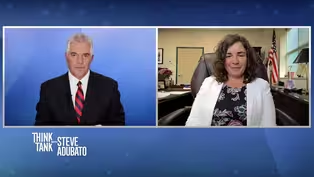
Christine Guhl-Sadovy addresses rising utility costs in NJ
Video has Closed Captions
Clip: 8/30/2025 | 9m 20s | Christine Guhl-Sadovy addresses rising utility costs in NJ (9m 20s)
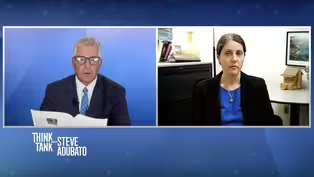
Examining recent Supreme Court rulings and its impact on NJ
Video has Closed Captions
Clip: 8/30/2025 | 11m 27s | Examining recent Supreme Court rulings and its impact on NJ (11m 27s)
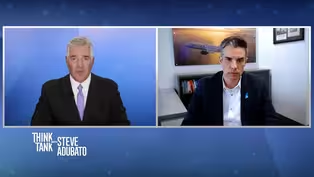
United Airlines VP of Newark Airport Operations talks delays
Video has Closed Captions
Clip: 8/30/2025 | 7m 57s | United Airlines VP of Newark Airport Operations addresses delays and safety concerns (7m 57s)
Providing Support for PBS.org
Learn Moreabout PBS online sponsorship
- News and Public Affairs

Top journalists deliver compelling original analysis of the hour's headlines.

- News and Public Affairs

FRONTLINE is investigative journalism that questions, explains and changes our world.












Support for PBS provided by:
Think Tank with Steve Adubato is a local public television program presented by NJ PBS