State of Affairs with Steve Adubato
Christine Guhl-Sadovy/Julie Roginsky/Dale Florio/Ben Dworkin
Season 8 Episode 24 | 27m 44sVideo has Closed Captions
Christine Guhl-Sadovy/Julie Roginsky/Dale Florio/Ben Dworkin
Christine Guhl-Sadovy, President of the New Jersey Board of Public Utilities, examines NJ’s clean energy commitment. Julie Roginsky, Democratic Strategist, and Dale J. Florio, Esq., Republican Strategist, discuss the results of the 2024 Presidential election. Benjamin Dworkin, Ph.D., Director of the Rowan Institute for Public Policy & Citizenship, examines key voter issues & the future of polling.
Problems playing video? | Closed Captioning Feedback
Problems playing video? | Closed Captioning Feedback
State of Affairs with Steve Adubato is a local public television program presented by NJ PBS
State of Affairs with Steve Adubato
Christine Guhl-Sadovy/Julie Roginsky/Dale Florio/Ben Dworkin
Season 8 Episode 24 | 27m 44sVideo has Closed Captions
Christine Guhl-Sadovy, President of the New Jersey Board of Public Utilities, examines NJ’s clean energy commitment. Julie Roginsky, Democratic Strategist, and Dale J. Florio, Esq., Republican Strategist, discuss the results of the 2024 Presidential election. Benjamin Dworkin, Ph.D., Director of the Rowan Institute for Public Policy & Citizenship, examines key voter issues & the future of polling.
Problems playing video? | Closed Captioning Feedback
How to Watch State of Affairs with Steve Adubato
State of Affairs with Steve Adubato is available to stream on pbs.org and the free PBS App, available on iPhone, Apple TV, Android TV, Android smartphones, Amazon Fire TV, Amazon Fire Tablet, Roku, Samsung Smart TV, and Vizio.
Providing Support for PBS.org
Learn Moreabout PBS online sponsorship- [Narrator] Funding for this edition of State of Affairs with Steve Adubato has been provided by PSE&G, powering progress.
Holy Name.
Robert Wood Johnson Foundation.
Working for a more a healthier, more equitable New Jersey.
Johnson & Johnson.
New Jersey Sharing Network.
New Brunswick Development Corporation.
Delta Dental of New Jersey.
Everyone deserves a healthy smile.
Community FoodBank of New Jersey.
And by NJM Insurance Group.
Serving New Jersey’s drivers, homeowners and business owners for more than 100 years.
Promotional support provided by New Jersey Globe.
And by NJBIZ.
Providing business news for New Jersey for more than 30 years, online, in print, and in person.
[INSPRATIONAL MUSIC] - Hi everyone, Steve Adubato.
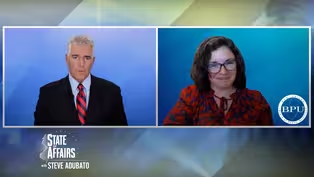
We kick off the program with the President of the Board of Public Utilities in New Jersey.
Christine Guhl-Sadovy.
Christine, good to see you, Madam President.
- Good to see you, Steve.
- You got the logo right there in the corner.
I see that.
Tell everyone what the Board of Public Utilities is.
We'll put up the website right now.
- Great, so the Board of Public Utilities is the state department that regulates our public utilities, electric, gas, water.
And we also are the state's Office of Clean Energy and Office of Broadband.
And we help advance the governor's clean energy goals and expand broadband throughout the state of New Jersey.
- Along those lines, let me disclose that, through a third-party, an ad agency that the BPU retained, we have a grant to do public awareness around clean energy for full disclosure purposes.
Christine, let me ask you this.
Energy prices, if you will, we had an interview with Rich Henning from the Utilities Association.
He's trying to explain the grid and how it, you know, energy companies buy off the grid.
And, simple explanation if we can do that.
Why the heck are energy prices higher, electric energy prices higher?
Our bills higher?
- I'll try to be as simple in my explanation as possible, so- - I'm simple, so I need a simple explanation.
(both laughing) - So, you know, people care about their bills, right?
If your bill is high, then you care what your rate is.
If your bill is low, maybe you care less about what your rate is.
So the majority of your electric bill, as we all know it, is the cost of energy generation.
So the state of New Jersey procures energy through our utilities, through an auction process and the cost of energy generation fluctuates.
And there are a lot of reasons that that might be the case.
The tightening of supply and demand is certainly a big part of that.
Energy is a commodity when there are conflicts and we rely on things like natural gas and other fossil fuels, those are finite resources and world conflicts can have a lot to do with the cost of energy.
As we do more electrification and expand things like broadband, we're gonna see an increase in demand.
And so we're going to see an associated rise in costs.
And then, you know, of course, we have to invest in our grid to ensure that we have safe and reliable electricity and that costs money.
And so to make sure that our grid is stable and that we, you know, reduce the number of outages and provide that electric service we have to make those grid investments through the utilities.
- Christine, I actually understood that, which is- - Great.
- I hope everyone did too.
So let me try this.
Governor just, literally, as we're doing this program, we're taping it on the 12th.
It'll be seen after the 12th of November.
You and the governor committed to clean energy.
But there's things going on in the new administration, Trump administration, Congress, talking about what they think should and shouldn't be done in this regard, you and the governor just as committed as you've been to clean energy, correct?
- Absolutely.
So the state of New Jersey, under Governor Murphy's leadership, has a goal of 100% clean energy by 2035.
A big part of that is our offshore, you know, our goals around offshore wind.
But it also includes things like solar and energy storage, and of course, you know, supporting our nuclear generation, which is roughly 40% of our clean generation in New Jersey.
And we are 100% committed, both the governor and myself, to ensuring that we meet those goals.
It's really not just about, you know, climate change.
We wanna make sure that New Jersey is doing its part to mitigate climate change, but it's also about public health, reducing pollution.
And Steve, really importantly, energy independence.
When we invest in our resources here in New Jersey, like offshore wind, like solar, and around the region, we ensure that we're not relying on other countries and issues around the world to provide energy for the residents of New Jersey.
- Got it, and let me be clear.
As we're taping, there are lots, there are issues in the courts, let's say, that could play out a lot of different ways.
The date will be up there on the screen as to when we're dating, when we're having this program, having this conversation.
So things are gonna change.
That being said, Madam President, let me try this, Christine.
When you talk about energy independence, when people use the expression, and I asked Rich Henning this from the Utilities Association, they have these slogans, "Drill, Baby Drill."
When they talk about fracking, as if that's the solution.
Isn't it much more complex than that?
- So Steve, absolutely.
You know, when we think about our goal of 100% clean by 2035, we are looking at it from a quick portfolio standpoint.
As I pointed out, we have a significant amount of nuclear generation.
You know, we also are on our way to five gigawatts of solar.
For a state, that is as geographically small and densely populated as New Jersey, that's an incredible achievement.
We're also looking at energy storage as a way to ensure that when we are relying on intermittent resources like offshore wind and solar, we have the appropriate base load support so that we're not, you know, risking reliability.
That's our number one goal is ensuring that we have safe and reliable electric service for our residents and we're committed to that along with our goal of 100% clean energy.
- So over a decade ago, Hurricane Sandy happens, the grids impacted.
We learned from that.
- Absolutely.
You know, we learned about things like redundancy, ensuring that we have redundant support for our resources, making sure that things like substations are more flood-resistant, right?
That's so important as we think about things like sea level rise.
But now Steve, even, you know, not catastrophic events like Hurricane Sandy, even smaller weather events that we're seeing much more frequently where we have high winds, excessive rains, though not right now, obviously, we're in a drought, but those events can cause outages and we need to make sure that the grid can support everyone's power needs every day, not just, you know, and not just only while we have these really significant weather events.
- Hopefully, what the president just said about being in a drought is also dated a month or so when this is seen and there is not a drought, but Christine- - Let's hope so.
- Yeah, Christine Guhl-Sadovy, President of the Board of Public Utilities in the great state of New Jersey.
Christine, thank you so much for joining us.
We appreciate it.
- Thank you Steve.
Great to see you.
- You got it.
Stay with us, we'll be right back.
(grand music) - [Announcer] To see more State of Affairs with Steve Adubato programs, find us online and follow us on social media.
- Everything you ever wanted or needed to know about politics right here.
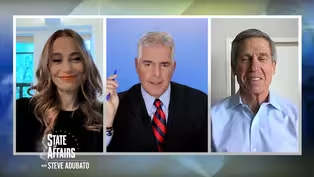
Julie Roginsky, Democratic Strategist and Principal of BARO Strategies.
And also Dale Florio, Republican Strategist, Managing Partner, Princeton Public Affairs Group.
Julie and Dale, good to see you.
- Good to see you.
- Hey, Steve.
- We are taping this only a week after the election.
We'll be seeing a little bit later.
So, let's not date ourselves.
Julie, the Democrats got crushed because?
- We don't know how to communicate.
We don't know how to speak to voters in their own voice and on their own level.
We preach and we scold, and we don't listen.
That's why we lost.
- And Dale?
Donald Trump and the Republicans taking over in Congress won for a lot of reasons.
The most significant is?
- Just energy, right?
I mean, you can say anything you want about Donald Trump.
He just creates energy, talks in simple sentences that people understand.
To Julie's point, right?
I mean, listen, I think the Democrats put the Vice President in a very, just, almost impossible to win situation.
We can talk about what she could have done or said, but just a difficult situation to even have the President go through that first debate.
There should have been a serious conversation- - President Biden?
- How he chooses not to run again.
It was tough.
- Julie, let me ask you something.
You've always been the kind of, so-called Democratic strategist, who's never afraid to be critical of the Democrats when they need to be criticized.
Why the heck do you think the Democrats or the leaders in the Democratic Party, whatever that means, didn't have an honest discussion a couple years ago and say, "We're gonna talk to the President.
He clearly can't run again.
Let's have an open primary.
Let's see who wins."
Why was that so hard?
- Because I think when you're working in the White House, two things happen.
And this happens in the Governor's office as well here in New Jersey.
This happens everywhere, right?
One is you start drinking the Kool-Aid because you support your principal.
That's why you're there.
You're loyal to your principal.
And if you're not loyal to your principal, you gotta get out.
So from that perspective, clearly they were loyal to their boss.
And two is that, I think they probably assumed that because they saw him day-to-day and he was functioning just fine.
And from people who I know who see him all the time, he is very much with it.
Maybe he's not speaking as eruditely as he once did, although he was never particularly erudite.
But you know, he's not- - But not in a public forum.
Not in a public forum.
- But, but, well, this was the first time we saw him in a public forum.
And that's, I think, part of the problem, right?
Is that we didn't know how he was going to do.
None of them probably assumed he was going to do as poorly as he did until he did.
But I think a lot of it has to do with just, look, why did Phil Murphy's staff defend him on some really indefensible things?
And why did Chris Christie's staff defend him in some indefensible things?
And I can go back, you know, governor after governor, it's not a partisan issue.
- So, the Emperor has clothes on, even when the Emperor does not have clothes, Julie?
- It is your job to convince everybody else that the Emperor has clothes.
That's the hallmark of- - But what about to the Emperor?
- I'm sorry?
- What about to the Emperor?
Don't you need to tell the Emperor, "Hey, you're naked."
- If you are a good staffer, and most importantly, if you have a principal who wants to hear it, then yes.
But I have to tell you, and Dale correct me if I'm wrong, I have worked for very, very many politicians, and there are very few and far between who actually want to hear the truth.
- Hey, listen.
I agree with Julie.
I mean, she's absolutely right.
It was a hard situation.
Very, very difficult.
I'm just saying that they put the vice president almost in an unwinnable situation, right?
Just very difficult for her to win.
- Let me ask this.
Go ahead, Julie 'cause I wanna talk policy as well as, 'cause both of you- - Yeah.
- Go ahead, Julie.
- Yeah, the other thing I wanna add, and Dale touched on this a little bit is, look, I think the American people ever since, at least since the 2008 crash, but probably even prior to that, really hate politicians.
They want people who seem genuine, right?
And so, for example, Chris Christie always did very well, even in a Blue state, because he seemed genuine.
You might like him or not like him, but he seemed like a real guy.
Hillary Clinton didn't seem so genuine, but Donald Trump did, which is why I think he won in 2020.
Biden was a real guy.
Scranton Joe, right?
People understood him.
And then Trump was... And this time around, Trump despite being around for 10 years, still doesn't seem like a politician.
He still seems like a real guy.
Now, you might debate that issue, but that's how he is perceived by people.
And I think for the next person who runs on the Democratic ticket, they have to really be authentic.
Authenticity is the key.
They have to stop being worried about pissing off one coalition or another.
They have to speak plainly.
Be themselves.
And that's really, really crucial going forward.
- Talk about pissing off coalitions, Dale.
Let's talk policy.
The president, President Trump argues that he is going to engage in mass deportation.
He talks about tariffs immediately.
China in particular, tariffs in China.
Talks about a whole range of things.
"On Day 1, gonna be done."
You understand government better than most.
How hard is it gonna be for him even with Republican Congress to act on those things effectively?
Please, Dale.
- I am sure that there's gonna be dozens and dozens of executive orders that attempt to do some of these things.
- Explain to folks executive orders versus going through the legislative process, Dale.
- Sure thing.
An executive order is delivered by the Chief Executive, be it a president or governor that directs a government agency to do this or to do that.
Or it puts in a policy that needs to be followed.
Now, those executive orders can be challenged in court by a Congress, but if he has both houses, that may not be the case, or somebody else could challenge it.
But executive orders tend to carry a lot of weight and are very successful, especially at the presidential level.
So, he can do all those things that you just described, Steve.
- Can he do that with tax policy?
Can he extend the 2017 tax breaks or tax cuts, if you will, for wealthier folks or corporations and others?
Can he do that by himself?
My understanding is he can't.
- When it comes to fiscal policy, it's a different story.
He's not on solid ground when it comes to those types of things.
- Julie, tax policy.
The president wants to cut taxes for whom, Julie Roginsky?
- Elon Musk, the person that delivered the White House to him.
I mean, the Trump tax cuts the first time around truly benefited the very wealthiest among us disproportionately.
That's not a debate, that's just a fact.
But I will say for anybody who voted for him because they thought that there'd be mass deportations or because they thought somehow you'd be paying less because of tariffs.
'cause China was gonna pay for it, I've got bad news.
You want your strawberries to be about 15 bucks a pint?
Support the deportations.
You want your iPhone to be about $3,000 that you buy for your kids or for yourself for Christmas?
Ask for those tariffs.
I mean, much like Mexico didn't build that wall in the first term, nobody's paying for these deportations and nobody's paying for these tariffs except the American people.
And I think it all sounds very good on paper, but in reality, when it happens, it's gonna be awful.
And by the way, for all the Latinos and places like Passaic who voted for Donald Trump, when he comes for Abuela, you have nobody to blame by yourself.
Because the best interview that I saw recently was with a shop owner, I think somewhere either in New York or New Jersey, who's Latino, who said, "Yes, I voted for Trump.
But he's not gonna be coming after families.
He's just gonna be coming after the bad guys."
Well, no, actually, this person who's gonna be in charge of these deportations said, "If you are here illegally and you've been here for 30 or 40 years and you married a citizen and you have children who were born here, you're getting outta this country.
And if you wanna keep staying together as a family, everybody's gotta get out."
- Yeah, you don't believe that's gonna happen, do you?
- Do I?
- I know, Julie.
I know you do.
I'm asking Dale.
(laughs) - Okay.
- The devil is always in the details, right, Steve?
Campaigns are full of buzzwords.
Mass deportation.
Immigration was a huge issue.
He sold it.
The logistics of what he ultimately does could be an entirely different story.
- And tax policy?
- I'd be really surprised if there was mass deportations.
I really would be surprised- - Would you be surprised if there are tax cuts extended, Dale?
- I would not be surprised if tax cuts are extended.
Maybe not by executive order, but I think there'll be an attempting Congress.
There may not be enough votes for that, but- - Do you think the majority of Americans who don't make $200,000, $300,000 or more, or multimillionaires, billionaires, et cetera?
Do you think the vast majority of folks who voted for President Trump will get those benefits?
- I think if they see buying eggs at the grocery store going down, I don't think that they're gonna care if somebody that's making more money than me gets a tax cut 'cause they wanna see what impact it has on them.
If it helps them keep their job, if it helps them get better prices on things that they wanna buy.
You know, we understand how tax policy works, right?
The people that have more money, invest that money, which then creates other jobs and keeps businesses going.
- Complex stuff.
Go ahead, Julie.
Final word, 20 seconds.
Go.
- 20 seconds.
January 20th, 12:01 PM, Donald Trump is gonna take credit for the greatest economy in the world, Joe Biden's economy.
So, let's see what happens with his economy.
But at 12:01 PM, every Republican's gonna say, "We're living in the age of prosperity."
- Julie Roginsky.
Dale Florio.
Interesting stuff.
Fascinating times.
Thank you, Julie.
Thank you, Dale.
Good stuff.
- Thanks, Steve.
Stay with us.
You got it, we'll be right back.
(grand music) - [Announcer] To see more State of Affairs with Steve Adubato programs, find us online and follow us on social media.
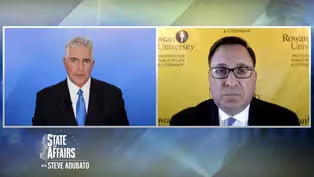
- We're joined once again by Dr. Ben Dworkin, who's Director of the Rowan Institute for Public Policy & Citizenship, Rowan University, one of our longtime higher ed partners.
Ben, good to see you.
- Good to see you, Steve.
- All right, this is after the 2024 election, be seen, I don't know, weeks after, months after.
Put it in perspective: the biggest takeaway for you from this historic election is?
- Just the scope of the Trump victory.
It was not just in certain areas; it was pervasive, and that made it significant and stunning.
I mean, most of us were walking into this election thinking that it was a tied race, and it clearly was something different.
So there are questions that are coming forward for our polling, for our, as people look at how campaign strategy is designed based on that polling.
Because I don't think anybody really expected this kind of large-scale red wave across the country.
- You mentioned polls.
Ben, I would be remiss if I didn't ask you and put this on the table: I mean, these polls are so wrong so often; and if policy decisions are made, or perception of where people are or are not on candidates, on issues are so off, why the heck are we still doing polling if polls are crappy so often?
- Well, they're not always crappy.
- No, they're not always, but they're off.
- But that's why you still use them is my point.
You know, it's not everyone is bad.
But clearly a whole bunch of them were off in this election.
Trump is a unique candidate when it comes to polling.
People don't respond.
People don't want to participate.
Pollsters over the last, I mean, we've seen this off since 2016.
Pollsters have tried to make accommodations to deal with it.
Clearly, the polling community really hasn't found a proper formula for polling when Donald Trump is on the ticket.
- That being said, how much of this, from your perspective, Ben, you understand public policy better than most, how much of this election was and is a rejection of the public policy agenda of the Biden-Harris administration?
- I think it's a significant part.
But there's a big caveat here.
You know, the straw that breaks the camel's back is as heavy as every other straw.
There's never one thing that will make the difference in a campaign.
And so we're gonna have to look at a lot of different things.
Certainly, what we're beginning to see as post-election analyses come out is that there clearly was a rejection on the Biden administration.
Kamala Harris tried to turn the page, but she was turning the page in effect on herself because she was part of it.
And she went out on "The View" and other places and said I couldn't tell you where I would change anything in terms of what we did.
So that's part of it.
But there are probably several other issues that we might not have, we don't quite understand just yet.
And that's gonna come over the next few months.
- From a public policy perspective, President Trump talks about mass deportation on day one; excuse me, an extension of the 2017 tax cuts for wealthier Americans and corporations.
He talks about a range of issues, and also including wind energy, turbines, let's do away with them.
The federal government's not gonna fund it anymore.
What's realistic in terms of what he's gonna be able to do with Congress, and how much is he gonna just do by executive order, Ben?
- I think he's gonna try and do everything by executive order.
It's certainly the easiest and most efficient way to impose a certain policy.
Congress is gonna be difficult.
Even if the Republicans win the House, it's gonna be very close.
And it's hard to put together, as we saw over the last couple of years, it's hard for the Republicans to put together a working majority.
Now, Donald Trump being in the White House will make a difference, and certainly he'll be able to, because of his command of the Republican Party, he'll be able to work to impose his will on any legislator who might be hesitant to do something.
But I think it'll be harder.
So we're gonna expect a lot more of the executive orders.
And they will cover a range of policies that he's articulated and thrown out there.
We'll have to see which one comes first, but it's gonna be a flurry in those first 100 days.
- Ben, do you believe that the 2024 election winds up having a significant impact on the 2025 race for governor of New Jersey, in this sense, that because President Trump only lost New Jersey by five percentage points, many polls had him winning by way more than 10, up to 12, 14, 16 percentage points.
Question, do you think a more quote MAGA/Trump-oriented Republican candidate has a better chance of getting the Republican nomination today than before the November 5th election?
- Yes.
And there's more to that, but just to focus on that specific question, yes, the more MAGA candidate in New Jersey's Republican Party I think has a better shot, simply because there's a national endorsement of Donald Trump.
He won this election.
You know, 140 million people, Americans went out to vote in a free and fair and nonviolent election, and one side won.
And I think that is going to inspire people who believe in Trumpism, who believe in Donald Trump, who want to emulate his type of politics and his type of policy agenda: so yes.
- But that's in a primary, Ben.
That's in a Republican primary.
- Yeah.
- Sorry for interrupting.
Do you have any sense of a general election, how much different the electorate is in New Jersey today than it was a year ago?
- In a general election, I'm not sure that the Trump agenda, someone trying to be more MAGA than the others.
If they win the primary, I'm not sure that person is going to win the general or be competitive in the general election.
The fact is, Kamala Harris won.
She won by five points.
Winning is winning.
- In New Jersey.
- In New Jersey, yes.
And, you know, winning is winning.
I think in a year from now, when we go to the polls for a general election for governor, we're gonna be looking at a year's worth of the Trump administration.
If the past is any kind of prologue, then what we're looking at is a sharp reaction against the incumbent, against an incumbent White House, whomever is in the White House.
People are gonna react against that.
We're gonna be in a very different political environment as we head into the fall of 2025.
- Before I let you go, Ben, how much soul-searching do you think the Democratic Party needs to do to be more competitive moving forward?
- Oh, I think it's gonna be huge.
And it needs to be.
There needs to be confrontation among different parts of the party.
And not everyone's gonna be happy with it.
And people are gonna crumble.
- Hard conversations, Ben?
- Really hard conversations.
Hard conversations about Israel and Gaza.
Hard conversations about the economy.
Hard conversations- - Immigration.
- About immigration.
Exactly.
And so all of this is going to... What we did have in immigration, for example, the knee-jerk reaction, we're gonna be a sanctuary state, we're gonna be a sanctuary city.
Well, once a lot of migrants started coming to those cities, the people who live in those cities and those states started reacting very negatively.
So it's not just a talking point that people could throw out there.
The party's gonna have to have, do a lot of soul-searching right now.
But we've seen this before, Steve, and parties come back.
- Ben Dworkin knows more about politics and public policy and citizenship than most folks, so pay attention.
Dr. Ben Dworkin from Rowan University, our longtime higher ed partner.
Good to see you, my friend.
Thank you.
Appreciate it.
- Thank you, Steve.
- I'm Steve Adubato.
That is Professor Dworkin.
See you next time.
- [Narrator] State of Affairs with Steve Adubato is a production of the Caucus Educational Corporation.
Celebrating 30 years in public broadcasting.
Funding has been provided by PSE&G, Holy Name.
Robert Wood Johnson Foundation.
Johnson & Johnson.
New Jersey Sharing Network.
New Brunswick Development Corporation.
Delta Dental of New Jersey.
Community FoodBank of New Jersey.
And by NJM Insurance Group.
Promotional support provided by New Jersey Globe.
And by NJBIZ.
- (Narrator) Since 1903, PSEG has worked to keep our commitment to customers and communities, to keep your lights on and homes warm.
We’re there when challenges strike like storms or economic uncertainty.
We're preparing for tomorrow by working to replace aging infrastructure, provide carbon free nuclear energy, and deliver energy efficient options to customers.
PSEG, powering progress.
The future of polling and key voter issues behind elections
Video has Closed Captions
Clip: S8 Ep24 | 9m 55s | The future of polling and key voter issues behind elections (9m 55s)
The impact of the new Trump administration’s policies
Video has Closed Captions
Clip: S8 Ep24 | 10m 56s | The impact of the new Trump administration’s policies (10m 56s)
President of NJ BPU addresses clean energy in NJ
Video has Closed Captions
Clip: S8 Ep24 | 7m 45s | President of NJ BPU addresses clean energy in NJ (7m 45s)
Providing Support for PBS.org
Learn Moreabout PBS online sponsorship
- News and Public Affairs

Top journalists deliver compelling original analysis of the hour's headlines.

- News and Public Affairs

FRONTLINE is investigative journalism that questions, explains and changes our world.












Support for PBS provided by:
State of Affairs with Steve Adubato is a local public television program presented by NJ PBS