State of Affairs with Steve Adubato
Christine Weydig; Robin Peacock; John Harmon
Season 6 Episode 17 | 27m 12sVideo has Closed Captions
Christine Weydig; Robin Peacock; John Harmon
Steve Adubato sits down with Christine Weydig, Director of the Office of Sustainability at the Port Authority of NY & NJ, to discuss becoming sustainable on a global scale; Robin Peacock, Executive Director, Meeting Emergency Needs with Dignity, joins Steve to examine food insecurity; John Harmon, Founder, President and CEO, African American Chamber of Commerce, examines the rising housing costs.
Problems playing video? | Closed Captioning Feedback
Problems playing video? | Closed Captioning Feedback
State of Affairs with Steve Adubato is a local public television program presented by NJ PBS
State of Affairs with Steve Adubato
Christine Weydig; Robin Peacock; John Harmon
Season 6 Episode 17 | 27m 12sVideo has Closed Captions
Steve Adubato sits down with Christine Weydig, Director of the Office of Sustainability at the Port Authority of NY & NJ, to discuss becoming sustainable on a global scale; Robin Peacock, Executive Director, Meeting Emergency Needs with Dignity, joins Steve to examine food insecurity; John Harmon, Founder, President and CEO, African American Chamber of Commerce, examines the rising housing costs.
Problems playing video? | Closed Captioning Feedback
How to Watch State of Affairs with Steve Adubato
State of Affairs with Steve Adubato is available to stream on pbs.org and the free PBS App, available on iPhone, Apple TV, Android TV, Android smartphones, Amazon Fire TV, Amazon Fire Tablet, Roku, Samsung Smart TV, and Vizio.
Providing Support for PBS.org
Learn Moreabout PBS online sponsorship- [Narrator] Funding for this edition of State of Affairs with Steve Adubato has been provided by Kean University.
Where Cougars climb higher.
Investors Bank.
Hackensack Meridian Health.
Keep getting better.
The Healthcare Foundation of New Jersey.
Horizon Blue Cross Blue Shield of New Jersey.
Here when you need us most, now and always.
The New Jersey Economic Development Authority.
New Jersey's Clean Energy program.
Lighting the way to a clean energy future.
Eastern Atlantic States Regional Council of Carpenters.
And by Operating Engineers, local 825.
Promotional support provided by New Jersey Globe.
And by New Jersey Monthly, the magazine of the Garden State.
Available at newsstands.
[INSPRATIONAL MUSIC] - Hi everyone.
I'm Steve Adubato.
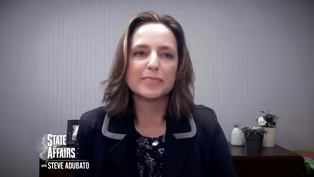
We welcome Christine Weydig, who is director of the office of sustainability for the Port Authority of New York and New Jersey.
Good to see you, Christine.
- Nice to see you also, Steve.
Thanks for taking the time to chat today.
- Our pleasure, the office of sustainability, first of all define sustainability as it's defined at the Port Authority.
And what does the office do?
- Sustainability at the Port Authority means reducing our direct impacts on the environment and also working with our business partners to reduce their impacts on the environment.
And that usually takes the form of reducing activities that generate greenhouse gas emissions, but it also includes reducing waste, reducing the use of single use plastics, water conservation, really looking at all of the ways that we can be less impactful to our environment.
- You know, we've had several experts on around climate change and get all kinds of answers to this.
From your perspective, Christine, where are we with climate change?
With the progress we are making and where are we falling behind?
- Well, we're, we are- - With the clock ticking.
- The clock is certainly ticking.
And the reality is we are way behind schedule in terms of reducing our greenhouse gas emissions.
The good news is I believe a lot of organizations are really starting to take their role in climate change mitigation very seriously.
In addition to climate change adaptation.
Adaptation has always been a pretty tangible thing for most organizations, especially- - What does that mean?
Climate change adaptation.
I'm not sure what you mean.
- Adaption.
So climate change is happening already.
We see it in all of the extreme weather events that are impacting our region.
So Hurricane Sandy was a great example.
It was really wake up call for the region but we're seeing it in the forms of other extreme weather events.
So nuisance flooding, heat, all sorts of things.
And so adapting our businesses and our lives to be ready for climate change is really important.
But I think what more organizations are doing now is they're realizing they have a role in mitigating climate change.
So that means what are we doing today through our actions to reduce those greenhouse gas emissions so that even if climate change is happening, the effects of it can be diminished or we can avoid the most catastrophic impacts of climate change.
So you see that in-- - No.
Finish your point.
I'm sorry.
- That's okay.
So, I was going to say, you see, you definitely see a lot more activity in terms of the commitments that organizations are making.
So the Port Authority has a net zero by 2050 commitment for all (indistinct) emissions.
- Net zero what?
- Greenhouse gas emissions.
- By 20...?
- 50.
- Here's the thing, the Port Authority has that goal but the Port Authority based on a compact from 1921 between New York and New Jersey, the states come together because there are a whole range of issues, you know that do not know any borders, particularly infrastructure transportation related issues.
However, New Jersey has policies in this regard around sustainability.
New York has policies.
Connecticut does as well as does the federal government.
Question.
How the heck do you make public policy around sustainability, greenhouse gas emissions et cetera, climate change when there are no borders?
- There are no borders.
It's a global problem.
And in fact we might be feeling the impact disproportionately or other parts of the world might feel it disproportionately.
It won't be uniformly felt across the board and climate scientists have a lot of sophisticated models but the reality is it's a global problem but we need collective actions.
So the states both New York and New Jersey are actually setting some really high standards for climate action, California, of course does as well.
But that doesn't mean that every state in the union is meeting those same objectives.
And right now the U.S. federal government has established some targets, but it doesn't necessarily mean that the legislation and the policy to really hold everyone accountable are there.
So your point is a really good one which is how are we all going to get there?
And especially if there are certain countries or organizations or states that are committing to it and others that aren't or maybe there are targets that are articulated but not a lot of action to back it up.
But the fact is, and what we took very seriously at the Port Authority was we need to catalyze that action.
So if we all say, oh, it's a global problem and no single actor can do anything about it, then nothing will be done about it.
But if our business partners, most of the major airlines have their own ambitious greenhouse gas reduction targets, you see a lot more of the shipping companies are doing the same and their industry groups.
And a lot of big corporations are saying that they're going to net zero.
So if everyone is making their commitments and the public is starting to hold these organizations accountable for showing the roadmap and the activities that will get them there, then it's through that collective action that we can have an impact.
But right now we are behind schedule and there's a lot of work to be done, but we can't take a hands off approach to this because there are no boundaries.
- So let's be clear for those who don't know what the Port Authority of New York New Jersey actually does and why Christine's talking about this from a regional and global perspective, PS the Port Authority of New York New Jersey an underwriter of our infrastructure economic related economic development activity, programming.
That being said, the Port Authority is responsible for the airports in the New York New Jersey region.
That includes Newark, Kennedy, LaGuardia, correct?
- Yes.
- They're responsible for the tunnels and bridges that connect to New York and New Jersey, the ports, and a whole range of other very important infrastructure projects in our region.
So therefore the Port Authority, I'm not gonna say controls but is responsible for a large amount of physical activity, particularly around transportation.
Is that a fair assessment, Christine?
- That is a fair assessment and transportation right now is the single greatest sector of the economy that's contributing to climate change and why we're taking very seriously our ability with our business partners so we don't operate the aircraft in the end.
Those are the airline - Oh, and PS Port Authority, Trans Hudson Path.
You're responsible for that as well.
- We are responsible for that and the World Trade Center site.
And, yes, we have a very big footprint and very hard to abate sectors of the economy.
- But real quick on this.
Car sales, there's more, there's greater demand for cars than ever before.
Gas prices are what they are, but if there's more demand for cars, electric cars can take a while.
That being said, if there's more demand for cars, does that mitigate against the goals that you and your colleagues at the Port Authority, as well as governor Murphy and and the governor of New York and other places in terms of reducing greenhouse gas effects when there's more demand for cars on the road?
- There is more demand for cars on the road, but you see all of the major automakers are moving to all electric models.
And some of them have already announced that they won't make internal combustion engine vehicles over the next handful of years.
And so you are seeing that those cars are getting cleaner but there also is more of a demand for personal vehicles as you said and until we really see the retirement of some of the combustion engine vehicles, then having more electric vehicles on the road won't necessarily be a solution to vehicle related emissions.
But we are both the states of New York and New Jersey have adopted some rules around requiring that all new sales of on-road vehicles, both passenger vehicles and trucks need to be electric within a very specific timeframe.
And so you will start to see that turnover that we need.
But another thing that we all really need to be mindful of- - Real quick, Christine only have a few seconds.
So go ahead and make your point - The supply chain emission.
So every, all of the emissions that go into making those vehicles also needs to be considered.
- Complex stuff.
Christine, thank you so much for joining us and talking about an incredibly important issue that affects all of us.
Thanks, Christine.
- Thank you.
- Stay with us.
We'll be right back.
(grand music) - [Announcer] To watch more State of Affairs with Steve Adubato, find us online and follow us on social media.
- We're now joined by Robin Peacock, who is Executive Director of MEND, M-E-N-D, Meeting Essential Needs with Dignity.
Robin, great to have you with us.
- Thank you, Steve.
I'm excited to be here.
- Okay.
Describe the organization as we put the website up.
- Sure.
MEND is a collaborative and community driven network of food pantries based in Essex County, New Jersey.
And we bring them together and listen to their needs and respond to those needs.
- In the summer of 2022, as we tape this program what does "hunger and or food insecurity" look like in the communities you serve?
- Well, it's, you know, long been an issue in Essex County.
This is not new, you know, the pandemic certainly exasperated it, but we're seeing, you know, numbers of people coming to the pantries that are double to quadruple what they were pre pandemic and that's continuing, it's also looks like everyone you know and love in your community.
You know, it affects everyone and it's more prevalent than most people think.
- What's MEND On The Move?
- MEND On The Move is a new program we launched in 2021, it's designed to extend fresh food access beyond the pantry walls.
We collaborate with lots of community partners.
We're up to 14 right now.
And that food support looks like home deliveries in partnership with Amazon and the community of fresh food produce boxes.
We also do free mobile markets, so fresh food that's available on site at select locations where community partners have asked for our support.
- You know, what's interesting to me, as we prepared for this segment, what kept coming up is that it appears as if you're changing the model of getting food to those who need it.
So we've done a lot of programming on food insecurity, on hunger related issues.
Are you saying that the obstacles that stand in the way for people to get access to food pantries causes us to change the model so that you're getting food to people, A and B how extensive to connect B given all the logistical challenges involved?
- Yeah, it's hard.
I mean, I would say we pride ourselves on transforming the entire hunger relief model.
I think, you know, the way it's existed historically has been very emergency food based, which is what people think of, the boxed and canned goods.
What we have learned over the years in meeting with the community leaders of the pantries is number one, they want their folks to eat like everybody else, right?
We want to have a variety of fresh food available, not just the same 10, you know, canned or boxed goods.
So that's number one.
Number two is, yeah, the logistics are really challenging and some folks can get to the pantries and the pantries are a trusted, you know, welcome place of support in these communities.
So we wanna enhance them as much as we can.
And then we wanna create this new program that extends food access beyond that.
And, you know, that's the hard part.
I think that's why it's not super prevalent, but we're willing to take on that challenge and that's what we're working toward.
- And your funding comes somewhere.
As we put the website up, I wanna be clear is it government funding?
Is it private funding?
Both what?
Individuals.
- It's no government funding yet.
- Zero.
- Zero.
Yeah, zero, we're working on it.
We'll get there, but it is really private donations from individuals, foundations and then we have a couple events each year that we host.
- Yeah.
As people know for our not-for-profit, I didn't make this expression up, but I live it every day.
And I guarantee you know it, no money no mission.
Right?
- Yeah, that's right.
I mean, I will say people have been supportive.
I think when we talk about the work we're doing everyone gets it.
It's a pretty basic concept, right?
This right to have access to fresh and healthy food resonates in the community.
So people have responded and that's helped us navigate the last couple years and grow some programming that we wouldn't have otherwise been able to do - The Fresh Food Hub.
Describe it.
- Yes.
It's a small warehouse space in Orange, New Jersey.
It was funded initially by a grant from Impact100 Essex to get it up and running.
So we did that in June of 2020, and now it's basically some walk-in fridges, a van, basically a centralized place where these pantries can receive support from us.
So we can source donations in bulk.
We do a lot of local food purchasing, which we're really proud of.
So to sort of purchase in bulk, have it delivered here and then be able to get it to the pantries when they need it in the quantities they need on the timing they need makes a big difference in their ability to support their patrons.
- Sorry for interrupting.
You know, the folks at the Healthcare Foundation New Jersey told us about your organization.
They care deeply about issues of hunger and food security as well.
But here's what I'm curious about, as we put your website up again, what is the message you wanna send to people watching right now in public broadcasting, other platforms as to how they can be helpful?
- They can be very helpful by donating, that's the first step.
We always look for volunteers as well.
So I would say those two are the primary sources of support for us.
And I think just learning more about the work we're doing and spreading the word, you know, we've been around for 40 years, but a lot of people don't know who we are and what we're doing as this kind of backbone organization.
And I think, you know, following us on social media is helpful.
Just spreading the word a little bit more so that we can continue to grow.
- Final question, New Jersey has I believe 9 million people.
Do you have a clear sense of how many of those 9 million people fall into this category?
I hate putting it in quotes, "food insecure".
Have any idea?
Which is obviously not the same number pre February, March, 2020.
- Yeah.
The number I've seen recently is one in 12.
I think it could be more than that to be quite honest.
And what we see at the pantries is it's vulnerable populations.
It's children, it's seniors that are disproportionately affected, certainly people of color.
So we're dealing with it in the way that's hopefully culturally responsive and nutritious food to try and make sure that folks can eat like everyone else.
- We always remind people you talk about statistics, remember you're talking about people not numbers.
- That's right.
- Robin Peacock, Executive Director of MEND, M-E-N-D, Meeting Essential Needs with Dignity.
Robin, thank you so much for joining us.
We appreciate it.
- Thank you so much.
Appreciate the time.
- You got it.
Stay with us, we'll be right back.
(grand music) - [Announcer] To watch more State of Affairs with Steve Adubato, find us online and follow us on social media.
- Once again, he's with us.
He's John Harmon, Founder, President and Chief Executive Officer of the African American Chamber of Commerce of New Jersey.
Good to see you, John.
- I'm honored to be here once again.
Thank you - As always.
Hey listen, before we talk about a range of issues, can we plug the program you're still doing on NJ PBS?
That is an important program.
Tell everyone what it is.
- "Pathway to Success" airs every first Saturday of the month from 9:00 to 9:30 AM and re-airs at 11:30 on Tuesday evenings.
Thank you.
- And that is on our public television station in New Jersey, NJ PBS.
All right, enough plugging for our station.
Hey John, listen, we've been doing this series called "Urban Matters" in cooperation with the folks over at Kean University.
They have the John S. Watson Urban Institute that does public policy questions.
If I put you on the spot, which I will, and ask you the top three urban issues that matter more than any other, what would they be and why?
- Well, there's a number, given the inflation now.
Childcare is at the top.
Housing is significant, either renting or seeking to own a home, the cost of transportation, and of course, public safety and economic opportunity.
That's a mouthful.
- I'm gonna take these one at a time.
Let's go back to childcare.
Our series, "Reimagine Childcare," looking at affordability, accessibility, quality of childcare.
Why is the challenge and the problems associated with childcare, why are they even more difficult and challenging in urban communities?
- Well, I mean, access to quality childcare is important.
The cost is, from what I hear, it just continues to go up.
And many households are run by single parents.
And in order for a mom to be gainfully employed, she needs someone to take care of the kids or she wants to advance her education.
She needs someone to take care of the kids.
So, I think it's very important to have quality childcare for these young men and women.
- Hmm.
You know, you mentioned public safety/crime.
Connect issues of public safety to business, to economic vitality in urban communities?
- Well, if you use, I know we're talking about New Jersey, but if you use Philadelphia... - You could use national, whatever, again, we're New Jersey centric, but these are... - Yeah.
Philadelphia.
- Any city anywhere.
Go ahead, John - Philadelphia, for example, a few days ago.
A gentleman from the Philippines was visiting, going back to the airport via a Uber, and was hit by by a stray bullet.
Tourism, that's gonna kill tourism, not only in Philadelphia and New York.
Folks getting shoved or shot or stabbed or robbed on the subway.
Those are real things that affect the economy.
Small business owners who are depending on people to patronize them, may see a steep reduction in people coming to do business with them.
But perceptions of communities and towns, because of public safety.
And God forbid, they're not overly populated by black and brown people.
That then feeds into an adverse perception.
So, public safety is an unfortunate ill in society that we all must find a way to make it safer.
- John, go back to the transportation issue.
When you talk about transportation being a challenge/problem in urban communities, what specifically?
Are you talking mass transportation?
What are we saying?
And again, what are the economic implications of that?
- So, I guess I was referencing the rising cost of gas.
Gas north of $5 a gallon.
And God forbid if you are a small business that's working for, let's say, FedEx or UPS or Amazon with one of these small trucks.
Diesel $6, $7 a gallon.
And that's a significant barrier to overcome and then that's passed back on to a consumer.
So, if you look at the black demographic with our low income, our low net worth, these rising costs is destroying disposable income.
And so families are having to make some very hard choices.
So, that trickle down effect is adverse right now.
- There was a, and I believe you participated in this, a series of public discussions about state public policy or state policy as it relates to the business community.
And no disrespect to the governor, but I'm listening to the governor talk about the business climate in the state and how friendly it is to business.
And then I hear a range of business leaders, not all but many, not just a few, who say that they don't feel it, they're not feeling the love.
And New Jersey is not as friendly, in fact, there's some who'll call it unfriendly to business.
What do you see?
- I would have to agree with that with some respect.
I think that the state of New Jersey ranks very, very low nationally, in terms of being a business-friendly state.
And we're heavily taxed here and low incentivizing, particularly on a small business sector.
Small businesses and businesses in general, pay high taxes.
I think there was about $50 million in the budget earmarked for programs around businesses.
Don't quote me on that, but we think that number should be a little higher, I think.
- But hold on one second.
We've had many people from the New Jersey Economic Development Authority.
They are, in fact, I'll disclose, an underwriter of ours.
But they've had many people come on saying the EDA has a whole range of programs that support small business.
You say?
- Yeah, So I was about to get into that and start to kinda - - I'm sorry, go ahead.
- name some players.
The EDA is probably one of the most creative partners we have in the state, helping small businesses.
But I think there's some things that the EDA can do as well.
I think credit enhancement for small business lending.
I think that could help significantly.
Incentivizing small developers in development.
Most of your developers that do, let's say affordable housing and that would come outta DCA, there are five or six traditional players who've grown very large over the years.
I think the focus of these small developers, giving 'em resources so that they can scale and grow as well, I think, is increasingly important.
There's a lot of government deposits that go on in community banks around the state.
And I think there could be better engagement with the banks and government to create more opportunities to help small businesses get in a better place.
That there could be some facade improvements.
There could be some point of sale improvements.
I mean, resources, given the small businesses that are still struggling to come out of the pandemic - Pandemic.
- I think, there's never too much that the state could do to help small businesses.
We've come out of the administration that was a little more top down approach with incentives.
And so small businesses are saying, okay state of New Jersey, we can be a little more aggressive from the bottom up.
We're not saying that they're not doing anything.
We're just saying that there's a lot more that can be done.
- John Harmon is the Founder, the President, and the Chief Executive Officer of the African American Chamber of Commerce here in the state of New Jersey.
And again, one more time, plug the NJ PS show.
- "Pathway to Success."
Every first Saturday, 9:00 AM.
And then it re-airs Tuesday evenings at 11:30.
- That's John Harmon.
Hey John, thank you so much.
We appreciate it as always.
- Thank you, sir.
- Thanks for watching, folks.
We'll see you next time.
- [Narrator] State of Affairs with Steve Adubato Is a production of the Caucus Educational Corporation.
Funding has been provided by Kean University.
Investors Bank.
Hackensack Meridian Health.
The Healthcare Foundation of New Jersey.
Horizon Blue Cross Blue Shield of New Jersey.
The New Jersey Economic Development Authority.
New Jersey's Clean Energy program.
Eastern Atlantic States Regional Council of Carpenters.
And by Operating Engineers, Local 825.
Promotional support provided by New Jersey Globe.
And by New Jersey Monthly.
(Spritely music) - (Chloe Firefly) With New Jersey's Clean Energy Program, there's so much to save.
Free assistance for a more energy efficient home.
Win-win!
Small business?
Big savings on your kitchen equipment.
Delicious!
Long lasting and so efficient.
Love it!
Hi, I'm Chloe, your guide to clean energy.
Keep at it, New Jersey.
Gotta go..
Learn more at njcleanenergy.com Or call 1-866-NJSMART.

Becoming Sustainable at Port Authority
Video has Closed Captions
Clip: S6 Ep17 | 10m 11s | Becoming Sustainable at Port Authority (10m 11s)
Combating Food Insecurity in Essex County
Video has Closed Captions
Clip: S6 Ep17 | 7m 55s | Combating Food Insecurity in Essex County (7m 55s)
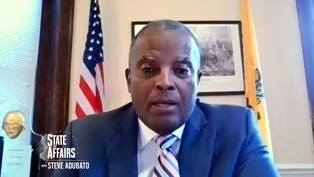
John Harmon Examines Public Safety and Housing Costs
Video has Closed Captions
Clip: S6 Ep17 | 9m 53s | John Harmon Examines Public Safety and Housing Costs (9m 53s)
Providing Support for PBS.org
Learn Moreabout PBS online sponsorship
- News and Public Affairs

Top journalists deliver compelling original analysis of the hour's headlines.

- News and Public Affairs

FRONTLINE is investigative journalism that questions, explains and changes our world.












Support for PBS provided by:
State of Affairs with Steve Adubato is a local public television program presented by NJ PBS