State of Affairs with Steve Adubato
Christopher Paladino; Robin Grossman; Sen. Michael Testa
Season 7 Episode 7 | 26m 35sVideo has Closed Captions
Christopher Paladino; Robin Grossman; Sen. Michael Testa
Steve Adubato is joined by Christopher Paladino, President of the New Brunswick Development Corporation, to highlight the initiatives that are underway at DEVCO; Robin Grossman, Executive Director of Playworks NY/NJ, highlights the importance of creating safe spaces for children to play; Sen. Michael Testa, 1st Legislative District, discusses the school funding formula and election integrity.
Problems playing video? | Closed Captioning Feedback
Problems playing video? | Closed Captioning Feedback
State of Affairs with Steve Adubato is a local public television program presented by NJ PBS
State of Affairs with Steve Adubato
Christopher Paladino; Robin Grossman; Sen. Michael Testa
Season 7 Episode 7 | 26m 35sVideo has Closed Captions
Steve Adubato is joined by Christopher Paladino, President of the New Brunswick Development Corporation, to highlight the initiatives that are underway at DEVCO; Robin Grossman, Executive Director of Playworks NY/NJ, highlights the importance of creating safe spaces for children to play; Sen. Michael Testa, 1st Legislative District, discusses the school funding formula and election integrity.
Problems playing video? | Closed Captioning Feedback
How to Watch State of Affairs with Steve Adubato
State of Affairs with Steve Adubato is available to stream on pbs.org and the free PBS App, available on iPhone, Apple TV, Android TV, Android smartphones, Amazon Fire TV, Amazon Fire Tablet, Roku, Samsung Smart TV, and Vizio.
Providing Support for PBS.org
Learn Moreabout PBS online sponsorship- [Narrator] Funding for this edition of State of Affairs with Steve Adubato has been provided by The Healthcare Foundation of New Jersey.
Veolia, resourcing the world.
The New Jersey Economic Development Authority.
Kean University.
Where Cougars climb higher.
IBEW Local 102.
Lighting the path, leading the way.
RWJBarnabas Health.
Let'’s be healthy together.
Horizon Blue Cross Blue Shield of New Jersey.
Here when you need us most.
The Port Authority of New York and New Jersey.
Moving the region through air, land, rail, and sea.
And by Operating Engineers, Local 825.
Promotional support provided by The New Jersey Business & Industry Association.
And by Northjersey.com and Local IQ.
Part of the USA Today Network.
[INSPRATIONAL MUSIC] - Hi everyone, Steve Adubato and we kick off the program.
He's been with us before, he is Chris Paladino, President of New Brunswick Development Corporation, DEVCO.
Good to see you, Chris.
- Good to see you, Steve.
Great to be back.
- Chris, I'm looking behind you.
Is that what I think it is?
Is that the Helix, the Health and Life Science Exchange in New Brunswick?
Is that it?
- So actually it is H1.
It's the first building of the Helix.
Eventually the Helix will be three separate buildings on a four acre site in downtown New Brunswick across the street from the train station, probably approaching 1.6 million square feet.
This is the first 550,000 square feet.
- We've talked about this before with Chris as things have evolved, explain to folks why the Helix, why the Health and Life Science Exchange, first of all, why it matters so much, not just to the state and the nation when it comes to innovation and research but also who the players are involved in it, go ahead.
- Well, look, I think this comes from the governor's, you know, program of a stronger and fairer economy to basically put New Jersey back into its former place of a global power in innovation.
And this is a big step towards that.
So what we're doing with H1 is we're bringing Rutgers translational research, that is researchers who are ready to take work from the bench to the bedside.
We're bringing the medical school and we're bringing the innovation hub where entrepreneurs can do startup companies.
They can take discovery and commercialize it and put it into one ecosystem.
- So Rutgers is playing a key role, but DEVCO, explain to everyone what the New Brunswick Development Corporation is and why DEVCO is so involved.
- You know, look, the New Brunswick Development Corporation is a not-for-profit company that, we help put things together.
So what we've done here is Rutgers is a major player in this project but we've also brought core partners,, the New Jersey Economic Development Authority Hackensack Meridian Health, the Robert Wood Johnson Barnabas Health System, Princeton University, DEVCO itself, Middlesex County.
And then we've started to bring other partners.
We've got the University of Tel Aviv involved in this project, we have Atlanta.
- Whoa, back up.
Why the University of Tel Aviv?
Why would they be connected to this?
- Because, you know, Rutgers has created a relationship with the University of Tel Aviv.
And look, we live in a global world and they're doing joint shared research and it'll be done here in New Brunswick, it'll be done in Tel Aviv, it'll be done remotely.
But also we've created a partnership with the Atlantic Technology Institute in Galway that has a very large entrepreneur biotech program.
And we're going to host in this building five Irish companies doing medical devices who are going to come here with the intent to try to commercialize in the United States.
- Chris, shift gears for a second.
so the Silicon Valley Bank collapse.
The connection between that bank and the tech world, right?
So many tech companies involved connected with Silicon Valley Bank.
What, if any, impact do you see with the work you and your colleagues are doing as it relates to high-tech innovation, tech-centric companies, and financing?
Loaded question, I know, but obviously you've been talking about this as we've been talking about it right now.
- Well, what we're trying to accomplish and do using it to create an ecosystem and environment where collaboration and discovery can create creative collisions.
But a important part of that is an academic scientist has a discovery, it gets licensed.
They start to try to commercialize, they move into our innovation hub.
One of the reasons that the New Jersey Economic Development Authority has been an major important partner is that the Governor's Evergreen Fund, the venture capital fund, is gonna be located in this building.
And it will also be a place where venture capitalists can have offices and become partners.
They can see the type of work that's being done and make that direct connection and hopefully make that first and second phase of investment to help grow those companies.
So we're trying to make it easier for these folks to collaborate, to understand what they're doing, and then eventually invest.
- But the financing is huge.
You seem to be saying, you are saying, Chris, that what I just described with the concerns about the banking industry and particularly that particular bank, Silicon Valley Bank, and the tech world, is not related to this.
- It's not.
I mean, it's not.
Because we're at that stage where we're looking at people doing first phase investment of equity into small companies.
You know, that later stage when you're growing your companies and you're going to banks for types of financing, that that's the next stage.
I mean, look, we're very fortunate to be in the financial capital of the world here.
It's one of the reasons that, you know, besides having more engineers and PhDs in New Jersey per square mile we're also 30 miles from Wall Street here.
So being able to have people really connect and to be able to visit someone's laboratory and look in their microscope and understand what they're doing is gonna be a big leg up for this trying to commercialize discovery that goes on here.
- Before I let you go, Chris, jobs connected to this initiative.
What are we talking?
- The first thing we gotta start with is that in this building alone, when it's at capacity, be close to 2000 people who will work in this building.
We're gonna be 2400 construction jobs.
But our economist has said that the work that will be done here will generate $800 million in the first 10 years of new NIH funding.
- NIH, National Institutes of Health, go ahead.
- $100 million of new license and patent revenue to Rutgers.
And our economists had said that those licenses and patents will generate 5000 new jobs in the region over 10 years.
- And again, the connection to the, make it clear we're not here to do a commercial for Governor Murphy.
Not our job.
But how is the Governor's office involved?
- Look, these are conversations that in this room I had with Governor Murphy before he became governor, throughout transition, and then as they were developing their economic plan and if you go through the fairer and and stronger economy, their program, there's probably four or five pages of that program dedicated to this.
This is something that has been central.
It's something that he and I talk about on a daily basis.
Or talk to the chief of staff, the head of the EDA.
This is a critical part of showing that New Jersey can recapture its place in the innovation economy.
We lost that.
You know, you go to Kendall Square in Cambridge and all of the companies that are headquartered in New Jersey are doing research in that neighborhood.
And we just want to bring some of that back.
- Chris Paladino, he's the President of New Brunswick Development Corporation, otherwise known as DEVCO.
Chris, I wanna thank you for joining us.
We appreciate it.
- Thanks, Steve.
It's always great.
- You got it.
Stay with us, We'll be right back.
(grand music) - [Announcer] To watch more State of Affairs with Steve Adubato, find us online and follow us on social media.
- We're now joined by Robin Grossman, Executive Director of Playworks, New York, New Jersey.
Robin, good to see you.
- Thanks for having me Steve.
- You gotta it.
Tell everyone what Playworks is as we put up the website.
- Sure.
Playworks is the leading evidence-based nonprofit leveraging the power of play to help kids socially, physically, and emotionally during the school day and you know, throughout their lives.
- You know, you've told our producers that play is a quote unquote "an equity issue."
Make that case.
- Sure.
I mean, not everyone has the opportunity for safe green spaces or safe outdoor spaces to play.
Playworks focuses on the schools and the communities most in need.
And oftentimes those, you know, those communities really have less opportunity and access to play.
And so you know, for us we want all kids to have the same opportunity.
- Newark, New York City, are those the two primary areas?
- They're primary areas.
I mean, we're throughout New York and New Jersey.
We're also upstate in Rochester and Buffalo and Niagara Falls and you know, throughout Westchester and other New Jersey locations.
- Robin talk about, when I think about our own kids and watching them play over the years with other kids, and I don't want to get too analytical about what comes out of play, what the byproducts of play are but it does teach us an awful lot about life.
Does it not?
Talk to us.
- Absolutely.
I mean, you know, we get our social emotional skills through play, right?
You know, and that's pretty much it.
You know, it's about respect for each other.
It's about leadership, empathy, conflict resolution, teamwork, leadership, and more importantly, inclusivity.
You know, now more than ever.
You know, we want kids to feel included, to feel like they have an opportunity.
And we want there to be play for our kids with all abilities.
- COVID and play, isolation.
COVID and play, again, three years plus into the pandemic.
You don't get those years back.
Say a kid was five and that kid seven, eight coming, I don't wanna say outta the pandemic 'cause we're living with COVID.
A lot less play for a long time.
Real impact, correct?
- An enormous impact.
I mean, one of the things that we're seeing is that we're working with kids who might be in third and fourth grade and things that we would've worked with them, you know, in first grade.
You know, you said it, the pandemic isolation.
The fact that children were not interacting with each other but they also weren't interacting with adults or adults that, you know, work with them.
Whether, you know, not their parents but obviously other adults in their lives.
You know, so for us, we're sort of back to basics with kids and making sure those social-emotional skills are right there in step with the academic lessons that they need to learn.
- So help us understand this in terms of Playworks work.
How do you facilitate this?
Is it through the schools?
Is it through other organizations?
How do you actually get to these kids?
- Right, so we partner with both schools and out-of-school providers, both you know, offering direct service and training and consultative opportunities for adults who serve kids.
So we might partner with schools, art school providers they could be community centers, YMCAs, boys and girls clubs.
You know, there's a lot of organizations that we work with but our main focus is working with schools with the highest need.
So those tend to be urban settings, if you will.
And oftentimes those kids have less access, less opportunity, you know, not only to play, but to you know, equipment, to you know, to whatever it might be available to them.
And so we really focus on things that they may not need equipment, you know, you could go onto our website and take a look at our game guide and the opportunity there.
- What is a game guide?
- Yeah, so it's a game guide.
It's hundreds of pages of different games and activities and it's broken down into different, you know, opportunities with equipment, without equipment, you know, what kind of access do you have?
We wanna be sure that kids can play no matter where they are.
So for example, we live in the northeast, right?
So there's a lot of bad weather.
Kids might not have as much access to the outdoor space.
So we're really looking to show a school how they can play in a hallway, how they can play in a cafeteria, how they can play in a classroom and give those kids the opportunity.
You know, it's also really important that they sort of get that physical, you know, energy out so they can be more focused when they get back into the classroom.
- There's a real connection between play and mental health.
- Absolutely.
- There really is.
- Yeah, there's no doubt.
- Talk about it.
- I mean, you know, it's all three of those things, right?
The social, the physical and emotional.
And for us, you know, we want kids to be able to have that break.
You know, we know that educators and parents are concerned about that, you know, that pandemic time of you know, academic loss.
But for us they're really equal.
You know, it's a partnership between play and you know, the academic setting.
And for us, you know, kids need to you know, learn those social skills so they can be mentally strong and they can, you know, support each other, be peer leaders but also be respectful of their adults and really feel good about themselves.
That's the most important thing.
You know, sometimes having fun is the most you know, mentally healthy thing you can do.
- You know, you making me go back and think about growing up in Newark, New Jersey, when I did, who I grew up with, and I realized that the kids I played with on Tiffany Boulevard, the street in Newark, New Jersey and then on Highland Avenue where we moved to when I was nine, that the way we played had a big impact on our neighborhood slash community.
Am I making too much of that?
- No, not at all.
Because you know, it comes down to culture and climate, right?
Of that community and whether that's your, you know, neighborhood community or whether that's your school community.
You know, that's one of the things that Playworks is focusing on with our partners, right?
What does that school culture and climate look like?
And similarly, if you guys are all out on the street, you know, no matter what you're playing, right?
Wiffle ball, kick the can, any of those things you know, kickball, which is one of our favorites, you know, the most important thing is how you interact with each other and what does that mean for your community.
And that's the same in a school setting.
Absolutely.
- You remind me of the Ridge Street School playground which was open all summer as a kid, public school that I grew up in the neighborhood.
And it was open all summer and they used to have summer programs.
Now they do not allow dodgeball anymore but at the time they did.
But I remember that whether it was kickball or dodgeball whatever it was, basketball, all concrete, right?
Brick City has its name, Newark for that reason, right?
But man, I mean it was a place where we were all day in the Ridge Street School playground.
I'm sorry, you brought me back.
Robin, final words on your end.
- You know, listen Steve that's exactly what plays' about, right?
Is that we are always gonna remember those, you know, those scenarios, whether we're playing with our friends we're playing in school and those are the things that sort of, you know, build who we are.
And that's why it's so important to ensure that kids have those opportunities, that they're you know, socially, physically and emotionally strong and they're partnering that with their academics.
And you know, that's what Playworks is here to help.
We hope people will check out our website, check out that game guide that I talked about.
Absolutely and it's you know, for us we hope you'll reach out and learn more about us.
- Robin Grossman, Executive Director of Playworks, New York, New Jersey.
Thank you so much and sorry for my reminiscing about my play as a kid.
Appreciate it.
- Thanks so much.
- Stay with us, we'll be right back.
(grand music) - [Announcer] To watch more State of Affairs with Steve Adubato, find us online and follow us on social media.
- We're now joined by State Senator Michael Testa, Republican representing the first legislative district all the way down in South Jersey.
Good to see you, Senator.
- Great to be seen.
It's good to see you as well, Steve.
- Let everyone know the counties that you represent.
- So I represent all of Cape May County, the majority of Cumberland County and a sliver of Atlantic County.
- The whole range of issues that you and your colleagues are looking at or not looking at, your top two or three priorities in the state legislature are?
- I would say our budget right now, which is severely bloated at 53 billion.
I would talk about our school funding, specifically our rural school funding and our energy master plan.
I think we need to really take a long hard look at the realities of what can be achieved and what cannot be achieved and whether we should even be going down this green road to nowhere it seems.
- Go back to the school funding.
The biggest beef you have or argument you have with the school funding formula as it relates to quote rural districts as you are describing, what is it specifically?
- Well, look, you have some of my rural school districts I'll use Weymouth as an example, who continues to get cut.
There's an actual legitimate school safety issue there.
They were cut about $400,000 last year.
They continue to get cut again this year.
With Weymouth you walked directly into the school.
They want a security measure that has a vestibule to protect school students.
I think that everybody would agree on that.
And then you have a school district like Wildwood that got cut in the seven figures.
They can't possibly be able to budget to have that level of a cut each and every year and have their budget just be so up and down.
It's wholly unfair.
We need to do better than that.
Yet somehow in the budget there is room for a 12 million French museum in Jersey City.
It just seems wholly unfair and it's a a case of the haves and the have nots.
- So now let's stay on the issue of education before we move to some climate change green road to nowhere, as you described.
Let's do this.
You have been outspoken on what you believe to be the need for parents to have more control, influence, I'm not sure what word you want me to use when it comes to what their children are learning in school.
What specific subjects and what concerns do you have that would not allow for teachers to play that role?
- Well, I just wanna have more parental involvement.
I mean, just even over this past week, you saw that the Department of Education who said that they had advertised when parents could sign up to be involved.
They did this over a holiday weekend.
They announced it on holy Thursday.
Obviously Good Friday is a holiday for a lot of practicing Christians in the state of New Jersey.
So they're not gonna necessarily be aware of when they have to sign up.
Over the weekend obviously is the Easter weekend, and they had until Monday at 12 o'clock, I believe, to sign up.
- I appreciate the logistics but you've talked about sex education.
What specifically are your concerns about what is in the curriculum regarding sex education when in fact if I don't, if I understand the law correctly, any parent can opt out and have their kid not be in that class.
So what exactly is the concern?
- Well, the opt-out provision is actually the concern, Steve, because most parents are actually have a level of trust that what their children are being taught is in fact appropriate.
And something that my colleague Senator Holly Schepisi exposed that was in the Westfield curriculum, I have to tell you, if a neighbor were to show an eight, nine, or 10 year old that material they could be put on Megan's law list.
I mean it was really graphic material that didn't make much sense to me that was going to be taught to school-aged children.
And I think that parents should absolutely be made aware of what the materials are before there's this opt-out provision possibly having an opt-in provision.
And I think that we saw, what the level of parental involvement meant in the 2021 election cycle.
There were parents that were outraged, parents that wanted to be more involved in their children's education and they didn't want to necessarily have to opt out.
They wanna be able to maybe opt in and they wanna see the materials before they are presented to their children.
- It's interesting, Senator, you're one of the, considered to be one of the most thoughtful, articulate, senators who's very collegial with your colleagues and the way you communicate.
I'm obsessed about communication, it's very civil, which doesn't sound like a big deal, but unfortunately it is.
Question, you're also a major, you played a role in President Trump's campaign, if I'm not mistaken.
What role did you play exactly?
- I, along with Senator Joseph Pennacchio were his campaign co-chairs for the state of New Jersey in 2020.
- So here's what I'm curious about.
Given how civility matters to you, you can sense it in the conversation with you right now, what role do you believe President Trump has played in terms of contributing to a degree of polarization and divisiveness, not to mention political violence connected to January 6th.
- Obviously President Trump and I have different styles, and Steve, I appreciate the fact that you are giving me some kudos on my attempts to always be civil with the other side.
- Well deserved, well deserved.
- Well thank you.
It's called civil discourse for a reason.
We're allowed to disagree and I think that we need to be civil.
- Without being enemies.
- That's absolutely correct.
- One of my friends who's a big supporter of Donald Trump, said, Steve we're facing a civil war.
And I thought, don't people just disagree?
No, you have to be my enemy.
You don't buy that.
- I don't buy the fact that you have to be my enemy.
Look, I mean, there some areas of political discourse where I'm firmly planted on the other side of the aisle from many in this state.
But guess what?
We can go grab one of New Jersey's craft beers together and some of New Jersey's greatest pizza and have a laugh and we can agree to disagree.
I think that's what our founders believed to be the check and balance.
- Well, President Trump, sorry for interrupting senator, but President Trump engages in name calling, engages in demonizing, and in fact, many have argued that he contributed to the environment on January 6th that caused an insurrection and an effort to overturn the 2020 election.
I know that's not what you're about.
- That is not what I'm about.
But I will say this, one of the issues that I had, I will say with President Trump and I will say this openly was the fact that people would not have confidence in the voting process and specifically the vote by mail process.
I'm not only a senator, but I'm a county chair.
I want people to believe in the political process that that when they go to vote or when they send a ballot in through the mail, that their vote is going to count.
- Is that the same as saying an election was stolen?
- Well, I wasn't outspoken about that at all.
I want to make sure that everybody's vote is in fact counted.
That's why we have things like challengers, Steve, that are making sure that people are doing their job and doing their job correctly and counting their votes.
We should hold everybody's feet to the fire to make sure that our elections have integrity.
And myself and other colleagues like Senator Corrado, Senator Bucco have election integrity bill packages.
That's where we should be focused to make sure.
- We're talking about an insurrection on the Capitol to stop the process where 60 plus courts had decided that there was not enough evidence, and you're a lawyer.
I'm not.
But the process was playing forward and the president actually said, let's get Mike Pence to do the right thing.
And you know the Constitution better than most.
It wasn't in the Constitution, it wasn't his role.
And all I'm asking is, to what degree did President Trump contribute to that political violence?
- Well, with regards to the violence, for the people that were down in Washington, DC, protesting, that's their first amendment right.
Anybody, and I will say this Steve, I'll speak for myself.
I won't speak for President Trump.
I'm not him.
And he and I don't communicate on a regular basis, if at all.
I will say this, anyone that stormed the Capitol building and tried to get inside the Capitol building should be prosecuted to the fullest extent of the law.
That is not okay.
That is not American.
That is not upholding the election process the way we are supposed to uphold.
That is behaving like a third world nation.
- That is State Senator Michael Testa from the first legislative district.
We appreciate his time.
I'm Steve Adubato, we will see you next time.
- [Narrator] State of Affairs with Steve Adubato Is a production of the Caucus Educational Corporation.
Funding has been provided by The Healthcare Foundation of New Jersey.
Veolia, The New Jersey Economic Development Authority.
Kean University.
IBEW Local 102.
RWJBarnabas Health.
Let'’s be healthy together.
Horizon Blue Cross Blue Shield of New Jersey.
The Port Authority of New York and New Jersey.
And by Operating Engineers, Local 825.
Promotional support provided by The New Jersey Business & Industry Association.
And by Northjersey.com and Local IQ.
Here at Kean University, everyone gets their chance to climb higher.
Michael came to Kean and found his passion for health care, and now he's a doctor.
After Tricia graduated, her graphic design work was featured in The New York Times.
Samantha is studying athletic training and finding her path to an internship with the New York Giants.
Real Students.
Real Stories.
Real Success.
Cougars Climb Higher.
Kean University.
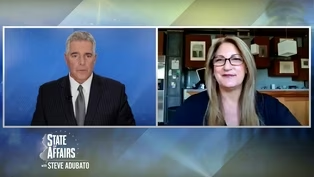
The Importance of Playtime and Safe Spaces for Children
Video has Closed Captions
Clip: S7 Ep7 | 9m 12s | The Importance of Playtime and Safe Spaces for Children (9m 12s)
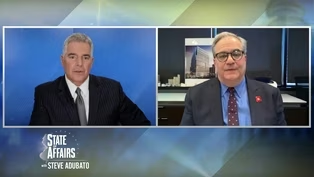
The Initiatives That Are Underway at DEVCO
Video has Closed Captions
Clip: S7 Ep7 | 8m 23s | The Initiatives That Are Underway at DEVCO (8m 23s)
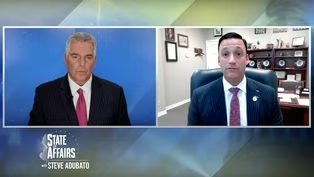
Sen. Testa Addresses His Concerns About Public Education
Video has Closed Captions
Clip: S7 Ep7 | 9m 44s | Sen. Testa Addresses His Concerns About Public Education (9m 44s)
Providing Support for PBS.org
Learn Moreabout PBS online sponsorship
- News and Public Affairs

Top journalists deliver compelling original analysis of the hour's headlines.

- News and Public Affairs

FRONTLINE is investigative journalism that questions, explains and changes our world.












Support for PBS provided by:
State of Affairs with Steve Adubato is a local public television program presented by NJ PBS