
Church Messiah 150th, Judson Center 100th, Ford Piquette
Season 52 Episode 42 | 26m 46sVideo has Closed Captions
Church of the Messiah Detroit’s 150th, Judson Center’s 100th and the Ford Piquette Museum.
We're celebrating major milestones for two organizations in the Detroit area. The Church of the Messiah Detroit commemorates its 150th anniversary with a Nov 1. gala. Judson Center, a metro Detroit nonprofit human services agency, celebrates its 100th anniversary. Plus, a tour of Detroit’s automotive history at the Ford Piquette Avenue Plant Museum.
Problems playing video? | Closed Captioning Feedback
Problems playing video? | Closed Captioning Feedback
American Black Journal is a local public television program presented by Detroit PBS
Church Messiah 150th, Judson Center 100th, Ford Piquette
Season 52 Episode 42 | 26m 46sVideo has Closed Captions
We're celebrating major milestones for two organizations in the Detroit area. The Church of the Messiah Detroit commemorates its 150th anniversary with a Nov 1. gala. Judson Center, a metro Detroit nonprofit human services agency, celebrates its 100th anniversary. Plus, a tour of Detroit’s automotive history at the Ford Piquette Avenue Plant Museum.
Problems playing video? | Closed Captioning Feedback
How to Watch American Black Journal
American Black Journal is available to stream on pbs.org and the free PBS App, available on iPhone, Apple TV, Android TV, Android smartphones, Amazon Fire TV, Amazon Fire Tablet, Roku, Samsung Smart TV, and Vizio.
Providing Support for PBS.org
Learn Moreabout PBS online sponsorship- Coming up, we've got a great episode of "American Black Journal."
Church of the Messiah in Detroit is celebrating a major milestone this year.
We're gonna talk with Senior Pastor Barry Randolph.
Plus it's also a big year for Human Services Agency Judson Center.
We'll get the details and we'll explore Detroit's automotive history inside the Ford Piquette Avenue Plant Museum.
Stay where you are.
American Black Journal starts right now.
- [Narrator] From Delta Faucets to Behr Paint, Masco Corporation is proud to deliver products that enhance the way consumers all over the world experience and enjoy their living spaces.
Masco, serving Michigan communities since 1929.
Support also provided by the Cynthia & Edsel Ford Fund for Journalism at Detroit PBS.
- [Announcer] DTE Foundation is a proud sponsor of Detroit PBS.
Among the state's largest foundations committed to Michigan focused giving, we support organizations that are doing exceptional work in our state.
Learn more at DTEfoundation.com.
- [Narrator] Also brought to you by Nissan Foundation and viewers like you.
Thank you.
(upbeat music) - Welcome to "American Black Journal."
I'm Stephen Henderson.
This year marks the 150th anniversary of the Church of the Messiah in Detroit.
The church is gonna celebrate this major milestone with a special event on November 1st.
Senior Pastor Barry Randolph has been a frequent guest here on the show as part of our ongoing Black Church in Detroit series.
I sat down with Pastor Barry to talk about how the church has been a mainstay in the East Side community known as Island View.
Pastor Barry Randolph, it is always really great to see you.
It is especially great to see you here near the 150th anniversary of the Church of the Messiah.
Welcome to American Black Journal.
- Thank you for having me.
Always good to be here.
- Yeah, so let's talk about this anniversary.
150 years, there are very few things in the world that make it that long.
And there are few things in our city that are still around that were around 150 years ago.
Tell me about the significance of this anniversary of the Church of the Messiah.
- Well, I know a lot of people know about the work of Church of the Messiah, and they know the recent history, but a lot of people don't know that the church has been around actually since 1874, which when I tell people that, they really get surprised.
The interesting thing about Church of the Messiah is it's an Episcopal church, and it's always been an Episcopal church.
I get people say, "Oh, it used to go there "when there was an Episcopal church."
I'm an Episcopal priest.
It's still an Episcopal church.
- Still Episcopal, right.
- Oh, yeah.
And its history is it was started by, it's a mission of Christ Church Detroit, which is on Jefferson and 375.
So we are a mission of them, and they're almost 200 years old, but they started us.
What's interesting about Church of the Messiah, East Grand Boulevard in Lafayette was not our original location.
We've been in this spot since 1901.
So about 123 years we've been in this spot.
But the physical structure of Church of the Messiah literally came from St. Paul's Episcopal Church, which is now on Woodward and Warren.
It used to be downtown.
It caught fire.
They decided to build a new St. Paul's, which would be the Episcopal church's cathedral.
They decided that it would be on Woodward and Warren.
The then pastor of Church of the Messiah went to the Episcopal diocese and said, "Can I have the leftover pieces of the old church to take and build Church of the Messiah?"
Which was a wood structure that was on Mount Elliott to build the actual physical structure.
And so they moved it stone by stone, 1899, rebuilt it, East Grand Boulevard in Lafayette, which was Champlain Street, which is now Church of the Messiah.
And St. Paul's, which is our cathedral, St. Paul's Church Detroit, Episcopal Church Detroit, is 200 years old this year.
So they're 200 and we are 150, but we are the physical structure of that old building.
- Yeah, yeah.
So let's talk about the current mission and existence of Church of the Messiah and kind of when that developed.
Obviously, it's in a very different place today, a very different neighborhood than it would have been when it was founded or built in that spot.
Your work is really focused on that neighborhood and the people in that neighborhood and their needs.
When did that become what the sort of central focus of Church of the Messiah is?
- Wow, that's a great question.
And you gotta remember, Church of the Messiah is on East Grand Boulevard.
And back when we were put on East Grand Boulevard, it was grand.
They named the street grand 'cause it was grand houses.
- It was grand.
- But it was grand buildings.
And then right after the Depression, the '30s, the '40s, the '50s, the neighborhood began to slowly make a little bit of a decline.
And then by the time the '60s and the '70s and '80s came, it really was in a deep decline.
And that's when our mission started.
Right around that late '60s, '70-ish period, that's when we created Church of the Messiah Housing Corporation, which was started in 1978, which was specifically created to build affordable housing in this neighborhood called Island Beach.
So that's when that started.
In 1993, we created another 501(c)(3), which is called the Boulevard Harambee, Boulevard because we're on East Grand Boulevard, standing for Building Leaders for Village Development, which is a social services and empowerment arm that was created in 1993.
And then from that, that led to the employment office, business incubation center, the doctor's office, the marching band, the solar power charging stations, the internet services, all of that spun off from that.
So that's the Church of the Messiah that you see today.
- Yeah.
Let's talk about how the history of the church informs for you the things that you do, that the idea of the Episcopal faith and the mission here in Detroit, how does that shape the work that you're doing with the folks there in the neighborhood?
- Well, I can tell you this much.
The Episcopal church is underrated, in my opinion.
It is a powerful force to be working with.
Our Bishop, Bonnie Perry, is amazing.
The work that not only Church of the Messiah do, but many of our Episcopal churches in the state of Michigan are doing incredible things.
Messiah is just part of that thread.
We're really known because of the fact that the work that we do, but the Episcopal church plays a major role.
The Episcopal church has a history of being able to work on racial reconciliation, bringing people out of poverty, social justice issues, issues of gun violence.
All of that is part of the Episcopal initiative and Church of the Messiah plays a major role in that.
All of those things affect us in this community and neighborhood, and that's why we fight so, so hard for it.
But yeah, we're part of a bigger organization that a lot of times, a lot of people don't know, but the Episcopal church is amazing.
- Yeah, let's talk about the 150th anniversary.
You've got a celebration coming up.
What will people find if they attend that?
- Yeah, so the 150th anniversary is Friday, November 1st.
It's gonna be at the Cathedral of St. Paul, which is the actual physical structure that we came from, Woodward and Warren.
I know the tickets are $100.
You can go on our website to be part of that.
You're gonna learn about the history of Church of the Messiah, the work that we do.
We wanna be able to continue that.
We wanna go 150 years into the future.
But what you will really learn is not only the history of the Episcopal church, but you will also learn what we're going to be doing in the near future, our legacy plan.
You will be learning about all of the young people who are now part of the church who are gonna take us into the next millennium.
I mean, they are amazing.
We're going to continue the work that we're doing with gun violence.
A lot of our work is going to be national.
We're gonna continue the work that we're doing on racial reconciliation and helping Detroit be the best possible place that it can be.
And I'm gotta put a shout out out there.
Our moderator is gonna be Rich Hamburg, the president of PBS.
He is going to Detroit PBS.
He is gonna be our moderator.
We're gonna have a good time.
It's gonna be a festive night, six to nine o'clock.
And I must admit, I'm gonna take my shoes off and I think I'm gonna probably hit the dance floor a little bit.
- Hit the dance floor, that's right.
So as the leader of Church of the Messiah and the congregation, and of course all the work there, talk a little bit about what you see for its future.
I mean, you and I won't be around for another 150 years, but you'll certainly be around in the next year and probably the next five or 10 or 20.
Give us a sense of what you think is next for Church of the Messiah.
- That is an excellent question.
I must say I'm excited.
Now I've been a pastor for 22 years and 22 years is a long time to do anything, especially any one thing.
And that was not on my agenda, that was up to God, what he was telling me to do.
And it's been a privilege to be the pastor.
But one of the things that I think I'm most hopeful for is the fact that we have a generation of young people who are amazing.
I know a lot of times they get the short end of the stick, but they are amazing.
They're doing incredible things.
And I always say that young people don't reject God, they reject the package of church, that package that the church put God in.
And here, we help them with their spirituality and activism.
Those two things go together.
They know that they're going to be the ones who are going to do the work.
We live by a scripture that says, "The kingdom of heaven is not mere words, "it's a demonstration of power."
We wanna demonstrate that power.
We don't wanna commit spiritual malpractice by being able to say God is good, but there's no evidence of it.
We wanna show that evidence, and our young people, they are making it happen.
They're working on the issue of gun violence, they're working on the issues of social justice, and they are doing amazing work.
So the future is very bright for Church of the Messiah, very bright.
- And when you think about the young people who are involved there, that's gonna give you real hope about not just the work you're doing, but the community that it's in.
And that's always been my impression about the relationship there, that yes, the work that the church is doing is really important, but it is building on what's already there, and it's overlooked, and it's disrespected.
You connect directly with it though, and lift it up.
- Yeah, I think one of the things that people need to know, especially about Island View, it is well-organized, and it's not just Church of the Messiah in this community and neighborhood.
I mean, you've got Field Street Block Club, you got St. Bonaventure's, you got Mac Development, you got Charlevoix Village.
There's so many groups, the Bog Center, there's so many groups and organizations in this community and neighborhood making it happen.
It's not just us alone.
And I like to compare Island View, if you wanna get just a little bit religious with it, with Jesus Christ.
Here he is, the Son of God, but he didn't do the work by himself.
He went and got well.
So it's a team effort.
We're all supposed to collectively work together.
And our biggest advantage is we have the same mission.
We wanna empower our people with the best resources possible so that they can have the best quality of life that they can possibly have.
That's what the mission is.
That's what it's all about.
- Yeah.
Well, Pastor Barry Randolph, congratulations on 150 years for Church of the Messiah.
And of course, for the incredible time that you have been the pastor there.
Thanks for being with us here on American Black Journal.
- Thank you so much, Stephen.
Always a pleasure.
- The Human Services Agency Judson Center is also celebrating a huge milestone this year.
The organization is marking 100 years of helping children, families, and adults live better lives.
Judson Center offers autism, foster care, adoption, behavioral and physical healthcare and disability services.
It's Centennial Awareness Campaign is titled, "Where Care is an Art."
(soft music) - She always does this with me.
- It's beautiful.
- I spoke with Judson Center President and CEO, Lenora Hardy Foster, about the agency's history and how it is transforming lives in our community.
So a hundred years of the Judson Center, that is an awfully long time.
Tell me what this centennial anniversary means for the center and for the many, many people that it serves.
- You know, we are so excited.
When you think about being a nonprofit human service provider that has been able to sustain ourselves for a hundred years, that means so much to us.
I think if anything, it tells about a nonprofit that has been creative and innovative over those hundred years.
We first started in 1924, opened the doors as an orphanage for boys and girls.
And the birth of Judson Center came from a group of Baptist ministers that wanted to do good for children.
And we remain true to that to this day.
One of our core programs is foster care and adoption.
But when I think about, Stephen, over these hundred years, the difference that we have been able to make in the lives of so many children, adults, and families, we serve over 14,000 annually.
So think about 1924, small, small nonprofit.
The name was the Detroit Baptist Home for Children.
And 60 years into this wonderful organization, we changed the name in 1984 to Judson Center.
And if I could just share the things that we have been able to accomplish over the hundred years, which is so remarkable, and I think that's where all of our pride and joy comes from, to know that being an agency that really believes in working with children and trying to help them find that forever home is so important to us.
But we're about community.
What are other things that we can do within community that is really gonna make a difference and be able to impact so many lives?
Over those years, we've expanded into disabilities.
We believe in individuals with a disability, no matter what it may be, if they're diagnosed with a mental illness, if they're on the autism spectrum, if they are in a wheelchair, that they should be given an opportunity, the same as you and I, to become an employee one day.
So our disabilities program provides soft skills training, supported employment, and help them to find and secure a job.
Then we expanded into behavior health.
And today we're so proud.
We have an integrated care model.
And we are one of the CCBHCs here in the great state of Michigan that stands for Certified Community Behavioral Health Clinic.
It's an integrated model that includes behavioral health, primary healthcare, and substance use disorder.
And then our autism program.
We're so proud that we can make a difference in the lives of so many children that are diagnosed with autism.
We have five locations.
And so over those hundred years, we've expanded.
We started right there in Oakland County, in Royal Oak, the corner of 13th and Greenfield, a hundred years ago.
We're still there today.
That's our largest campus, but we have almost 10 locations that are spread over five counties.
We moved into Washtenaw, to Wayne, to Macomb, to Genesee.
And we have one program, which is a foster care program that is statewide.
The Mayor, the Michigan Adoption Resource Exchange.
We're proud of the success and things that we've been able to accomplish over the hundred years and the joy that we see in the faces of the people we serve.
- Yeah, yeah.
So talk about what the needs look like now in the places that you serve and how those have maybe changed over recent years.
I mean, there's a lot of things that are changing in this community.
There are a lot of challenges that are presenting themselves that are new or different.
How does that look from the Judson Center's seat?
- Absolutely.
So some of the changes that we've experienced, if I start with foster care and adoption, is being able to have support programs in place.
Think about our foster parents.
They need to be provided training and education on how to be a foster parent, you know?
And so we have grants that provide that service as well as other supports, you know, for that population that we serve.
We know that today we live through and still living through much better and pandemic that none of us was prepared for truly impacted our ability to provide the services that we were so accustomed to.
So living through that and really trying to ramp up to get to a level where we used to be has been very challenging.
With our autism program, it requires face-to-face service.
We can't provide an autism service, you know, over telehealth.
You gotta see that child in person.
So there are things that we were forced to pivot, being able to make sure that our professional staff in the behavior health program and primary healthcare, that we had to train them on how to use telehealth, you know, so that they could work from home during the pandemic.
And now some of those things that have changed, here it is a human service organization opened the door, our 400 employees, we've so used to them being in the office.
We had to learn a little bit, that was a challenge.
How can we also learn to allow staff to work remotely?
Because everybody wants remote work nowadays.
So there are things that we've had to look at how we could change, but still be that strong organization, the Judson Center, you know, that care about.
Number one, we're here to provide quality care to all of the children and adults and families that come to us.
- Yeah, yeah.
And so let's look forward a little bit, the next 100 years, but of course, starting with the next year and the next five years.
But what are the things that you anticipate that the Judson Center will need or will need to do going into that second century?
- Absolutely.
And Stephen, one of the things that we were able to do, we took this year right before we reached 100 years and we put together a very good plan.
You know, what is this gonna look like?
What do we need to do to get our message out?
You know, so I think that we've been very successful in sharing that story about 100 years.
And on November 1, a few weeks from now, we're having a huge celebration.
You have to celebrate that milestone.
So 100 years, a gala, Centennial Gala, with guests coming, 500 plus people will be in attendance and they will get to hear what we've been able to do over those 100 years.
And we're gonna share with them what the next 100 years is gonna look like.
Starting small, because it's kinda hard to project 100 years from the day where you're gonna be.
But what we're saying, 100 years from now, we wanna still be an organization that is here, doing good in the communities that we impact.
But let's say doing those first five years.
Right now, we have a major capital campaign that's taking place.
That location, 13 mile in Greenfield, where we've been for 100 years, we have a capital campaign that we really want to redo that campus.
It is time for a major overhaul, an uplift, to expand on that location, to fix up that location, to make sure folks know who we are and what we're doing.
So that's huge for the first five years.
In addition to that, I talked about the CCBHC model.
That is a model right now that was really started by our very own Senator Debbie Stabenow, was able to get that passed through Congress back in 2015, her and Senator Roy Blunt out of Missouri.
That model is being adopted right now in about 40 states.
Everybody loves that model.
So what we see, our challenge for the next five years, our largest integrated program operates out of Warren, Michigan in Macomb County.
We are replicating that in Royal Oak.
So that's a part of that capital campaign.
We wanna make sure that we can have an integrated model.
We do behavioral health there now, but we wanna expand it with primary healthcare and substance use disorder.
Stephen, when we talk about things that have happened during the pandemic that has impacted us and things that we've learned that needs more attention, substance use disorder.
- Yeah, yeah.
- Our children and our adults, very high in Macomb County.
So high numbers of children and adults that need those services.
- Yeah, yeah.
- And we're also gonna replicate it in Wayne County.
- Yeah, yeah.
Well, 100 years is an awful long time.
And that means that you guys have a tremendous impact on this community and a number of things that you have achieved.
So again, congratulations on reaching that 100 years.
And we look forward to celebrating that 100 years and to watching what the Judson Center is gonna be able to do in the next century.
It was really great to have you here with us.
Thanks so much for joining us on AmeriCorps.
- Thank you so much.
- Thank you, Stephen.
Greatly appreciate it.
- And we're gonna end the show today with yet another piece of Detroit history.
The Ford Piquette Avenue Plant was built in 1904 and served as the birthplace of Henry Ford's Model T. The plant is now a museum and "One Detroit's" Chris Jordan toured the site with its president and COO, Jill Woodward.
- The Ford Piquette Avenue plant is really one of the most important historic sites for the automotive industry in the world.
It is really the origin point of the Motor City.
So when we ask ourselves, where did Detroit get its start as the Motor City, it happened right here in Milwaukee Junction.
Henry Ford built the Ford Piquette plant in 1904.
He was here until 1910.
And this is where he envisioned and built the very first Model T which we know is the car that put the world on wheels.
We actually have Henry Ford's secret experimental room rebuilt here in the museum on the third floor.
And it's holy ground for a lot of people to see the spot where that vehicle, the very first one was made.
Over 15 million were made.
And when you come here, you can see, for instance, number 220 that was made right here in this building.
That's our red Model T downstairs in 1909.
We have over 65 very rare vehicles here, including one of the only collections of Henry Ford's letter cars.
Those are all the models leading up to the T that you can see anywhere in the world in the place where they were made.
I feel like we've lost a little bit the significance of Milwaukee Junction.
This is exactly where the Motor City got its start, right here because of the railroads.
There was all that innovation and entrepreneurship happening that really set the stage for what Henry Ford was gonna do right here in this building.
It was really the Silicon Valley of its day.
When we think about Detroit and what it means to the rest of the world, I think our contributions are really summed up by places like this that contain our history, our history that really went on to change the world.
The Model T really changed the way we live and drive today.
To have the birthplace of that vehicle here in Detroit preserved by chance and a lot of hard work is really a great gift.
- That's it for us this week.
You can find out more about our guests at AmericanBlackJournal.org plus connect with us anytime on social media.
Take care and we'll see you next time.
(upbeat music) - [Narrator] From Delta Faucets to Behr Paint, Masco Corporation is proud to deliver products that enhance the way consumers all over the world experience and enjoy their living spaces.
Masco, serving Michigan communities since 1929.
Support also provided by the Cynthia & Edsel Ford Fund for Journalism at Detroit PBS.
- [Announcer] DTE Foundation is a proud sponsor of Detroit PBS.
Among the state's largest foundations committed to Michigan-focused giving, we support organizations that are doing exceptional work in our state.
Learn more at DTEFoundation.com.
- [Narrator] Also brought to you by Nissan Foundation and viewers like you.
Thank you.
(soft music)

Church of the Messiah Detroit celebrates 150th anniversary
Video has Closed Captions
Clip: S52 Ep42 | 11m 7s | The Church of the Messiah marks 150 years of service and community building in Detroit. (11m 7s)
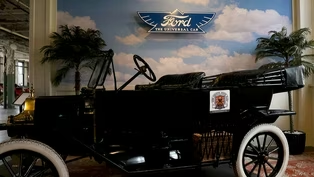
Ford Piquette Avenue Plant Museum preserves Detroit history
Video has Closed Captions
Clip: S52 Ep42 | 2m 23s | The Ford Piquette Avenue Plant Museum is working to preserve Detroit’s automotive history. (2m 23s)

Judson Center celebrates 100 years with Centennial Gala
Video has Closed Captions
Clip: S52 Ep42 | 10m 37s | Judson Center in metro Detroit celebrates 100 years with an upcoming Centennial Gala. (10m 37s)
Providing Support for PBS.org
Learn Moreabout PBS online sponsorship
- News and Public Affairs

Top journalists deliver compelling original analysis of the hour's headlines.

- News and Public Affairs

FRONTLINE is investigative journalism that questions, explains and changes our world.












Support for PBS provided by:
American Black Journal is a local public television program presented by Detroit PBS