
Church of the Messiah Detroit celebrates 150th anniversary
Clip: Season 52 Episode 42 | 11m 7sVideo has Closed Captions
The Church of the Messiah marks 150 years of service and community building in Detroit.
Church of the Messiah Detroit will commemorate its 150th anniversary this year with a special gala event Nov. 1 at the Cathedral Church of St. Paul in Detroit. This year’s anniversary theme, "The Audacity of Faith," celebrates the church’s 150 years of service and community building. Host Stephen Henderson talks with Pastor Barry Randolph about the church's anniversary.
Problems playing video? | Closed Captioning Feedback
Problems playing video? | Closed Captioning Feedback
American Black Journal is a local public television program presented by Detroit PBS
Church of the Messiah Detroit celebrates 150th anniversary
Clip: Season 52 Episode 42 | 11m 7sVideo has Closed Captions
Church of the Messiah Detroit will commemorate its 150th anniversary this year with a special gala event Nov. 1 at the Cathedral Church of St. Paul in Detroit. This year’s anniversary theme, "The Audacity of Faith," celebrates the church’s 150 years of service and community building. Host Stephen Henderson talks with Pastor Barry Randolph about the church's anniversary.
Problems playing video? | Closed Captioning Feedback
How to Watch American Black Journal
American Black Journal is available to stream on pbs.org and the free PBS App, available on iPhone, Apple TV, Android TV, Android smartphones, Amazon Fire TV, Amazon Fire Tablet, Roku, Samsung Smart TV, and Vizio.
Providing Support for PBS.org
Learn Moreabout PBS online sponsorshipThis year marks the 150th anniversary of the Church of the Messiah in Detroit.
The church is gonna celebrate this major milestone with a special event on November 1st.
Senior Pastor Barry Randolph has been a frequent guest here on the show as part of our ongoing Black Church in Detroit series.
I sat down with Pastor Barry to talk about how the church has been a mainstay in the East Side community known as Island View.
Pastor Barry Randolph, it is always really great to see you.
It is especially great to see you here near the 150th anniversary of the Church of the Messiah.
Welcome to American Black Journal.
- Thank you for having me.
Always good to be here.
- Yeah, so let's talk about this anniversary.
150 years, there are very few things in the world that make it that long.
And there are few things in our city that are still around that were around 150 years ago.
Tell me about the significance of this anniversary of the Church of the Messiah.
- Well, I know a lot of people know about the work of Church of the Messiah, and they know the recent history, but a lot of people don't know that the church has been around actually since 1874, which when I tell people that, they really get surprised.
The interesting thing about Church of the Messiah is it's an Episcopal church, and it's always been an Episcopal church.
I get people say, "Oh, it used to go there "when there was an Episcopal church."
I'm an Episcopal priest.
It's still an Episcopal church.
- Still Episcopal, right.
- Oh, yeah.
And its history is it was started by, it's a mission of Christ Church Detroit, which is on Jefferson and 375.
So we are a mission of them, and they're almost 200 years old, but they started us.
What's interesting about Church of the Messiah, East Grand Boulevard in Lafayette was not our original location.
We've been in this spot since 1901.
So about 123 years we've been in this spot.
But the physical structure of Church of the Messiah literally came from St. Paul's Episcopal Church, which is now on Woodward and Warren.
It used to be downtown.
It caught fire.
They decided to build a new St. Paul's, which would be the Episcopal church's cathedral.
They decided that it would be on Woodward and Warren.
The then pastor of Church of the Messiah went to the Episcopal diocese and said, "Can I have the leftover pieces of the old church to take and build Church of the Messiah?"
Which was a wood structure that was on Mount Elliott to build the actual physical structure.
And so they moved it stone by stone, 1899, rebuilt it, East Grand Boulevard in Lafayette, which was Champlain Street, which is now Church of the Messiah.
And St. Paul's, which is our cathedral, St. Paul's Church Detroit, Episcopal Church Detroit, is 200 years old this year.
So they're 200 and we are 150, but we are the physical structure of that old building.
- Yeah, yeah.
So let's talk about the current mission and existence of Church of the Messiah and kind of when that developed.
Obviously, it's in a very different place today, a very different neighborhood than it would have been when it was founded or built in that spot.
Your work is really focused on that neighborhood and the people in that neighborhood and their needs.
When did that become what the sort of central focus of Church of the Messiah is?
- Wow, that's a great question.
And you gotta remember, Church of the Messiah is on East Grand Boulevard.
And back when we were put on East Grand Boulevard, it was grand.
They named the street grand 'cause it was grand houses.
- It was grand.
- But it was grand buildings.
And then right after the Depression, the '30s, the '40s, the '50s, the neighborhood began to slowly make a little bit of a decline.
And then by the time the '60s and the '70s and '80s came, it really was in a deep decline.
And that's when our mission started.
Right around that late '60s, '70-ish period, that's when we created Church of the Messiah Housing Corporation, which was started in 1978, which was specifically created to build affordable housing in this neighborhood called Island Beach.
So that's when that started.
In 1993, we created another 501(c)(3), which is called the Boulevard Harambee, Boulevard because we're on East Grand Boulevard, standing for Building Leaders for Village Development, which is a social services and empowerment arm that was created in 1993.
And then from that, that led to the employment office, business incubation center, the doctor's office, the marching band, the solar power charging stations, the internet services, all of that spun off from that.
So that's the Church of the Messiah that you see today.
- Yeah.
Let's talk about how the history of the church informs for you the things that you do, that the idea of the Episcopal faith and the mission here in Detroit, how does that shape the work that you're doing with the folks there in the neighborhood?
- Well, I can tell you this much.
The Episcopal church is underrated, in my opinion.
It is a powerful force to be working with.
Our Bishop, Bonnie Perry, is amazing.
The work that not only Church of the Messiah do, but many of our Episcopal churches in the state of Michigan are doing incredible things.
Messiah is just part of that thread.
We're really known because of the fact that the work that we do, but the Episcopal church plays a major role.
The Episcopal church has a history of being able to work on racial reconciliation, bringing people out of poverty, social justice issues, issues of gun violence.
All of that is part of the Episcopal initiative and Church of the Messiah plays a major role in that.
All of those things affect us in this community and neighborhood, and that's why we fight so, so hard for it.
But yeah, we're part of a bigger organization that a lot of times, a lot of people don't know, but the Episcopal church is amazing.
- Yeah, let's talk about the 150th anniversary.
You've got a celebration coming up.
What will people find if they attend that?
- Yeah, so the 150th anniversary is Friday, November 1st.
It's gonna be at the Cathedral of St. Paul, which is the actual physical structure that we came from, Woodward and Warren.
I know the tickets are $100.
You can go on our website to be part of that.
You're gonna learn about the history of Church of the Messiah, the work that we do.
We wanna be able to continue that.
We wanna go 150 years into the future.
But what you will really learn is not only the history of the Episcopal church, but you will also learn what we're going to be doing in the near future, our legacy plan.
You will be learning about all of the young people who are now part of the church who are gonna take us into the next millennium.
I mean, they are amazing.
We're going to continue the work that we're doing with gun violence.
A lot of our work is going to be national.
We're gonna continue the work that we're doing on racial reconciliation and helping Detroit be the best possible place that it can be.
And I'm gotta put a shout out out there.
Our moderator is gonna be Rich Hamburg, the president of PBS.
He is going to Detroit PBS.
He is gonna be our moderator.
We're gonna have a good time.
It's gonna be a festive night, six to nine o'clock.
And I must admit, I'm gonna take my shoes off and I think I'm gonna probably hit the dance floor a little bit.
- Hit the dance floor, that's right.
So as the leader of Church of the Messiah and the congregation, and of course all the work there, talk a little bit about what you see for its future.
I mean, you and I won't be around for another 150 years, but you'll certainly be around in the next year and probably the next five or 10 or 20.
Give us a sense of what you think is next for Church of the Messiah.
- That is an excellent question.
I must say I'm excited.
Now I've been a pastor for 22 years and 22 years is a long time to do anything, especially any one thing.
And that was not on my agenda, that was up to God, what he was telling me to do.
And it's been a privilege to be the pastor.
But one of the things that I think I'm most hopeful for is the fact that we have a generation of young people who are amazing.
I know a lot of times they get the short end of the stick, but they are amazing.
They're doing incredible things.
And I always say that young people don't reject God, they reject the package of church, that package that the church put God in.
And here, we help them with their spirituality and activism.
Those two things go together.
They know that they're going to be the ones who are going to do the work.
We live by a scripture that says, "The kingdom of heaven is not mere words, "it's a demonstration of power."
We wanna demonstrate that power.
We don't wanna commit spiritual malpractice by being able to say God is good, but there's no evidence of it.
We wanna show that evidence, and our young people, they are making it happen.
They're working on the issue of gun violence, they're working on the issues of social justice, and they are doing amazing work.
So the future is very bright for Church of the Messiah, very bright.
- And when you think about the young people who are involved there, that's gonna give you real hope about not just the work you're doing, but the community that it's in.
And that's always been my impression about the relationship there, that yes, the work that the church is doing is really important, but it is building on what's already there, and it's overlooked, and it's disrespected.
You connect directly with it though, and lift it up.
- Yeah, I think one of the things that people need to know, especially about Island View, it is well-organized, and it's not just Church of the Messiah in this community and neighborhood.
I mean, you've got Field Street Block Club, you got St. Bonaventure's, you got Mac Development, you got Charlevoix Village.
There's so many groups, the Bog Center, there's so many groups and organizations in this community and neighborhood making it happen.
It's not just us alone.
And I like to compare Island View, if you wanna get just a little bit religious with it, with Jesus Christ.
Here he is, the Son of God, but he didn't do the work by himself.
He went and got well.
So it's a team effort.
We're all supposed to collectively work together.
And our biggest advantage is we have the same mission.
We wanna empower our people with the best resources possible so that they can have the best quality of life that they can possibly have.
That's what the mission is.
That's what it's all about.
- Yeah.
Well, Pastor Barry Randolph, congratulations on 150 years for Church of the Messiah.
And of course, for the incredible time that you have been the pastor there.
Thanks for being with us here on American Black Journal.
- Thank you so much, Stephen.
Always a pleasure.
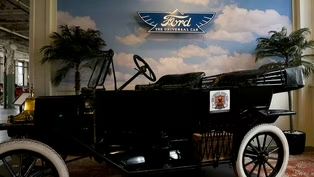
Ford Piquette Avenue Plant Museum preserves Detroit history
Video has Closed Captions
Clip: S52 Ep42 | 2m 23s | The Ford Piquette Avenue Plant Museum is working to preserve Detroit’s automotive history. (2m 23s)

Judson Center celebrates 100 years with Centennial Gala
Video has Closed Captions
Clip: S52 Ep42 | 10m 37s | Judson Center in metro Detroit celebrates 100 years with an upcoming Centennial Gala. (10m 37s)
Providing Support for PBS.org
Learn Moreabout PBS online sponsorship
- News and Public Affairs

Top journalists deliver compelling original analysis of the hour's headlines.

- News and Public Affairs

FRONTLINE is investigative journalism that questions, explains and changes our world.












Support for PBS provided by:
American Black Journal is a local public television program presented by Detroit PBS