State of Affairs with Steve Adubato
Cindy Jebb; Asm. Craig Coughlin; Elie Honig
Season 6 Episode 18 | 26m 32sVideo has Closed Captions
Cindy Jebb; Asm. Craig Coughlin; Elie Honig
Steve Adubato is joined by Cindy Jebb, Ph.D., President, Ramapo College of NJ, to highlight the college's contributions to the local economy; Asm. Craig Coughlin, Assembly Speaker discusses the need for bipartisan election reform; Elie Honig, CNN Senior Legal Analyst and former Federal and State Prosecutor, discusses his legal perspective on the January 6th insurrection.
Problems playing video? | Closed Captioning Feedback
Problems playing video? | Closed Captioning Feedback
State of Affairs with Steve Adubato is a local public television program presented by NJ PBS
State of Affairs with Steve Adubato
Cindy Jebb; Asm. Craig Coughlin; Elie Honig
Season 6 Episode 18 | 26m 32sVideo has Closed Captions
Steve Adubato is joined by Cindy Jebb, Ph.D., President, Ramapo College of NJ, to highlight the college's contributions to the local economy; Asm. Craig Coughlin, Assembly Speaker discusses the need for bipartisan election reform; Elie Honig, CNN Senior Legal Analyst and former Federal and State Prosecutor, discusses his legal perspective on the January 6th insurrection.
Problems playing video? | Closed Captioning Feedback
How to Watch State of Affairs with Steve Adubato
State of Affairs with Steve Adubato is available to stream on pbs.org and the free PBS App, available on iPhone, Apple TV, Android TV, Android smartphones, Amazon Fire TV, Amazon Fire Tablet, Roku, Samsung Smart TV, and Vizio.
Providing Support for PBS.org
Learn Moreabout PBS online sponsorship- [Narrator] Funding for this edition of State of Affairs with Steve Adubato has been provided by Seton Hall University.
Showing the world what great minds can do since 1856.
The Turrell Fund, supporting Reimagine Childcare.
New Jersey Sharing Network.
RWJBarnabas Health.
IBEW Local 102.
Lighting the path, leading the way.
Eastern Atlantic States Regional Council of Carpenters.
NJM Insurance Group.
Serving New Jersey'’s drivers, homeowners and business owners for more than 100 years.
Fedway Associates, Inc. And by The Russell Berrie Foundation.
Making a difference.
Promotional support provided by ROI-NJ, informing and connecting businesses in New Jersey.
And by NJ.Com.
Keeping communities informed and connected.
[INSPRATIONAL MUSIC] - Hi everyone, I'm Steve Adubato.
We're kicking off the show with Dr. Cindy Jebb, who is the President of Ramapo College of New Jersey.
Good to see you, Dr. Jebb.
- Oh, great to see you too.
Thank you very much for having me today.
- It is our honor.
And also I wanna thank you for your service to our military.
You're teaching at West Point.
Describe that work before we talk about Ramapo, your connection to West Point?
- Yeah, absolutely.
So I retired after 39 years of service, and a big portion of my time in the service was serving at West Point, particularly as senior faculty, and culminating serving as Dean of the Academic Board at West Point.
That was my culminating assignment.
And I feel that when people ask me how the transition's been from West Point to Ramapo, it's been very smooth.
And it's interesting to see that there's more commonality than anything else across the two institutions.
- Yeah, it's interesting you say that.
I often argue learning is learning, teaching is teaching, and I was honored a few years back to actually teach up at West Point.
Of course, on leadership and communication.
And the students, the cadets up there were just as engaged as anyone would ever want their class to be, their students to be.
But the question I have is this.
But you come to New Jersey... And immediately you laugh already, you smile already.
And you're dealing with state funding issues, you're dealing with enrollment issues, you're dealing with a whole range of issues that you may have dealt with at West Point but not in the same way.
Biggest challenge you face as President of Ramapo College?
- Yeah, so there are challenges, and actually, that's what makes this a very fun and exciting time to be in higher ed.
So the challenges, especially coming out of the pandemic... And I say coming out of, but I use that loosely since I think we need to remain humble.
(chuckles) In this environment, is I would say the big challenge based on what our discussions and collaborations have been with the K12 educators, are the learning deficits, wellness deficits, and social development deficits that we're seeing in that space.
And we wanna make sure that we understand that and that we're collaborating and finding ways to bridge gaps, as well as making sure that we have the resources necessary to really have the opportunity that students feel a sense of belonging when they're here on campus.
- Let me try this.
What do you say to parents, others, students as well, potential students, and for many of them college, higher education, they're not convinced of the investment?
They're not convinced of the investment of time, money and effort, the value of a college degree today, 2022 and beyond, versus five, 10 years ago.
Please?
- Yes.
No, I appreciate the opportunity.
And I wanna approach this in a couple of different ways because it's important, especially as we just said coming outta the pandemic.
What we're seeing globally around us, nationally around us, locally around us.
'Cause we're all connected and it really puts our mission in sharp focus.
And at the end of the day, I think we can all agree that our world is hungering for ethical leaders who are gonna be change agents across all sectors, and really advance our society.
And I say that because it's a strategic investment, right.
Higher education is strategic investment, and let me explain that a little bit.
I don't know if there's another institution that stitches our society together.
Coming from the military, I think the military has always prided itself to be part of that tapestry.
People coming from all over with different backgrounds and different perspectives and so forth.
Besides higher ed, where else do people come from different backgrounds, lived experiences, different perspectives, all with the idea of going through a journey together, right, of a transformational journey to learn about the world around them?
To be critical thinkers, to be able to have empathy and adapt to a changing world.
When we think about the kind of world that are students who are entering grade school right now, 65% of them are gonna be in jobs that don't even exist right now, according to the World Economic Forum.
Most people are gonna change professionally 12 to 15 times, according to the Bureau of Labor Statistics.
So the college education, particularly the liberal arts, when we think about how to think and not what to think.
By exploring disciplines across STEM and social sciences and humanities, and having the outcomes that are gonna be necessary to strive to really thrive in a changing world, higher ed is immensely critical.
And I would just also like to share with everybody, I'm very proud that Ramapo is part of the Dejeski Group by its six sister institutions.
And collectively, we contribute $6-billion to the New Jersey economy.
$220 million in tax revenue, 36,000 jobs.
There is a dire need when we think about what we can do to contribute to New Jersey specifically, and as especially state institutions, - One more before I let you go, real quick.
I was honored to host a few months back the Russ Berrie Making a Difference Awards, honoring people who are making a difference.
We've had many of them on the air with us, as part of our "Make a Difference" series.
Real quick, that was at Ramapo College.
- Yes.
- Gimme in 30 seconds or less on what that event was like for you, your first?
- Yes, I was inspired by, well, you saw that the heroics of phenomenal people who just in the moment did the right thing.
And that their ethos, if you will, was service to others.
And that is what our higher ed institution is all about, is being service-oriented, leader-oriented, individualized attention, so that people are inspired to make a difference.
They inspired everyone there in that auditorium that we were in, and I thought it was just a wonderful way to be again, introduced to the people of New Jersey.
- Dr. Cindy Jebb is President of Ramapo College of New Jersey.
Dr. Jebb, thank you so much for joining us, we appreciate it.
- All right, thank you so much, I appreciate it very much and look forward to seeing you again.
- We will.
Stay with us, we'll be right back.
(grand music) - [Announcer] To watch more State of Affairs with Steve Adubato, find us online and follow us on social media.
- We're now joined by the Speaker of the House, Assembly Speaker, Craig Coughlin.
Good to see you, Mr. Speaker - Steve, nice to see you again.
How you been?
- I've been doing great and listen, let's talk property tax relief.
We're taping this at the end of June.
Be seen a little bit later.
There will be a new state budget we hope on July 1st.
What is the anchor property tax affordable New Jersey communities program specifically in terms of who gets what in terms of property tax relief and who doesn't?
- Sure.
So what the anchor program is it started off as the governor's proposal to address the things that are most important to New Jersey.
Number one, mainly affordability.
You know, we got a message back in November at the election time that people were saying, we're not paying enough attention to the things that have mattered most to them.
And affordability is at the top of that list.
I think it's something that we all have known for a long time.
And so, the governor proposed that anchor program, which is you know, builds on the homestead rebate plan that so many people are aware of, but you know we've had an awful lot of good results in terms of our revenue.
Revenue's been stronger than anticipated.
I think there's good reasons for that.
I think it has to do with some good fiscal stewardship and the way we've managed the state up till now but it gave us an opportunity, Steve, and I advocated for expanding that anchor program to include to drive up the, you know, the people who are gonna benefit from that.
So it'll, if you make up to $150,000 you get a $1,500 tax credit.
If you make to 150,000 to 250,000 you get $1000 tax credit.
- What about for renters?
- Renters also get some of the $450 for all renters.
That's about nine- - Up to $150,000.
- Up to $150,000.
Correct.
So together that's over 2 million families that are gonna be benefited by this program.
And, you know, a 100 and folks who are, who are gonna get a 100 and $1,500 tax credit that takes the effect of the rate down, the average rate down to where we were a decade ago.
It's a really big deal.
- Mr. Speaker, let me ask you this.
What do you say to those who are, you know, what a lot of federal money came into the state of New Jersey, the COVID relief money, windfall of dollars that the revenue that the state never had before, that we shouldn't be spending it, not only not giving it back but shouldn't be spending it on new programs.
We should be saving it, putting it away when things get rough again and they will particularly if in fact there's a recession.
Speaker Coughlin, please.
- So we're well aware of the fact that a recession of some degree is likely.
We're also well aware the fact that the federal dollars will eventually be used up for other projects.
You know, some of the things that I think we ought to be doing with that are transformative things.
I think one of the things that's on the top of everybody's list, of Senate president's list, of governor's list, my list has to do with water infrastructure and and flood mitigation and clean water, making sure we have clean water for the generations to come.
And if we do that, then we're going to be able to look back 10 years from now and said we did something important and other projects like that.
So that's where we're gonna spend that money.
Now, the reason to do this now is because we have the opportunity to help people.
Property taxes are in the front of every of what people recognize as a real challenge to their affordability.
And, you know, we're fighting inflation which is something that is real but takes a real toll on families by helping them through the property tax relief.
We do two things, we address what is primarily important to them and we allow them to have some extra money to perhaps pay a utility bill or two, you know, to spend on their child's education or to childcare.
So I would argue that we should be spending this money on the people and making sure that they have that boost, doesn't mean we should.
We're not gonna squander the rest of it though.
- I got a real quick.
You mentioned childcare.
People who watch us know that we've been doing it long term public awareness program called Reimagine Childcare.
The most important childcare issue from your perspective is what?
Affordability, accessibility, quality, what is it and why?
- Well, affordability and accessibility.
I think they're both.
I, you know, until I've really began to do a deep dive I didn't realize that we have childcare deserts in the state of New Jersey.
And we need to address that.
Affordability is something that I talk to my members about.
And I talk to members of the public about being able to afford to send their children to childcare.
So we need to address both of those issues.
And we're going to in this budget.
The real, I mean, look, the other downside to that, the fact that the childcare isn't either readily available or is unaffordable, is it means that a significant portion of our workforce, awfully talented people, are not gonna be able to get back into it, right?
Now that disproportionately falls on women, right?
Because that's the first women- - Minority women disproportionately.
- Absolutely.
So giving them the opportunity to get back in a workforce, to succeed, to use their talents and to achieve their dreams.
That's what this is about.
- Gimme 30 seconds on election transparency.
There's a package of bills.
What is election transparency from your perspective and what is the role of the state legislature particularly after the 2020 election with so many people questioning the outcome of that election?
Go ahead, please, Speaker.
- Right.
We just passed a number of bills.
Four of them were bipartisan bills.
And I just wanna say this, Steve, at this point in time in this nation's history, the notion that Democrats and Republicans could come together, I had a bill which was dealt with the way we count vote by mails, posting them and and making sure things happen in real time so people have the confidence to know that these are things that are are happening, openly, fairly.
Those are the, you know, the things we wanna achieve.
Co-sponsoring that bill, first co-sponsor bill was Minority Leader John de Mayo.
At this time in our country's history, the notion that Democrats and Republicans could come together to pass election reform, recognizing that it's, you know elections are sacred things and that people need to be able to make sure without question that they're open and fair.
That's historic.
It really is.
It's nothing less than that.
Mike.
I, the folks on my colleagues on the other side of the aisle that deserve enormous amount of credit.
And so the folks on my side of the aisle, who sponsored the bills, we worked together.
They took some of our ideas.
We took some of their ideas and we got something good done.
- It shouldn't be that big a deal that Democrats and Republicans work together to secure our election.
- I mean, that's why it counts (indistinct) - But apparently it is, Speaker.
It is, it is.
Speaker of the House, Craig Coughlin.
I wanna thank you so much for joining us, wish you all the best.
Thank you, Craig.
- Thanks, Steve.
Nice to be with you.
- You got it.
Stay with us.
We'll be right back.
(grand music) - [Announcer] To watch more State of Affairs with Steve Adubato, find us online and follow us on social media.
- We're pleased to once again be joined by our good friend Elie Honig, who's a senior analyst at CNN, former federal and state prosecutor, and with a strong connection to Rutgers University.
Elie, listen, we're taping at the end of June, 2022.
This will be seen a little bit later.
Big picture, the January 6th congressional hearings matter why, particularly those who are watching right now saying, "Steve, stop making a big deal about this.
It happened, it was a day.
There are a lot of other important issues.
Inflation gas prices, the war in in Ukraine.
Let's move on."
You say.
- I disagree with those people.
I, I think you should not stop making a big deal of this.
I, I think people should stop underplaying this.
First of all, we are capable I believe, as, as a democracy, as a country of addressing multiple things at one time.
Yes, we can be concerned about Ukraine and inflation and gas prices, but we also can be very much concerned with what happened on January 6th.
I mean, that is foundational to all of the other stuff.
If we can't protect our democracy, we're not gonna be able to deal with the other issues.
So no, we absolutely should not underplay or move on January 6th.
I think the committee here is, is trying to serve several different audiences.
And while I, while I've been sort of, I think we need to be careful about the committee's presentation thus far, I think by and large, they've done quite an effective job.
They are speaking to the American public.
They are speaking to the history books.
This is a story that needs to be told fully and completely.
And candidly, I think they're speaking to the prosecutors and we're seeing that even more as time goes by.
I think we're seeing the committee getting more aggressive and more explicit in the way they're using language around criminal law and calling on DOJ and other prosecutors to, to impose accountability.
- You know, Elie, it's interesting.
Last time we had you on, we talked about your book.
"Hatchet Man" about Bill Barr, the attorney general, but as I'm watching the hearings and again, this, this isn't really dated because it's historical and it's important and it's evergreen, but it was Bill Barr.
Not only Bill Barr, it was obviously Vice President Mike Pence who did what the constitution said needed to be done, must be done by a sitting vice president presiding over the United States Senate at that time.
It was Bill Barr as attorney general who told the president in Barr's sworn testimony that you believing that the election was stolen from you, President Trump, is BS.
He stood his ground and the president was livid with him.
Did Bill Barr not do the right thing for the nation at that time?
- Bill Barr did do the right thing for the nation at that time.
And by the way, Steve, there's a long list of people I think here, who, who were Trump's enablers and helped Trump spread the big lie before the election who ultimately stood up and did the right thing.
Mike Pence and Bill Barr probably one and two on that list.
And, and there, there tends to be this absolutism where people say, oh how can you praise Mike Pence?
He did all these bad things.
But I wrote a whole book criticizing Bill Barr.
Okay, but people can't have done plenty of bad but also in the end, done the right thing.
It doesn't cancel out all the bad.
I think we need to consider all of it.
It's been really interesting to see Bill Barr emerge as sort of one of the star witnesses in his videotape deposition testimony that we've been seeing because indeed he did stand up as attorney general.
Belatedly I would argue, because he spent many months, I document this in my book, propping up the lie of election fraud, but ultimately in December, three, three weeks or so after the election, he did tell Donald Trump and he did tell the public there's no evidence of election fraud.
It's good that Bill Barr did that.
I do think it's important to note, however and this is a point I was alluding to earlier.
We need to keep in mind as we're seeing this committee presentation.
It is bipartisan.
There are Republicans on the committee, but it's also one-sided in terms of viewpoint.
This is not necessarily the same thing as a criminal trial.
There's no defense lawyer president.
- But what's the other point of view?
- Yeah, well, no, look, it's a good point, right?
I don't know what the counter narrative is to January 6th, but let me use Bill Barr as an example, because Bill Barr says to the committee, "Well, I resigned because Donald Trump was pushing these baseless election fraud theories."
And because he was, I think the quote from Bill Barr was detached from reality.
Now you hear that and you go, wow.
But if there was cross examination of Bill Barr, a good lawyer would say really, that's your story now?
Because when you resigned, you wrote a letter to Donald Trump on December 14th, 2020.
And you said in that, that you were continuing to investigate allegations of, of voter fraud, which you did say.
- It contradicts, okay, you're looking.
Elie, I appreciate you looking that from a legal perspective because you're a legal analyst, but at the same time and quote the other perspective.
Here's another perspective.
Let me play devil's advocate.
I love when people say, let's be fair.
Okay.
Sometimes I think truth is truth.
And other times I think it's gray and there are different perspectives on it.
So this is another perspective Elie, react to it.
This is a piece in the Associated Press, Jo Colvin, C-O-L-V-I-N. And this is, she's quoting Donald Trump where the president says the footage shown during the hearing had been doctored.
He downplayed it, this is President Trump downplaying January 6th, saying it was a quote, "simple protest that got out of hand".
That's another point of view - Dead wrong.
Both of those things are dead wrong.
I, I disagree with Donald Trump on both of those things.
And again, I don't know what the counter narrative is for January 6th.
Let's take, for example.
- Could the counter narrative be no matter what he was told by anyone else, he believed that the election was stolen.
He believed that.
Go ahead.
- Yeah., I'm not so sure that I buy into that, but let me say this.
My point is we need to be careful about seeing what the committee's doing and people are doing this.
They're looking at the committee's evidence and saying, well just put that in criminal court and it's game over.
My point there is there are different ballgames with different rules.
What happens in the committee is not the same thing.
It's not the same burden prosecutors need to be thinking about.
So let's start with that.
I agree with you.
There's no substantive defense to what we're seeing here.
There's no counter narrative to January 6th.
In contrast, let's take Ukraine, right?
There was, I think it was wrong, but you could say, well it wasn't a quid pro quo.
At least that you can understand what the other guy's gonna say.
So I think we agree on that point - However.
- Yeah.
- To those watching, many of whom are my friends who voted for Donald Trump, that's your business.
But a lot of them are either cops or they are pro cop.
I consider myself pro law enforcement while acknowledging serious, horrific events, incidents, patterns that disproportionately affect black and brown people, particularly those who are men, by white cops.
I acknowledge that, that being said, but some of my friends and others who call themselves pro cops who saw those law enforcement professionals being attacked, assaulted, some killed.
What is the possible excuse for that?
And where is the other side to that?
- There is none.
I 100% agree with you.
My, my point is just limited to, let's not take everything that the committee is showing us and draw the very quick facile conclusion that, well this would be an easy slam dunk.
- So Merrick Garland as attorney general should step in, prosecute, prosecute Donald Trump, prosecute John Eastman, who the attorney who was telling him these things.
Say you just won.
Rudy Giuliani, say you just won.
Let's take control of the election of, of the, the, the machines, et cetera.
That's martial law.
You're saying criminally a lot harder than politically influencing public opinion, which PS, I'm not convinced that those who really believe in and love Donald Trump.
And I say love, 'cause some say that or devoted to him, whether they even care about these hearings, Elie.
- Maybe they don't and, and everyone obviously has their own ability to decide whether they care.
I, I care a lot about these hearings.
I think they're very important for our, for our democracy.
And look, it is a very difficult decision that prosecutors have to make.
One of the interesting things that I think's been really revealing Steve.
You, you alluded to this, is we're seeing more evidence that we've ever seen before that Donald Trump knew or had to have known that he lost the election and that his theories were bogus.
And you know, one of the questions that's been coming up is well, what if he was just in denial, right?
What if he just chose to believe Rudy and, and John Eastman and to disregard Bill Barr and his own campaign lawyers and his own staff and the answer.
- His own daughter Ivanka, I believe , said she believed Bill Barr.
- She believed Bill Barr that her, that her, her father lost.
- Yeah, and so people, people have asked the question, well how then can a prosecutor establish that he knew.
What if he's just sort of delusional or, or, or, you know kids himself.
And my answer to that is an important legal concept called willful blindness.
If you're trying to prove intent in a case like this, Steve there's two ways to do it.
One is the person knew.
If you had a recording of Donald Trump saying this is hypothetical, I know I lost this thing but let's just do our best to try to steal it.
I mean, that's, you know, or if you admitted it.
Sometimes people do admit things, but you also can get there legally and prosecutorally by showing willful blindness.
The example that judges use when they're instructing juries is like an ostrich putting his head in the sand.
And I would argue here, that's exactly what we have.
We have Donald Trump saying," I'm gonna cover my ears and cover my eyes to all of these sort of credible people."
The people, Bill Stepian, Jersey guy, called team normal, shutting all of them out.
Even though there was way more voices, way more credible, and saying," I'm only gonna listen to these selected three or four people who are telling me what I wanna hear."
I would argue that that's sort of a textbook case of willful blindness.
- Elie Honig, who's a senior legal analyst at CNN, former federal and state prosecutor, Jersey guy.
Thank you Elie.
Appreciate it, my friend.
Thanks Dave.
Appreciate it.
Talk to you soon.
- See you next time folks.
- [Narrator] State of Affairs with Steve Adubato Is a production of the Caucus Educational Corporation.
Funding has been provided by Seton Hall University.
The Turrell Fund, supporting Reimagine Childcare.
New Jersey Sharing Network.
RWJBarnabas Health.
IBEW Local 102.
Eastern Atlantic States Regional Council of Carpenters.
NJM Insurance Group.
Fedway Associates, Inc. And by The Russell Berrie Foundation.
Promotional support provided by ROI-NJ, And by NJ.Com.
- [Narrator] This is the Seton Hall story.
One that comes to life every day on our campus.
This is the place where great minds discover, innovate, collaborate, and find their true calling.
This is the place where passion has a purpose, where learning inspires leading.
The bonds we make, the values we teach, inspire our community to take heart and take action.
This is Seton Hall University.
This is what great minds can do.

Legal Perspective of the January 6th Insurrection
Video has Closed Captions
Clip: S6 Ep18 | 11m 5s | Legal Perspective of the January 6th Insurrection (11m 5s)
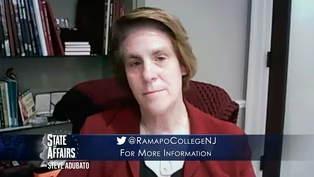
President of Ramapo College on the Value of a College Degree
Video has Closed Captions
Clip: S6 Ep18 | 7m 44s | President of Ramapo College on the Value of a College Degree (7m 44s)

The Urgent Need for Bipartisan Election Reform
Video has Closed Captions
Clip: S6 Ep18 | 8m 23s | The Urgent Need for Bipartisan Election Reform (8m 23s)
Providing Support for PBS.org
Learn Moreabout PBS online sponsorship
- News and Public Affairs

Top journalists deliver compelling original analysis of the hour's headlines.

- News and Public Affairs

FRONTLINE is investigative journalism that questions, explains and changes our world.












Support for PBS provided by:
State of Affairs with Steve Adubato is a local public television program presented by NJ PBS