
Cinecide/Wynton Marsalis DSO Residency
Season 4 Episode 17 | 23m 53sVideo has Closed Captions
Cinecide/Wynton Marsalis DSO Residency | Episode 417
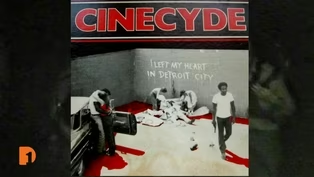
Formed in 1976, Cinecyde may have been Detroit's first punk band. 45 years later, they just released a new album, were nominated for a Detroit Music Award, and have no plans of slowing down. WRCJ's Linda Yohn catches up with world renowned Jazz musician Wynton Marsalis to talk about his upcoming, four-day long residency with the Detroit Symphony Orchestra. Episode 417
Problems playing video? | Closed Captioning Feedback
Problems playing video? | Closed Captioning Feedback
One Detroit is a local public television program presented by Detroit PBS
Cinecide/Wynton Marsalis DSO Residency
Season 4 Episode 17 | 23m 53sVideo has Closed Captions
Formed in 1976, Cinecyde may have been Detroit's first punk band. 45 years later, they just released a new album, were nominated for a Detroit Music Award, and have no plans of slowing down. WRCJ's Linda Yohn catches up with world renowned Jazz musician Wynton Marsalis to talk about his upcoming, four-day long residency with the Detroit Symphony Orchestra. Episode 417
Problems playing video? | Closed Captioning Feedback
How to Watch One Detroit
One Detroit is available to stream on pbs.org and the free PBS App, available on iPhone, Apple TV, Android TV, Android smartphones, Amazon Fire TV, Amazon Fire Tablet, Roku, Samsung Smart TV, and Vizio.
Providing Support for PBS.org
Learn Moreabout PBS online sponsorship- Hi, I'm Christy McDonald, and here's what's coming up this week on One Detroit Arts and Culture.
Detroit punk rock band Cinecyde stake their claim as the first punk rockers in the Motor City.
Plus, Wynton Marsalis talks about his long awaited return to Orchestra Hall, with the Jazz at Lincoln Center Orchestra.
Then Penny Stamps Distinguished Speaker Series director, Chrisstina Hamilton on this year's spring lineup of speakers.
It's all just ahead on One Detroit Arts and Culture.
- [Narrator] From Delta faucets to Behr paint, Masco Corporation is proud to deliver products that enhance the way consumers all over the world experience and enjoy their living spaces.
Masco, serving Michigan communities since 1929.
- [Male Narrator] Support for this program provided by: the Cynthia and Edsel Ford Fund for Journalism at Detroit Public TV, the Kresge Foundation, Community Foundation for Southeast Michigan.
- [Narrator] The DTE Foundation is a proud sponsor of Detroit Public TV.
Among the state's largest foundations, committed to Michigan-focused giving, we support organizations that are doing exceptional work in our state.
Visit DTEfoundation.com to learn more.
- [Male Narrator] Business Leaders for Michigan, dedicated to making Michigan a top 10 state for jobs, personal income, and a healthy economy.
AAA, Nissan Foundation, Ally.
The Fred A and Barbara M. Erb Family Foundation, and viewers like you.
(upbeat music) - Hi there, and welcome to One Detroit Arts and Culture, I'm Christy McDonald.
Thanks so much for being with me.
While COVID is keeping us closer to home these days, the creative community is finding ways for artists and groups to survive during this time.
And that's why we created One Detroit Arts and Culture, to keep you in touch with performances, music and cultural events that we love to engage with, and really fill our soul.
So coming up on the show this week, how dissatisfaction with rock music brought us Detroit punk rock band Cinecyde, and how the DIY rockers have evolved since the 70s.
Plus Wynton Marsalis tells us what we can expect to hear when he makes his return to Detroit.
Then director of the Penny Stamps Distinguished Speaker Series, Chrisstina Hamilton, shares the series eclectic spring lineup.
And then we'll finish off with a performance from Detroit's own punk rock pioneers, Cinecyde.
You know Detroit has never been shy about its pioneering music scene, and that includes punk rock.
So much of the music was self-produced and self-released, but rivaled the punk scene in New York and in LA.
One of Detroit's first punk bands, Cinecyde, formed in the mid 70's.
They are still making music today, and are even nominated for a 2021 Detroit Music Award.
We didn't know a lot about Cinecyde until our One Detroit editor, Chris Jordan, punk rock fan in his own right, who did some work with the band introduced us.
(upbeat music) ♪ Wanna look ♪ Wanna let you see ♪ Wanna speak ♪ Wanna let you say ♪ Run it back, same as before - Punk rock was really sort of a dissatisfaction about rock and roll.
It became one thing, or it became a narrower thing.
And it was, it was at the exclusion of anything else.
♪ Enemy man ♪ Enemy man ♪ Enemy Because you were passionate about music.
We were passionate about music.
You got angry, you know, passion, anger, you know, there there's punk rock, there you go.
♪ Here comes one single warning ♪ ♪ Coming to you from all of the way ♪ - [Chris] Formed in 1976, the same year that the Sex Pistols and the Ramones released their first singles, Cinecyde were, depending who you ask, Detroit's first punk band.
- We thought we were completely alone.
You know, Detroit was filled with cover bands, you know, and, you know just doing rock and roll covers.
You know it just wasn't what I was looking for.
It wasn't, you know, it wasn't a good enough kick.
- We decided to make a record.
Gutless Radio, which is sort of any anthem against radio at the time.
♪ Way to fucking know, Gutless Radio ♪ ♪ We don't like the things we do ♪ - As we discovered that there were some other things going on in other parts of the country, or other parts of the world, you would get wind of some sort of underground band or something.
And, you know, there was just no possibility that they would play any of that stuff.
I mean, it was sort of, you know, sort of brash, I mean most bands in rock and roll would be, you know, I wanna be signed.
I want the industry to love me.
In our case, it was, we were, you know, sort of just slamming, slamming the industry with the idea that it would be you know, we would do it yourself.
We would issue our own records and things.
♪ I ♪ Still ♪ Love ♪ You - [Chris] They were one of the central bands in what became by the early 80s a thriving, eclectic, fiercely independent punk scene in Detroit.
- All the clubs, and there were a lot of them that were doing punk.
They were full like every night.
It didn't matter who played.
In fact, a lot of, you know, kids would go to the bars just because they knew something was gonna go on in there.
- It was an eclectic scene.
So, you know, there's a nice spectrum of bands.
It wasn't one thing.
It was, you know, it could be bands that were very roots oriented, or could be bands that were, you know more rock and roll, a little electronica, you know, kind of stuff was sneaking in there.
But you know what all I seen too, the commonality was, you know it had to be a little raw had to have a little bit of an edge.
(upbeat music) - [Chris] 45 years later Cinecyde are still going strong, are still totally DIY, and just released their eighth album with the pulp si-fi inspired title track, Vegetable or Thing.
♪ Took it out ♪ Was the first mistake - This is a project that we worked on for a while, actually before the pandemic and then finished it up during the pandemic.
Chris Gerard was in the band and played bass with us, and we recorded a lot of that with him in the band.
And then he had health troubles and Chris went on his hiatus and we always thought that he would end up back in the band but things did turn for the worse, and he died.
Just an amazing, amazing guy, a beautiful soul, a great creator.
He always had an innovative and interesting way to look at things.
You know, maybe two thirds of the record was, you know, with Chris or something, it was close to being done but we kept putting it off and putting it off.
We were mixing and things during the COVID thing.
So essentially, you know, we just stayed safe and tried to be safe, but I thought we have to release it.
We're not going to, you know, we're not gonna not release it, and we're just gonna have to try different things like-- - Maybe we can do a rerelease when the virus is over.
♪ We're gonna rock and roll on his radio ♪ ♪ We're gonna rock and roll - So being in the independent music scene, the Detroit punk scene for just about 45 years how have you seen the scene change and how has your approach to making punk rock changed?
- You know, I don't know that I can say anything about a scene.
I'm always interested in what's going on in Detroit.
There was a load of great musicians, load of great people creating and making music and stuff.
I mean, it's through all these different eras through the 80s, 90s, 2000s, now.
I think that Detroit is sort of underplayed, it doesn't get the exposure that it should.
- Has your approach to writing punk rock changed?
Is it still the same sensibility?
The same spirit?
- I mean, Cinecyde is Cinecyde and it has a specific kind of sound, but I would say we evolve every time, every song.
(upbeat music) - To me, __ was just about getting back to our roots, you know, stripping music down and being, well being fun.
Yes, being aggressive it could be, but also, you know, respecting and understanding those roots, you know and those roots could be anything from, you know, some of the Garage Band sounds of 65, 66, or it could be Rockabilly from the 50s, X from Los Angeles, course I always appreciated The Cramps, or it could be, you know, Hank Williams or Johnny Cash, you know it could be any of that kind of stuff that you're bringing to a simplicity and a more directness.
The music, it just, for me, it just plays in my head, you know?
So it plays in your head and then you just kind of, okay try to work it out on an instrument and then boom, there it is.
Maybe, you know, for us, maybe for me, it's just, you know, it's my personality.
- And if you're still in the mood to rock, of course you are, don't worry because we have a performance from Cinecyde's latest album for you at the end of the show.
From punk rock to jazz, world famous musician, Wynton Marsalis is making his way back to Detroit with a four day residency at the Detroit Symphony Orchestra.
Marcellus will be accompanied by the Jazz at Lincoln Center Orchestra, who haven't performed in person as an orchestra since March of 2020.
Winton will also perform with other marquee artists like Anthony McGill and William Eddins.
Linda Yon from WRCJ has more.
(trumpet playing) - May I say Mr. Wynton Marsalis, that Detroit loves you madly.
- Thank you Linda, it's great to see you and to talk to you.
And you know I love Detroit, there's so many great musicians come from there.
And I had so many great experiences.
I always remember the great Marcus Belgrave.
(horn playing) And all that he contributed.
Roy Brooks, just so many, so many great musicians.
(drum playing) - So you're coming to Detroit.
You'll be part of a big residency at the DSO and I'll just mention it right up front.
Kasan Belgrave's gonna be in that band.
(saxophone playing) - That's right.
Kasan-- - Oh man.
- Kasan is playing with us.
I love him.
It's like the having one of your grandkids or your kid play with you.
We're looking for his go get this, there's some hard parts to play too.
That Prelude Fugues and Riffs.
That's a difficult saxophone part.
- Well, he's got it.
He's got it.
So when you come to Detroit and will be a residency at the DSO for four days, as I understand, will you be focusing mostly on the Democracy Suite?
- No we're playing Stravinsky Ebony Concerto.
(upbeat music) Prelude, Fugues and Riffs Bernstein, they're gonna be playing a piece that I wrote called Blue Symphony.
We're doing a jazz for Young People's Concert.
(upbeat music) The great Anthony McGill is playing the clarinet solo.
So you gotta check him out, he's unbelievable.
(clarinet playing) We're doing different educational activities with the DSL Civic Youth Ensemble.
We just gonna be in the house playing.
We're gonna do a concert just with the band of different music that we play with the theme of freedom.
We might play some of the Democracy Suite also.
- Now I know people can go to your website Winton, and they can hear you talk about it, but I think it's important.
And can you talk about the Democracy Suite for Detroit?
- Well, it has eight movements, and each movement is, it looks at the things we've experienced in this time and it uses the language of jazz.
It's all instrumental, there are no words, but everything from just the determination and resolve, it takes for people where health care workers to do their job.
To the presentness of people who are involved in a protest even though we are in a pandemic, risking their health and putting their social concerns above their own safety in some instances.
To the loss of loved ones in this time that you don't get a chance to visit with and sit with.
To black lives matter, the slogan that everybody has heard and knows different things that it signifies to.
The period before the election when mailboxes were bouncing away.
Like, you know, your postmaster general is making your mailbox disappear.
So I look to see the irony and the humor in that too.
To the feeling of people just out in the street, getting down, doing their thing, the different types of parade music in that kind of human, will define a groove no matter how bad the circumstance is.
And that's a few of the movements and there are others.
(calm music) - We've said this at Detroit Jazz Festivals, and it bears repeating, is that the Detroit audience knows the music.
And so you can't come play in lane.
You cannot, you know, phone it in, in Detroit.
You gotta be real.
- You know, I played it...
The first time I played in Detroit was with Art Blakey.
(upbeat music) And it was for like two weeks.
And it just, it's so many people knowledgeable about the music.
And you know, let's not forget Mack Avenue Records too, coming out of Detroit.
I mean, Detroit is, yeah.
You know, that's, yeah.
Gretchen is for real, yeah.
They've kept the vibe going in the belief of the music in a time when commercialism has taken over, now it's so celebrated.
That type of integrity is something we have to always make sure we give special note to.
- Yep.
- Because, you know, if we don't we'll look up and it will actually finally be gone.
It's like, can you cut every tree down, eventually, yeah.
You can.
(trumpet playing) - Well, welcome back to the city.
I understand that this appearance in Detroit, this residency, is actually the first time that you're gonna be back on the road since the pandemic started.
- Right.
- What a way to start.
- Yeah the whole ensemble, yes.
- The whole ensemble.
Yeah, we gonna be, let's see, we gonna be, let's see how we deal with it.
We ready.
We ready to do it, so.
- Oh, I know you are.
And how good will it feel to be, you know, not working with just the septet, but with, you know, with kids, with students, in person.
How good is that gonna feel to you?
- Yeah, so as, you know the pandemic, if it hasn't done anything, it's made us appreciate the lives we had.
So it's gonna be, it's not describable.
But we look forward to it.
You know, we can't, it's hard to find words for it.
- Jazz at the Lincoln Center Orchestra with Wynton Marsalis is in residence at the Detroit Symphony Orchestra from March 2nd through March 6th.
All right, this next story is from one of our partners here at Detroit Public Television, the Penny Stamps Distinguished Speaker Series.
Penny Stamps, director Chrisstina Hamilton gives us a preview of a spring lineup that is packed with a wide variety of speakers, from spatial video artists to industry leading investigative journalists.
Hamilton tells us who she's looking forward to and how the Penny Stamps digital series is here to stay.
Here's One Detroit's Will Glover with more.
- The spring lineup is here, it's underway.
So, as expected, it's very impressive.
Tell us a little bit about who we can expect to see and what's available for us to check out right now.
- This week, folks to join us Friday for Jad Abumrad who is, most folks will know him, from Radio Lab.
And a lot of folks also hopefully have heard his amazing podcast, Dolly Parton's America, which won a Peabody last year.
You know, anybody that's missed anything should know that our archive is available online.
So, you know, for example, if you miss the Henry Louis Gates program, you can go back and watch it.
It's there for you, you didn't miss it.
Another exciting PBS persona that we'll be hosting in April is Raney Aronson, who is the, you know the fearless producer director behind the show Frontline, which has certainly, you know, talk about, you know, cutting the edge of America.
You know, she's certainly doing an amazing job of that.
So we can't wait to visit with Raney, and we've got you know, some new program that we have, a new program that we have not yet announced.
- So tell us about it.
- We will.
I have to tell you, you're the first to hear the news.
We are adding for our, the week after Raney in April this will be, the program will be on April 9th, a program which will be a conversation between Wynton Marsalis and Ken Fisher, who is the director, or was the director for 30 years of the University Musical Society.
And that will be, I am sure another not to miss moment.
- Are there any plans to start thinking about what this is going to look like in the future as we get back to in-person?
- How that's gonna work out seems to shift constantly.
I think it was last night.
I heard President Biden saying he thought by Christmas things, you know, which was (laughs), not what, we were all hoping for a lot sooner than that.
- Yeah.
- You know, I am trying to think about how, you know, because obviously I'm right now trying to think about our fall programming and how we're gonna roll that out.
Without having any definitive on that.
You know, I'm trying to think about it in some way that we can have, be able to pivot somewhat to a more in-person format before we would even, you know, I think there are a lot of challenges around that too right though, because what happens to travel?
I can't imagine international borders are gonna be open as soon as perhaps we might be able to get together in the theater again.
Like you know, we used to always think of ourselves as a live first production and I think that has forever changed now.
You know, we will certainly be continuing to make work for our, you know, our online audiences, but we also really, really, really want to get back to those in-person engagements, you know, because it's so much, you know, much, there's more sort of engagement and conversation that happens in real time around these folks when we can have them in person.
I think we're also gonna see some of that too, though where we will have people who cannot travel here that we still want to engage, where we may have more of a digital platform in the theater for people in person to be engaging around as well.
So, you know, I'm trying to think about it and keep an open mind for the path forward.
- Who are you looking forward to most?
There's always, there's always a difficult question and that is going to be it for you.
Who are you most excited to see?
- Oh god, that's a really hard question for me because, you know, they're kind of like, it's, there's so many ways I look forward to each and every one of them right?
Because everybody has something exceptional to offer.
I have to say though, if I had to only pick one which is almost impossible, but I am very, very, very very excited about Pipilotti Rist.
This is, she's just a video artist from Switzerland who is exceptional.
This woman is absolutely exceptional.
A couple of the reasons that I would put her at the forefront of my list are A: she is really, really, really thinking about this space that you and I are in right now and how we're communicating and how we're all in these, we've all been sort of flattened out into this two dimensional, you know, screen space.
This is what her work is all about and how, you know, how does the physical body, you know, live in this sort of 2D environment.
- With that, where can people go to get that surprise, to get the insight and knowledge that is provided by the Penny Stamp series?
- You know we put things out through YouTube, through Facebook, PBS books as our partner.
So, you know, different libraries are offering this.
The Detroit Public Television website, and then pennystampsevents.org is sort of where, you know, our homepage, where you can find all the information on everybody.
And all programs are released Friday nights at 8:00 PM and then are available, you know in our archive, after that for on-demand viewing.
- The Penny Stamps Distinguished Speaker Series will webcast all of their events on Fridays, 8:00 PM right here at dptv.org.
And you can also watch and join the Penny Stamps conversation live on their Facebook page.
All right, that is gonna do it for me this week, but we are going to leave you with a performance from Cinecyde.
This song is called Vegetable or Thing from their new album of the same name, enjoy it.
And I'll see you next week, take care.
(upbeat music) ♪ They found in town in a frozen lake ♪ ♪ Took it out was the first mistake ♪ ♪ It all and killed them all ♪ The plant then (mumbles) (upbeat music) ♪ Vegetable or thing (upbeat music) ♪ It came down from outer space ♪ ♪ Wants to kill the human race ♪ It takes shape and fools us all ♪ ♪ Science says they'll cause our fall ♪ (upbeat music) ♪ Vegetable or thing (upbeat music) - [Female Speaker] You can find more @onedetroitpbs.org.
Or subscribe to our social media channels and sign up for our one Detroit newsletter.
Video has Closed Captions
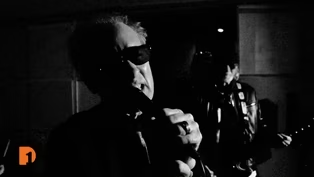
Clip: S4 Ep17 | 1m 26s | Cinecyde "Vegetable or Thing" | Episode 417/Segment 4 (1m 26s)
Video has Closed Captions
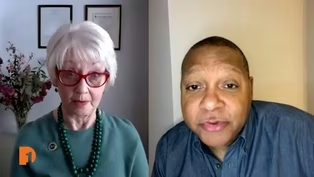
Clip: S4 Ep17 | 6m 2s | Wynton Marsalis DSO Residency | Episode 417/Segment 2 (6m 2s)
Providing Support for PBS.org
Learn Moreabout PBS online sponsorship
- News and Public Affairs

Top journalists deliver compelling original analysis of the hour's headlines.

- News and Public Affairs

FRONTLINE is investigative journalism that questions, explains and changes our world.












Support for PBS provided by:
One Detroit is a local public television program presented by Detroit PBS