Circles: The Life of Billy Cannon
Circles: The Life of Billy Cannon
9/14/2026 | 2h 27m 57sVideo has Closed Captions
Circles: The Life of Billy Cannon
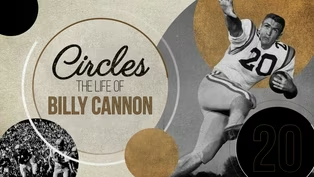
Billy Cannon seemed to have it all: a Heisman Trophy, a professional football career, and a successful orthodontic practice. Then, a federal counterfeiting conviction brought a stunning fall from grace. But it would not be the final chapter of his story. Explore the remarkable rise, devastating fall, and ultimate redemption of one of Louisiana's most iconic sports figures.
Problems playing video? | Closed Captioning Feedback
Problems playing video? | Closed Captioning Feedback
Circles: The Life of Billy Cannon is a local public television program presented by LPB
Circles: The Life of Billy Cannon
Circles: The Life of Billy Cannon
9/14/2026 | 2h 27m 57sVideo has Closed Captions
Billy Cannon seemed to have it all: a Heisman Trophy, a professional football career, and a successful orthodontic practice. Then, a federal counterfeiting conviction brought a stunning fall from grace. But it would not be the final chapter of his story. Explore the remarkable rise, devastating fall, and ultimate redemption of one of Louisiana's most iconic sports figures.
Problems playing video? | Closed Captioning Feedback
Where to Watch Circles: The Life of Billy Cannon
Circles: The Life of Billy Cannon is available to stream on pbs.org and the PBS app.
Providing Support for PBS.org
Learn Moreabout PBS online sponsorshipWelcome to Tiger Stadium.
I'm Linda majid, the executive producer at LP and the director of circles for Life of Billy Cannon.
We are so excited to bring this film to you.
You see, over my shoulder here, there's Billy Cannon's name, and this film is going to give you the whole story of how Billy's name made it to this important place.
The can of family entrusted this story to LPB.
And speaking of trust, Louisiana has trusted LPB to tell stories for the past five decades.
Dealing these special kinds of documentaries at LPB takes a lot of resources, and we cannot do it without the support of the community and without members like you.
It's like being part of the football team, right?
And if there's one thing that brings us together in Louisiana, it's football.
So please join our team.
Become a member of LPB.
And to thank you.
We have some special gifts that we've chosen just for you.
Take a look.
Circles.
The Life of Billy Cannon is a portrait of one of the most fascinating figures in Louisiana history.
When you become a member, you joined the LPB team and are helping us produce these stories that become a historical archive for our state.
Call during this broadcast and choose from these commemorative gifts.
Support LPB at $15 a month and receive the Billy Cannon combo.
We'll send you the hardcover book Billy Cannon A Long, Long Run, a DVD of this film and the official circles the Life of Billy Cannon mug for $10 a month.
Choose Billy Cannon, a long, long run by Charles de Gravelle, whose interview of Billy was so important to the making of this documentary.
Or for just $8 a month.
Receive a DVD of this film and a souvenir Billy Cannon mug.
Become a member to show your team spirit for this film and for LP.
Be.
Joined here with Bunny Cannon, who of course is the youngest daughter of Billy Cannon, and also Jay Darden, who is one of the producers of the film, and also in his I Could Have producer along with me.
So thank you both for joining us today.
Bonnie, I want to talk about why you decided to bring this to LBB.
It was a couple of years ago when I got word that you were interested in doing a documentary about your father, and I know that other media outlets had approached your dad for years and he had said no.
So why did you feel like the time was right and why did you bring it to us?
So he never wanted to do a documentary, and we talked him into at least meeting with the folks from ESPN and some other.
There were actually two entities that wanted to do it, and at the end of the day, he didn't want to do it.
And I don't know if he didn't want to do it because he didn't want to talk about it, or if he just didn't want the publicity that came along with it.
Because every time you do something like that, you have to go on a little bit of a press tour, and then you have to answer questions and do interviews.
And I think at that point in time, he he just didn't want to he wanted to be with his family, his grandkids and his horses.
And I think anything that he did would take away from that.
And so he chose not to do it.
And to my dismay, and so he always said, he said, Bunny, when I died, do whatever you want to do.
And I said, but that won't be any fun at that point.
But again, he got his way.
And we met and we hit it off.
And I've known Jay for a long time now, and it just seemed like the right thing to do.
And I would be remiss if I didn't talk about my Uncle Harvey.
My dad's brother was instrumental in putting video in public schools, and he worked a lot with LPB back in the early 70s.
And, I just think it was something that needed to happen.
And at the same time, PBS and LP, they were losing their national funding, and it just made sense that if anybody makes a penny off of this, it should be LP.
Well, thank you.
Thank you for reviewing it that way.
We really appreciate it.
And Jay.
Tell me you were pretty excited to be part of this project.
Why?
Oh, I mean, like every other child in Louisiana and growing up in the late 50s, early 60s, I wanted to be Billy Cannon.
And I've been a fan all my life and got a chance to know Doctor Cannon not really real well, but working with the Muscular Dystrophy Association, the telethon, and other things related to him.
Not to sing him not to sing.
Right in the old days.
But I jumped at the opportunity to be able to do this, and it was a story that has to be told.
I mean, it's a great story of redemption.
And then people who know the name Billy Cannon, they know what he represents to LSU football, but they don't really know the man.
And this gives people an opportunity to really learn a lot about who he was as a person.
Well, of course, part of our mission at LPB is to tell the stories of Louisiana and the history of LSU.
Football is pretty important to the state of Louisiana.
And we just heard Tim Brando made the comment that with that 1958 national championship, that Louisiana State University became LSU.
Your dad was such an integral part of that.
So just I'm curious what it's like to see your dad's, contributions be detailed in this way.
What does it mean to you?
Well, it wasn't until I came to college that I truly understood who he was and what he had done for Louisiana, for Baton Rouge, for LSU.
I had no clue that it went that deep.
But until, you know, the 1958 national championship, LSU was here.
But it wasn't really on the map as far as football and notoriety and all of that.
So it brought an economy.
I mean, it picked up the economy, it brought hotels, it brought, you know, people would come in for the weekends, whereas before it was, it was, I would imagine.
Of course, I wasn't here.
I would imagine that it was a sleepy little town, but I didn't realize the enormity of the 58 team and what that national championship did.
It was one of the only ones, I think, that year where it was broadcast throughout the country.
And so there were a lot of firsts with that.
But it also it built Baton Rouge into what it is today.
We had Exxon and we had LSU, but it wasn't it wasn't LSU, it was Louisiana State University.
It was a school.
But I think the 58 team made it a lot more important.
And J. I know you and Cathy Berry, who was also is a director and a producer on this film.
I really did a deep dive on the research of Billy's life that his contributions to Baton Rouge.
So talk about that history.
There's so much there from the news reports and what have you in Charlie's book, which is great.
Obviously, he had 70 hours of interviews with Billy that Cathy looked at all of them.
I looked at most of them to, to to get some of what Billy's insight was.
So we're hearing his insight about his life as well as the players and, and the real treat for me was hearing these guys who are his teammates.
I mean, these guys are in their 80s and but they're just like a team, like they were 50 or 60 years ago.
You know, they still love to tug at each other and tease each other.
And they were such an important part of the story.
And there were recollections of Billy's impact and the fact that he was always focused on the team.
That was never about Billy, even though he was a superstar.
It was always about the team.
And that that's a theme that carries through throughout the show, as you're going to see throughout his lifetime.
So, Jay, these gentlemen may be in their 80s, but they have memories sharp as tax, and it was so fun to film them.
For them.
It was like all of this happened yesterday and the camaraderie of a team, you know, you get them back together and they start talking about who did what, when.
And and that's a that was a great part of the whole filming process.
But their, their recollection about of Billy and his impact on the team and his strength and his speed and how unusual that combination was, was something I always remember.
And Bunny, you and I have talked about really the importance of getting these memories down, right?
Because we're losing them.
We're losing them fast.
That generation's going and we've got to get them.
We've got a number one show our appreciation for them while they're here.
And then remember them and take the time and look at the memorabilia.
And remember, because this stadium was is not this stadium without them, it's on their backs that this was made.
And so it's important for me to keep that legacy alive.
So that is why it is so very important that we are telling these stories.
That's why we do this at Louisiana Public Broadcasting.
This is our mission to preserve these stories for future generations, and to make sure that they know all the important things about our state.
And Billy Cannon is one of them.
So you need to join today like you did.
Like I did two members, two longtime members of LP.
Thank you.
So this is your chance to become a member.
And I want to thank a special member of our team here who is also an NFL great LSU standout and played eight seasons for the Cincinnati Bengals.
And he is a member of our friends of LPB board.
So is matching the contributions tonight for this evening, which is pretty significant.
That's a that's great.
Thank you.
So take take Bill up on this offer.
Please take a moment to become a member.
And you're going to get this awesome mug while you're at it.
Take a look.
Become a member to show your team spirit for this film and for LPB, your membership is how LPB can continue to serve its mission of public service as Louisiana's storyteller.
To thank you, choose from these commemorative gifts for $15 a month.
Receive the Billy Cannon Combo, including the hardcover book Billy Cannon A Long, Long Run, a DVD of this film, and the official Circles The Life of Billy Cannon mug for $10 a month.
Choose Billy Cannon, a long, long run by Charles de Gravelle, whose interview of Billy was so important to the making of this documentary or for just $8 a month, receive a DVD of this film and the souvenir Billy Cannon mug.
We also have exclusive credit card offers for the first donation of $1,000.
Choose the LSU 150th anniversary lithograph signed by Billy Cannon, Paul Dietzel, and Michael Hunt.
For the first donation of $1,500, choose a special replica of an LSU football helmet signed by Billy Cannon and Paul Dietzel.
Without your generosity, stories including this one would not be told.
Thank you for supporting LPB.
Well, we are back in Tiger Stadium, Bunny.
A lot of people have a special seat in Tiger Stadium.
And your father was no exception.
Yep.
He had his own seat, which was right over here.
And he used to sit with SB and Scotty Moran.
This is their suite, and they put the vinyl on here when he passed away in 2018.
And he, in 2019, Joe Burrow was number nine.
So legend has it that Joe Burrow won his national championship because my dad sat in seat number nine while he was alive.
I don't know if that's true or not, but I'm going to go with that.
I think it makes a lot of sense.
Yeah, so I could get used to the view of poor Bunny.
Not a bad seat in Tiger Stadium.
And I could sit up here with my Billy Cannon mug.
And if your dad were here, he'd put a little something extra for $0.25 and we'd be set.
So if you would like to become a member and get your Billy Cannon mug, take a look at these gifts.
Circles.
The Life of Billy Cannon is a portrait of one of the most fascinating figures in Louisiana history.
When you become a member, you join the LP team and are helping us produce these stories that become a historical archive for our state.
Call during this broadcast and choose from these commemorative gifts.
Support LPB at $15 a month and receive the Billy Cannon combo.
We'll send you the hardcover book Billy Cannon A long, Long Run.
A DVD of this film and the official circles.
The Life of Billy Cannon mug for $10 a month.
Choose Billy Cannon, a long, long run by Charles de Gravelle, whose interview of Billy was so important to the making of this documentary.
Or for just $8 a month.
Receive a DVD of this film and the souvenir Billy Cannon mug.
At any level you'll have access to.
Passport to stream this film and all your LPB and PBS favorites.
And for two Lucky Billy Cannon fans, we have these exclusive credit card offers that won't last long for the first donation of $1,000.
Choose the LSU 150th anniversary lithograph signed by Billy Cannon, Paul Dietzel, and Michael Hunt for the first donation of $1,500.
Choose a special replica of an LSU football helmet signed by Billy Cannon and Paul Dietzel.
Become a member to show your team spirit for this film and for LPB.
Well welcome back.
We are in Death Valley.
I've got Bunny Cannon, who's the daughter of Billy Cannon, and Jay Darden, who is a producer and a producer of the film Bunny.
We just were talking about in the film your dad's generosity, which was really tremendous.
And you said that this had never really been discussed in your family?
No, I mean, he was our dad.
He would go to work, he'd come home, we'd go to football games.
We never talked about what he did at work.
And it wasn't until he passed away that we found out that it was over 200 and something people that he was doing dental work on for free, and it was Doctor Who actually took my dad asked him, because, Bo, would you take a few patients that I have that I'm not charging?
And obviously I guess I'll just send me the files.
Well, a big box of files and it was over 200 and something people.
And he did it.
And thank you, Bob.
Doctor Cabot, because he he honored everything.
But my dad would always say poor people deserve to have their teeth fixed too.
Well, and I think your dad's background must have played into that because your dad grew up, he knew what it was to to need and to not have the resources.
And I didn't realize until this documentary the impact that my grandfather losing his leg had on the family.
But at 11 or 12 years old, he had to get out and he had to work and bring money back for the family.
My grandmother had to go to work, and I mean, it was basically it was all hands on deck at that point.
And that's where he learned his entrepreneurial spirit, I should say.
Jade, any comments on that?
Because I know that you and Cathy Berry have really done a deep dive into Billy's history.
And that's why this this show, I think, is so important because people know the name Billy Cannon.
They've known it for for decades.
They think about that run they see every Halloween, but they don't really know the guy behind the name.
And there was a very substantive guy behind the name.
He had some troubles, as we'll see later on in the show.
But, it's a great story of redemption and a great story of a guy who was given back in so many ways and always focused on the team.
But most people think that he was, he had troubles because he was a, a rascal, and he just wanted to get in trouble.
But he was really trying to earn money and trying to figure out ways to put money back in the family.
It's not because he was just moments of it.
I'm sure he was trying to, you know, be silly, but there was a reason why he did the things that he did.
It's because they needed money really badly, and he didn't want to be the charity case for the city.
And so that nobody really knows that they don't understand what made what made him tick.
And that was very significant piece of his life that nobody knows.
Well, they'll know it after this film because that's a big focal point of what we talk about, what's yet to come in the show.
But the impact that he had, as we'll see later in the show, was really the legacy that he leaves behind, not just the incredible prowess on the football field of the high school, college and pro level, but also what he did for those truly less fortunate than him.
So there are so many stories that have not been told, and I want to go back to the fake referee story that's in this film.
This had been really an urban legend.
But Jay, in your research, you found out it's it's true.
Yeah.
We've been watching the run back for decades every Halloween.
And you got two referees who are running stride for stride with Billy, one of them on the field and one of them off the field.
And this guy who's running off the field is not a game official.
He's a high school referee from Mississippi who snuck into the game with his referee outfit on and excited in the moment, ran all the way with Billy.
And I. Corroborated that story with a sportswriter from Mississippi and Bunny family had the experience, and we were in Florida Pizza in Baton Rouge back in the early 80s, and we were eating probably after a football game.
And the guy comes up and says, Doctor Cannon, I got we have a little bit of a history in common.
My dad was like, oh, did we play together?
And he goes, no, he goes, I was a referee.
When you made the run back, he goes, oh, the one that outran me.
And he goes, well, yeah, actually I wasn't a referee.
He goes, I was a high school referee and I couldn't get in.
So he sat behind the bench the entire time.
And you know, if you go to the YouTube video, the longest one, you can see him coming from behind the players and running up the field with him.
And he and my dad goes, well, so you're the one that called did like that.
And he he said, he said, yeah, that was me.
That was just instinct.
But you know, there was a there was a flag on the play and I'm wondering if it would have been a real referee there.
Yeah.
LeBlanc talks about being concerned that he was being called for the for the infraction.
And fortunately it was a yeah, it was on Ole Miss.
So J. There are other stories that did not make it in the film.
So real quickly, what is your favorite story that did not make the cut?
Well, as we saw, Billy was quite a negotiator when it came time to sign his contract and he convinced Bud Adams of the Houston Oilers to pay him $33,000 a year, but also to give him a new car, a new Cadillac, and.
But Adams gave him his wife's Cadillac that was parked in his own driveway.
Billy had seen.
So Billy comes home with the Cadillac and of course, but had to get a new Cadillac for his wife.
And as soon as he got the new Cadillac for his wife, they went out to dinner, but left a cigarette smoldering in the car, and the car burned up.
So then.
But Adams had to get his wife a third Cadillac, so it cost more Adams.
Three Cadillacs to sign Billy Canon.
That's awesome.
Did you know that story, though?
No, I did not know that story about the Cadillac love.
The president of the Houston Oilers at the time, Steve Underwood, told me that story.
He said, not a lot of people know this, but I was there when all this was happening.
And my boss.
But Adams at two by three Cadillacs, that is great.
But what's funny is my dad got the Cadillac from my grandfather, who had a wooden leg, and so they had to tweak the brakes.
So every time we rode in that Cadillac, we were going through the window because he would just touch the brake, that the whole thing would stop.
So I do remember that part.
Well, this is why we're here, to tell the stories of Louisiana that you're not going to hear any other way.
So please become a member if you haven't already.
And tonight though, here us, who is also an LSU standout and an exceptional professional football player and part of our friends of PB board, is matching the gifts tonight.
So thank you.
Take advantage of his generosity and check out these gifts.
Become a member to show your team spirit for this film and for LPB.
Your membership is how LPB can continue to serve its mission of public service as Louisiana's storyteller.
To thank you, choose from these commemorative gifts for $15 a month.
Receive the Billy Cannon Combo, including the hardcover book Billy Cannon A Long, Long Run, a DVD of this film, and the official Circles The Life of Billy Cannon mug for $10 a month.
Choose Billy Cannon, a long, long run by Charles de Gravelle, whose interview of Billy was so important to the making of this documentary or for just $8 a month, receive a DVD of this film and the souvenir Billy Cannon mug.
No matter the level, you'll have access to passport to stream this film and all your LPB and PBS favorites.
We also have exclusive credit card offers for the first donation of $1,000.
Choose the LSU 150th anniversary lithograph signed by Billy Cannon, Paul Dietzel, and Michael Hunt for the first donation of $1,500.
Choose a special replica of an LSU football helmet signed by Billy Cannon and Paul Dietzel.
Without your generosity, stories including this one would not be told.
Thank you for supporting LPB.
Circles.
The Life of Billy Cannon is a portrait of one of the most fascinating figures in Louisiana history.
When you become a member, you join the LPB team and are helping us produce these stories that become a historical archive for our state.
Call during this broadcast and choose from these commemorative gifts.
Support LPB at $15 a month and receive the Billy Cannon combo.
We'll send you the hardcover book Billy Cannon A long, Long Run.
A DVD of this film and the official circles.
The Life of Billy Cannon mug for $10 a month.
Choose Billy Cannon, a long, long run by Charles de Gravelle, whose interview of Billy was so important to the making of this documentary.
Or for just $8 a month.
Receive a DVD of this film and the souvenir Billy Cannon mug.
At any level you'll have access to.
Passport to stream this film and all your LPB and PBS favorites.
And for two Lucky Billy Cannon fans, we have these exclusive credit card offers that won't last long for the first donation of $1,000.
Choose the LSU 150th anniversary lithograph signed by Billy Cannon, Paul Dietzel, and Michael Hunt for the first donation of $1,500.
Choose a special replica of an LSU football helmet signed by Billy Cannon and Paul Diesel.
Become a member to show your team spirit for this film and for LPB.
Welcome back to Tiger Stadium.
You've been watching circles for Life of Billy Cannon, and I'm here with Bunny Cannon, with Jay Darden and Bunny.
You know, we've been revisiting some painful parts in the story of not just your dad's life, but in your family's life.
And I remember the very first conversation that you and I had about this project.
We discussed the fact that in order for LPB to tell the story, that you would have to trust us to revisit some of these painful parts.
I would like to hear from you about why you feel comfortable doing that.
And also, what has that process been like?
You know, it's never fun to talk about something that's that's a part of part of your history that you have kept in the closet for so long.
And people always make assumptions about it.
But the fact of the matter is we never talked about it as a family.
We never talked about it about with my father.
And so we took it for what it was worth.
We moved on.
We forgave him the minute it happened that there was no question about that.
There were no lingering effects of any of that.
We moved on.
That's as a family.
That's what we've always done because we've always had adversity.
We've always had people talking about us and and assuming different things.
And so we just packed it up and move on.
And but talking about it, I talk about him every day because I've got 4 or 5 things that I'm working on to secure his legacy at LSU in Louisiana.
And it's important for me, and I also work at LSU and in the fundraising business.
So my name gets me in a lot of doors.
And so I talk about him every day.
So that's my therapy.
But for the family it's been a little bit different because they do not speak about it.
They have different lives and they never interact with football at all.
They never interact with LSU.
And so it's very different.
But what I'm seeing is through this process, we're all talking about it for the first time, and it's a healing process.
And I think as a family it's going to be much easier for us.
But on the flip side to to those that are watching, it's incredibly important for you to see the bad, because when you see how really bad it got, you see how beautiful the ending is and what he truly did at the end that you're probably about to see.
Yeah.
So, Jay.
We've interviewed every member of the Can of family, which was really tremendous.
I know Billy Joel through interviews.
Yeah, I know I built and Billy told us at the end of that interview that he said, this is it, I'm done.
This was the last one.
He said he hadn't talked since the 90s, and this was the last time he was going to talk.
Yeah, but segments of the public were not as forgiving in the family didn't talk about this trauma quite a lot, but the public did in good ways and bad ways.
And there are a lot of people who wanted Billy to reenter society and regain his hero status.
And then there were those who said, well, this guy's a felon.
And it was a tough road for Billy to get back into the public mainstream.
But a lot of folks had a hand in that.
And as we've seen in the show, and as we'll see in this final segment of the show.
Yeah, I mean, it's it's a reminder and I think we all know this.
But talking to your family, you see how social media these days and the media distort things, and people are talking about things that they they don't know anything about.
You know, they don't know your dad.
They they don't even dad from Adam.
And they still have an opinion.
And it's a good sort of humbling reminder to be careful sometimes before we engage in conversations that we don't know the story.
You know, the the people of today and what they're going through, and you flippantly say something and if anything and all of this, what I've learned is just don't put it out there.
My sister called it noise, and there is a lot of noise and there's a lot of noise around.
LSU and LSU athletics in particular.
And my dad's name and you just you can't you cannot let it get to you.
And if social media would have been there in the 80s, I don't know if we would have made it out of it.
I really don't, because it was bad and our social media were, reporters following me to school when I was in the 10th grade, just learning how to drive.
And that was something or, or showing up on our doorstep or not getting off of our property when people were coming over.
So I, I can only imagine what it would be like today.
You know, we've seen the incredible athletic accomplishments that Billy had during his career at the high school, college and pro level.
But we'll see this in the last segment of the show about to come up.
The most impactful time of his life will probably 25 years, when he was not in the public spotlight, but he was doing the kind of work that needed to be done at Angola and reshaping the delivery of health care at that institution.
Yeah, I mean, I am grateful that you entrusted us to tell the story fairly and with integrity and with some sensitivity.
One of the things that really struck me, interviewing all of your family, is how you used humor to deal with you.
Have you have to.
You can't not.
You're a very funny family.
Yes we are.
You have to.
Well, we've tried to include some of those moments in the story.
I think that comes through because that is who you are.
And that's who he was.
I mean, he could sing a line to you, and you'd be home three hours later and you finally get it.
He was that quick and witty and very dry.
But he he was very quick witted and just he had a wicked sense of humor.
And if we got a little bit of that, then we'll be doing okay.
Well, thank you for trusting us.
Thank you for doing it.
It meant a lot to us that y'all went out and got the story, and we didn't tell you all of it, because truth will only come out if you do it.
And we appreciate LPB.
And it goes back way back to my family.
But y'all were the only ones that could have done it this way.
So thank you.
Well, and that's the time for those of you watching to to help LP and to help join today as you've done.
Yep.
And I've done and get your mug.
Yeah it's a great mug.
You're about to see I think the most remarkable part of the end of Billy's story.
And if you value this, and I hope you have, I hope you take this opportunity to become a member to support the work that we do.
Because we cannot do it without you.
This is a community effort.
We are a team.
We're like a football team.
And but we need to be a really big team in order to keep fulfilling our mission.
So please take this opportunity.
You're going to get the mug, which is really beautiful, and you will also get a chance to get the book by Charles, Duke, of which is very well researched.
And more importantly, you can help us keep doing this for decades to come.
Well, this is the last time that you're going to see us, but I think you're about to see really the best part of the film and the most important part of the story.
And as you can tell, it's been a team effort to tell this story.
So, you are part of this team.
Bo Harris is part of this team.
He has been matching the donations this evening, for which we are very grateful.
And actually, LSU has been part of this as well.
We're so thankful that they've allowed us to film this here in the stadium.
And we want to thank the Tiger Athletic Foundation for their support of us as well.
So this is your opportunity to be part of the team, to become a member.
You will get this mug.
You're going to get access to passport.
You will be able to watch this film anytime that you want to.
And I think that after you see the ending, you're going to want to see it often.
So take this moment to become a member.
Become a member to show your team spirit for this film and for LPB, your membership is how LPB can continue to serve its mission of public service as Louisiana's storyteller.
To thank you, choose from these commemorative gifts for $15 a month.
Receive the Billy Cannon Combo, including the hardcover book Billy Cannon A Long, Long Run, a DVD of this film, and the official Circles The Life of Billy Cannon mug for $10 a month.
Choose Billy Cannon, a long, long run by Charles de gravel, whose interview of Billy was so important to the making of this documentary.
Or for just $8 a month, receive a DVD of this film and the souvenir Billy Cannon mug.
No matter the level, you'll have access to passport to stream this film and all your LPB and PBS favorites.
We also have exclusive credit card offers for the first donation of $1,000.
Choose the LSU 150th anniversary lithograph signed by Billy Cannon, Paul Dietzel, and Michael Hunt.
For the first donation of $1,500, choose a special replica of an LSU football helmet signed by Billy Cannon and Paul Dietzel.
Without your generosity, stories including this one would not be told.
Thank you for supporting LPB.
On behalf of the entire cannon family.
Thank you for watching circles.
The life of Billy Cannon and taking this journey with us.
For many years, we held our father's story close.
It is a story of extraordinary triumphs, painful failures, redemption, and the enduring power of a second chance.
We are deeply grateful to everyone at Louisiana Public Broadcasting for telling his story with honesty, compassion, and respect.
But I also want to thank all of you who are members, because it's you who make these programs possible.
If you are not a member, please join in honor of my father who loved LPB.
LPB understands that Billy Cannon's life is more than just a football story.
It's a Louisiana story.
They honor the legend while revealing the man behind the Heisman Trophy, a devoted husband and father, dentist, and an imperfect human being who never stopped trying to make his life meaningful for himself and for others.
Thank you to everyone who shared their memories and helped bring this documentary to life.
And a special thank you again to all of you, as well as the sponsors and board members.
Billy Cannon loved the people of Louisiana, LSU and LPB.
Please join the cannon family in supporting LP as it preserves the people, traditions, and stories that my dad held so dear.
Providing Support for PBS.org
Learn Moreabout PBS online sponsorship












Support for PBS provided by:
Circles: The Life of Billy Cannon is a local public television program presented by LPB