
City of Peace, Food for Seniors, ShotSpotter, Weekend events
Season 8 Episode 7 | 26m 46sVideo has Closed Captions
Youth leadership, a seniors food program, the ShotSpotter expansion and weekend events.
Several Detroit organizations came together to promote peace and highlight the diligent work of the youth in Detroit. Focus: HOPE expands its Food for Seniors program to assist more seniors experiencing food insecurity. BridgeDetroit’s Malachi Barrrett gives an update on the concerns behind Detroit’s ShotSpotter expansion. Plus, check out events around town on “One Detroit Weekend.”
Problems playing video? | Closed Captioning Feedback
Problems playing video? | Closed Captioning Feedback
One Detroit is a local public television program presented by Detroit PBS
City of Peace, Food for Seniors, ShotSpotter, Weekend events
Season 8 Episode 7 | 26m 46sVideo has Closed Captions
Several Detroit organizations came together to promote peace and highlight the diligent work of the youth in Detroit. Focus: HOPE expands its Food for Seniors program to assist more seniors experiencing food insecurity. BridgeDetroit’s Malachi Barrrett gives an update on the concerns behind Detroit’s ShotSpotter expansion. Plus, check out events around town on “One Detroit Weekend.”
Problems playing video? | Closed Captioning Feedback
How to Watch One Detroit
One Detroit is available to stream on pbs.org and the free PBS App, available on iPhone, Apple TV, Android TV, Android smartphones, Amazon Fire TV, Amazon Fire Tablet, Roku, Samsung Smart TV, and Vizio.
Providing Support for PBS.org
Learn Moreabout PBS online sponsorship- [Narrator] Coming up on "One Detroit," an East Side Detroit Church celebrates the work of young activists promoting peace in the city.
Plus, Focus Hope addresses an increase in food insecurity among seniors by offering assistance in several new locations.
Also ahead, we'll examine the criticism over technology that detects the sound of gunshots in Detroit neighborhoods.
And there's still a few weeks of summer left.
We'll give you some ideas on how to enjoy your weekend and beyond.
It's all coming up next on "One Detroit."
- [Announcer] From Delta faucets to Behr Paint, Masco Corporation is proud to deliver products that enhance the way consumers all over the world experience and enjoy their living spaces.
Masco, serving Michigan communities since 1929.
Support for this program is provided by the Cynthia & Edsel Ford Fund for Journalism at Detroit Public TV.
- [Announcer] The DTE Foundation is a proud sponsor of Detroit Public TV.
Among the state's largest foundations committed to Michigan-focused giving, we support organizations that are doing exceptional work in our state.
Visit dtefoundation.com to learn more.
- [Announcer] Nissan Foundation and viewers like you.
(upbeat music) - [Narrator] Just ahead on this week's "One Detroit," Focus Hope is helping more senior citizens in southeastern Michigan put food on the table with the expansion of its free food program.
Plus, questions arise over the accuracy of a surveillance technology that alerts Detroit police of gunshots in the city.
And Cecilia Sharpe and Peter Whorf of 90.9 WRCJ have a list of events you might want to check out in Metro Detroit this weekend.
But first up, the Church of the Messiah in Detroit's Island view neighborhood is shining a light on the young people in its congregation who are promoting peace and unity in the city.
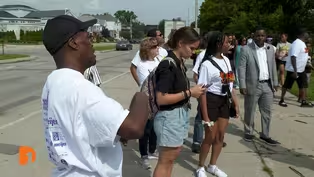
During this year's 17th annual Arise Detroit Neighborhoods Day, the church held an event where youth leaders presented their strategies for creating a better Detroit.
"One Detroit" contributor Daijah Moss was there and has the story.
(upbeat music) - Today is Arise Detroit Neighborhoods Day.
And we are celebrating all of the positive things happening in the city of Detroit.
Primarily for the young people, a lot of you do great things, but the media only want to report the bad things.
The bad things make the news.
But the good things that happen with young people in the city of Detroit sometimes don't do it.
But today, we're celebrating all of the positive young people doing great things in the city of Detroit.
So this is your day.
We're here to celebrate you all in the things that you do.
- PPM, that's Peace & Prosperity Youth Action Movement, which is an organization geared towards young, amazing individuals through the ages of 12 to 18 and 18 to 25.
We talk about and organize around all things such as identity building, speaking truth to power, and learning how to turn a lot of that pain into purpose to ultimately help them become the best version of themselves.
- We represent Peace & Prosperity Movement Youth Action Detroit, AKA PPM.
We are a youth organization group supported by One Love Global.
We network with another, build collective power, and improve community year round.
And our priorities are community safety, ending violence, environmental justice, and education justice.
We recognize these interconnected issues with racial justice at the heart.
We are here today because we believe youth voice is important when it comes to elections, leaderships, and ending all violence in all forms.
Our opinions matter even if we can't vote yet because decisions are being made to impact our future generations in our lives right now.
- Our young people are not just our future, they are our today.
As one of the young ladies said, a lot of our older people are getting older, you know?
And so it's time for our young people to stand up.
It's time for our young people to have a voice.
And it's time for them to move and shape.
- What I've learned throughout some of this work, most of this work, is that the youth that we have are brilliant.
We just have to figure out ways to bring that out of them.
If we figure out the right systems and mechanisms to bring out the intelligence, our youth in our communities will flourish.
- As a youth of Detroit, I've seen myself come through the roughs.
I've seen other children come through the roughs and make something of themselves.
And I've seen others give up on us, and I'm never giving up on Detroit.
- We are intentional on investing in our youth and building them up to be the best versions of themselves from their own perspectives, not how the world sees them, not how society molds them into being, but how they are created in God's gifts and God's talents.
- PPM is giving me an opportunity to be someone I really wanna be in life, giving me an opportunity on I can grow more than just school and to be in a classroom and just sit down and listen and learn.
It's actually giving me a lot of room to walk around, look at things from a different perspective.
- PPM has helped me because I was a person who struggled with staying out of like an angry, as like an angry person, I was an angry person and I used to have very bad anger issues.
And PPM has helped me grow to be able to control my anger and to help me mature as a young lady.
- What I learned is how to communicate.
Communicate is a big part because usually I just be like, oh, I'm just gonna stay quiet.
But now I get to basically use my voice and that's basically what PPM is about, hearing the youth voice.
- So it's very hard to become what you don't see, right?
And so it's very, very important.
At first, I think that we provide good examples to the youth of what peace and unity looks like.
Because ultimately the backside of that if you don't do these things is destruction of your own communities.
So it's very important for the longevity of our communities, for the progression of our communities, that the youth understand these things very early on about why this is essential for us all to move forward as community, as a city, as a culture, as a people, everything.
- I believe that as we watch our elders and as we watch leaders from the past, I think it creates the opportunity for young people to step up and see the pitfalls that they have taken and be able to lead in a place from a place of integrity, honesty, and transparency.
- I think action is more important than anything.
That's just my personal opinion I would say.
Anytime I've been in a meeting with Pastor Barry, I'm always the one who's like, okay, we've talked, what's next?
Like all I care about is next steps.
What are we going to do next to make sure we get our plans into fruition to actually come out and be seen in the world?
- Let's go, people.
- Oftentimes the stereotype is that young people don't care about their community.
Young people are not involved in their community.
Young people are just out being violent and doing things that are egregious to the community.
However today, Pastor Barry called forth a lot of young people who are in the community doing some great work, whether it's in real estate, whether it's in education, whether it's in political aspect, whether even in ministry.
There are a lot of young people here today who are doing some great things that Pastor Barry is showcasing, highlighting.
- I feel like our youth is facing that not being able to speak without like an adult bringing them down.
And with PPM, we are allowed to do that because we have adult speakers for us.
So even if that adult does try to like fight us back or whatever, we know we have people to back us up for it.
- I love to learn this thing called life alongside our youth organizers and our young adults and just be the story in a sense that I wish I knew of or the story that I wish was read to me when I was a young Black woman from inner city Detroit, who also didn't have many folks in my corner to help me find my way.
- When I'm older, I want my kids to be how I was when I was younger.
I want them to be a part of the PPM and everything and just show them the right way.
Start them on a good path like I was.
- [Barry] I am peace.
- [Crowd] I am peace.
- [Barry] And I am Detroit.
- [Crowd] And I am Detroit.
- [Barry] And I'm making it happen.
- [Crowd] And I'm making it happen.
- [Barry] We applaud you all today.
God is good.
(applause) - [Narrator] The nationally recognized civil and human rights organization Focus Hope is expanding its reach to senior citizens in need of food assistance.
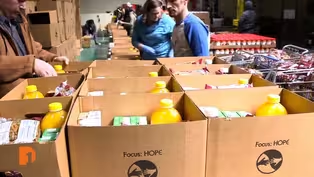
The nonprofit has added 43 new sites in southeastern Michigan to serve seniors experiencing food insecurity.
Eligible residents can register at these locations to receive monthly food boxes.
"One Detroit" contributor and "American Black Journal" host Stephen Henderson got all the details from Focus Hope's food program director, Frank Kubik.
(upbeat music) - So tell me about Food For Seniors, which is this program that you're expanding, but also tell me about the current climate for hunger and food scarcity right now and how different it looks.
I imagine that that has a lot to do with the decision to make this available to more people in in the metro area.
- Exactly.
We have the Commodity Supplemental Food Program here at Focus Hope.
It's a national program funded by USDA.
It's for low income seniors who are 60 and over and have a monthly income of $1,580 a month or less.
So you get a nutrition balanced food box.
The nutritionist at USDA put the package together, canned fruit, meat, juice, vegetables, cheese, pasta, peanut butter, beans, et cetera.
It's meant to supplement what you already have.
And what we're seeing with a lot of seniors is unfortunately this is not a supplement.
It's more of almost a majority of the food that they have each month.
So it's difficult for seniors.
And with the rising number of seniors who are food insecure, you've got, you know, 7%, 7.1 million, I'm sorry, of seniors in this country are food insecure.
These seniors have worked all their lives, they've contributed so much to this country and make it the country it is today.
But many of them work at low paying jobs where jobs didn't record their earnings.
So when you look at a social security statement each month, like they really don't get a true value of what they put into this country.
And hearing your golden years, you shouldn't have to worry about where your next meal's coming from.
So programs like this that are senior only programs to USDA, they were geared to the seniors who needed a boost in their food, their balanced food.
And it's just balanced food to keep them healthy.
This is a great program for them.
What we've seen with the need is this growing, and this is again the fastest rising group of hungry in this country is that there's so many seniors are isolated and homebound.
And the challenge we have is reaching those seniors.
And I think that challenge is the same whether it's in Detroit, Los Angeles, New York, Dallas, Alaska.
I was at a national conference and we heard about Alaska and some of the challenges they faced and I think, man, I have to worry about getting from one side of town to the other.
And they cross rivers to get food to seniors.
So the program operators are really dedicated to get this food to seniors.
So it's important now.
We see the cost of everything going up.
I wouldn't get my oil changed.
I was shocked at what that was the last time.
Look, if you're living on a fixed income, you've got you utility cost, putting gas in your car, if you have a car, paying for other food, again, this is a supplemental amount of food.
It's not meant to carry you through the whole month.
Your medical costs, your home repairs.
You go to so many homes, what do you see?
A leaky roof.
I mean there's so many things that a senior has to deal with and on a fixed income, programs like this are just super important.
- 43 new sites throughout Metro Detroit and we should stress it's Metro Detroit.
People think of poverty and they almost always think of Detroit.
And that's true.
We do have an acute problem with poverty and food insecurity and housing insecurity and all those things here.
But that's true increasingly in other communities, and to an even greater extent than in the past.
- And I think what we've seen, we cover Wayne, Oakland, and Washtenaw counties.
There's not a sign that says "End of Hunger when you cross Eight Mile."
That need extends beyond Eight Mile.
I think 10% of the seniors in our metropolitan area are food insecure.
So we have to get out to those seniors, as we've mentioned with the limited resources, and just the fact it's hard for seniors to get out.
We have to get to Rochester.
I can't have a site here on Oakland Boulevard and say, okay from Ann Arbor, come and get it.
Mount Clements, here we are.
It doesn't work that way.
So it's up to us to make sure that we get on those communities.
So now we're reaching out to, we're in Utica, we're in Rochester, Ann Arbor, Roseville, Ypsilanti, our whole service area, we're getting more sites.
So when you hear about the additional sites that we've added to our program, we're looking to even add more because what we don't want is someone not to be able to get the food that they need.
So it's on us to make sure we get that food too then.
- It's also a reminder, I think during the pandemic, I think we were all made much more aware of the needs that exist and they were made worse during the pandemic.
And I think people really stepped up in ways that they hadn't before to try to make sure that the folks could get through.
Now we're at least talking about being in post-pandemic, but those needs don't really go away for everyone.
And the awareness that the pandemic raised for all of us, I think we gotta maintain that.
We have to stay in that space and understand that there are folks who all the time are gonna need help.
- And pandemic brought it home, I think to a lot of us, and there is no normal anymore.
The normal is not to be normal, I suppose.
And what we had to do to adapt to the pandemic in terms of even serving the seniors, we went from a system where you would come into our sites and pick up food to one where you'd pull up in front and open your trunk and we put it in there.
And so the things that happened then have not gone away.
The seniors are not become instantly hunger issue was gone away just like around the holidays when you see an uptick in folks that are volunteering and helping and we appreciate that, it means so much, especially that time of year, but it doesn't stop on January 1st.
And so now that we're out of the pandemic, hunger hasn't stopped.
And I think the awareness that has created the people were stepping up and helping their neighbors and their friends and their communities and their families.
We tell folks, look at those who are closest to you because sometimes we don't see it, that the people that are closest to us are the ones that are most in need.
So that hasn't gone away.
But the awareness that the pandemic did bring to the issue of hunger, we wanna make sure that people don't forget about that and keep doing the things they need to do.
So we take care of our seniors.
- [Narrator] Let's turn now to a controversial surveillance technology used by Detroit Police.
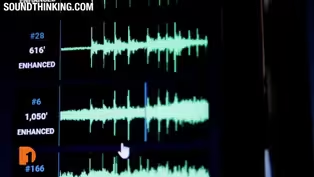
The California company, SoundThinking Inc, was hired by the city in 2021 to install its ShotSpotter system in neighborhoods to detect the sound of gunshots.
However, some residents and officials question the technology's track record for accurately identifying and pinpointing the locations of gunfire.
I sat down with Bridge Detroit reporter Malachi Barrett, who's been closely watching the story to get the latest on the city's use of ShotSpotter.
(upbeat music) - Bring us up to speed on what ShotSpotter is and I guess what the latest DPD is doing with the technology.
- So ShotSpotter is a gunshot detection technology that's offered by a private company based out of California known as SoundThinking.
ShotSpotter is the name of the audio surveillance tool.
Generally the idea is they set up these listening devices in neighborhoods to hear gunfire sounds.
When they pick something up, they send an alert to the police and ideally that will help police get a better idea of where gunshots are happening throughout the city.
In Detroit, it's been here since March of 2021 and there were contracts that were approved last summer by the city council to expand the city's relationship.
Originally this kind of started out as a pilot program in really just kind of two police precincts.
The council approved a $7 million contract that expands that now to I believe 12 police precincts throughout the city.
- How accurate is the device itself?
- ShotSpotter says that they are accurate up to 82 feet.
They are able to track the location of a gunshot supposedly.
So that will actually kind of help further kind of pinpoint where an area is.
The question of how accurate is it in practice I think is still an open one.
We received some data from ShotSpotter itself, a scorecard that basically shows what the accuracy rate was for 2021 and the first part of 2022.
It took us a year to get that information through a Freedom of Information Act request.
- You had to FOIA?
- We had to FOIA for that.
The data was not released.
And I think this is kind of part of the ongoing criticism and controversy around this technology is like the transparency around how well it's working, how we even determine what success looks like I think has changed a little bit as we've talked about this in these community conversations and from the police.
But in terms of like, there's been 35,000 some alerts so far this year.
So could you say that that's 35,000 gunshots?
I think it's hard to say based on the accuracy information that we have.
So the data that we got showed that 99% of the alerts were actually accurate based on a couple of different, I mean there were a limited number of false positives where the system will say something is gunfire that really isn't, or missed locations.
But in the vast majority of cases, ShotSpotter itself is saying that their technology is really accurate and they're actually obligated to meet a 90% threshold under that contract with the city.
- Basically, if they're supposed to reach a 90% threshold and they're reporting 99%, is there any independent body to verify what the company's report of their success has been?
Because it seems kind of obvious that if they're auditing themselves essentially, of course they're going to meet the threshold.
- So the way that these mistakes are reported, it has to come from DPD to ShotSpotter.
So a police officer will say "Hey, we showed up at a scene, there wasn't any evidence of a gunshot.
We think that this was a mistake."
Or "We showed up at this place and actually the gunshot happened a block over, so the location was inaccurate."
That's really the only way that that can get tagged in the first place.
So there's concern that we might be missing or this doesn't offer kind of a full and complete picture of what the accuracy looks like because you're already getting kind of only the things that police are able to prove as a mistake.
And then there has been no independent third party analysis in Detroit.
And what we found in other cities, when there is a third party analysis, for example, in Chicago, which is one of the bigger cities to be using this technology, the vast majority of these alerts couldn't be connected to any crime.
So in most cases, I think it's hard to say.
From the other aspect of what are we actually getting out of this technology, what are we solving here?
I think it's hard to say that it's reducing crime or even leading to arrests and convictions and prosecutions of gun-related crime, which was early on talked about as one of like really the key benefits of this program.
- Why is it so difficult to get the data from either SoundThinking or the ShotSpotter company or DPD themselves?
- Yeah, I don't really know.
I think that's a really good question because this data is supposed to be owned by the city of Detroit.
And as you said, this is a taxpayer funded program.
It's obligated to be released to the public.
The Board of Police Commissioners, you know, the civilian oversight body that is kind of in charge of creating accountability for the police, they're obligated to receive weekly, I believe, might be quarterly reports.
They're supposed to receive regular reporting on the accuracy rate of ShotSpotter.
And they haven't received any of that.
- They haven't received any?
- They haven't received any reports.
Board secretary told me that they've never received a report on the accuracy.
- What is DPD say about how they're using the system?
Are they saying it's helpful?
Have they said it's helped them solve more crimes?
What are they saying?
- What kind of comes next in this is better understanding what our expectations for ShotSpotter should be because that conversation I think has changed quite a bit since it originally was unveiled.
- I don't think we should look at ShotSpotter as an either or, it's an and.
It's an and community investment.
It's an and to all these other things that we're doing with the police department.
It's and transparency.
So it's not either or, but it's a tool.
It's simply a tool that alerts us as a police agency when someone is firing a gun in our community.
- Police Chief James White has said that just even the presence of these things should make shooters think twice about firing a gunshot within the area.
Since then, I think we've seen the police transition more to talking about how it helps them collect evidence that will help them solve crimes that lead to recovery of guns and convictions for homicides and other kind of gun related crimes.
- [Narrator] Are you looking for something to do in metro Detroit this weekend?
There's plenty of arts and culture activities to choose from.
Cecilia Sharpe and Peter Whorf of 90.9 WRCJ have some suggestions in today's "One Detroit Weekend."
- Gotta take advantage of the summer weekends while we have them here in Michigan.
So Cecilia, what do you have to share for our viewers to seek out this weekend?
- Well, Annie Bacon & Her Oshen will be headlining at The Blind Pig in Ann Arbor.
The folk rock Americana sound mixed with her empathetic words will overcome the audience with emotion.
It should be a great one.
- [Peter] And the Blind Pig is such a great spot for live music.
There'll be more live music being performed at the St. Rafka Church Summer Festival tomorrow through the 20th at St. Rafka Church in Livonia.
The festival showcases the beautiful aspects of Middle Eastern and American culture with delicious Middle Eastern and American food, carnival games, henna tattoos, bounce houses, and so much more.
- Peter, that sounds like a great place for a lot of family fun.
Also, this weekend is the Howell Mellon Festival, which celebrates the cantaloupe hybrid melon claimed to only be found in the Howell area.
The three day event includes live music, fast action, motor sports, RC racing cars, a vendor fair, cornhole tournament, and more.
Plus, don't forget to indulge in the one and only Howell Melon ice cream.
- Melon ice cream, eh?
Sounds incredibly delicious.
A Michigan mainstay starts back up this weekend and runs every weekend through October 1st.
That's the Michigan Renaissance Festival.
This weekend just happens to be the Pirates and Pups theme.
So feel free to get dressed up in your best pirate outfit, throw on a bandana on your dog, and bring them up to Holly for some renfest entertainment.
- Love that we get to have this festival as an option into the early fall.
And if you feel like taking a little drive across Michigan, I encourage everyone to go to the Frederik Meyer Gardens and Sculpture Park in Grand Rapids where Joss Stone will grace the stage showing off her unique and mesmerizing voice.
That's August 20th.
- The drive to Grand Rapids can be great, and the city is a lot of fun.
Definitely something people should take the time to do.
And of course, there's so much more happening around the area.
So let's take a look at what's to come in the next week.
Hope you all have a great weekend.
(upbeat music) - [Narrator] That will do it for this week's "One Detroit."
Thanks for watching.
Head to the One Detroit website for all the stories we're working on.
Follow us on social media and sign up for our weekly newsletter better.
(upbeat music continues) - [Announcer] From Delta faucets to Behr Paint, Masco Corporation is proud to deliver products that enhance the way consumers all over the world experience and enjoy their living spaces.
Masco, serving Michigan communities since 1929.
Support for this program is provided by the Cynthia & Edsel Ford Fund for Journalism at Detroit Public TV.
- [Announcer] The DTE Foundation is a proud sponsor of Detroit Public TV.
Among the state's largest foundations committed to Michigan-focused giving.
We support organizations that are doing exceptional work in our state.
Visit dtefoundation.com to learn more.
- [Announcer] Nissan Foundation and viewers like you.
(upbeat music)
Detroiters raise concerns about city’s ShotSpotter expansion
Video has Closed Captions
Clip: S8 Ep7 | 6m 5s | Controversy surrounding Detroit’s ShotSpotter expansion raises concerns among residents. (6m 5s)
Focus: HOPE expands seniors food program with 43 new sites
Video has Closed Captions
Clip: S8 Ep7 | 6m 31s | The Food for Seniors program provides food boxes to senior citizens 60 years and older. (6m 31s)

One Detroit Weekend: August 18, 2023
Video has Closed Captions
Clip: S8 Ep7 | 2m 29s | Cecelia Sharpe and Peter Whorf share what you can do around Detroit this weekend. (2m 29s)
Peace & Prosperity Youth Action Movement promotes leadership
Video has Closed Captions
Clip: S8 Ep7 | 6m 34s | Peace & Prosperity Youth Action Movement promotes youth leadership at Neighborhoods Day. (6m 34s)
Providing Support for PBS.org
Learn Moreabout PBS online sponsorship
- News and Public Affairs

Top journalists deliver compelling original analysis of the hour's headlines.

- News and Public Affairs

FRONTLINE is investigative journalism that questions, explains and changes our world.












Support for PBS provided by:
One Detroit is a local public television program presented by Detroit PBS