
City Officials Want to Step Up Protections for Renters. Here’s What to Know
Clip: 9/22/2026 | 18m 6sVideo has Closed Captions
A breakdown of what two rival proposals would do and what’s at stake.
Both Mayor Brandon Johnson and his harshest critics on the Chicago City Council agree: Rent is too high in Chicago. But that’s pretty much all they agree on, as two rival proposals to change Chicago’s rules governing property owners and renters barrel toward a duel.
Problems playing video? | Closed Captioning Feedback
Problems playing video? | Closed Captioning Feedback
Chicago Tonight is a local public television program presented by WTTW
WTTW video streaming support provided by members and sponsors.
City Officials Want to Step Up Protections for Renters. Here’s What to Know
Clip: 9/22/2026 | 18m 6sVideo has Closed Captions
Both Mayor Brandon Johnson and his harshest critics on the Chicago City Council agree: Rent is too high in Chicago. But that’s pretty much all they agree on, as two rival proposals to change Chicago’s rules governing property owners and renters barrel toward a duel.
Problems playing video? | Closed Captioning Feedback
Where to Watch Chicago Tonight
Chicago Tonight is available to stream on pbs.org and the PBS app.

WTTW News Explains
In this Emmy Award-winning series, WTTW News tackles your questions — big and small — about life in the Chicago area. Our video animations guide you through local government, city history, public utilities and everything in between.Providing Support for PBS.org
Learn Moreabout PBS online sponsorship>> It's been 40 years since the Chicago City Council approved the residential landlord and tenant ordinance or are lto.
Now the first major updates to the ordinance governing tenant.
Landlord rights are on the agenda for tomorrow's City Council meeting.
Older people will consider 2 different proposals.
The protecting renters ordinance or pro the arrow introduced by the mayor and advance last week by the Housing Committee and the Fair and Accountable Illinois rental ordinance or fair introduced by Alderman Govern Villegas and advanced by the Zoning Committee.
Joining us now are Michael Glasser, president of the neighborhood Building owners Alliance.
Gilbert, Villegas 36th Ward Alderman and sponsor affair.
Jean chief of policy in the mayor's office and Roger Wilson, executive director of the Virginia Burns Hope Center.
Thanks to the 4 of you for joining Thank Alderman, let's start with you.
It has been 40 years since the original ordinance.
What took so long to update it?
>> Yeah, you know, and heavy some discussions with other all come They had said that this has always been a hot topic and then at under de Leon rom, they always said, well.
Lammert, if you can get the tenants to agree to something of tennis, you can get the lander assembly.
Something will move forward if not, it's state of the status quo.
And so what we see here is an opportunity after 40 years to take a look at making some adjustments, given the fact that time has passed.
So it's just been a very contentious and you can see right now that is still contentious, which is good.
This is this is democracy that's playing out.
think this is an opportunity to hear from as many voices as possible to perform the balance legislation.
Roderick Wilson, why is now the right time?
>> It's been the law when the right time we've the provisions within the polling that we've been fighting for a long time.
We're trying to keep people in their homes to stable last communities.
So this ordinance and the timing is not right for now.
I mean, when you look at the state of black folks Chicago, we made up of 2% of population last 30, 40 years.
With that we lost 40,000 black people have a counter without a 20%.
That's due to not having the right policies in place, price gouging and gentrification is happening communities.
So it's been the time we got a white man that is actually going take this and do it do what we need.
5 communities.
>> Jean, the original draft, a pro included certain eviction protections.
What changed in the most recent proposal?
Since we introduced pro, we have embarked on a wide listening tour engaging with stakeholders, landlords tenants, small, big.
>> To hear.
What are the things you're seeing?
What are the challenges you're having and what we heard is that while there were certain provisions of the just cause for eviction policy, as we initially introduced it, it's really positive towards stabilizing community says Rod is saying there are also some concerns about unintended impacts.
And so knowing that tenants have been fighting for the other pillars of pro for decades.
We wanted to remove that in a spirit of compromise so that we can continue to work on that.
Understand what people's concerns are and reshape that policy in a way that works for everyone.
And so that's what you passed through Housing Committee last week is a compromise that ongoing negotiation and listening that we've Michael, does that compromise move the needle for you at all?
You know, we're looking at.
>> Legislation or ordinances that have the impact of making housing more affordable.
And our chief concern either of these ordinances as it does nothing to make rents more affordable and fact study the provisions within the ordinance is and they had fees and rules and fines and would do nothing but to the tenants rents.
So in terms of the goal of making runs more affordable, we think these ordinances are off base.
>> Pro would codify the city's eviction council program that provides legal representation to tenants facing eviction Broderick.
How would that impact renters?
It will help keep people in their homes.
What we found is this just a pilot program, a pro and one I want to start off with, you know, the black community in Chicago.
It's just important represent an eviction court.
>> But what we found is 95% of the people want to stay in their homes when they have representation, a resolution can be worked out.
And that's what we're trying to get to.
So it shows that having right to counsel does work.
So that's what we want to make sure we keep that because again, best, I think that's the purpose trying to keep people in their homes to community stabilize neighborhoods.
The bill come in as you can built a community.
If human thing, every 3 to 5 years because prices are going agree with that.
We do need to figure out that's not that this ordinance is not meant for that.
That's right.
Control best another conversation.
But because of price gouging, that's why some fun and affordable.
But this does give a week course and provides representation for tenants so they can stay and they all so that we can have bad actors.
Slum absentee landlords so they can be registered.
So we know where they are and we don't have to go months and months trying find them.
So I think it does help when a substandard homes and provide So Michael, what do you say to that?
Because landlords tend to have that representation when they go to court.
And do you think it is more likely that resolutions could be worked out?
>> That protect both the landlord and the renter of everybody has an attorney when they get to court.
Well, right now, the county ever since COVID instituted a program.
>> That requires that every tenant who's in eviction court in cages, in mediation process.
And that has the impact of extending the eviction process of a lot about 45 days with perhaps.
And I've spoken to the head of the program at the county level.
He says 25% of those cases achieve some resolution.
Many 75% don't.
We're open to a right to counsel as long as the impact of right to counsel isn't to unnecessarily delay.
The case is because evictions to take 9 months have deep and serious impact on the operations of a building when an owner of SE a 3 flat as a tenant is unable to pay the rent.
To be deprived of come deprives the building of revenue needed to invest capital operations.
>> Villegas fair includes measures that are intended to increase the supply of rental units.
Why is the the right place to address that problem?
>> I think that not talking about supply and a time where we're missing hundreds of thousands of units.
And this is something that's occurring across the country.
We've got a truly cut the red tape.
We got to make it easier to build here.
We see what's occurred.
And Phoenix, Austin, Nashville, other cities that have overbuilt prices have stabilized some cases come down.
So what we need to do is incorporate and in there because of the fact that supplies a big indicator, big driver as to why rents are going up.
So this is simple supply and demand.
And so what we want to do is talk about protecting renters rights.
Putting forward a pathway for housing providers, but then also deal with to.
But the main issue, which is supplies.
And so we feel that this is a good opportunity there in order to help streamlined process, to get buildings built.
>> Joe Jones of the pro ordinance not also address rental supply as well.
>> So we taken some provisions from autumn and the ADA says fair ordinance included them in ours, including annual building, ripped report from our Department of building so that we can be tracking that the end of the day, data is everything need to make data informed policy decisions and supply and renter protections are not mutually exclusive building.
More housing doesn't protect that rent or from an abusive landlord.
And I'm not saying all landlords are abusive front.
We know we have a lot of great small landlords to really invest in their communities.
And this is, you know, not meant to hurt anyone.
If you are following the rules treating your tenants rights, you will never be fined.
There aren't any unnecessary fees or things like that.
What we are asking for is transparency and good data so that we can actually respond to the tenants who need help and know who their owner is and actually get resolution.
And so these things are not mutually exclusive.
We can't build our way into safer, healthier housing.
We need to do both.
And that's why the mayor's office has led green social housing.
We've passed 80 use.
We've continue to cover bins.
New developments every single week.
And these things must happen together.
>> The only fault and your theory when you come in, come economics if you have enough supply in cost down.
But the problem is everything's being built in building is being sold it to high bit rate too high.
So by the time you get to that saturation point.
More more people will be that left the city who can't afford to live here.
So I which is saying we have to get on way out again.
We're talking about the cost of renting versus protections.
The protection was about protections.
That's what that's about.
But we want to address the cause.
You have to regulate the cost of how how much land look amazed there when it's now because it what we can build way out of without losing another 3, 4, 100,000 people at the city.
The average man is in Chicago's 2300 a month.
That means you got to make $90,000.
If you make and that if you work in a four-time job with Chicago's many ways over $17, the federal 7 over will 17.
You're making 35,000.
So in order for work for what I have with me full time, jobs and minimal ways to play the average paid average with costs.
That's the power because there is no regulation, a window bill, that they got to stay affordable the Chicago What want to jump in and give either of you, Michael or Alderman Villegas opportunity to respond to that before before would like to go one person back.
He's just occur for the record.
>> You said there's many great small landlords.
We called housing providers, by the way, but there's also many really terrific larger owners of buildings.
I deal with landlords are housing providers of who own to play at all the way to folks at on hundreds of units.
There's a concern and the and the and a the level of integrity and honor.
We love Chicago.
We love what we do and we love the responsibility to provide quality housing.
With respect to your very important, Survation Ys.
I have to say that between 9 controllable costs, belts against what you said comes the reality that we've got skyrocketing insurance.
Skyrocketing utility costs and property tax and most housing providers with whom I speak, including in some of the more challenging neighborhoods, see the rate of increase is an increase of operating costs, exceeding that, which we achieved with higher rents.
So it's really a complicated question.
In all due respect to your viewpoint, there's those there's necessity for investors to come in and chase to return.
That's acceptable.
In order to invest in housing in the city.
And I would I would just add that when you're talking about reason why we focused on housing as well as because we feel that it's important.
The we're a competition with cities throughout the country.
People can invest in any city matter of fact, they have.
And so what we need to do is figure out how to protect renters, which are against us.
we take a look at setting a pathway for landlords that and housing providers that want to provide a service.
>> But then also we take a look at the folks that are going vest ultimately in Chicago.
The more housing we get, the better it is for our budget as well because we're talking about new property tax as we talk about new people, spending money.
And so I'm I bullish on Chicago given the fact we've seen on the municipalities throughout the country over built.
I think we're positioned perfectly.
The number one issue that people want to do with need to know when they invest Chicago's predictability.
how what what's the rate of return?
What it when they enter this market?
Are they going?
Are they going to be subject to to a property tax that's going to continue to escalate because of the fact that we have unfunded pension, unfunded pension liabilities.
There.
Listen, this all this to occur under my watch or this mayor's watch.
This has been going on for decades, but we've got to get arms around this order to create new revenue, create housing opportunities.
And so that's why ordinance 3 things again, protecting renters setting.
A path for housing providers, but then also making sure that investors are.
They're letting people know that we're open for business.
So John, sorry.
I don't know that.
I know you.
I know you're past because John, you mentioned, you know, obviously they're a great landlords, be they, you know, smaller landlords or some of the bigger ones Michael referred But either way, both ordinances, both pieces of legislation would establish a registry of rental units in the city that have different disclosure requirements.
>> And different fees.
John, tell us about pros requirements and why take the necessary?
>> Sure.
The rental registry we've proposed collects a really critical data, both for enforcement so that the city can do appropriate inspections or if are receiving complaints actually get hold of the owner.
What we see is a growing trend of elsie's buying up housing, big and small.
And so it's very difficult to understand who's ultimately responsible and accountable to taking care of that property.
we are proposing a modest fee from $0.
If you're a owner occupied 0 to 6 a 6 owner and then anywhere from $20 per unit per year, which is less than $2 per month.
And the very largest housing providers are $60 per unit per year or $5 a month.
That is a reasonable fee.
And what we are doing we're going to be able to fully fund additional support staff so that tenants and landlords alike can call our Bureau of Rental Housing Services and get Help weve specifically both are department of Buildings and our Department of Housing to do what they do best Department of buildings are the subject matter.
Experts on construction code and making sure that those construction permits are approved.
We're very concerned about putting unfunded mandates on the Department of buildings that might actually slowed down construction.
Department of Housing is well positioned to enforce the residential landlord.
Tenant ordinance.
When we get 3, 1, one calls with concerns about building conditions.
Only about 20% of those actually deal with the construction code and building code violations.
80% of those are about relational tensions between what are my rights, a vote?
you know, what can my my tenant also be doing on both sides.
And so what we want to set up is faster mediation and a real enforcement arm that doesn't rely on the courts, which are slow and expensive so we can get passed a resolution biggest Villegas.
of course, different registry requirements and fair.
And while we're on it, you know, we're talking about these 2 different departments that would have a different responsibility.
>> Depending on which ordinance gets passed or doesn't.
And in the case of the fair ordinance, it would be with the Department of Buildings.
So first, I guess a little bit about the requirements, the registry.
Yes, and we also listen, I'm alderman and sometimes we have >> buildings where we have absentee landlords.
And so we're calling the Department of buildings are having to get department along and near to research.
And so we want to make it easier for ourselves as well so that we can contact the the owner of the property and say you must maintain your property.
So we are in favor of or registry.
Devil's in the details that being said, our office rental services because of the fact that we feel joined the calls that come in are related to 2 issues around mold.
Leaky this broken that those are the calls that come in from 3, 1, 1, And so we feel the Department of buildings better situated for that this and right now the Department of Housing doesn't have the staff necessary to carry out the arrow teal building inspections.
The from the building's doesn't have staff necessary for their Also, that's why our guns talk specifically about moving some staff over in order to make sure that we have department that's ultimately gets the most calls around tenant issues, infrastructure issues and putting them in a position to succeed yet there's a lot of similarities here, right?
So could be a matter of having these discussions.
But, you Rodriguez from the get-go did not include just cause relocation fees because we knew ultimately passed on to the renters.
And so we know unfunded mandates ultimately down to the consumer.
We're seeing it play out in Washington, D.C., right now.
We have a president who's put for tariffs and thought the built the companies are going pay for those tariffs.
They passed onto the consumer.
We saw this as a rent tariff.
We want to make sure that we're not raising rent some people.
That's why fear never included those provisions because we know it gets passed out.
Any unfunded mandate gets passed on to the renter and at a time when affordability one of the top issues, I'm not going allow in order pass for to put more burden on these families, we've got 10 seconds left.
What are you hoping happens tomorrow?
The poll is past.
We we get the protections we need.
>> People get stand home.
Resting you, Michael.
10, 5 0nd.
We need to take cold hard look at how to increase supply of housing in.
will take a little while to do it.
But we have to look at increasing supply to address this issue.
Right?
All eyes on City Council tomorrow for a number
 New
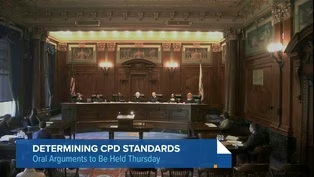
NewIllinois Supreme Court Will Soon Decide Fate of CPD Disciplinary System
Video has Closed Captions
The court will hold oral arguments Thursday. (3m 13s)
Providing Support for PBS.org
Learn Moreabout PBS online sponsorship New Episode
- News and Public Affairs

Top journalists deliver compelling original analysis of the hour's headlines.

- News and Public Affairs

FRONTLINE is investigative journalism that questions, explains and changes our world.
 New Episode
 New Episode
 New Episode
 New Episode
 New Episode
 New Episode
 New Episode

 New Episode
 New Episode
Support for PBS provided by:
Chicago Tonight is a local public television program presented by WTTW
WTTW video streaming support provided by members and sponsors.