
Across New Mexico
Civil Discourse
12/2/2025 | 56m 31sVideo has Closed Captions
Conversations with New Mexicans to hear their viewpoints on issues affecting their communities.
This program spotlights a group of New Mexicans in conversation about what civil discourse means to them by discussing issues that have the potential to bring their communities together.
Problems playing video? | Closed Captioning Feedback
Problems playing video? | Closed Captioning Feedback
Across New Mexico is a local public television program presented by NMPBS
Across New Mexico
Civil Discourse
12/2/2025 | 56m 31sVideo has Closed Captions
This program spotlights a group of New Mexicans in conversation about what civil discourse means to them by discussing issues that have the potential to bring their communities together.
Problems playing video? | Closed Captioning Feedback
Where to Watch Across New Mexico
Across New Mexico is available to stream on pbs.org and the PBS app.
Providing Support for PBS.org
Learn Moreabout PBS online sponsorshipFunded generously by the following The New Mexico First Legacy Fund at the New Mexico Foundation and its donors, including the Greg Nelson, Warren Nelson family.
More donors at NMPBS.org.
And by viewers like you Thank you [Indistinct chatter] [Intro music] >> Hakim: What does civil discourse look like in today's political climate?
What could it look like?
That's what the producers of our program were charged to discover within New Mexico.
They traveled all across the state to speak and engage with community leaders and ordinary people.
The conversation you are about to see will hopefully invite you to think critically about your own participation within your community.
[intro music] Good morning everybody.
>> All: Good morning.
>> Hakim: Good morning.
Is this conversation feeling civil?
And I want you to think about it through the lens of what are we modeling here?
That should be part of a conversation in your community.
Or what are we modeling here, that should not be other than having cameras in the room.
>> Dianna: It shouldn't be always the same people at the table having these conversations.
You know, the directors of that nonprofit or the city mayor.
Punch actually said something earlier when I first met him, and he was telling me about how he's, you know, is on the city council.
And he felt kind of out of place because he said he didn't have a degree.
And, you know, lots of people that have degrees are usually in those positions.
And he did not.
And we kind of have to get away from thinking that only certain kinds of people get to be at the table and get to have these conversations when it should look like this.
People who do all kinds of things and they run nonprofits or they work for funeral homes or, you know, they have a boxing place.
Like it should be a good, consensus of a lot of different kinds of people, whether you're educated or not or you have an elected, position or not.
>> Lorenzo: I think some leadership in our region, in our area, they really make a real attempt to try to have conversations with their constituents.
I just don't think it happens because the announcements are made online.
They're posted somewhere.
Do they get, does everybody get an email?
Not everybody has electronic you know, emails.
Do they have, can they mail something to them instead, in both languages?
Just to be able to get that out so that more people participate.
We don't do enough of that.
We don't do enough of that to engage more people.
So only the people that can read, only the people that have email or have access to social media or electronic announcements, get to go to these.
So it's never equal across the board because the people that you really want to have the conversations with aren't there.
They are not present.
>> Cathryn: There's so many people that represent so many different communities that don't feel safe to be able to be part of that conversation.
Because the fact that we can't have these tough conversations in a way where everyone can leave feeling safe, not stigmatized or judged or maybe even targeted.
It goes beyond just being a voice for people who can't come to that table.
We really, really need to bring people to the table.
What does that mean?
Does the table need to look different?
Like we need to make spaces feel just as safe as you all have made us feel today to be able to talk about this.
We need to go back to our communities and I think individually talk to those communities, that are at work during this time or not online hearing about it or that are at home, because it's not safe to come out and express their concerns in public.
In a situation where there will be discourse, there will be disagreement about it.
That's, that is, I think, a responsibility of a community to be able to come together and provide that space, not just whoever can speak the loudest or talk the longest.
>> Jena: We can't say whatever people want right.
And I think culturally, I struggle with this with work a lot and social media, and working with farmers and, working with, you know, tribal nations and just trying to really, and I am in social media, and I feel like I'm constantly like, just like, wait, how come we don't have this in three languages?
How come we don't have this, you know, is this accessible?
Like so it's hard.
It's a hard like, balance of like, there's no where to meet.
You know, there's nowhere to put this, like, let's put it in a coffee shop.
Who goes to, accessibility.
Like who goes to that coffee shop?
It's still the same people.
>> Paul: I've had, interactions with people where I find that we are using code words to communicate, to try and figure out where a certain person might be on the spectrum, of left or right, or to these administration.
And, the conversations I've had with those on the far right usually end up with them getting up and leaving.
And it really surprises me because I remember one time I was having a conversation with a guy and it was, you know, I it was just a conversation and something came up and I answered it in a certain way that triggered something.
And the guy just lost it.
He just couldn't deal with a little bit of reality, you know?
And, it's so difficult now, but I think that, people need to gather like this and maybe, for all of us, this is a point where we might want to, we might want to use this as a model in our communities to try and bring people together and communicate.
Just where, you know, just so they feel like they have a safe space and that they can be listened to.
>> Nkazi: So I've always been worried about the people that don't speak or write anything.
People that don't know what's happening.
Right, and I say so how do you reach them if their leader that you are working with is anti- what's-supposed-to-be-normal?
How do you reach those people?
Because he speaks the languages he writes the languages.
He gets all the news on TV.
These people sit there, they wake up and they are happy.
They have food, their childeren go to school.
Beyond that, we are the ones educated we think we're educated and not really helping the ones that are not like us.
For instance, there's some times when you have to warn them or advise them about something that's coming up.
We don't know how to do that.
And so someday something will happen to that family and to say, “Oh my God, why didn't we leaders, teach the people about the current situation?
So here are the bags being sewn for the homeless.
There's about 200 bags, finished bags in this space.
We try to give them waterproof.
That way when they sleep outside on the ground, it doesn't get water.
So now I'm fixing to give out before Christmas comes.
One thing I like in Albuquerque is when we have cultural events, people come together and we rejoice.
We eat foods from different cultures and we share our stories.
But this time is different.
It's very different.
I sometimes I feel lost, like, where am I?
Am I still in Albuquerque?
Am I in the International District?
Or am I in an island there by myself?
But, this time that we're in, because whatever we're in, whether it's positive or negative, it affects everybody.
>> Cone: And so in what I do, the pre-need insurance, I have to have a license, to sell life insurance.
Roswell is a much slower pace of life.
These are just normal people.
There's a lot of ranchers.
There's, people that that work in retail.
These are people that are just normal everyday folks.
And they talk a little bit slower, they react a little bit slower - it's something I really fit in with.
Every community starts with the people.
Location really doesn't matter.
But you've got to have the mindset.
The people have to be of the same mind.
You know, outsiders don't work here, as I was told.
If you're an outsider from a big city, you'll never make it here.
That's not true.
I moved from Los Angeles.
You know, you can't come in and expect to change everything.
You become part of the community - you don't try to take over the community and make it what you're used to.
It's a shame there's such division in society.
On all sides.
No one's blameless.
And no one has the high ground.
People tend to see division and bitterness before they see commonality.
And that's a shame.
We may not agree, but we don't understand their life, and we don't understand where they're coming from.
Because we haven't lived their lives.
But their stories could be just as valid as mine.
It doesn't make my story right and there's wrong.
But it's going to take all parties to sit down and agree to listen, rather than just talk and scream.
Everything starts with respect.
You have to have respect for yourself and respect for other people.
Unless you have that as a foundation, nothing else matters.
If we're going to have a conversation, you're going to have six of the 11 chairs, okay, but what's going to happen?
You're going to side with the five people that are there that you agree with.
And then you have six over there that disagree, that all agree with each other.
So if you're going to have a group like this, you're going to have to have a strong moderator that's going to sit there like you and and get opinions from all sides, and let them know you can have your opinion.
He's going to have his opinion.
Those might be in conflict, but neither one is wrong.
>> Hakim: And you're both going to go home with the same opinions you came in with, but hopefully...both better for it.
Both better for it.
[Crosstalk] >> Lorenzo: I think the problem is too, is that a lot of our new politicians come in and they've got these grand ideas of being leaders, and what they have is an agenda.
And they're not willing to represent their entire constituency.
They're willing only to go along with their agenda.
>> Maureen: We don't have a lot of spaces where we collectively come to decisions.
So even like this conversation, we're not sharing a material reality that we're debating changing.
You know, we're coming from all over the state.
And, often when you're having a debate about even issues that directly affect you in your community, you don't have a choice over the outcome.
So everyone's just fighting over which way the decision should have gone, without a stake in the decision truly.
The more times you're just strengthening your skills of bringing a group together, listening, practicing, voting, like bringing democracy all the way down into the DNA of your day, it becomes less of an abstract conversation to just start practicing making decisions together.
You'll strengthen those skills, and then you'll have those skills for when you have to make more, emergency decisions or safety decisions for your community.
And also when, if you get, I wouldn't say it's always a genuine invitation from leadership or city council, “What does the community think about this?” -you've already practiced organizing in your community to come up with collective voices and explain the nuance of your disagreement.
>> Jay: I think that's particularly relevant too, because down in Las Cruces, the county commission just recently voted to approve of $165 billion industrial revenue bond for an AI data center.
And there was a huge amount in the community that came out expressing a lot of concerns about the environment, energy production, all this stuff.
A lot of people that were seeing it as a job opportunity, stuff like that.
But really a lot of the community just saw it as the county already made the decision.
There was one commissioner that was like asking the questions and the rest of them just voted yes.
They didn't seem to care too much about the concerns community had.
And they've been having conversations for months and months already, so it seems like they already made the decision.
And I think that's another issue with a lot of leadership is a lot of times they go into the meetings with their mind already made up.
They're not willing to have their mind changed by anybody who comes to speak from the public, one way or another.
And even when it comes to public conversations, maybe they show up to community engagement events, their minds already made up.
And it's difficult when leadership won't be flexible, accountable in that regard.
I very much so believe, elected officials are public servants, first and foremost.
They shouldn't be activists.
Yeah, activism is great, but if you really want to be an activist, it's kind of a conflict of interest to be the elected official and the activist, because you're just stepping in and making the decision on behalf of those groups.
You're not listening to everyone involved.
>> Lorenzo: I have a little bit of a question on that, though.
Do those few hundred people represent the 200,000 people that live in our county?
That's the question I have.
Yeah and that's where I think it's difficult.
Because I feel like so many times we don't engage those people.
In this case, I don't feel like the county was really going to like Santa Teresa or Sunland Park to ask the people there what they thought.
They were talking with some like leadership.
In this case, we're going to the community organizers.
We're going to maybe business people within the area, and then we ask them what they think.
But we don't always ask all the residents, maybe not just for Project Jupiter, but any other community investments that we're talking about.
And I also think from a political angle, I'm weird because I'm in the political theory camp that doesn't agree with the left-right binary.
I don't think you can just put people into boxes like that.
And it's so easy to become tribalistic, us versus them, when you do that, especially at the national level.
We see that it's just red or blue.
There is no like gray area in the middle.
>> Eva: So if that's an issue where the majority population was, okay, I need to make my voice heard.
But there's a lot of people that couldn't make it to these meetings.
Well, put it up to voting, then the people would vote yes, I want this in my community, and no, I don't want it in my community.
And then you get the majority of the people that show up to vote and you get their voices and that this is not 100 people making the decision for 250,000.
>> Cathryn: But then we even get into the issue of politicizing another issue, and then there being voter access issues too to where there's a lot of communities, their voice wouldn't even get to be heard if it was down to a vote.
Because they couldn't access the polls or, only about a quarter of our population votes anyway.
>> Cathryn: I think that the hateful language that happens in politics - it's a strategy and we're falling for it.
Regular people are being told scary things that other - that are in jeopardy and as if we could do anything about it.
And so what the hope is, is that we will just be mad at each other.
We'll get all up in our feelings about all of the things that they told us are in jeopardy, and how other people- my neighbors are a threat to me.
It really takes away the humanity and compassion that any regular person would want to act on, and puts it now into some sort of political obligation to act or withhold because you don't know what your're allowed to do.
You don't know what's aligned with this group that you're aligned with, or if they're okay with it.
And I think that that's part of why it's so important that people come together and just talk about what they believe.
Don't don't think about what you were told.
Talk to your heart.
What does your heart say?
Us regular people should really be the ones to lead that charge and start talking to each other and finding common ground.
And from there, we can encourage our leaders to do the same thing, too, and incentivize that.
If we can incentivize actual solutions rather than just winning or feeling like we're right, then we'll be better.
We'll have healthier communities >> Jay: 20 years from now.
The issues that we have today are going to get even worse.
And that kind of applies the same way that 20 years ago, we had a bunch of issues and we didn't really address them as best as we could, and we're dealing with the consequences of that today.
There's a lot of people here who are kind of just doing their own thing.
And there's a lot of great places for community, but it's also kind of like disheveled in a way where it's all in little different camps.
And instead of being all unified as one collective group of people together working to solve these problems, we're kind of all pulling our own resources in different areas.
And so then when we try to address some of these issues of safety or like, the sense of community, it's hard to do that when you have a bunch of different pots you're trying to use instead of just one big place, where you're centralizing everything.
In class it's interesting, over the years, I've noticed how people have kind of become a little more close-hearted or insular, kind of not talking about things as much.
I'm sure that's probably an effect of social media and how we use it in general, because instead of doing face to face interactions as much, we do it online and there's like kind of like that veil between people.
And so in a sense, they're more unfiltered online, but then in person they like are very filtered with how they present information.
And so I think that impacts it to some degree.
And I feel like, I kind of tied in how I feel like that's a bit of a gap in the country and our communities right now, is this sense of investment.
But I think broadly, we have a lack of civic engagement from people.
They're very kind of tapped out, they'd yet again, rather scroll on TikTok or something on their phone instead of focusing on the here and now that are issues that are pressing in the community.
And I think it's fine to do that kind of stuff, but then also work on helping the community and making it a better place.
So it's kind of we should work with the tools that we have, and that we also have a responsibility to try and fix the things in our community that maybe aren't working as well as they could be.
>> Hakim: How in your own personal opinion, what do you think we need to be having better, more meaningful conversations and that can be in your community, or you can spiral it out to the whole world.
>> Jay: I know a lot of young people use social media.
They're very reliant on it for engaging with each other.
But I also, I really don't like social media, and I think it's because of things like algorithms, because of how there's like a disconnect, because you're behind a screen.
And so you don't really see the human element with another person.
Oftentimes, the rhetoric people, the way people talk on social media is very aggressive.
It's antagonistic, and it's as if we're enemies as opposed to people in the same country, on the same planet trying to solve these different issues.
And obviously we're going to have all the different thoughts, but I think even if we completely disagree with each other, we should still be able to communicate about it.
Especially because I generally believe in trying to truly understand the other side, maybe only because I want to truly understand what I don't want to be maybe, if that's like a strong inclination, but also because if you don't really understand the other side, then you don't really know if you would actually agree with them.
You're just siloing yourself away into your own thoughts.
>> Cone: And in college, my professor just said, we can disagree without being disagreeable, and I don't know that that's even possible in today's society.
You can't disagree on anything without tempers being raised or flaring up.
And I think he's absolutely right.
A lot of it has to do with social media and electronic intervention.
People have gotten away from face to face conversation.
People say things behind the anonymity of a screen that they would never say in a forum like this, they'll say things to you and call you things that they would never sit five feet away from you and say, but all of a sudden now there's anonymity.
It gives them that perceived strength that they don't really have, okay.
But it makes them feel bigger than they are.
And it feels like they can they can say things they wouldn't normally say.
>> Eva: I think we would have to form a base and say, “Why don't we start with our our common ground?” Because I think everyone's desire is to create a world that is going to be good for our kids.
I'm a mother, so that's one of the things that I worry about.
If you're a father, even in the towns that we live in, there's issues that need to be addressed, and we usually go by our moral compass.
So I think if we start those conversations by, okay, these are the things that we want to address, and that's our common ground.
If any of you think differently, well, let's just start having views.
Why do you think that way and then why I think this way.
And then we can maybe become like, work out a better answer.
It doesn't have to be your way, doesn't have to be my way.
It can be to speak the general good.
>> Cathryn: I want to know why we disagree.
Because I know my basis, and I know where my beliefs come from and my my value systems.
And more than anything, I also know that every human I've interacted with, we have so much in common that it always surprises me when somebody disagrees so radically for me that it tells me there's a bump in the road somewhere along the way.
It's not that we are so diametrically opposed as humans, it's that, something got lost, and I want to find out what that is.
Because if I can find out what that is, that creates that actual human connection between us.
And if more people could feel safe in doing that, because it does require us being able to expose ourselves a little bit, and weak points.
Because oftentimes when we're coming to a conversation, any kind of setting with a disagreement, we're coming there to defend our arguments.
But it needs more information, it needs more education, it needs more perspectives.
And I think that's what we get by talking to each other and finding out how other people that we get along with on any other issue, just earlier today, I would hang out with all of you guys individually, all of you individually, and I don't even know what you believe about so many different things because it doesn't matter.
>> Lorenzo: Everything that I do is based around my morality.
That's the most important thing to me.
And as I agree with everybody now, but we've gotten away from listening.
We've gotten away from- we've become talkers.
And you would think that the internet would take away from that, but it doesn't.
It actually adds to it, we've become talkers, not listeners.
I was in the newspaper industry for a long time, and one of the things we always walked away, during elections was that we always knew that there was going to be a happy medium, that somewhere along the line, our leaders were going to come together and make good decisions.
But that doesn't happen anymore because we're so far away from each other in the spectrum.
Everybody is either far to the right or far to the left.
There's no happy medium.
You can't even, “Oh I like that about what they're doing.” That doesn't happen anymore because it's now you're either with us or you're against us.
Either believe in what we believe or you're against us.
Again, they're setting up the carts for everybody on the food that's going out.
I always think about quality of life and what's really good for the community.
And it can't just revolve around my family.
I think it has to revolve around everybody's, because I don't think it was intended for us to, live in silos and make it about ourselves.
I honestly believe that, we're all interconnected somehow.
It's really, really about the people.
The culture here is unbelievably rich.
Nobody is really, I think there might be a few people that are from New Mexico.
The rest of us were brought here a different way.
Whether it was through Mexico, whether it was from the, West Coast or the East Coast or you move to take a job working at one of the labs or, it's just the culture is so rich here.
It's incredibly rich.
And I think that we can't ever set that aside.
My father worked for a Union Pacific, so he wasn't always home.
I was basically raised by my mother.
And my father's the first one to ever thank my mom for raising her children.
He was always away.
We would look forward to him coming home.
He instilled work ethic in us.
We worked.
Our house was not heated by, heating system.
We use wood to heat our home.
So we had to chop wood.
And we learned all these things from my father.
And my mother, she raised us to have manners.
She raised us to be, good kids and pay attention to it and be respectful.
She made sure that we had a Catholicism in place.
Stick us to catechism.
My mom went to everything that my dad couldn't go to.
And it made a big impact on me, just, I think on all of us, on my brothers and my sister and myself.
Just having such nurturing parents.
>> Jena: I know you love it.
I never, ever question how much- There's so many powerful, like, activists that are living in my neighborhood, and doing things for the area.
And all we get is like, you know, the governor's sending National Guard to our neighborhood.
Why?
To help?
Like?
(Laughs) Um because we could use it.
But, um- I think the thing is that people don't- I think the people who are doing the work, don't ask or need the press of what the people who are actually in the neighborhood doing the work, like the it's just like, oh, I heard this.
And then like the people who hear things are way better at getting all the bad press to come in and like, flashing it and making it bigger and louder than the people who are just doing the work, don't have time to get on a microphone and say, like, we're doing all this work.
It's so diverse and there's so many layers to it, and it's just really sad that, like, what gets picked out is, negativity and crime.
And- and I won't say that like, I don't- like there is there is a lot of drug use.
You know, I live right a couple blocks down central.
There's a lot of drug use, there's a lot of different things and crime that may happen, but I feel safe because I know my neighbors and we're all living in the same neighborhood.
So like, we all want the same things.
We all want our kids to be safe.
We all want our kids to, like, have a good education.
We all want our kids to have food.
We all want them to play at the park, be able to walk to the park, and we come together to make that happen.
I think I'm physically getting like so conflicted in all of these conversations because like, as a mother now with young kids, you know, I'm transitioning into this place of just like not being the person that's like out there on the streets, like very angry about injustice and like, you know, protesting and doing these things to this place of, like, finding.
And it's like all of this wrong.
So great to me.
Like I'm sitting here and it feels really great, and I feel safe and comfortable with everybody in this room.
But like, how do I leave this room and then see, you know, it's just see what's happening all over the world in my phone, you know, I step away from that.
I try not to see it.
How do I raise children that are compassionate but yet also like, don't are oppressed because they want to listen too much.
And I feel like yes, we have to listen.
But like it's so hard to find that media, >> Cathryn: My perspective, just to even add to that, just as a thought because I, I want to know too, you know, how do we have these conversations in person with people, not just what we see on our phone that is sensationalized or radicalized?
It's easy to get on social media and say the most crazy, outlandish stuff, or see a post of somebody who you just disagree with so much, and then you you want to come in and defend something.
But coming from you're coming from a place of defense even.
And I think that that is what we need to stop doing, because that's engaging in the engagement, we don't want that social media is perpetuating.
There are things that are happening that we need to know about.
But it's that it's that culture of engagement of, I have a better argument than you, and I can be angrier than you and smarter than you.
Online and other people will come in and back me up.
That's so dangerous because that doesn't apply in real life.
When you would go and talk to our real, real life neighbors, that's a real life conversation where we're maybe even like, “hey, thanks for taking my trash down the other day to, man,” like, we're having real life conversations that would not take place online.
And I think that, even to the point of, you know, having neighbors that, you know, we all have neighbors, I'm sure that disagree with us or that we need to be ready to have something to say.
It's those online platforms in that kind of radical sense that I use for myself is that's my education based on maybe where where my neighbor might be starting from.
>> Paul: Well, there's a there's a couple of things that everyone is touched on, which I find interesting.
And in particular, it's using social media.
We should be using that as a contact point, not, conversation point.
And that's where the work would come in, is if you have made contact with someone, you say, how do you follow that up?
Well, the thing that I've been like noticing lately, within the last couple of years is in northern New Mexico.
The farmers markets have been growing and growing and growing.
They're getting bigger and bigger.
More people are participating.
And I'm sure it's happening in a lot of other places.
But I find that the farmers market is the place where people talk to each other, no matter what it is.
Oh, do you like that bread?
You know this.
Did you try that jelly?
And all of a sudden there's a conversation going, because, the farmers market is a very traditional Pueblo activity.
There's still a lot of farming going on, but they're not doing it on the scale with the intention that they're building the food chain, that they're helping with food security.
But that message is starting to come through because these markets are getting bigger and bigger, and we can see a day when we're not being, controlled by the, supply chain we've bought into that supply chain thing.
And when I go to the farmers market, I say, oh, well, there's everything here, you know?
And if you learn how to canned fruit and vegetables and meat, you don't even have to worry about that part of it.
You know, it becomes something that people can share.
And I guarantee you, the farmers markets that I go to, people are talking, they're having conversations, and it's friendly stuff.
It's good stuff.
Some of it can get political, but, you know, it.
It's face to face.
And if it's face to face, like you said, it's hard for you to say something to someone if you're looking at them in the face.
A bully would do that.
The camera was pointed at her.
She would take over, and she was very traditional, very much a grandmother for everybody.
She had.
She was a stickler boy.
(laughs) For feast day, she would clean her house inside and out, and people in the village used to make fun of her because she had the cleanest outhouse in the village.
And I used to think to myself, well, that's not funny.
I'm thankful.
The outside world has the perception that we live in poverty, and they've always had that perception, and that label works for the power structure.
It doesn't work for the community.
Because growing up here in the Pueblo, I never felt like I was wanting for anything.
Especially good food, good healthy food, good healthy physical activities, spiritual guidance, elder leadership.
When I was a little kid, I could walk into any house in this village, just walk in and they would greet me and they would say, “Paul, come and sit down, have a tortilla,” or share something.
I mean, it was like one of my favorite things in the world was to go visit all my aunts to see which one of them was going to feed me something that was really good.
When we started out as kids, who knows what our politics were, you know, who knows?
Everybody was just hanging out with everybody.
There was a certain time and a certain level, I guess maybe after high school, into college, when people were forming opinions that were not necessarily held by all of us.
And that's when it started to get this separation.
It wasn't until recent that I kind of felt like there's been a shift because of things going on in our administration, on the outside world, and I'm feeling like I have to watch my back because now I can be profiled.
It's been passed legally by the Supreme Court, which means that if the police want to stop me because I look like an immigrant, they have the perfect right to do that.
>> Eva: Here in Carlsbad, a lot of parents, like both parents, work.
So their child is that age.
They're already staying at home by themselves.
And there's access to liquor.
There's access to cigarets, there's access to guns.
Unfortunately, there's drugs that they have access to because parents give them money and they have the money to buy drugs.
And there is unsupervised now, so who was taking care of those kids?
So it's making sure that they're doing okay.
I mean, if they're having- their mental health is compromised and they have access to all of these things, there's nothing important that they're going to have.
I mean, that they're going to make the right decision.
There was one incident, I was at the emergency room, and there was, a young boy that came in from a gunshot wound, um- he was 14 and and he didn't survive.
The first thing that came to my mind is- At 14.
Why would you have a weapon?
To begin with, you know, and maybe that's just my point of view, but.
I think our youth are so.
Vulnerable.
So, no, I have not anybody, or the other parents address that.
I think a lot of people here are very private, and they decide to just either not talk about it or just keep it to themselves.
>> Maureen: The amount of people I know who have gotten injured here, myself included, it was actually that bench where my teammate popped my shoulder back in, um- We wanted new turf.
I'll say that.
We wanted investment and healthy communities and places to be physically active and safe.
This just feels like the classic Santa Fe way of answering that call.
So there are a lot of transplants that move here and try to build something they had somewhere else, but cheaper- Maybe with some entitlement to the land or the resources here.
I think it's hard to see what's been lost socially.
People feel it.
I think people feel more loneliness and more agitation and more fear, but they don't necessarily see what's been taken away or the structures that supported more connection or more conversation between community members.
It reminds me of in the beginning of the pandemic, when I felt like collectively, people, really started to appreciate parks again, because it was a place to be outside and all of a sudden you realized all the other people that were in your neighborhood who also maybe you had things in common with or like your kids who wouldn't have met were running towards each other.
Your dogs who wouldn't have met are running towards each other.
And this is just another one of those places.
I feel like it creates a space for people to be together and do something together, and appreciate the things you can do together that you can't do alone.
It's why I would want us to have more places where we came together and made developed a shared language about what we're experiencing, a shared analysis about how we could address it as a community and I'll always believe in grassroots organizing.
So, I shared strategy around how to organize to make that change.
And the more that people see examples of their neighbors having conversations with each other, the more they're inspired to turn and talk to their neighbors.
So I'm just grateful to be part of this, and I hope if someone watches it, they talk about it, with their neighbors on their block.
>> Nkazi: I don't think that all of us experience everything that other people are experiencing, Especially when it comes to the populations that we serve.
It makes me sad because, you know, for instance, we have- my husband and I bought a property where we train people in English skills, craft skills so that they can sell and make money.
And um- so for me, it's like, I wish that everybody knew how to speak or write English.
And then there's also with this situation, there's also a safety issue.
How are how are you going to tell someone who doesn't know English what what to do and what not to do during this situation?
How are you going to tell them that?
No.
You know, we're no longer going to the center now where we we train in activities, children and old people.
How are you going to tell them?
No, we're not doing that anymore.
>>Hakim: And you don't have to s but I'm just going to say for the benefit of the room, they have immigration status issues that could be a problem.
So they're staying at home, right?
Yes.
It is very, very, very, very difficult because right now there's things that I wanted to let these, women and the families know and the leaders that speak English and understand what's going on.
And those are the highest problems for everybody because they know and speak English and they have they have their own opinions.
And so we have to be very, very careful when around them and speaking to them.
>> Maureen: I really like what you said about it being a safety issue, to be able to have conversations.
So I imagine on the other side of these conversations, if you know your neighbors and you can trust that, you can have a conversation with them, that's respectful, you can also trust that you can knock on their door if you need help, you know, or if you- if you have an emergency or, you have a need.
And so I think when I look at Santa Fe, there's, there's all these moments of, like interruption of community, not just those moments where neighborhoods are cut off through infrastructure, and like neglect, but also when people can't afford to stay in the community, they can't keep a social safety net that maybe they've made through running into each other in public or just having, relatives and their relatives, extended communities, look out for them and see them grow up.
And even as a renter, I've moved every year since I've lived in Santa Fe, and so I don't have the same neighbors year to year.
And I was thinking about how when I do things that make me feel like I'm part of a community, they're muscles that are not natural anymore.
Like, I live in a four plex.
It's four apartments.
We share a building and when I moved into my apartment, my landlord, her granddaughter, had just moved out and left behind a couch.
And my landlord told me that the man in unit one would want the couch if I didn't want it.
And I was like, I have to go knock on his door.
I have to talk to him, you know?
And then I've been knocking on his door and he'd be tired coming home from work, not ready to receive the couch today.
And it turned into, like, this multi-month, conversation with Ron, my neighbor.
And, you know, one.
And at the end of it, it resulted in him getting a great couch and me finding out about his grandkids and like, realizing we both have cats and, just like the the kindness and curiosity towards neighbors is a muscle that you can only practice, if you have time, space and like a little bit of, vulnerability to practice it.
But it feels really important to recognize it's become, less natural.
And people are holding more pain and more stress and more dislocation than ever before in Santa Fe.
Maybe not ever before, but it's it's heightened.
>>Dianna: I think about the spac Like, where is the space even for that kind of a conversation?
Like we're here today in this group, and this is a very feels like a very good, a very self, like a very safe space where we can all talk to each other freely and express what we believe in freely.
But like in real life, where is that space?
I know, like there's like marine said, there's like this very heightened sense of, like uncertainty and like scared ness.
And I can tell you from, like, a personal, like, opinion, like, sometimes I see somebody with a certain kind of hat or like a certain kind of shirt, and I automatically think, and I shouldn't make that assumption, but I automatically think like, oh, no, that person's not going to like me.
They're going to want to change my mind, even though I don't want them to change my mind because I believe what I believe, and I think we've lost that respect of like just respecting what each other believes, even if it's different.
So I grew up like 20 miles, 20 or 30 miles from here and a very small, like two stoplight town.
All of my family, though they're not in New Mexico.
They're actually just across the border in Texas.
Our families, is close by.
I like being able to drive over to see my parents in about 20 minutes.
So, family one keeps us here, but also jobs.
We've.
My husband and I have both found employment here that we find, fulfilling and that we both enjoy.
And so jobs have kept us here.
And each other having, you know, a marriage and just a nice, quiet, comfortable life.
I love that I know so many people in my community some way, somehow we know somebody who knows somebody, and it just feels really close and tight knit.
And in times of like, turmoil, I feel like it's a community that comes together to take care of each other.
I had no idea when I moved here in 2007 and I mean moved to like, actually live in Clovis, had a home here.
I had no idea that green chili was this thing.
And I was like, what?
What is this?
Why are you putting it and everything?
So even though, like, there's that small amount of distance, you know, that was a huge cultural thing that I didn't realize, like green chili was such a New Mexico thing around here.
>> Herman: Before we used to train every day, but now we only train twice a week because I'm getting so busy.
I'm just a regular guy.
I'm heavily involved with my family.
My daughters.
I have four daughters.
I'm heavily involved with the church and, with the jail ministry and I love reaching out.
I learned a term that I didn't know is called a servant's heart.
And everybody tells me I have a servant heart.
I don't know what that is, but I just love to work with people.
I've, I've worked with so many children, so many youth, from elementary to high school to college students.
I love it when it's, graduation season because I go get to eat at everybody's house.
But on the flip side, I have spoken at a few funerals.
Some of my students have passed away.
And, I've spoken maybe about five funerals over 16 years, and it's heart wrenching.
At first I was just doing it because my daughter wanted to box, but after a while I noticed I could be a voice, a positive voice who I'm like.
The difference between me as a coach and other coaches, they're trying to make world class fighters.
They're trying to make the next big thing.
I'm trying to reach every student that I have, every student that comes into my gym.
I want them to know to stay off of drugs.
I want them to know to get a good job.
I want them to know to get up early.
Some things my dad used to tell me, get up early.
Yeah, he would tell me to get up early and work, you know, and same things that my dad taught me.
I'm teaching these guys.
And, if I can be a positive role model, that's the best way I can.
Before, it was just a broad group of kids.
But after I started doing the funerals, I zeroed in on each kid, and I just.
I pray for them, and I just encourage them, you know, I just I don't push God on them or anything.
People would try to tell me, open up a Christian boxing club, but I don't want to reach Christians.
(Laughs) I want to reach the knuckleheads.
You know, I love that when the juvenile detention center here in Farmington, they would give me inmates and they would pay them three months in advance, and I would train them and I would tell them, how come you want me to train the inmate to box the fight?
And they said, no, it's a different that's the only way they get their stuff out.
And it's a different kind of teaching.
And so many kids have talked about me in the juvenile detention center.
And so that's how my name came up and they found me.
And I've been training a lot of kids.
It's for me, it's not meaningful conversation.
It's more of meaningful, exemplar ship.
Every area of my life, I work hard and I show people I work hard.
Not to- just for an example.
You know, if you want something, work for it.
In the boxing gym, If you don't like me, we'll punch you in the face.
You know, we don't talk about it.
We do it.
I'm more of an action.
I like my nickname is punch.
I'm more of an action.
And I like this more of action, Yeah I'm a verb.
We just make it happen.
We I drive a tow truck with a vehicle down a canyon.
There's no written rules.
We have to make it happen and get that vehicle out.
Sometimes we're in the middle of winter vehicles in the middle of the the- not ocean, the river.
And we have to go in there, you know, and we just make it happen.
And we're just.
And I'm just an example.
I don't like to talk about it.
I like to show, that's kind of where I'm at.
I do like social media and I'm a picture person.
I've always been a picture person since way back in the day.
And, my friends, now they can I use your picture from from way back from.
Oh, yeah.
That's what it's for.
Pictures.
tell a story for me.
So I'm all about pictures.
I'm all about, being that example.
In the gym at my work and my family, I have a lot of people asking me about marriage counseling.
I'm not even a counselor, but I just show you on social media, spend time with your family, take your kids out to to do family things, take family trips, you know, spend time with your spouse, love your children.
And, it's just I'm just an example kind of person.
Not more of a conversation kind of person.
>> Jay: Maybe not just actions, but being intentional with what we're doing.
Because I know I drag social media a little too much, probably, but I just think it's because people aren't.
I don't feel most people are intentional with it.
They're just making noise with it.
There's traveling neighbors screaming from the mountaintops.
But then, like when I talk with some of these people and like, okay, yeah, I'm also worried about that issue, what are we going to do about it?
And then they're like, oh, and, you know, and then they get wishy washy about I'm like, I think it's fine to make these statements to communicate on social media.
But then if you don't really want to follow it up with action afterwards and I'm like, then you're just making noise.
It's like if people are trying to listen to music on the radio and somebody else making some noise and radio makes it, you can't hear the music.
So the ones who are trying to make a difference aren't active in the community.
Trying to organize it makes it harder for them sometimes, because then they have to deal with the political behemoths of the division.
We're dealing with weather in the country, in the world, what have you.
And so I do think that's action is something we should focus on more and being intentional.
And I do think also we kind of talk about like this foundation where people sometimes aren't able to stay, where their family grew up or maybe it's you moved into a newer community.
I do think having some sense of community, maybe not an investment per se, but recognizing as yourself, yourself, being a part of that whole.
If you can't see yourself in there, then, well, why am I going to take my time and show up to these meetings?
So I'm not going to listen to me anyways.
And then we have this political division, which makes it even harder because then you automatically cut out half the community.
But if you're not even involved in the community, then you're just like, I'm not going to show up.
And that makes it much harder for the few people who do show up to actually figure things out.
>> Eva: I also think that maybe we're overthinking it, because I don't think we necessarily need to go and like, walk and form the picket line.
But like most of us said, like, just go to your neighbor.
We've been so detached with knowing the people in our immediate community, just contact with them, take in some cookies, you know, start with your kids, with my daughter.
When without this political turmoil.
Just told me several times, like, mom, what do I do?
And I just- I told her, Just listen to them.
I mean, hear what they have to say.
Don't become defensive.
And then you tell them your point of view.
Why do you feel this way?
And she- She came back the other day.
She was really happy because we cook Mexican meals, of course, and she's taken some of the leftovers to her school.
And she said, mom, they were asking me like, what is this food?
Because I've never seen it.
And I told them, the world, my mom and my parents are, from Mexican heritage, and they're teaching me their culture.
And that's how she she approached more people.
They were more interested about what the food was and how did we cook it.
And.
Well, can you bring me some, some more food?
Whenever your parents cook?
And so I think to start in with, with our kids and, also let them, let them or give them that voice to be like, educate other people about your, your culture and why this country has been so rich of being a melting pot, you know, and I think just starting with one step, you know, like befriending your, neighbor or if you're in the line or the grocery market just started like, oh, “the peaches are really ripe today, right?” And, you know, just break that ice and be comfortable talking with other people.
You know, just, I was like, I've made references of now when people go and knock on your door, we hide.
And it's like, oh my God, like he's snacking on something.
Yeah.
And before I used to be like, somebody would show up a visitor, an unexpected visitor to your house, and you would welcome- welcome them in.
I'm sorry, and I was like, “Oh, you want something to eat?
Do you want something to drink?” And then you would have this lovely evening of, someone visiting your home.
>> Hakim: A huge thank you to all of our guest.
It requires way less effort to simply avoid tough conversations from a place of what we have to lose.
Then it does effort to engage in difficult conversations from a place of what we have to gain.
Shout out to New Mexico News map for introducing us to many of our guests, and to New Mexico first, and its mission to be a catalyst for positive change.
By engaging New Mexicans in policy and enabling action, this program was imperative to continue that mission by focusing on creating meaningful dialog within communities across New Mexico.
Thanks for participating in this program.
We say participate because we hope you implement some of these ideas in chats and dialog within your communities and with your neighbors, and embrace the chance to listen more than speak.
>> Funded generously by the following.
The New Mexico First Legacy Fund at the New Mexico Foundation and its donors, including the Greg Nelson Warren Nelson family.
More donors at NM, PBS.org, and by viewers like you.
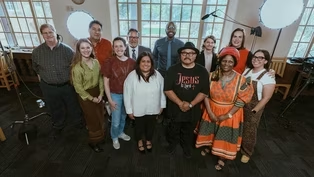
Preview: Across New Mexico: Civil Discourse
Conversations with New Mexicans to hear their viewpoints on issues affecting their communities. (30s)
Providing Support for PBS.org
Learn Moreabout PBS online sponsorship New Episode
- News and Public Affairs

Top journalists deliver compelling original analysis of the hour's headlines.

- News and Public Affairs

FRONTLINE is investigative journalism that questions, explains and changes our world.
 New Episode
 New Episode
 New Episode
 New Episode
 New Episode
 New Episode
 New Episode
 New Episode

 New Episode
 New Episode
Support for PBS provided by:
Across New Mexico is a local public television program presented by NMPBS