Florida Road Trip
Clay County
Season 2026 Episode 2 | 26m 46sVideo has Closed Captions
Explore the stories of service, farming, and community in Clay County.
Join the ride to Clay County, where rivers, farms, and military roots shaped a community grounded in service. Explore Camp Blanding’s wartime legacy, the story of Penney Farms and new beginnings, and traditions at the Clay County Fair. Florida Road Trip uncovers the people, places, and stories that make Clay County a uniquely connected Florida destination.
Problems playing video? | Closed Captioning Feedback
Problems playing video? | Closed Captioning Feedback
Florida Road Trip is a local public television program presented by WUCF
Watch additional episodes of Florida Road Trip at https://video.wucftv.org/show/central-florida-roadtrip/
Florida Road Trip
Clay County
Season 2026 Episode 2 | 26m 46sVideo has Closed Captions
Join the ride to Clay County, where rivers, farms, and military roots shaped a community grounded in service. Explore Camp Blanding’s wartime legacy, the story of Penney Farms and new beginnings, and traditions at the Clay County Fair. Florida Road Trip uncovers the people, places, and stories that make Clay County a uniquely connected Florida destination.
Problems playing video? | Closed Captioning Feedback
Where to Watch Florida Road Trip
Florida Road Trip is available to stream on pbs.org and the PBS app.
Providing Support for PBS.org
Learn Moreabout PBS online sponsorship>>This program is brought to you in part by the Paul B. Hunter and Constance D. Hunter Charitable Foundation, a proud partner of WUCF and the Central Florida community.
>>On this additional Florida Road Trip, we're heading into Northeast Florida to explore the history of a county shaped by service, hard work and a deep sense of community.
>>This camp was renowne for being able to train soldiers for a more traditional European style environment or a more Pacific theater, a swampy area.
>>Where a man known for his retail stores tried to build something entirely different.
>>If they planted crops, raised some livestock for two years, that land was theirs.
>>And where generations still gather to celebrate agriculture, community and the people.
>>This isn't Tasha's fair.
It's the people's fair.
>>Fro training grounds to traditions.
Florid Road Trip is taking the scenic route through Clay County.
♪♪ Hi there and welcome to Florida Road Trip, I'm Scott Fais.
Clay County's past is layered.
Shaped by the river and then generations of communities which built homes that then turned into traditions.
This is one place where history is still alive.
>>There's about ten other counties in the United States named Clay County, and most of them are after Henry Clay.
Henry Clay had nothing to do with Clay County.
Never came here, wasn't related to anybody from here.
But at the time when they named the county, the Whig Party was very popular in Clay County.
And so they just said, well we'll name it after Henry Clay.
Even though none of them actually ever met him.
>>Not long after the Civil War, Clay County gained national attention for something completely different: Green Cove Springs.
>>The big thing that happens after the Civil War is medical tourism.
The spring at Spring Park becomes a magnet for all of these people from up north.
And Doctor Applegate build the first hotel in Green Cove.
And the other big hotel is in Magnolia, and they're all capitalizing on come down here during the winter.
If you're consumptive o if you have any kind of disease, you drink this water, this mineral water, it's going to make you better.
So they were actually bottling it and selling it up north.
>>Today, its spring-fed pool continues to attract locals.
Bridging the past and the present.
Yet another industry also played a hand in shaping life in Clay County.
>>Really agriculture played an important role in Clay County history as man other counties in this country.
We had the Gustafson family that was here.
They came as indentured individuals working for people here in Green Cove.
And Mama Gustafson known as Mama Gus.
She had an old cow in the backyar just several blocks from here.
And she milk the cow every day.
By 1970 I believe they had about 6,000 head of milk cow that they processed every day.
But sadly, all that is no in the past, the dairy was sold.
>>The rise and fall of Gustafson dairy mirrors Clay County's broader shift from farmland to residential community.
>>World War Two brought the next major transformation.
>>During the Second World War we had Camp Blanding, and here in Green Cove, we had Lee Field that trained Navy pilots.
>>After the war, we had the mothball fleet.
The mothball fleet is like, gee we've built all of these ships and destroyers and destroyer escorts, the Tin Can Navy.
What do we do with all these ships?
We don't need them now anymore.
Right?
That' what the government's thinking.
And they store them here at Green Cove Springs.
They built these huge piers thousands of feet long.
That lasted until 1964, whe Lyndon Johnson became president.
He decided that Texas needed the mothball fleet.
>>As Clay County grew, a ne town emerged: Keystone Heights.
Shaped by a family with a clear vision for its future.
>>In the Florida land boom of the 1920s, John Lawrence was attracted to this region, and he was originally from Pennsylvania, so together with his three brothers, he formed the Lawrence Development Company, and they set about making this community.
They named it Keystone Heights after the state.
Pennsylvania, its nickname was the Keystone State.
That's how we received our name.
>>Creative promotion brought seasonal residents seeking a warmer climate and a sense of culture.
>>He developed postcards and brochure and really publicized the area.
And so people started to come into the area of Keystone from all of these advertisements that he had put out.
He was elated when Doctor George Mead, who was from New York, he had just become the president of the Chautauqua.
So Lawrence was very excited about that, because with Doctor Mead he then brought the Chautauqua to Keystone, and Keystone became the Chautauqua City of the South.
That was a social movement in the early 20th century.
>>There's one place that tells the story of Clay County's history, records, and preservation, all from one spot.
The Clay County Historic Triangle.
>>Two of the county's oldest buildings that the county owns, are here at the triangle.
So we have the 1890 courthouse and the 1894 jail.
The public is allowed to come visit the cellblock here.
[DOOR SLAMS] >>Inside the archives, find records documenting generations of life in Clay County.
>>Profanity, drinking, stealing of cows.
You know, cattle rustling.
And this one right here.
Somebody dropped a dime on Nathan because he went to jail for adultery.
>>The main thing, I think, that separates Clay County from perhaps other area are the people that live here.
There's a really communit that runs throughout all of us.
And preserving that and continue that on this part of the challenge that we all have in maintaining history.
♪♪ >>For more than 80 years.
Camp Blanding has shaped soldiers lives.
It got its start as a National Guard training pos on the shores of Kingsley Lake.
And then during World War Two it grew into one of the largest posts.
>>Camp Blanding comes from a longer history with the National Guard here in Florida.
So in the early par of the 20th century up to 1939, the guard had a post over on the Saint Johns River fairly close to Jacksonville at a place called the Black Point Military Reservation.
They had over there a piece of propert that was officially Camp Foster.
And in 1939 that portion of the Black Point Military Reservation is now part of Naval Air Station Jacksonville.
>>With th Navy expanding in Jacksonville, the Florida National Guard needed a new home.
They found it in Clay County with Camp Blanding.
In 1940, the War Departmen officially took over the camp.
>>We went from 30,000 acres to 150,000 acres.
In the space of 90 days, they built 10,258 buildings on this post.
>>The sprawling facility gets its name from Major General Albert H. Blanding, who is one of the highest ranking officers to come out of the Florida National Guard.
Almost overnight, Camp Blandin became a massive wartime city.
Chapels, theaters, and even the largest hospital in the South filled the camp.
At its busiest, more than 65,000 soldiers trained here all at the same time.
>>This camp was renowne for being able to train soldiers for a more traditional European style environment, or a more Pacific theater, a swampy area.
So this post was unique in the sense that it was able to train soldiers for both of the kinds of environment that they ultimately faced.
>>More than 850,000 soldiers trained at Cam Blanding during World War two.
The people working at the museum today make sure that none of these stories fade, while Camp Blanding remains an active training facility.
>>We see a lot of families for veterans that come back, and the veteran's passed away and the family goes, you know, we don't.
Dad, granddad, Uncle Joe never really talk much about what he did.
And we're trying to track that down now.
And so we try to help them as much as we can.
>>There was another side of Camp Blanding during the war, one many visitors are surprised to discover.
>>Camp Blanding actually ha two prisoner of war compounds.
There was a German navy compound, which was pretty small, about 250 prisoners, and the German army compound was much larger.
Between 1,000 and 1,200 prisoners.
At the end of the war, there were almost 7,000 German prisoners of war in Florida alone.
>>There's a famous quote Tom Brokaw's book The Greatest Generation, and I always tell folks, that' an overwhelming understatement.
The more you dig into what these men and women did during the war, not just for our country, but for for the whole planet.
And it's just it was way beyond just a great generation.
>>Camp Blanding stand as a reminder of the generations who trained here, served abroad, and forever changed the course of history in Florida and beyond.
♪♪ Quietly tucked away in the woods where the Black Creek meets the Saint Johns River awaits a quiet respit that has welcomed generations.
Today, it's affectionately known as Camp Chow.
The camp began during one of the country's more challenging eras.
Yet leaders saw the opportunity and built a place where young people could gather and learn.
>>Camp Chowenwaw Park started as the first permanent camp for the Duval County Girl Scout Council.
They opened for their first session in July 1st of 1933.
There are three of the Council women that were credited for its creation.
As soon as they heard about being able to get free labor from the government, they jumped right on the opportunity.
Herbert Hoover created the Reconstruction Finance Corporation.
This was a progra that loaned money to businesses and banks, and would provide the fundin for the labor to build the camp.
>>At the time, it was said that they had about every unskilled and skilled laborer in Jacksonville working here some days, over 150 men at a time.
>>There were efforts to tur that patch of forest into a Girl Scout experience for more than 70 years.
But Camp Chowenwaw sits on land with a story stretching back thousands of years.
>>Archeological surveys have found that it was inhabite back in the Mississippian period of the indigenous peoples of Clay County.
Additional evidence goes even farther back to the woodland period where lithic flakes were found, and suggesting that it was used as a hunting camp.
The Big cabin is the only structure that exists when the camp opened in 1933.
>>Visitors can explore rustic cabins, treehouses, forest trails, and historic waterways.
Camp Chowenwaw is at the confluence of Black Creek and the Saint Johns River.
Black Creek goes into Clay County around 30 miles, including the South Fork and the North Fork.
So this was a major route not just for Native Americans traveling the land, but also was a source of transportation for agricultural products.
And then when the girl Scouts own the property, this was a high point of recreation for them.
I think Camp Chow is a great story for conservation and preservation, and making sure that people get out and are enjoying nature as they were during the time of the Girl Scouts.
>>It's hard t imagine what this place would be if Clay Count had not purchased the property and preserve it.
♪♪ >>Orange Park has always embraced new beginnings.
This area used to be covered by orange groves.
That' how the community got its name.
And although the orange trees have sinced vanish, the house behind me serves as a reminder to the legacy that one family created.
>>This had been a plantation.
The entire Orange Park was Laurel Grove Plantation.
It kind of fell into disrepair after the war was over, and reconstruction moved in and into the community comes Washington Gano Benedict of the Florid Winter Home Improvement Company.
They planted 250 orange trees on every lot, marketed it to people up north to come down and you had a ready made income.
You could build your house.
You already have an income waiting for you.
And so that was orange tree until the 1880s when they froze.
And that ended that industry.
Washington Gan Benedict had back up industries.
There was a palmetto industry where they were making things from Palmetto Leaves, and there was a moss factor where they were stuffing stuff into furniture, cushions of Spanish moss and sending that out.
So he had all of that, even patented his palmetto.
So he was very ingenious.
And he built a huge hotel an had tourism as another industry.
>>By the early 1900s, Orange Park found itself evolving and the Clark family would soon influence its direction.
>>They had a business in downtown Jacksonville.
They looked around and they saw the son was wearing knickers and and velvet and.
No, no we want this boy to go barefoot and go fishing and hunting and all that stuff.
And so they bought 30 acres out here in Orange Park.
And Mr.
Clark started the pecan grov on top of his plumbing business.
Then on top of all that, mayor of Orange Park.
>>Their 1912 home still stands today, safe from demolition and preserved as a public treasure.
>>Carrie Clarke in this very house started the first Baptist Church of Orange Park on her porch.
She started a Sunday school.
She actually went around and picked kids up and brought them to the Clarke House porch.
And they had Sunday school with that piano.
The Clarke's influence could be found everywhere from the women's club to the garden club, to community reforms that helped shape the modern town.
They did so much for this community.
When they were living here, in the beginning, there was no law about putting your pigs, goats, anything behind a fence.
They were all over the place, which was becoming a health hazard.
And you have to remember that these women couldn't vote, but they still managed to get legislatio passed through their husbands, to get the animals behind fences.
And that was a big health boom.
They had an intuition for the right choices.
It didn't have to be easy.
It just had to be useful enough to the community to spend the time and do it.
And they they did not chance on that.
Anything that needed their time.
They were more than generous.
>>Visitors come for tour or to feel a sense of nostalgia that brings the past close enough to touch.
>>Most people when they come in Clarke House remember their grandma, and they'll go in the kitchen and they'll see that state of the art in 1912 sink that a plumbe put in for himself or his wife, and think my grandma had that exact same sink.
And it makes you nostalgic and you miss your grandma, but you got your grandma because you get to be here with her.
♪♪ >>Cash or credit?
One Clay County town's visio reflects a gentleman whose name used to be above thousand of American department stores.
James Cash Penney didn't want to build retail here.
Rather, community.
>>He opened his first store in Florida in Jacksonville in 1922, and he also found out that there was going to be an auction for a farm land coming up in about two weeks.
He got 120,000 acres of land for $400,000.
>>James Cash Penney may have been known for his department stores, but his childhood inspired his dream.
Formed by years spent working the land.
>>He grew up on a 400 acre farm.
His dad was clergy, and he said to him one night, you know, you have got to get a job, because even when he was eight, they were telling him he needed to buy his own shoes because he couldn't afford to buy shoes for everybody.
And he cut grass and he fed the pigs.
>>In 1922, Penney and his associates registered 10,000 acres as Long Branch City.
He invited farmers to claim 40 acre tracts with just one stipulation.
>>If they planted crop and raised some some livestock for two years, that land was theirs.
No payment.
It was just for them.
>>But not all families worked the land in the same way.
A separate neighborhood known as New Hope grew from a different experience.
>>I knew that the opportunity for people of color to get land was not to say very easy.
It cost somebody something, but it was possible because everyone around that was doing sharecropping.
They were given the opportunity to buy land, not just actually taking, you know, how sharecropper were in on the treatment of it was that every time you went to pay your bill, you had more bill added on, an so you never paid off the bill.
But J.C.
Penney was very different.
He actually allowed them to pay off their land and purchase a home.
>>The two communities grew side by side, often helping each other, and the area became known as New Hope.
New Hope that you're not desperate.
We're not down and out, and we're going to alway have new hope in this community.
>>Back in Penney's central community, the founder undertoo something unusual for the era: a retirement communit named Memorial Home Community.
>>They decided that they would start out with missionaries and ministers and YMCA workers who did not have much in the way of resources when they retired.
So he built homes for all of them.
Cottages.
For several years after he paid for all their groceries until they could get their feet on the ground.
>>In 1927, the state legislature chartered the city as the Town of Penney Farms.
When the Great Depression hit in 1929, Penney sold most of his holdings, except for 200 acres he deeded to the Memorial Home community.
Through it all, one thing has never changed: the people.
>>People were always willing to help out other people.
Volunteering was one of the big things that Penney asked for.
And we can find people who volunteer.
♪♪ >>Each spring, something special visits Clay County.
It's loud, can sometimes smell like hay, it tastes pretty sweet.
And it's a lot of fun.
But at its heart, the Clay County Agricultural Fair is much more than that.
This is a tradition where families gathe to preserve the county's past.
>>The roots, as far as historian.
What I have discovere and what I've lived through too, and been involved in, was through Cracker Day and through organizations like Clay County Cattlemen and through people like Mr.
Jesse Godbold.
He had the vision.
>>This same group of people got together and determined that we needed to have a fair and started out, and it started out small, obviously, it was a four day fair.
>>The early focus on cattle, farming, and community never went away.
It grew alongside Clay County itself.
>>Today, one o the most unique places to visit at the fair is someplace that folks don't expect.
The early Florida villag where you can step back in time to see Florida as it was, well more than a century ago.
>>You can see anything in here from biscuits being cooked on a stove.
>>There's some baby biscuits in there if you want another one.
>>Yes, please.
Thank you ma'am.
>>The collard greens are being cooked in big pots to somebody making cow whip.
>>This isn't a reenactment.
These are real buildings, real tools and real stories.
>>I lived in this house till I was 18 years old.
>>I can remember not having electricity.
I can remember doing homework by a lamp.
And we cook with a wood stove.
And that's the way we did that.
>>For many, Early Florida Village is more than history.
It's family.
And from the very beginning, the fair's mission has always been education.
>>The whole goal was to make agriculture get it better known in Clay County, because Clay County was starting to grow and you were starting to get a lot of people moving in that didn't realize, you know, what the agriculture was and how important it was, and even today, how important it is even in this county.
>>And the fair runs almost entirely on volunteer power.
>>We're one of the only fair that is truly a volunteer fair.
We have four paid staff members, myself and three others.
Everybody else you meet out here are all volunteers.
We have over 2,000 that volunteer here at the Clay County Fair.
Where else can you g that it's truly volunteer power?
This community really supports this fair.
They take their vacation time to come work this fair, which is something.
When I first started here, I thought it was wild.
I'm like, they take vacation?
Like they don't want to go to Key West or to the beach.
No, they come to the Clay County Fair.
Once you volunteer here, it's in your blood.
>>It's like family to me.
It is.
I mean, to me, this is my school house.
You may lose a lot of things, but you don't have to lose your memories.
>>The people who show up take pride in this tradition and then pass it on to make more memories every year.
>>I hope they think back and like, wow, that was fun.
It was a clean, safe, fair and I learned something.
I hope that they continu passing it down from generation to generation.
[WHIP CRACKS] The people really make this a fair.
I mean, it's the people's fair.
I'm the face of the fair.
But this isn't Tasha's fair.
This is the people's fair.
I'm just in the seat to make things happen.
>>A fair built by volunteers, rooted in agriculture and powered by the people of Clay County.
From riverbanks to fairgrounds.
Clay County's story is told through its people.
Here, history just isn't learned.
It's lived.
That's going to wrap it up for this edition of Florida Road Trip.
Thanks for joining us.
I'm Scott Fais.
We'll see you down the road.
But first, safe travels everyone.
♪♪ >>This program is brought to you in part by the Paul B. Hunter and Constance D. Hunter Charitable Foundation, a proud partner of WUCF and the Central Florida community.
♪♪
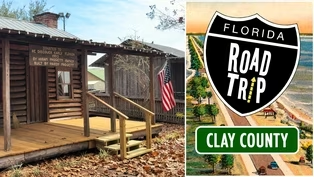
Preview: S2026 Ep2 | 30s | Watch a preview of the Clay County episode of Florida Road Trip! (30s)
Providing Support for PBS.org
Learn Moreabout PBS online sponsorship












Support for PBS provided by:
Florida Road Trip is a local public television program presented by WUCF
Watch additional episodes of Florida Road Trip at https://video.wucftv.org/show/central-florida-roadtrip/