
Climbing in Southern Nevada
Season 4 Episode 7 | 26m 47sVideo has Closed Captions
Red Rock Canyon offers epic climbing and a community committed to conservation.
Red Rock Canyon is a world-class climbing destination — and a community effort. Host John Burke meets Leici Hendrix of the Southern Nevada Climbers Coalition to explore the sport’s challenges, rewards, and growing popularity. From scaling cliffs to picking up trash, climbers are working hard to protect this desert gem for generations to come.
Problems playing video? | Closed Captioning Feedback
Problems playing video? | Closed Captioning Feedback
Outdoor Nevada is a local public television program presented by Vegas PBS
Climbing in Southern Nevada
Season 4 Episode 7 | 26m 47sVideo has Closed Captions
Red Rock Canyon is a world-class climbing destination — and a community effort. Host John Burke meets Leici Hendrix of the Southern Nevada Climbers Coalition to explore the sport’s challenges, rewards, and growing popularity. From scaling cliffs to picking up trash, climbers are working hard to protect this desert gem for generations to come.
Problems playing video? | Closed Captioning Feedback
How to Watch Outdoor Nevada
Outdoor Nevada is available to stream on pbs.org and the free PBS App, available on iPhone, Apple TV, Android TV, Android smartphones, Amazon Fire TV, Amazon Fire Tablet, Roku, Samsung Smart TV, and Vizio.
Providing Support for PBS.org
Learn Moreabout PBS online sponsorshipToday on Outdoor Nevada, the Red Rock Conservation Area is a mecca for rock climbers of all levels and disciplines.
People travel from all over the world to climb here; this includes locals.
I met with Leici Hendrix.
She's not only a climber, she takes great pride in the area, taking care of it and educating others.
Let's get to it.
This is Outdoor Nevada.
♪♪♪ Nevada.
It's an adventure waiting to happen.
Waiting for you.
What do you say, you ready?
Because I am.
♪♪♪ (John Burke) One of the things that you may not know about me is that Red Rock Canyon happens to be one of my favorite spots in all of Nevada.
It's also a world-class rock climbing destination with over 2,500 different routes for sport, top rope, bouldering, and a whole lot more.
So today we're going to take a closer look at this wonderful sport and one of my favorite areas.
♪♪♪ My name is Leici Hendrix.
I am the president of the Southern Nevada Climbers Coalition, and we're a local climbers' organization that works to protect rock climbing in Southern Nevada.
The reason we exist is because there's so much rock climbing all over Southern Nevada, and protecting access to it is incredibly important.
Part of the ways you do that is you work with climbers and educate them to understand how to be responsible stewards of the places that they're climbing.
And you also want to make sure and take care of the places that you're climbing so they can be used for future generations.
So this group was created in order to do that.
I have climbed all over the world.
I've climbed all over Nevada.
I've climbed all over the U.S.
I've climbed in Greece, I've climbed in Spain, I've climbed in Australia, just all over.
Rock climbing came into my life when I was 25.
I was with one of my really good friends, and she really liked this guy.
She had a huge crush on him, and he was a rock climber.
She asked me if I would go climbing outside with them in Little Cottonwood Canyon in Salt Lake City, Utah.
I went outside with them and climbed a few pitches and just totally fell in love and started climbing at a local gym there.
I think what I love about rock climbing is it really challenges me mentally and physically, and it forces me to really kind of be present and in the moment.
I was definitely not a good rock climber at first.
I don't think anyone is a good rock climber at first.
Rock climbing is a skill sport, and it just takes a long time to develop the skill to do it well.
There are many different types of climbing.
There's bouldering, where you don't climb more than probably 20 feet and you have pads underneath you for safety, you don't have a rope, and you're typically doing really hard moves.
There's sport climbing where you are leading typically.
You're bringing the rope from the ground up to the top of the cliff, and there's pre-placed bolts in the wall and you're clipping those bolts as you're climbing.
There's also "trad" climbing, traditional climbing, where you go up the wall and you place all of your own gear as you're going up the wall, and usually that involves climbing multiple pitches so you're not just stopping and then coming down.
You're going up and up and up and up and then coming down.
And then there's also aid climbing, which is where you go up the wall using any means necessary.
So you're placing your own gear, and you're actually pulling on that gear and using it to get yourself up the wall rather than just using your hands and your feet.
My favorite type of climbing is sport climbing.
Sport climbing is my favorite because it allows me to push myself mentally and physically and really perform at the edge of my physical fitness.
It feels incredible to succeed in rock climbing because it's sort of a culmination of pushing yourself mentally and physically and overcoming any sort of fear or thoughts of doubt that you have.
I feel fear when I'm climbing all the time.
Climbing can be a really scary sport.
It's not natural to fall into thin air, so it can be scary.
I deal with fear when climbing by telling myself that I know I'm going to be scared and that it's okay and that I'm safe and I can do it anyways.
Failure is one of the hardest things about rock climbing.
Sport climbing specifically has a lot of built-in failure.
You're typically trying something that's hard for you over and over and over again, so you rarely succeed.
I feel like it's taught me a lot about failure because it forces me to sort of face my worst fears and parts of myself.
The climbing in Nevada is world-class.
We're really lucky, especially in Red Rock National Conservation Area, because we have all of the disciplines of climbing and it's incredibly rare in such a small area to have sport climbing, trad climbing, bouldering and aid climbing, and it's all incredible and world-class.
So rock climbing is growing tremendously and has been growing over the last several years.
It's just really gaining popularity, and Red Rock National Conservation Area is one of the biggest hotspots for rock climbing.
And not only do climbers from Nevada come to Red Rock, but climbers from all over the world come here because it is an incredible destination.
So the Southern Nevada Climbers Coalition is really focused on continuing to advocate for rock climbers and also educating them about how they can be better stewards of the land around them.
And we intend to continue to provide opportunities for climbers to volunteer and to clean up crags and protect the places that they play.
I definitely feel incredibly grateful for climbing.
It's brought so much to my life: community, friends, perseverance and just incredible moments experiencing the world around me.
-First of all, let's talk about the rock climbing community.
What kind of people are doing this?
-All sorts of people are rock climbing, young, old, rich, poor, doesn't matter.
-If somebody is interested in getting into this, what's your first line of advice?
-I would say if you want to get into rock climbing, you should check out a local rock climbing gym in your area and go there and see if you like it.
-Now, this is a sport that takes a certain amount of equipment, right?
I mean, what have you got here?
-Sure.
This is equipment for sport climbing, and you definitely need a rope.
A rope is your lifeline in climbing.
-Is this equipment the same for every-- you say "sport."
Would it be the same for bouldering or any other type?
-No.
So for bouldering you don't need a rope, but trad climbing, aid climbing and sport climbing you would need a rope similar to this one.
-Okay.
What else you got?
-We also have a harness, which is really important for climbing.
You wear this and you tie your rope to it and it keeps you safe.
-Is this stuff that you first try out at an indoor rock climbing facility just to get comfortable with the equipment and you start to figure it out?
-Yes, exactly.
You can go to an indoor rock climbing facility, and they can show you actually how to use this equipment.
-Okay.
What else you got?
You got clips, you got special shoes... -Yes.
So we've got quickdraws.
These are what you use for sport climbing.
There are bolts in the wall and you place a quickdraw in those bolts, and then you clip your rope to the quickdraw so if you fall, this is protecting you from hitting the ground.
And then we also have these shoes.
-Are these yours?
-Those are mine.
-They are tiny.
-They're not comfortable, but they get the job done.
So rock climbing shoes are designed to help you perform.
You can see they sort of-- for these, for sport climbing, they've got a down-turned toe and a high arch, and they really help you sort of press into the rock and they're covered in rubber so you stick to the rock and have better friction.
-And I'm guessing they're meant to be a little bit more compressed, a little bit smaller than a regular shoe.
-Exactly.
You want them to be tight, not too tight, but tight enough so you can feel the sensitivities of the rock beneath your feet.
-Do you use gloves?
-I use gloves for belaying.
So belaying is a really important part of rock climbing.
Partnership is just a really important part of rock climbing in general, and belaying is when you are managing the rope for your partner who is climbing.
-How do you learn how to do that?
-You can also learn that through an indoor rock climbing gym or a guiding service.
-And what makes a good belay person?
-A good belayer is a person that is attentive and able to understand and, you know, communicate needs and then also takes the time to really sort of understand what rope dynamics are and how to efficiently move the rope so you're supporting your climber in the best way possible.
-If you're a beginner, is Red Rock someplace that you would recommend?
-Absolutely.
Red Rock is great for beginning rock climbers.
There's so many easier rock climbs here that are just really fun and well protected.
-Now, I'm going to be honest.
When I look at the clips and the shoes and things, I get-- and then the rock, I get a little intimidated.
But talking to you, that seems to lessen.
It's not that intimidating once you know what you're doing.
-Exactly.
It's just like anything else.
Once you learn, it becomes easier and easier.
-If somebody joins your club, your organization, will they find like-minded individuals that will help them?
-Absolutely.
If you were to join the Southern Nevada Climbers Coalition or any other rock climbing group in the area, you would definitely find people that you could go out rock climbing with.
-And you said this is all ages.
I mean, what's the youngest you've seen?
What's the oldest you've seen?
-I have seen people as old as, you know, in their 80s rock climbing.
-Really?
-Yeah.
And then I've also seen, you know, kids as young as two in the gym.
And more and more these days, the really good rock climbers are actually, you know, between the age of like 13 to 18.
-What is a common misperception about the sport?
-I think a common misperception about the sport is that it's dangerous.
I think rock climbing is actually a much safer sport than people think it is.
-So if somebody is interested in reaching out to you and really getting into this, what would you like to say to them right now?
-I would say that you should take the opportunity to go to a local gym and see if you like the movement that climbing allows your body and kind of go from there.
-I gotta say, I've always found this sport to be intriguing but incredibly difficult for me, but talking to you, it seems much more approachable.
I just want to thank you, your organization, for everything that you guys are doing out here, it's a really big deal, and for being here today just to make this more accessible to people that would be interested.
I've been waiting to say this all day: You are a rock star.
-Thank you, John, appreciate that.
♪♪♪ Leici is not only an avid climber, she's the president of the Southern Nevada Climbers Coalition, a group who loves to climb, hike and do good by our public lands.
Leici, tell me about your organization.
Who are you guys and what do you do?
(Leici Hendrix) We are the Southern Nevada Climbers Coalition.
We're a local climbing organization that protects access to rock climbing in Southern Nevada.
-Well, you're walking around with trash bags.
Does that mean what I think it means?
-It does.
Today we're out here cleaning up trash on a popular climbers' and hikers' trail, but we also do advocacy work to represent rock climbers' interests.
We educate rock climbers about how to be better stewards, and we do trail maintenance and crag cleanups.
-In layman's terms, you're a large group of rock climbers who care about the areas that you go to, and these volunteers come out and clean up the trails; is that right?
-That's correct.
-How many members do you have?
-We have about 300-something members.
We're right in the neighborhood of between 300 and 350.
-That number is just a small fraction of the total number of rock climbers in Southern Nevada, right?
-Yes, that's true.
There are thousands of rock climbers in Southern Nevada and thousands more that come to visit from all over the world.
-One of your favorite spots is this one.
Tell me exactly what this trail is.
-This trail is in Calico Basin in Red Rock National Conservation Area.
It's an area called Kraft Mountain, and it's home to thousands of world-class boulder problems.
-I can see why it's one of your favorites.
-Yes, it's beautiful out here.
-I get why you want this area to be pristine and clean as possible, but you're moved to action.
Why do you feel so deeply about it?
-I feel really deeply about protecting this place because I've spent a significant amount of time here, and the time that I've spent here has been really impactful to my life.
I want to ensure that other people can have those experiences too.
-Would you say that all the members feel the same way?
-Definitely, or some version of that.
We continued on the trail, picking up trash and a lot of dog poop, but I wanted to get to know everyone better so we found a good spot and took a break.
Let me ask you this: How big of a problem is this, or do you think that maybe you're super-sensitive because you use these lands?
-I think that it's a huge problem.
I think, unfortunately, with the amount of people that visit this place and don't understand that it's important to pack out their trash, we've just seen a huge increase in lots of different trash items around Red Rock National Conservation Area.
And you can imagine if every single person left a piece of trash when they came, this place would just be a dumpster basically.
-What are the numbers, generally speaking, of people that come out here, do you know?
-I know in Red Rock National Conservation Area, there's about 2 million people a year that visit.
-Yes, one piece of trash per person is a lot of trash.
-Exactly.
-What are you finding out here?
What are some of the things that you're cleaning up?
-We find all sorts of things.
Irene found a sock earlier.
But people find televisions, they find all sorts of different things, but it's primarily dog poop.
There's a lot of people that walk their dogs here and they don't clean up after their dogs.
-Do you think you're making a difference?
-I think we're making a huge difference.
You know, I know that our group cleans up lots of pounds of trash weekly, and not just that.
I know that we're educating other climbers to do the same.
-What tip would you give somebody to be a better consumer of the outdoors?
I mean, how can you help them?
-I think the best thing to do is number one, always pack out everything that you bring in with you, and then number two is to try to stay on the trail.
Staying on the trail in a sensitive desert area is really important because you're ensuring that you're not trampling the fragile ecosystem.
-Irene, let me ask you.
Now, where are you from originally?
(Irene Yee) I moved from the East Coast about seven years ago from Boston specifically.
-Why do you come out here and do this?
You're not getting paid.
-I mean, the outdoors is kind of where I found myself.
It taught me the most lessons about life, and especially rock climbing.
And there's something so enjoyable about fresh air and the physicality of it or just enjoying the beauty of a different kind of landscape.
-I mean, specifically volunteering, why are you volunteering with these guys?
-I mean, I just want to see the place I love be taken care of, and when I come out here, I want to enjoy it for its beauty and not for its dog poop and trash.
So, you know, since I enjoy it so much, I want to make sure that I give back to it to make sure my impact is as low as it can be.
-How much dog poop and trash are we talking about?
-Um, it's pretty heavy out here.
You can pick up about 15 pounds pretty easily within the first 15 feet of the trail.
That's normally-- most dogs want to get out of the car and it's the first thing they do, and it's probably where the attention is a little bit lower from the owners.
And really poop out here becomes trash.
It pretty much is the same thing.
It doesn't break down out here like it does on the East Coast in those environments.
-What kind of feeling do you get when you have done a day's work and it looks better than you left it?
-That's always a satisfaction, right?
You know, the world is unfortunately full of issues, so the way that I try to kind of contain that space is to do things locally to help out where I live because that is the difference I can make.
-And these are some pretty cool cats you're volunteering with, right?
-Yes.
These are some of my favorite people and, you know, they all do good work.
It's all a volunteer-based organization so really, you know, individual help really matters in organizations like these, and the time and effort that we put in can really make a difference.
-Jorge, give me a little back story.
Where were you before Nevada?
(Jorge Jordan) Well, before Nevada my girlfriend and I were freezing in Kentucky, and we decided to do a road trip.
We were going to go to Mexico but we took a short stop and stopped in Vegas, and seven years later, we have a house here and we're pretty involved with the local advocacy organization of the Southern Nevada Climbers Coalition.
-Let's open that up.
Your level of participation is deep.
I mean, it's action-oriented.
Why so passionate?
-It's a place where I can have a means of continuous improvement.
And I say that, you know, and you might think I'm talking about like how strong I am, how fit I am, but one thing I've noticed about climbing in general over the past decade is these climbing areas as well are seeing the opposite of continuous improvement.
They're getting loved to death, I think is the best way to say it.
I've visited a lot of climbing areas over the years that have literally been closed down due to the amount of loving to death that has occurred to them.
And so as I've started to participate more in my realm of rock climbing not only through climbing, but through advocacy and access, you know, activities, I find myself spending time repairing hardware on routes to keep people safe so we don't get, you know, complaints from land managers that say, what are you guys doing out there.
I find myself out here trying to restore trails so that land managers don't come out here and say, why do you guys have 30 trails going to the same place.
And I find myself out here, you know, whenever Irene makes the call to come out and pick up some poop as well.
So whatever we can do to continuously improve our climbing areas for generations to come.
-Kelsey, way up there on the rock.
Stella!
What's your story?
Where are you from?
(Kelsey Smith) Originally from the San Francisco Bay Area in California, moved here coming up on five years ago.
-How's it going?
-Love it, love it.
-You know, five years and you're out here fighting for these lands.
That happened kind of quick.
What's bringing you out here?
-Well, I'm probably the newest person in the group.
I've only been climbing about a year now, but just coming out here, especially this year with the pandemic, has been so sanity-saving and so good for the soul and, you know, it's one of the ways that I can give back.
-Do you look at this-- because I can see where people would see this group of superheroes and go well, they're on the case so we're good, just let them handle it.
Do you see that?
-I would disagree with that, but I see that happening a lot and I think the reverse should be happening.
We need to be drawing more people in because there's such a small fraction of people who are out here that are volunteering their time, and there's so few people who are giving back.
You know, money is great, donations are great, but time is-- you know, we can't calculate that.
It's invaluable to be out here doing the work to pick up trash and pick up dog poop and maintain the trails and keep it beautiful out here.
-I could just see coming out here to volunteer and seeing a group of people with bags picking up trash, what that must feel like, that visual must feel like to you.
Does it feel like well, there's hope?
-It does.
It does.
It's really encouraging to see people out picking up, and it's more common to see that.
I think it is sort of trending in a way in some ways for hikers and climbers to start picking up after themselves and I'm seeing more of it although there's still an unfortunate amount of "thanks for doing that, guys," and then just walking right past and not doing anything themselves.
So I wish a few more people were like hey, how can I get involved?
That would be ideal.
-If I were to look in the future and come back and tell you, you know what?
You failed.
The place is full of trash.
Would it change what you're doing today?
-No, because if we stop what we're doing today, we're definitely going to have that reality.
And if we keep doing what we're doing, there's a chance that we won't.
There's a chance that if we keep working at this, we won't fail and we will get more people on our team.
-Tell me more about that.
What do you hope for the future?
Not only of these lands, but of this organization.
-I would love to see way more of the local climbers become members of the SNCC.
It's really inexpensive for an annual membership, and that money really goes towards a lot of good things.
It goes to bolt maintenance, it goes to WAG bags, it goes to trail maintenance, so many good things.
I'd love to see more people volunteering.
I know so many people are out here in the climbing community, and they just come out and have fun and go home.
If we just got a small fraction more people, that would make a huge difference.
-So you all have been giving so much to everybody's experience of these lands, not just your own, and I don't care what you think.
You're superheroes to the rest of us, and I wish you the most success you can possibly have in all your endeavors with everything that you're doing.
On behalf of everybody in the state of Nevada and anybody that uses these lands, thank you for what you're doing.
I know sometimes it seems invisible to you, but the results are not.
So I wish you continued success.
Thanks a lot, guys.
I have to tell you, and I really can't stress this enough, this group, the Southern Nevada Climbers Coalition, they are amazing.
We continued on our hike and continued to pick up trash along the trail.
And my takeaway from today?
We all need to do our part to maintain the beauty of our public lands.
So when you get out there and you see some trash, just pick it up and carry it out.
This is a team effort.
We all need to do our part.
♪♪♪ Support for Outdoor Nevada comes from Jaguar Land Rover Las Vegas.
♪♪♪ Inspiring the spirit of adventure with confidence in any terrain or condition.
We're proud to help introduce a new generation of adventurers to the diverse experiences that our state has to offer.
Information at jlrlv.com.
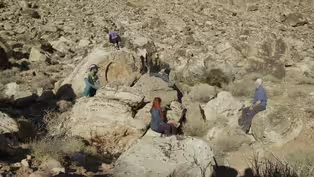
Meet the Climbers Fighting to Save Red Rock Canyon
Video has Closed Captions
Clip: S4 Ep7 | 12m 15s | Southern Nevada Climbers Coalition clean trails, clear trash & advocate for responsible recreation. (12m 15s)
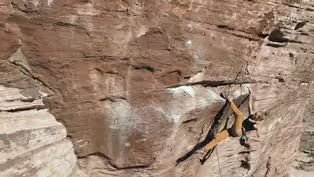
Why Red Rock Canyon Is a Climbing Mecca
Video has Closed Captions
Clip: S4 Ep7 | 12m 5s | Explore Red Rock Canyon’s world-class climbing and the community working to protect it. (12m 5s)
Providing Support for PBS.org
Learn Moreabout PBS online sponsorship












Support for PBS provided by:
Outdoor Nevada is a local public television program presented by Vegas PBS