
Did Xi get what he wanted out of Trump's China visit?
Clip: 5/15/2026 | 9m 51sVideo has Closed Captions
Did Xi get what he wanted out of Trump's China visit?
President Trump left China more or less empty-handed after his two-day summit in Beijing. The panel discusses if Xi Jinping got what he wanted out of Trump's visit to China.
Problems playing video? | Closed Captioning Feedback
Problems playing video? | Closed Captioning Feedback
Major funding for “Washington Week with The Atlantic” is provided by Consumer Cellular, Otsuka, Kaiser Permanente, the Yuen Foundation, and the Corporation for Public Broadcasting.
Did Xi get what he wanted out of Trump's China visit?
Clip: 5/15/2026 | 9m 51sVideo has Closed Captions
President Trump left China more or less empty-handed after his two-day summit in Beijing. The panel discusses if Xi Jinping got what he wanted out of Trump's visit to China.
Problems playing video? | Closed Captioning Feedback
Where to Watch Washington Week with The Atlantic
Washington Week with The Atlantic is available to stream on pbs.org and the PBS app.
Buy Now
10 big stories Washington Week covered
Washington Week came on the air February 23, 1967. In the 50 years that followed, we covered a lot of history-making events. Read up on 10 of the biggest stories Washington Week covered in its first 50 years.Providing Support for PBS.org
Learn Moreabout PBS online sponsorshipGood evening, and welcome to Washington Week.
On his way back from China, President Trump told reporters, we've settled a lot of different problems that other people wouldn't have been able to settle.
One thing that wasn't settled was China's support for Iran.
Another unsettled issue, American arms sales to Taiwan, and more broadly, American support for Taiwan.
Just as Trump's backing of America's European allies is an open question, so too is his support for Taiwanese freedom.
Joining me tonight to discuss the future of the planet, Peter Baker, the chief White House correspondent at The New York Times, Susan Glasser is a staff writer at The New Yorker, Mark Mazzetti is a Washington correspondent at The New York Times, and Nancy Youssef is a Pentagon correspondent and staff writer at The Atlantic.
Thank you all for joining me.
The future of the planet will be discussed tonight.
Peter, it seems like Xi Jinping got what he wanted out of the summit.
That fair?
Peter Baker, Chief White House Correspondent, The New York Times: Well, he was the host.
He was the dominant figure here, right?
Trump was the supplicant in a way coming to his territory, to his turf.
And he didn't give anything away, as far as we know, right now.
You never know if there are secretive agreements that we don't yet understand.
But, certainly, Trump did not get a breakthrough out of it, did not get any cooperation on the Strait of Hormuz, did not get any large trade deal.
And Xi got at least something of what he wanted in terms of Taiwan, some ambivalence at the very least on the part of the president.
Jeffrey Goldberg: Yes.
What could China do in the Strait of Hormuz?
Peter Baker: Well, they have a little impact on Iran, obviously.
They, over the years, have been one of Iran's bigger customers and they could, in fact, play it either way.
They could pressure Iran to come to the table and make some concessions, or they could in fact supply them with weapons to help them fight the war against us, and that's the question there.
Jeffrey Goldberg: You point to Mark Mazzetti like he's the weapons supplier.
Peter Baker: He's the weapons guy.
Jeffrey Goldberg: We'll get to that question in a minute of weapons supplier.
But, Nancy, let me ask you, so playing on this, if you're Taiwan's government right now, how are you feeling about America's commitment to your security?
Nancy Youssef, Staff Writer, The Atlantic: I think uneasy for a couple reasons.
One of the things that emerged from this was the president was unwilling to even talk about Taiwan until he was on the plane headed home.
They've been waiting for months for this $14 billion arms package, and we saw more ambivalence from the president about funding that, and the unwillingness to sort of definitively say that the U.S.
is ready to stand by its policy.
President Xi was willing to definitively say that any involvement by the United States would lead to a clash.
It was not reciprocated by the United States in its willingness to equally say that it would continue to defend its position.
So, I think if you're in Taipei right now, there's reason to be nervous.
In addition, militarily, the United States has moved a lot of its naval resources to the Middle East.
And so some of the defenses that we have had in the region, some of our commitment militarily has shifted towards the Middle East.
Jeffrey Goldberg: And the U.S.
has also spent down some of the stockpiles of the missiles fired by these weapons systems, correct?
Nancy Youssef: That's right.
So a lot of the air defense systems that we kept in places like South Korea, that we kept in the region, were moved over to the Middle East for the war in Iran.
And it'll take years to rebuild those stockpiles.
Jeffrey Goldberg: So, Susan, let me ask you about two even more important allies in Asia, South Korea and Japan, and you're watching Donald Trump, not just these last two days, but watching Trump's general performance and demeanor when it comes to Asia.
What are you thinking right now?
Susan Glasser, Staff Writer, The New Yorker: Yes, I mean, you know, I think there was an enormous amount of trepidation looking in advance of the summit on the part of America's allies.
They've seen how Donald Trump has treated Europe.
Nancy mentioned the air defense.
South Korea paid a large amount of money to be stationed with THAAD air missile defense system.
Donald Trump had already, even before the summit, had to pull it out because of the war in the Middle East.
And so I think what Donald Trump has made very clear is that no matter what's written on paper, no matter what laws are passed by Congress, there's no permanent commitments or alliances as far as he's concerned.
And I think you also have to juxtapose these things.
For the last decade, basically, Republicans as well as Democrats in Washington have been signaling to our partners in Asia, you know, now is a different moment.
We see China as a much more significant long-term threat, our only peer competitor, the major rivalry of the 21st century.
Donald Trump, in just a few days, has sort of abandoned that position.
And I think that, in some ways, we're so inured to how radical and disruptive Trump has been to American foreign policy and domestic policy that we kind of need to take a breath and say, if any other president of our recent lifetime, Democrat or Republican, had gone to China and said the things that Donald Trump has been saying, we would be having major front-page headlines saying Donald Trump reverses American foreign policy in Asia.
Jeffrey Goldberg: Yes.
Mark, it does seem like Xi accomplished one mission, which is to convince the world that the Americans see China as their peer.
Is that fair?
Mark Mazzetti, Washington Correspondent, The New York Times: I mean, President Trump was effusive in his praise of President Xi, calling him a great leader.
President Xi reciprocated by playing YMCA by the Village People, and that made President Trump very happy.
He was -- as Peter said, it was sort of as a supplicant, and it was it was a very good show for President Xi.
And as Nancy said, he sort of cast some doubt on the question of Taiwan, right?
President Trump infused a little bit of doubt about weapons and the support of Taiwan, which is sort of this bedrock policy of the United States.
Jeffrey Goldberg: But going to this -- I want you to watch -- I want you to watch Trump talking about China.
This is on the plane ride back about deference.
Reporter: Did you talk to him about the cyber attacks that he's done in the United States or the MSS has done?
Donald Trump, U.S.
President: I did.
And he talked about attacks that we did in China.
You know, what they do, we do too.
I told him, we do a lot of stuff to you that you don't know about, and you're doing things to us that we probably do know about.
But we do plenty.
It's a double-edge sword.
Jeffrey Goldberg: You've covered intelligence for years.
Very unusual for an American president to say, yes, they do stuff to us.
We do stuff to them.
They don't even know some of the stuff that we do, wink, wink.
That's going to Susan's point, we're not -- we're still not used to seeing that kind of presidential behavior.
Mark Mazzetti: Yes.
It's a theme over the last several weeks that the administration did not want to disrupt the summit, intelligence be damned, about what China was doing, right?
So, we reported a couple stories about how China was -- well, it's a little murky exactly how many weapons have been shipped to Iran or the extent of the weapon shipments, but there are some plausible deniability, and there were shipments of missiles that have gone to Iran from China.
The president and the administration didn't want to talk about this much.
He wanted to talk about, well, we've mostly been good on Iran, okay?
Jeffrey Goldberg: Talk about your reporting a little bit on this question.
Mark Mazzetti: Yes.
So, we reported over the last few weeks that there is intelligence that China has tried to use third-party countries to ship at least one large shipment of shoulder-fired missiles called MANPADS that can shoot down helicopters, jets.
We saw this in Afghanistan.
And so this is China dipping their toe in the water in the military confrontation in Iran.
And then the question is, of course, well, so what does China want?
I mean, they're not -- they don't want Iran to have a nuclear weapon but they don't want to bail the United States out of a mess that the United States is currently in.
So, they're going to make it hard, and as we saw the last couple days, they're not going to make it easy on President Trump to get out of this.
Jeffrey Goldberg: China and Russia, generally speaking, enjoy when America goes on big adventures in the Middle East.
Mark Mazzetti: Sure and they are happy if this continues for some time.
Not forever, but for some time.
And, of course, as we said, they're looking at this very, very closely with the drawdown in the munitions for what it really matters to them, which is Taiwan.
Jeffrey Goldberg: Okay.
Come back just from the perspective of an intelligence reporter.
Come back to this -- the way that Trump presents information to the world, yes, we spy on them, too.
I don't recall presidents kind of flippantly and openly talking about this kind of tit-for-tat.
It's not only revealing of information that probably shouldn't be revealed, but it also sort of goes to this, in his own mind, kind of a moral equivalence, like, yes, they do it to us, but we do it to them, so we're all pretty bad.
Mark Mazzetti: Right.
Remember, recall the famous Putin meeting, right?
Jeffrey Goldberg: Helsinki.
Mark Mazzetti: Right, in Helsinki, where he talks about the U.S.
intelligence assessment on the Russia, on the election.
So, it -- Jeffrey Goldberg: Right.
Just to remind people that's when he said he doesn't believe U.S.
-- he doesn't believe U.S.
intelligence because Putin said it didn't happen.
Mark Mazzetti: Right.
And so Putin says it, so, you know, who are we to believe here, right?
And in this issue, now maybe, you know, there's good reason to downplay and not spill out into public some really sort of hot intelligence operations going on.
There may be some reason to do that.
But as you say, there is a kind of equivalence that he's downplaying and making it kind of seem like it's no big deal.
And we're talking about very significant cyber operations that the Chinese have been involved in.
Jeffrey Goldberg: Right.
Did Trump -- do we know if Trump brought up privately with Xi, did the administration give any indication that they brought up with Xi this movement of Chinese weapons toward Iran?
Mark Mazzetti: Not that we know of.
And whether it was done behind the closed doors, whether it was done in other bilateral meetings or you know, in intelligence channels, we're not sure.
We certainly know they weren't trying to make a big deal of it before the summit.
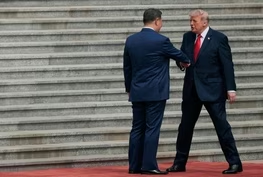
What role does China play in resolving the Iran war?
Video has Closed Captions
What role does China play in resolving the Iran war? (13m 27s)
Providing Support for PBS.org
Learn Moreabout PBS online sponsorship New Episode
- News and Public Affairs

Top journalists deliver compelling original analysis of the hour's headlines.
 New Episode
- News and Public Affairs

FRONTLINE is investigative journalism that questions, explains and changes our world.
 New Episode
 New Episode
 New Episode
 New Episode
 New Episode
 New Episode
 New Episode


Support for PBS provided by:
Major funding for “Washington Week with The Atlantic” is provided by Consumer Cellular, Otsuka, Kaiser Permanente, the Yuen Foundation, and the Corporation for Public Broadcasting.