
As setbacks mount, Trump turns his anger toward the media
Clip: 10/2/2026 | 6m 19sVideo has Closed Captions
As setbacks mount, Trump turns his anger toward the media
As he gets agitated over losses that are piling up, President Trump has turned his anger toward a familiar target, the media. The panel discusses the assault on press freedom.
Problems playing video? | Closed Captioning Feedback
Problems playing video? | Closed Captioning Feedback
Major funding for “Washington Week with The Atlantic” is provided by Consumer Cellular, Otsuka, Kaiser Permanente, the Yuen Foundation, and the Corporation for Public Broadcasting.
As setbacks mount, Trump turns his anger toward the media
Clip: 10/2/2026 | 6m 19sVideo has Closed Captions
As he gets agitated over losses that are piling up, President Trump has turned his anger toward a familiar target, the media. The panel discusses the assault on press freedom.
Problems playing video? | Closed Captioning Feedback
Where to Watch Washington Week with The Atlantic
Washington Week with The Atlantic is available to stream on pbs.org and the PBS app.
Buy Now

10 big stories Washington Week covered
Washington Week came on the air February 23, 1967. In the 50 years that followed, we covered a lot of history-making events. Read up on 10 of the biggest stories Washington Week covered in its first 50 years.Providing Support for PBS.org
Learn Moreabout PBS online sponsorshipJeffrey Goldberg: I want to pivot to something else that is also important to him, which is the re-litigating the 2020 election, which he of course lost, but which he says he won.
We saw something very odd in Congress this week a hearing in which the former prosecutor, Jack Smith, was testifying and Senator Eric Schmitt tried to trap Smith but managed to trap himself.
Why don't we just watch this for a minute?
Sen.
Eric Schmitt (R-MO): What would you say if I had a series of text messages from your team that said you were in Atlanta at a Warrior Hawks game on February 3rd, 2024, the day after Willis and Wade announced their affair?
You -- I don't think you know that we have this stuff.
So, I'll give you a second to process it so you don't, you know, perjure yourself.
Jack Smith, Former Special Counsel: I recall going to a University of Maryland basketball game where Caitlin Clark was playing right around that time.
Sen.
Amy Klobuchar (D-MN): Could it then be that University of Iowa is the Hawkeyes?
Could that be it?
That might be the confusion over the names of the team, but perhaps you should have looked at it more carefully.
Jeffrey Goldberg: I just want to remind all of you that we're the country that won World War II.
Apart from just being embarrassing for Senator Schmitt it's revealing insight into what preoccupies many Republicans in the legislative branch even today.
Is that fair to say that they -- the question that I have is he doing that because Trump wants him to do it, or is it because it's more widespread as an organic concern within the party?
Michelle Price, White House Reporter, Associated Press: Well, what we see often in hearings, whether it's somebody who's, who works for the administration who's testifying or it's the members themselves, it is all a performance, it is all a show.
They know that the president likes to watch C-SPAN.
He likes to watch the hearings.
There is kind of an audience of one going on here.
And, you know, I don't know how much Eric Schmitt personally -- he may personally care about getting Jack Smith, but it is very clear that this is a thing that President Trump cares a lot about.
And if you are a Republican member of Congress, you kind of live and die politically based on your standing with the president in most cases right now.
And showing that you're taking all these steps to kind of further his causes, the things that are important to him, that's how you remain in good standing.
Steve Inskeep, Host, NPR: There's another part of that exchange that was remarkable to me, and that is that Senator Schmitt, having had this misapprehension about where Smith was, says, and you're a dirt bag, used the word dirt bag.
And Senator Klobuchar effectively asked him to take that back.
He said, no, I stand by that.
And so his facts have been exposed as not facts, but it's like, I'm calling the name.
I'm going to go with the name.
And that I wouldn't say that's just him.
That is our politics right now.
It's can you land the name?
Can you stick the landing on the name?
Jeffrey Goldberg: Right.
Steve Inskeep: And he went there, and that's, that was the product of that exchange.
Jeffrey Goldberg: Right.
Zolan, you wrote recently about the president as he gets more agitated about losses that may be piling up, that he's turning his attention to the media more than ever.
And you write that, you know, he stripped funding from public television and radio, the Pentagon fired the editor and publisher of Stars and Stripes, et cetera, and he's thrown whole networks and news organizations out of the White- or is trying to throw them out of the White House.
Post-election, would a Democratic Congress be effective at protecting press rights, or is he going to double down on this rolling assault?
Zolan Kanno-Youngs, White House Correspondent, The New York Times: Well, I think the current litigation that we're seeing both with the Associated Press as well as this case involving MS NOW, CNN and Politico is going to matter a good amount, not just for entry onto White House grounds, but just how much power the president has over what's called the White House Pool, which I take every opportunity I can to inform people really matters, right, in terms of tracking where the president goes and having independent journalists put questions to him that are actually critical and seeking of the truth.
Will Congress be able to actually shield the press?
I don't know.
But what we do see already is a trend where when the president's power is being questioned in the lead up to that ban, lost in the Supreme Court on mail ballots, right, Kennedy Center loss as well.
So, as he continues to face pushback, you see him try to assert power over one of his more favorite foes, right, the media.
Jeffrey Goldberg: Yes.
Michelle, you're a direct -- you're directly involved in this.
How has your life as a journalist been changed by this, or has it?
Michelle Price: I mean, we still do our jobs.
We will always still do our jobs.
We still cover this administration.
We cover it a little differently sometimes if we can't be in the room, but we would never stop covering the most powerful person arguably on the planet because of this.
You know, this is a matter of free speech.
Our court case is ongoing, and people can read the filings, but we feel it's very important.
And to Zolan's point, it's not just about who's asking the questions, and they're being tough questions, but it's called a protective pool.
It is also so that there is independent record of the president, his movements, especially in those worst case scenarios.
This is a president who had -- who's had multiple attempts on his life.
When he was at -- on that stage at Butler, there is no protective pool.
There was no pool of reporters going with him to the hospital.
There are conspiracy theories that kind of sprout up because people did not see where he went.
There's no film footage.
So, it serves a broader purpose for the American public and just for the continuity of the office.
It's important.
Steve Inskeep: Can I just add something about the effect of this?
I don't feel that any of this has prevented any of the coverage that the president would not like.
The media are still doing their jobs.
As a reporter, I've often felt when someone refused to talk to me, I sometimes ended up with a better story because it forced me to work harder and go to other sources and find other information.
I'm still reading Associated Press dispatches that I learn from.
I'm still seeing good reporting on CNN and other news outlets.
I'm on my way over here and reading The New York Times and learning a story that says that the president personally ordered $20 million in ads to be spent on himself, government funding for ads.
We knew about the ads, but did not know his personal involvement.
And I'm continuing to learn those things.
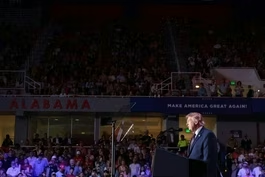
Trump makes himself main character of GOP midterm campaign
Video has Closed Captions
Trump makes himself main character of GOP midterm campaign (16m 30s)
Providing Support for PBS.org
Learn Moreabout PBS online sponsorship New Episode
- News and Public Affairs

Top journalists deliver compelling original analysis of the hour's headlines.
 New Episode
- News and Public Affairs

FRONTLINE is investigative journalism that questions, explains and changes our world.



 New Episode

 New Episode


 New Episode
Support for PBS provided by:
Major funding for “Washington Week with The Atlantic” is provided by Consumer Cellular, Otsuka, Kaiser Permanente, the Yuen Foundation, and the Corporation for Public Broadcasting.