
Trump embraces Xi as he turns up attacks on American media
Clip: 9/25/2026 | 16m 58sVideo has Closed Captions
Trump embraces Xi as he turns up attacks on American media
It’s been a busy week in Washington. A state visit from China’s president, a new campaign launched by the American president against the media. There are also more signs that Republicans are distancing themselves from Trump, which might explain why he’s so angry at the media, because you have to take out your frustration on someone.
Problems playing video? | Closed Captioning Feedback
Problems playing video? | Closed Captioning Feedback
Major funding for “Washington Week with The Atlantic” is provided by Consumer Cellular, Otsuka, Kaiser Permanente, the Yuen Foundation, and the Corporation for Public Broadcasting.
Trump embraces Xi as he turns up attacks on American media
Clip: 9/25/2026 | 16m 58sVideo has Closed Captions
It’s been a busy week in Washington. A state visit from China’s president, a new campaign launched by the American president against the media. There are also more signs that Republicans are distancing themselves from Trump, which might explain why he’s so angry at the media, because you have to take out your frustration on someone.
Problems playing video? | Closed Captioning Feedback
Where to Watch Washington Week with The Atlantic
Washington Week with The Atlantic is available to stream on pbs.org and the PBS app.
Buy Now

10 big stories Washington Week covered
Washington Week came on the air February 23, 1967. In the 50 years that followed, we covered a lot of history-making events. Read up on 10 of the biggest stories Washington Week covered in its first 50 years.Providing Support for PBS.org
Learn Moreabout PBS online sponsorshipJeffrey Goldberg: I want to turn to the visit by President Xi to Washington for a state visit.
There are flyovers, a lot of planes, and a lot of fancy dinners, but not much happened.
I mean, unless I'm wrong, Adam.
Adam Harris, Host, Radio Atlantic: We got a lot of platitudes out of it.
We got an extension of this sort of almost like ceasefire in the trade war temporarily, but I think -- Jeffrey Goldberg: Like a two-month extension.
Adam Harris: A two-month extension, exactly right.
Well, we came into this week with the idea that they would be talking about A.I., right, all of the warnings that we've been getting from kind of across the political spectrum.
You had Scott Bessent who said that he met with his counterpart in China and that they had discussed a potential sort of like red phone for A.I.
and a warning system on the back end.
But, you know, several days on, what we have seen is that, you know, China didn't come with any of its CEOs in the same way that Trump came with CEOs to -- when he made his visit to China.
So, it was almost as if they were in two different places, right, where Trump likes to move fast and negotiate and say, oh, we want to, we're going to get a deal done right now, where China's saying, well, we're still trying to thaw this relationship that has been sort of tense and, you know, you've, going through a series of retaliatory trade tariffs and -- Jeffrey Goldberg: I bet OpenAI is building that red phone right now.
That'll be good.
It'll be manned by a bot.
The -- and, Susan, I want to talk about the A.I.
in China because that was the -- if there had been consequential outcomes here, that would have been a consequential outcome.
This is what Xi said this week about A.I.
Both China and the United States are leading nations in artificial intelligence.
We have both the capability and responsibility to develop and manage A.I.
for good and ensure that the development of A.I.
is always under human control and serves the wellbeing of the people.
Trump, on the other hand, said this week at the U.N., the United States also totally rejects any attempt to construct a globalist scheme to control for the artificial intelligence being spoken of so much now.
Hereinafter officially called super intelligence, changing the name and that the use of the word artificial makes intelligence fake.
It makes it sound fake.
Okay, so we're in a weird situation, not the first time we've been in a weird situation, that the leader of the Communist Party dictatorship that rules China, rhetorically at least, sounds more with it, maybe than the president of the United States on this subject.
Talk through their differing approaches.
Susan Glasser, Staff Writer, The New Yorker: Yes.
No, Jeff, I mean, if anything, the quote that you read, you know, it's certainly eyebrow-raising if the president -- his A.I.
approach is to say, I'd like to rebrand it.
You know, it's not a branding problem that's causing these engineers to say that there's -- Jeffrey Goldberg: What's the expression?
You know that expression in Washington, sometimes you have a P.R.
problem and sometimes you just have a problem?
Susan Glasser: Yes, exactly.
Jeffrey Goldberg: I think these companies have a problem.
Susan Glasser: Like, Houston, we have a problem, right?
Jeffrey Goldberg: Yes.
Susan Glasser: I mean, you know, the people who are building A.I., you know, a good proportion of them are warning us that there's not a zero chance risk of them destroying humanity, as we know it.
And, apparently, that has taken a second priority for the president of the United States to rebranding A.I.
and also showing the leader of China his new helipad.
But, you know, if anything what I was going to say, Jeff, is that your quote is one of the less embarrassing quotes, if that's possible, that Donald Trump gave about artificial intelligence this week.
At his speech at the United Nations General Assembly, he talked about rebranding A.I.
He also talked about the fact that A.I.
was just another hoax, like, quote, Russia, Russia, Russia, like climate change, and all the other things that they're trying to fool us with.
And so what's fascinating to me is that Donald Trump is now viewing the sort of A.I.
doom warnings coming, again, from inside Silicon Valley itself.
He's now saying that's some kind of a Democratic hoax, like his collusion with Russia in the 2016 campaign.
Jeffrey Goldberg: Right.
Susan Glasser: And it shows the extreme personalization of power.
He came out after his first meetings with Xi the other day and he said, I don't want to do anything about Russia.
Our guardrail -- sorry, about A.I., our guardrail for A.I.
is the Department of Justice.
Jeffrey Goldberg: Our guard -- Vivian, what - - the personalization of power is interesting idea.
Why is Trump slotting A.I.
into this kind of reaction narrative?
In other words, why is he taking the side of untrammeled A.I?
Vivian Salama, Staff Writer, The Atlantic: I mean, there's the argument that he doesn't quite understand how it works, and this is something that we hear a lot -- Jeffrey Goldberg: To be fair, that we share some of that.
I mean, nobody really -- there's a few hundred people who might understand how it works.
Vivian Salama: No judgment.
No judgment.
Jeffrey Goldberg: Yes, no judgment.
Yes.
Vivian Salama: Just putting it out there is that, you know -- Jeffrey Goldberg: Just being fair.
Vivian Salama: -- he's someone who doesn't use email and, like, you know, he's just maybe of a generation or just the type of man that he is, that he just doesn't really delve into these issues very deeply.
There's also the business side of it.
I mean, we were just talking about the business opportunities, you know.
Yes, Xi did not show up with CEOs, but the entire state dinner with Xi was packed with tech CEOs from the United States, who Trump very eager to kind of get them having a leg up in businesses and especially in China where there are opportunities for cooperation for American businesses to kind of take advantage of some, you know, of the market there.
And I think he sees it as, you know, let's wait and see if this is going to be good for American business before we cast judgment too much on this technology.
And, of course, you have people like J.D.
Vance and others who are younger and a little bit more - - I'm not ageist, but putting it out there, you know, he has came from Silicon Valley and kind of is a little bit more immersed in things like this and he's a little more cautious with his language.
Jeffrey Goldberg: Yes.
I noticed at the state dinner, the head table, Trump and Xi, Jensen Huang, the NVIDIA chairman, who's quite bullish in that Trumpian kind of it's all going to be fine, and Elon Musk, by the way, always a surprise guest at the White House these days, who has been warning about A.I.
And what a fascinating conversation that could have been because you have the Chinese -- we've been told in this country beware of China and its autocratic development of A.I., killer robots and killer everything.
But then you have an American president who is taking a kind of extreme libertarian view.
It's all very muddled now to try to make sense of this.
Peter Baker, Chief White House Correspondent, The New York Times: It also is sort of this kind of an arms race view of it as well.
Jeffrey Goldberg: Yes.
Peter Baker: Like, you know, if we don't do it, China will.
And, you know, look, there is an argument that, you know, could we trust China to restrain itself even if we did come to some sort of an international accord, right?
Had they been good actors on the stage before?
It's an open question.
But this reminds us of the early days of the Cold War when nuclear arms were still being developed by only a handful of countries, and we tried to figure out how do we keep that genie back in the bottle?
Jeffrey Goldberg: Right.
Vivian I noticed that -- as you have, that the summit ended in a kind of typical way with the Chinese ultimately coming back to the thing that obsesses them, Taiwan.
Vivian Salama: The Chinese put out a statement while President Trump was very keen to just put out that it was a great meeting, they did lots of great things.
The Chinese put out a very flowery statement where they talked about cooperation and partnership and, you know, the need to enhance their strategic cooperation.
And then tucked in like paragraph number five was this very stern statement about the need to respect China's, you know, territorial claims over Taiwan.
And basically in summary, the U.S.
needs to stay out of it.
And that is very keen, especially because of the fact that President Trump has never really been explicit about his views on Taiwan, and he's sort of taking a wait-and-see approach on what kind of positions invest with Xi.
There's been major concerns that he will kind of throw in the kitchen sink or Taiwan if he's to get a China deal.
And so this has been a concern here in Washington, especially including among Republicans who don't want to see that.
Jeffrey Goldberg: So, at the end of this summit, we're back where we were before.
We have no sense of whether -- we understand that China's preoccupied with taking Taiwan by force possibly.
And we have no sense of whether the president of the United States will actually do what other presidents we think would have done, which is defend Taiwan.
Vivian Salama: And his advisers tell me, you know, there is no change in the U.S.
policy toward Taiwan.
And I say, well, why doesn't the president just say that?
And they say, the president's going to do what he's going to do.
Jeffrey Goldberg: Well, I'm going to do what I'm going to do and pivot to -- well, it's all Trump, alas, here we are.
But the press crisis that we're having, Adam, I wanted to show you a clip of President Trump addressing Kaitlan Collins from CNN.
You all remember that he just booted MS NOW, CNN, Politico, a judge ordered them back.
But we're in this endless back and forth with the President Trump deciding arbitrarily which reporters are allowed to come onto the White House grounds.
Just watch this one thing with us.
Donald Trump, U.S.
President: It's an honor to be here.
I'm surprised that CNN is here covering me.
You shouldn't be here.
Kaitlan Collins, Anchor and Chief White House Correspondent, CNN: The United Nations allowed us in, sir.
Trump: You should not be here covering me.
You say you weren't going to cover me.
You shouldn't be covering me.
Jeffrey Goldberg: Adam, what's so interesting to me is that he thinks, based on this performance, that he actually is in charge of the press.
Adam Harris: Yes.
You know, it's been his M.O.
for the last, you know, decade-plus.
I mean, even when he was a private citizen, this was his M.O., which was trying to control the press, right?
There are reports of him even kind of going back to where he would call reporters and pretend to be his own press secretary.
This is like his thing.
Jeffrey Goldberg: Who among us doesn't do that?
Adam Harris: Who -- you know, if I could.
But I think what we are seeing is a, a president who feels increasingly cornered.
You think about the economy, you think about the sort of losing battles across the board, whether that is with Iran, whether that is the sort of warnings on A.I.
that might -- in his argument, right, slow down the economy because data centers have been propping up and the building of data centers have been propping up so much economic activity, that he has defined a sort of enemy, and the press is his usual enemy that he goes to.
Jeffrey Goldberg: Right.
Vivian, you were actually on pool duty today at the White House.
What's the feeling over there this week?
It must be strange.
Vivian Salama: It was very strange.
You know, there was definitely a sigh of relief that the reporters who were banned were back, but there's also an eerie feeling, and I'm sure they all -- you know, Peter and Susan can attest to this, that there's an eerie feeling that it's not done yet.
And, obviously, the unprecedented action taken by the president has really shaken the press corps because it is a violation of the First Amendment, just blatantly so, to ban anyone from the White House grounds, let alone any kind of pool sprays and things like that, is next level.
Jeffrey Goldberg: Yes.
Vivian Salama: And I just want to point out the irony of all of this is that this week ended with a very quick tour to the National Archives today with President Xi before he took off, and President Trump showcasing a lot of the old democratic documents, the Founders' documents, and the last one that he showed him was the Bill of Rights on this day.
That's the -- Jeffrey Goldberg: An opportunity for both presidents to learn about the First Amendment.
Vivian Salama: About the -- well, you know, right there in, in writing was the First Amendment that talked about freedom of the press, and Trump's standing next to this authoritarian leader who tightly controls the press in his country, and he is trying to sort of show off these documents with pride while also kind of undermining them back at the White House.
Jeffrey Goldberg: Right.
Vivian Salama: It's a very strange reality.
Jeffrey Goldberg: Right.
Susan, I want to read something that you wrote this week about the president's new and possibly precarious position in his own party.
40 days before the midterm elections, Washington is increasingly consumed not by Trump's endless antics so much as by the rapidly clarifying political reality of the predicament in which the president, deeply unpopular and trapped in an unwon war -- I like that expression -- of his own choosing in the Middle East, has got himself and his party.
A reckoning, one far harsher than was expected even a few months ago, now seems imminent.
There's a kind of a weird parallelism here with Netanyahu.
Counting out Trump is always a dangerous move for political commentary, but why is this moment different, do you think?
Susan Glasser: Well, I mean, look, what's fascinating is that you saw so many Republican-elected officials and candidates this week just almost at the same time hit the panic button.
You know, that's the phrase been used in some of the coverage.
There's a sense that Donald Trump hasn't figured out a way to dig out of the mess in time for them to better their party's fortunes in November.
Across the board, you're seeing the nonpartisan election ratings shifting in the direction.
I think just today, Cook Political Report had 15 more races that went in the direction of Democrats for the House of Representatives.
The Senate is far more in play.
I think if we had this conversation at the beginning of this year, Jeff, we would've been very skeptical that that was possible.
I don't think anyone's outright predicting it right now, but things that would've been not even conceivable.
We're talking about Democrats possibly, you know, looking to pick up a seat, a Senate seat in Iowa, you know, which is kind of remarkable.
Jeffrey Goldberg: And Donald Trump is going to Alaska next week to campaign, which is -- if a Republican president has to go campaign for a Republican in Alaska, that's not a great sign.
But, Adam, are you willing to go out on a limb in saying that the Democrats are going to take both houses of Congress?
Adam Harris: I -- going out on that limb is not my forte.
But what I will say, right, if you sort of look at the accumulation of data thinking about The New York Times had the focus group recently with voters down in Texas, where they were talking about Ken Paxton and James Talarico.
And the first thing as I was reading it was that this seems like a Roy Moore situation, where the -- for the folks who are looking at Ken Paxton and saying, this one -- this is someone who is so morally corrupt that I can't -- Jeffrey Goldberg: Roy Moore was the candidate in Alabama.
Adam Harris: Roy Moore's the candidate in Alabama who Doug Jones ends up -- ended up beating.
And to imagine having a Democrat in Alabama after the great switch was thought unthinkable.
And so considering the quality and the caliber of candidate thinking about Ken Paxton, but also the economic issues when you're considering that gas prices, diesel prices are up, you think about the owner/operator truck owners who are spending $1,200 to fend up -- fill up a 200-gallon tank, it's a lot to consider.
Jeffrey Goldberg: Right.
I mean, is that the number one issue, diesel and gasoline prices?
Ultimately, if you can't get those down, then you've lost.
Peter Baker: Yes, and you're not going to make a significant difference in the next six weeks probably.
But I think they're representative of a larger disappointment on the part of Trump voters.
Our colleague at the Times, Sabrina Tavernise, did a great story this week about the lack of trust on Trump voters as well as Democrat voters as well.
That's a challenge for both parties, but particularly for Trump, people who think they've lost faith in him.
One of the voters told her, I think I was sold a bill of goods.
They now have looked at Trump and said he didn't deliver on what he promised.
He promised a better economy, lower prices, no endless wars.
Well, guess what?
Economy is not good for a lot of people, prices are up, gas is up, and we are in what at the moment is an unwon war.
Jeffrey Goldberg: Right.
Coming back to this question of the Senate and the House, the Democrats need to flip four seats in the Senate.
In reality, is that going to be possible?
Adam Harris: I think it's more possible now than it was six months ago.
I think that's -- Jeffrey Goldberg: Texas?
Adam Harris: Texas.
If Texas is in play, then it does become a real -- Jeffrey Goldberg: And Michigan, where, El Sayed is actually in the lead in the polls.
Peter Baker: Although we did have polling this week saying Collins was ahead in Maine.
The Democrats really need Maine.
There's another poll saying she's not.
Jeffrey Goldberg: Collins is going to win Maine for the next 300 years.
Peter Baker: Well, she might, but most Democratic maps would suggest that Maine -- Jeffrey Goldberg: I take that back.
I don't want to be held again.
I don't want that to be held against me.
But that's a -- Collins is another survivor to me.
Peter Baker: She is a survivor.
But -- yes.
Susan Glasser: Well, Trump's trade war with Canada doesn't help in Maine, which is, you know, deeply affected and intertwined with the economy of Canada.
I think, you know, we'll see, but I think Collins is still a very vulnerable incumbent.
Jeffrey Goldberg: Vivian, last 30 seconds, the Iran war.
If he hadn't gone to war against Iran seven months ago, would he be in this shape?
Vivian Salama: I mean, we've actually seen this war splinter his party in some ways.
People who were devoutly supportive of the president now speaking out against him, condemning him and his decisions, it's really torn the party apart.
And we're going to see particularly after the midterms whether people like Vice President J.D.
Vance and others will be willing to take a firmer stance just to distinguish themselves moving forward.
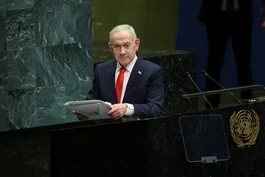
Egypt’s secret warning to Israel before Oct. 7
Video has Closed Captions
Egypt’s secret warning to Israel before Oct. 7 (6m 3s)
Providing Support for PBS.org
Learn Moreabout PBS online sponsorship New Episode
- News and Public Affairs

Top journalists deliver compelling original analysis of the hour's headlines.
 New Episode
- News and Public Affairs

FRONTLINE is investigative journalism that questions, explains and changes our world.



 New Episode


 New Episode


 New Episode
Support for PBS provided by:
Major funding for “Washington Week with The Atlantic” is provided by Consumer Cellular, Otsuka, Kaiser Permanente, the Yuen Foundation, and the Corporation for Public Broadcasting.