State of Affairs with Steve Adubato
Col. Callahan Discusses Diversity in NJ State Police Force
Clip: Season 8 Episode 3 | 9m 48sVideo has Closed Captions
Col. Callahan Discusses Diversity in NJ State Police Force
Colonel Patrick J. Callahan, Superintendent of the New Jersey State Police, talks with Steve Adubato about improving diversity within the state police force and rebuilding trust in black and brown communities.
Problems playing video? | Closed Captioning Feedback
Problems playing video? | Closed Captioning Feedback
State of Affairs with Steve Adubato is a local public television program presented by NJ PBS
State of Affairs with Steve Adubato
Col. Callahan Discusses Diversity in NJ State Police Force
Clip: Season 8 Episode 3 | 9m 48sVideo has Closed Captions
Colonel Patrick J. Callahan, Superintendent of the New Jersey State Police, talks with Steve Adubato about improving diversity within the state police force and rebuilding trust in black and brown communities.
Problems playing video? | Closed Captioning Feedback
How to Watch State of Affairs with Steve Adubato
State of Affairs with Steve Adubato is available to stream on pbs.org and the free PBS App, available on iPhone, Apple TV, Android TV, Android smartphones, Amazon Fire TV, Amazon Fire Tablet, Roku, Samsung Smart TV, and Vizio.
Providing Support for PBS.org
Learn Moreabout PBS online sponsorship[INSPRATIONAL MUSIC STING] - Hi everyone, Steve Adubato.
We kick off the program with Colonel Patrick Callahan, who is the superintendent of the New Jersey State Police.
Colonel, great to have you with us.
- Thanks for having me, Steve.
- You got it, there's so many issues we could talk about, but I wanna talk about this.
New Jersey, one of the most diverse states in the nation by any metric, even though people are segregated in all kinds of communities, our school districts, you're not on for that.
Let's talk about the diversity, if you will, within the state police.
More specifically, last year of the 3,117 New Jersey State troopers, 174 were women, 5.6%.
In New York state, the number of women who are state police officers, state troopers is 13%.
Why the challenge or why the problem as it relates to women in the force?
- You know what, I don't know, I don't have a great answer for as to the why, Steve.
I can speak to the initiatives that we've had in the last several years.
It disappoints me, even the last class that graduated did not have one Black female in that class.
I think, again, of our 3,200 to have 200 women, we have retired women who help us in that recruiting effort.
I do know that when they do get accepted into the academy, that very rarely do our women recruits leave.
We have eight in there now and they don't quit.
So I wish that they would not only see this program, but look to our women troopers as to a career path that is extremely rewarding and in a profession where we need more women.
- Colonel, put in perspective this whole question of diversity within the state police workforce.
Why is it so important to have more women, more state troopers of color in this state of New Jersey?
Put into context also the long history of racial profiling that had gone on in the state police adjudicated by the federal government.
The federal government came in and acknowledged that whole series of court cases, you can research it.
Why is it so important, Colonel?
- Well, I think it's important because I think it speaks to that national narrative about public trust.
And when we talk about where we draw our troopers from, you know, the police are the public, and the public are the police, but when we are asked to come into our inner cities, whether that's our capital in Trenton or Newark or Camden or Atlantic City, I think the public wants to see women and men in blue that look like them and that represent them.
I think there's an understanding and a relationship that this trooper knows what I've been through, or this trooper knows where I've come from.
And I think that that in and of itself will certainly help us get over those obstacles.
I was a young trooper when the Department of Justice came in for that consent decree, and now here we are almost 30 years later, Steve.
- That's right.
- And I think we need to do a much better job at having qualified and diverse recruits represent the New Jersey State Police because they're gonna make up the next 25 or 30 years of service to the citizens of this state.
- You know, Colonel, first of all, we appreciate your candor in this regard.
You're in no way trying to defend or explain away the problem with diversity in the state police and to exacerbate this issue or to explain it more clearly, three out of every four officers, state troopers are white.
Why has this been- It's one thing to talk about how hard it's been to attract women into the state police, but to what degree has it been particularly challenging to attract people of color into the state police?
- I think we do have to acknowledge the past.
I think of my father.
My father was a Jersey trooper who went and responded to Newark and to Plainfield.
And we can all envision those black and white footage of that civil unrest in those two major cities.
- 1967.
- '67, correct.
So here we are 57 years later and the impact, and those grandfathers and grandmothers who pass on that mistrust and that angst to the next generation.
I understand why there may be young Black women and men that may not wanna join a profession that historically had mistreated them, but what I'm asking is that if they want to see change and be a part of igniting change, that they become a part of that solution.
And I think we've made strides.
I think we need to do a lot better, but I think if they join us in that endeavor, I think we will get to a better place.
Understand that some troopers have confided in me.
I just met with the Black Troopers Coalition this week, and some of their communities, they don't wanna see them become troopers or law enforcement officers.
They feel that- - Why not?
- I think they feel that it's somewhat of a betrayal of sorts that why would you go join an organization that historically has not treated us well.
- Colonel, sorry for interrupting.
Do you think that you, your colleagues in law enforcement, are seen by some in the African American and potentially the Latino community as well, as quote unquote the enemy?
- Unfortunately I do, Steve.
I think I would be foolish not to think that when I've been a part of this discussion for 30 plus years, and I've sat in churches and I've sat in community town meetings and had hard conversations with pastors and community leaders, but I also point to the relationships and how far we've come.
I think back to George Floyd and his murder and the protests, thousands of thousands of protests in New Jersey, and we only had a handful of arrests.
And that's because of the time that we've spent in communities trying to, you know, humanize the badge and show a compassionate side to the New Jersey State Police, which I think is a, that's a daily, that's a daily endeavor that we have to undertake, that has to be rooted in genuine relationship.
- Colonel, before I let you go, what is the department in the United States Department of Justice Initiative, 30 by 30 initiative?
Is that 30% of new police officers, police recruits by 2030 be women?
- I don't, I'm not familiar with that initiative, Steve.
I'm sorry.
I don't know where that initiative was coming from.
- It's a 5-year-old initiative.
The federal government has this new initiative where they're talking about 30 by 30.
The goal, if you will.
- Right.
- It's interesting.
It's this federal initiative, but it's only the state police, in the state police in every state that would make a difference.
The Department of Justice may have that goal, but they're not getting that done, Colonel, correct?
No disrespect to them.
It's your job.
- Nothing against our federal partners, but there's over 500 police departments in New Jersey.
We make up, you know, 3000 plus of the enlisted members.
There's another 35,000 or so law enforcement officers, but I know the state police, we embrace that type of scrutiny, Steve, each and every day.
Either you're on the wrong profession if you don't wanna take on that scrutiny.
But as I said, I want our young Black and brown community members to think about a profession where they can go out and serve and become part of that change that we've listened to for five decades that we want it to be a part of.
And I hope, and in seeing this, that they would like to join that endeavor.
- Colonel Pat Callahan, who heads up the state police in the state of New Jersey with a long and complex history there.
Thank you, Colonel.
We appreciate it.
Thank you.
- Thank you, Steve.
- You got it.
Stay with us, we'll be right back.
- [Narrator] State of Affairs with Steve Adubato is a production of the Caucus Educational Corporation.
Celebrating 30 years in public broadcasting.
Funding has been provided by The Turrell Fund, a foundation serving children.
The New Jersey Education Association.
RWJBarnabas Health.
Let’s be healthy together.
The Port Authority of New York and New Jersey.
Rowan University.
New Jersey’s Clean Energy program.
Johnson & Johnson.
Horizon Blue Cross Blue Shield of New Jersey.
NJM Insurance Group.
And by these public spirited organizations, individuals and associations committed to informing New Jersey citizens about the important issues facing the Garden State.
Promotional support provided by The New Jersey Business & Industry Association.
And by New Jersey Globe.
(light music) - The New Jersey Board of Public Utilities, in partnership with utility companies throughout the state, can help you save money and create a more comfortable home through Comfort Partners, a free program that helps income-eligible customers reduce their utility bills through cost-effective measures that save energy, including lighting, hot water heaters, large appliances, heating and cooling improvements, insulation, and much more.
Learn more at NJCleanEnergy.com/CP.
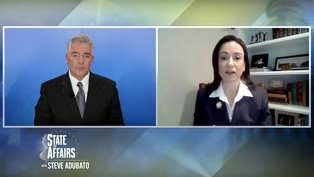
Making The Child Tax Credit More Accessible for NJ Families
Video has Closed Captions
Clip: S8 Ep3 | 9m 59s | Making The Child Tax Credit More Accessible for NJ Families (9m 59s)
Modernizing the School Funding Formula in The Garden State
Video has Closed Captions
Clip: S8 Ep3 | 9m 6s | Modernizing the School Funding Formula in The Garden State (9m 6s)
Providing Support for PBS.org
Learn Moreabout PBS online sponsorship
- News and Public Affairs

Top journalists deliver compelling original analysis of the hour's headlines.

- News and Public Affairs

FRONTLINE is investigative journalism that questions, explains and changes our world.












Support for PBS provided by:
State of Affairs with Steve Adubato is a local public television program presented by NJ PBS