State of Affairs with Steve Adubato
Col. Patrick J. Callahan; Sen. Vin Gopal; Asw. Aura Dunn
Season 8 Episode 3 | 27m 53sVideo has Closed Captions
Col. Patrick J. Callahan; Sen. Vin Gopal; Asw. Aura Dunn
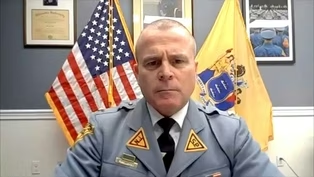
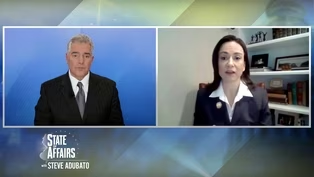
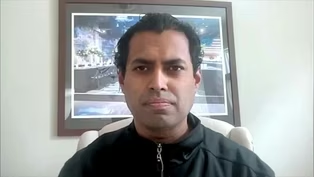
Colonel Patrick J. Callahan, Superintendent of the NJ State Police, talks about improving diversity in the police force and rebuilding trust in communities. Sen. Vin Gopal, Democratic Conference Chair & Senate Education Committee Chair, discusses modernizing NJ’s school funding formula. Asw. Aura Dunn, Republican Assistant Minority Whip, discusses making the Child Tax Credit more accessible.
Problems playing video? | Closed Captioning Feedback
Problems playing video? | Closed Captioning Feedback
State of Affairs with Steve Adubato is a local public television program presented by NJ PBS
State of Affairs with Steve Adubato
Col. Patrick J. Callahan; Sen. Vin Gopal; Asw. Aura Dunn
Season 8 Episode 3 | 27m 53sVideo has Closed Captions
Colonel Patrick J. Callahan, Superintendent of the NJ State Police, talks about improving diversity in the police force and rebuilding trust in communities. Sen. Vin Gopal, Democratic Conference Chair & Senate Education Committee Chair, discusses modernizing NJ’s school funding formula. Asw. Aura Dunn, Republican Assistant Minority Whip, discusses making the Child Tax Credit more accessible.
Problems playing video? | Closed Captioning Feedback
How to Watch State of Affairs with Steve Adubato
State of Affairs with Steve Adubato is available to stream on pbs.org and the free PBS App, available on iPhone, Apple TV, Android TV, Android smartphones, Amazon Fire TV, Amazon Fire Tablet, Roku, Samsung Smart TV, and Vizio.
Providing Support for PBS.org
Learn Moreabout PBS online sponsorship- [Narrator] Funding for this edition of State of Affairs with Steve Adubato has been provided by The Turrell Fund, a foundation serving children.
The New Jersey Education Association.
RWJBarnabas Health.
Let’s be healthy together.
The Port Authority of New York and New Jersey.
Moving the region through air, land, rail, and sea.
Rowan University.
Proudly serving New Jersey for 100 years.
New Jersey’s Clean Energy program.
Lighting the way to a clean energy future.
Johnson & Johnson.
Horizon Blue Cross Blue Shield of New Jersey.
Here when you need us most.
And by NJM Insurance Group.
Serving New Jersey’s drivers, homeowners and business owners for more than 100 years.
Promotional support provided by The New Jersey Business & Industry Association.
And by New Jersey Globe.
[INSPRATIONAL MUSIC] - Hi everyone, Steve Adubato.
We kick off the program with Colonel Patrick Callahan, who is the superintendent of the New Jersey State Police.
Colonel, great to have you with us.
- Thanks for having me, Steve.
- You got it, there's so many issues we could talk about, but I wanna talk about this.
New Jersey, one of the most diverse states in the nation by any metric, even though people are segregated in all kinds of communities, our school districts, you're not on for that.
Let's talk about the diversity, if you will, within the state police.
More specifically, last year of the 3,117 New Jersey State troopers, 174 were women, 5.6%.
In New York state, the number of women who are state police officers, state troopers is 13%.
Why the challenge or why the problem as it relates to women in the force?
- You know what, I don't know, I don't have a great answer for as to the why, Steve.
I can speak to the initiatives that we've had in the last several years.
It disappoints me, even the last class that graduated did not have one Black female in that class.
I think, again, of our 3,200 to have 200 women, we have retired women who help us in that recruiting effort.
I do know that when they do get accepted into the academy, that very rarely do our women recruits leave.
We have eight in there now and they don't quit.
So I wish that they would not only see this program, but look to our women troopers as to a career path that is extremely rewarding and in a profession where we need more women.
- Colonel, put in perspective this whole question of diversity within the state police workforce.
Why is it so important to have more women, more state troopers of color in this state of New Jersey?
Put into context also the long history of racial profiling that had gone on in the state police adjudicated by the federal government.
The federal government came in and acknowledged that whole series of court cases, you can research it.
Why is it so important, Colonel?
- Well, I think it's important because I think it speaks to that national narrative about public trust.
And when we talk about where we draw our troopers from, you know, the police are the public, and the public are the police, but when we are asked to come into our inner cities, whether that's our capital in Trenton or Newark or Camden or Atlantic City, I think the public wants to see women and men in blue that look like them and that represent them.
I think there's an understanding and a relationship that this trooper knows what I've been through, or this trooper knows where I've come from.
And I think that that in and of itself will certainly help us get over those obstacles.
I was a young trooper when the Department of Justice came in for that consent decree, and now here we are almost 30 years later, Steve.
- That's right.
- And I think we need to do a much better job at having qualified and diverse recruits represent the New Jersey State Police because they're gonna make up the next 25 or 30 years of service to the citizens of this state.
- You know, Colonel, first of all, we appreciate your candor in this regard.
You're in no way trying to defend or explain away the problem with diversity in the state police and to exacerbate this issue or to explain it more clearly, three out of every four officers, state troopers are white.
Why has this been- It's one thing to talk about how hard it's been to attract women into the state police, but to what degree has it been particularly challenging to attract people of color into the state police?
- I think we do have to acknowledge the past.
I think of my father.
My father was a Jersey trooper who went and responded to Newark and to Plainfield.
And we can all envision those black and white footage of that civil unrest in those two major cities.
- 1967.
- '67, correct.
So here we are 57 years later and the impact, and those grandfathers and grandmothers who pass on that mistrust and that angst to the next generation.
I understand why there may be young Black women and men that may not wanna join a profession that historically had mistreated them, but what I'm asking is that if they want to see change and be a part of igniting change, that they become a part of that solution.
And I think we've made strides.
I think we need to do a lot better, but I think if they join us in that endeavor, I think we will get to a better place.
Understand that some troopers have confided in me.
I just met with the Black Troopers Coalition this week, and some of their communities, they don't wanna see them become troopers or law enforcement officers.
They feel that- - Why not?
- I think they feel that it's somewhat of a betrayal of sorts that why would you go join an organization that historically has not treated us well.
- Colonel, sorry for interrupting.
Do you think that you, your colleagues in law enforcement, are seen by some in the African American and potentially the Latino community as well, as quote unquote the enemy?
- Unfortunately I do, Steve.
I think I would be foolish not to think that when I've been a part of this discussion for 30 plus years, and I've sat in churches and I've sat in community town meetings and had hard conversations with pastors and community leaders, but I also point to the relationships and how far we've come.
I think back to George Floyd and his murder and the protests, thousands of thousands of protests in New Jersey, and we only had a handful of arrests.
And that's because of the time that we've spent in communities trying to, you know, humanize the badge and show a compassionate side to the New Jersey State Police, which I think is a, that's a daily, that's a daily endeavor that we have to undertake, that has to be rooted in genuine relationship.
- Colonel, before I let you go, what is the department in the United States Department of Justice Initiative, 30 by 30 initiative?
Is that 30% of new police officers, police recruits by 2030 be women?
- I don't, I'm not familiar with that initiative, Steve.
I'm sorry.
I don't know where that initiative was coming from.
- It's a 5-year-old initiative.
The federal government has this new initiative where they're talking about 30 by 30.
The goal, if you will.
- Right.
- It's interesting.
It's this federal initiative, but it's only the state police, in the state police in every state that would make a difference.
The Department of Justice may have that goal, but they're not getting that done, Colonel, correct?
No disrespect to them.
It's your job.
- Nothing against our federal partners, but there's over 500 police departments in New Jersey.
We make up, you know, 3000 plus of the enlisted members.
There's another 35,000 or so law enforcement officers, but I know the state police, we embrace that type of scrutiny, Steve, each and every day.
Either you're on the wrong profession if you don't wanna take on that scrutiny.
But as I said, I want our young Black and brown community members to think about a profession where they can go out and serve and become part of that change that we've listened to for five decades that we want it to be a part of.
And I hope, and in seeing this, that they would like to join that endeavor.
- Colonel Pat Callahan, who heads up the state police in the state of New Jersey with a long and complex history there.
Thank you, Colonel.
We appreciate it.
Thank you.
- Thank you, Steve.
- You got it.
Stay with us, we'll be right back.
(grand music) - [Announcer] To watch more State of Affairs with Steve Adubato, find us online and follow us on social media.
- We're now joined by State Senator Vin Gopal, a Democrat from Monmouth County.
He's the Democratic Conference Chair in the Senate and also Chair of the Senate Education Committee.
Senator, good to have you with us again.
- Good to be with you Steve.
- As always.
Listen, can we talk about this?
No, we can, we will.
Talk about the state school funding formula, the state dollars that go to local school districts as a key part of aspects of how schools are paid for, along with property taxes.
What the heck is the formula, what's wrong with it, and what needs to be done to address it?
Because you've had many of your colleagues who came on and were taping today, said over 100, maybe 150 school districts, lost state funding to their communities, which is gonna cause them to raise taxes and/or cutback in the schools.
- Yeah, Steve, I think we need more clarity on this funding formula.
The funding formula was put in 2008 and it has not been modernized since then.
We've had a lot of changes.
Mental health, special education's a big driving factor.
In Long Branch, they lost $10 million this year.
They lost the most money of anywhere.
Last year, they gained 600,000, so that's a $10.6 million swing in one year.
And they have about three weeks to put together a budget on cutting $10 million.
This is a district that's almost 70% free and reduced lunch.
- But what explain... By the way, that's in your district, one of your colleagues on the Republican side of the aisle implied that it was somewhat political because the Democrats are in control of both houses of the legislature and the governor's office.
But that's your district.
You're the Chair of the Senate Education Committee.
You're a Democrat, a ranking Democrat.
And Long Branch lost what?
- $10 million, and I don't know what colleagues said that, but that's absolutely not true.
The funding formula.
- Okay, so what's the rationale for that?
Why would they lose that money?
- So ratables are coming in.
People from New York are buying properties on the waterfront, right?
By Pier Village, you've got a lot of property tax abatements, you've got a lot of people buying second homes, and there's a piece of the funding formula that relies heavily on property valuations.
It's not what should be happening.
- Senator, let me jump back in here.
So, your district, Long Branch, loses $10 million.
They were 600 grand up the year before.
One of your Republican colleagues in the Senate I taped an interview with earlier in the day, said, "This is somewhat political how decisions are made."
If it's political, then why would a ranking Democrat in the Senate like yourself, Chair of the Senate Education Committee, lose over $10 million in one of your communities, A and B?
If it's not political, what the heck explains it?
- Yeah, it's absolutely not political.
The formula is heavily dependent on property evaluations, and that's not how you should be funding your school districts.
We've had a lot of people move into Long Branch and Asbury Park along the coastline, all the way down to Atlantic County, people from New York, people buying second homes.
That's increasing the property values of the town.
But Long Branch is still 77% free and reduced lunch, so it's hurting the schools when that happens.
And that's why we need to revisit the formula, modernize it.
Special education, Former Senate President Sweeney, championed Extraordinary Special Education.
That's still a big expense for our school districts.
So I think all of that needs to be on the table as we look towards the next six months to modernizing this formula.
- So let me follow up on that.
Senator, to the districts like Long Branch and others that have lost millions of dollars, right, but they're planning their budgets, how the heck can they make up those losses?
Because no one's gonna fix this formula anytime soon, the state formula for funding public schools through state revenue.
They are gonna have to either increase property taxes and/or, if you will, cut back on teachers, extracurricular programs.
This hits hard.
How the heck are they gonna manage that?
- All of the above.
We're lobbying the governor and DOE to provide stabilization aid in the budget, the upcoming budget, as they did last year.
And we need to really have a hard look at the formula.
We have 600 school districts, Steve.
What is the bar?
How many music programs does the district have?
How many art programs, how many sports programs?
If a school district decides they wanna build a stadium or have a second lacrosse program, is that the responsibility of the state or is that the responsibility of school district?
So- - What do you say?
- One of the things I wanna accomplish in this formula is get experts and have a bar.
Let's set a bar.
What is our expectation?
Why do we have 600 school districts that all do something else, something different from mental health?
Some districts have a therapist on site, others go contract to a third party, others have a school-based youth service program.
We need to work together.
And the secondary education committee is prepared to do that along with Senator Ruiz over the next several months to say, "What is the bar that all 600 districts need to be eligible for?"
And if any district wants to go above and beyond that, they gotta pay for it locally.
- But Senator, at the same time, regionalization.
Combining, merging school districts.
I live in the town of Montclair.
If Montclair, at 38 to 40,000 people, I think, in town, many of whom come from New York, as you mentioned earlier, coming down to Long Branch and Asbury Park, we're getting a lot of folks in Brooklyn, west side of Manhattan.
Next town over is Glen Ridge.
Tiny little town, 1.2 or three square miles.
What about if Montclair wanted to merge with Glen Ridge, former regional school district, one high school, one principal, one superintendent, one sports program.
And that's not gonna happen because one or both communities is gonna say, "No way."
Are you saying if you say, "No way," then you're gonna have to pay your way because you're refusing to be open to regionalization, consolidation, whatever you want to call it.
I know it's a loaded question, but this regionalization conversation has been going on forever in New Jersey, otherwise known as home rule.
"I want my own, I'm not merging with you."
Go ahead, Senator, I'll get off my soapbox.
- No, you're right, and I think I came into the Senate six years ago as a young optimist.
I think I'm still younger, but as a young optimist thinking we can regionalize and share services.
And it's like the old saying about Congress, right?
Everybody hates Congress.
They always vote for their Congress person.
Everybody loves the idea of consolidation, just don't do it in my backyard.
The state has provided funding resources for anyone that wants to engage.
Any town, sewer authority, parking authority, school district wants to engage in any type of shared service or consolidation.
The state is willing to pick up all the costs.
I've had bills I've introduced, I've had bills that have been signed into law.
Like, we're pushing on this, but it's not easy.
Parents get upset, Board of Ed members get upset.
I had two districts in Monmouth County that I was trying to get them together, and you talk about Montclair, these districts would've added up to maybe 300 kids total.
And I had one of the fathers angry at me because the plan would've involved shutting down a school building, which he and his father had gone to, and he wants his son to go to that same school building.
I think it's just so unfortunately complicated.
But that's why we gotta get back to the school funding formula.
- But he wants this property taxes low, lower than they are, or not raised.
- 100%, and that's why this all has to be part of the school funding formula.
How many shared services do you have?
That's important.
- Senator, next time we have you back, I'm gonna do this because you understand childcare better than most, having children of your own that you have to deal with.
We have an initiative called Reimagine Childcare that is expanding to a broader initiative called First 1,000 Days NJ, which deals with impactful issues dealing with families and children.
When you come back next time, let's make sure we talk about that and other issues.
Okay, Senator?
- Would love to.
Thank you so much.
- Thank you so much for joining us as always, Senator Vin Gopal, we'll be right back right after this.
(grand music) - [Announcer] To watch more State of Affairs with Steve Adubato, find us online and follow us on social media.
- We're now joined by State Assemblywoman Aura Dunn, who's the Republican assistant whip, which means she's in leadership in the Lower House in the Assembly.
Assemblywoman, good to have you with us.
- Thank you for having me.
Excited to talk about the budget today.
- Well, we're talking about the budget, that's one thing, but this is a fiscal issue.
Put this in perspective for us.
The state's child tax credit issue, what is the issue with it, first, and why are you looking to expand eligibility?
What is it, first of all?
- Well, it's tax relief, right?
It's helping families.
Right now, in the State of New Jersey, it's under a certain age.
I am looking to expand it to families with older children.
Like I say, big kids, big expenses.
So I really think that is the way to address poverty and the affordability issue that we are struggling with so much here in the State of New Jersey.
- So let me say this.
We're a part of an initiative.
For years, we've been talking about child care for our Reimagine Child Care initiative.
It's expanding significantly.
It's morphing into the First 1,000 Days NJ initiative, dealing with important issues impacting children and families.
This issue, the state's child tax credit issue, affects children and families, particularly in vulnerable communities.
Fair to say?
- Absolutely.
But that's just the start.
I'd love to talk more about child care and what we need to do to stabilize that sector in the state.
Because there is not enough.
We're not doing enough.
The silver lining to COVID was that people finally accepted that this was an economic issue, when women's participation in the workplace went down to the level of the 1980s during COVID.
And we didn't have anyone to care for our children.
It became a real economic reality.
So we did some things, but they were on a temporary basis, and I'm looking to make them permanent so we can truly stabilize this industry, which is led by women and predominantly women of color.
- Go back to the state child tax credit.
Make it clear again how you're looking to expand it.
Right now, and I'm reading from a press release that you and your team put out, your measure would increase the amount of the state's child tax credit and expand eligibility.
Taxpayers with children ages six to 11 who are currently excluded, they're excluded?
- Mm hmm.
- Would receive- - Yes they are.
- They would receive a tax credit, sorry for interrupting, between 1,200 and $2,000.
For children who are under six years of age, the tax credit would be increased from 1,000 to 1,600.
Additionally, the income limit to receive the tax credit would be raised from 80,000 to $100,000.
A quote from you: "More than 40% of children in New Jersey experience financial hardship because of New Jersey's notoriously high expenses."
Please, talk about it.
- So that increase of the household income is very important.
Here in New Jersey, for a family of four to make ends meet, you'd need a minimum of $80,000, which is considered low-income today.
So this child tax credit is not yet reaching even the working class, the middle class families that often, they reach what we call a benefits cliff, right?
Because they're making a certain amount of income, but then are no longer eligible for other assistance.
Also known as ALICE, ALICE households right?
Asset Limited, Income Constrained.
- What happens to those families?
What are they facing?
- So they face the hard choices.
That's what we saw in COVID, where the mom would leave the workplace and, you know, resorts to staying home with the kids.
And we know that was during virtual learning, and it was, a lotta families say, "Please don't bring that up again, Aura.
Please don't remind us of that.
That was such a hard time."
But we're out of that.
- But what's the lesson from it?
- Right?
- People may not be, sorry for interrupting.
People may not want to be reminded of it.
Trust me, I get it too.
But what's the lesson in all that, Assemblywoman?
- Well, the lesson, I think, is that where are our priorities as a state?
And as a member of the Assembly Budget Committee, this will be my third year now, I'm happy to have a seat at the table to discuss what those priorities should be.
Our budgets reflect our priorities, right?
And we prioritize the family, but we're slipping.
We're slipping again with that.
We could see that in the budget that the governor's just proposed for fiscal year 2025.
- Yeah, let's talk budgets.
So you're on the Budget Committee right now, right?
- Yes.
- So you may not know this unless you read the history books, but back in the mid '80s, as a member of the state legislature, I served on the Senate and Lower House Budget Committee.
And I remember, I didn't know what the heck was going on because all the discussions and all the decisions seemed to be made in another room that I wasn't in as a freshman member of the legislature by the so-called leadership.
How, in all these years since then, how much more transparent and open is the process?
Or do you recognize what I just described?
- I absolutely recognize what you described.
(Steve laughing) And I- - I thought it was just me.
- No.
(Steve laughing) And for a minute, I said, "I thought it was just if you were in the minority party."
- No, I was Democrat- - But- - At the time, and the Democrats controlled both houses of the legislature.
- It's actually, there's many words I could use to describe it, but doesn't that sound insane?
And I actually have several measures, several legislative proposals to address the issue- - What's the most important?
- The most important is what I think would really bring a tremendous amount of transparency to the process, which would be making sure that all of the budget resolutions, all the funding asks, are posted and made available to the public 30 days prior to when we as a legislative body have to approve that budget.
How 'bout that?
Imagine that.
- Tell folks what goes on right now.
How last minute are these items?
- Well, you can fight it on the floor.
It's within 20 minutes.
(Steve laughing) We break, 20 minutes later we get called back.
I get handed a stack, 400-page bill, and told, "You've got your up or down vote on it."
And tucked in there was, last year, over $1.5 billion in just special interest projects.
I call them, they're straight-up earmarks.
We can get into semantics of what you wanna call them, but they're not anything that we deliberated over the three months prior in the budget process.
- And they are disproportionately, in all candor, I remember this, because I sponsored some of those so-called earmarks, the party in power is, frankly, the disproportionate number of those projects funded, stuck into the budget, wind up going to members of the majority party and their districts, not the minority party.
Is that a fair assessment?
- That is.
That's right, that's right.
And we saw it, you know, right before an election year, it's really flush with projects that are gonna help some of those districts that might be in a vulnerable spot.
One of my proposals is to actually call for a competitive process.
Take away all earmarks.
Obama did it when he was in office.
- I cannot believe what you just implied, Assemblywoman.
(Steve laughing) Assemblywoman Aura Dunn, Republican assistant minority whip, a leader in the legislature.
Thank you, Assemblywoman, we'll talk again soon.
All the best.
- Thank you.
Have a great day.
- I'm Steve Adubato.
That's Assemblywoman Dunn.
We'll see you next time.
- [Narrator] State of Affairs with Steve Adubato is a production of the Caucus Educational Corporation.
Celebrating 30 years in public broadcasting.
Funding has been provided by The Turrell Fund, a foundation serving children.
The New Jersey Education Association.
RWJBarnabas Health.
Let’s be healthy together.
The Port Authority of New York and New Jersey.
Rowan University.
New Jersey’s Clean Energy program.
Johnson & Johnson.
Horizon Blue Cross Blue Shield of New Jersey.
NJM Insurance Group.
And by these public spirited organizations, individuals and associations committed to informing New Jersey citizens about the important issues facing the Garden State.
Promotional support provided by The New Jersey Business & Industry Association.
And by New Jersey Globe.
(light music) - The New Jersey Board of Public Utilities, in partnership with utility companies throughout the state, can help you save money and create a more comfortable home through Comfort Partners, a free program that helps income-eligible customers reduce their utility bills through cost-effective measures that save energy, including lighting, hot water heaters, large appliances, heating and cooling improvements, insulation, and much more.
Learn more at NJCleanEnergy.com/CP.
Col. Callahan Discusses Diversity in NJ State Police Force
Video has Closed Captions
Clip: S8 Ep3 | 9m 48s | Col. Callahan Discusses Diversity in NJ State Police Force (9m 48s)
Making The Child Tax Credit More Accessible for NJ Families
Video has Closed Captions
Clip: S8 Ep3 | 9m 59s | Making The Child Tax Credit More Accessible for NJ Families (9m 59s)
Modernizing the School Funding Formula in The Garden State
Video has Closed Captions
Clip: S8 Ep3 | 9m 6s | Modernizing the School Funding Formula in The Garden State (9m 6s)
Providing Support for PBS.org
Learn Moreabout PBS online sponsorship
- News and Public Affairs

Top journalists deliver compelling original analysis of the hour's headlines.

- News and Public Affairs

FRONTLINE is investigative journalism that questions, explains and changes our world.












Support for PBS provided by:
State of Affairs with Steve Adubato is a local public television program presented by NJ PBS