
College with COVID-19/Fixing In-Home Healthcare
Season 4 Episode 36 | 26m 46sVideo has Closed Captions
College with COVID/Fixing In-Home Healthcare | Episode 436
MI needs tens of thousands more home health aides right now to care for seniors seeking to remain at home in their final years. Christy talks with New York Times bestselling author and higher education journalist, Jeffrey Selingo, and why the church meets more than just spiritual needs. Episode 436
Problems playing video? | Closed Captioning Feedback
Problems playing video? | Closed Captioning Feedback
One Detroit is a local public television program presented by Detroit PBS
College with COVID-19/Fixing In-Home Healthcare
Season 4 Episode 36 | 26m 46sVideo has Closed Captions
MI needs tens of thousands more home health aides right now to care for seniors seeking to remain at home in their final years. Christy talks with New York Times bestselling author and higher education journalist, Jeffrey Selingo, and why the church meets more than just spiritual needs. Episode 436
Problems playing video? | Closed Captioning Feedback
How to Watch One Detroit
One Detroit is available to stream on pbs.org and the free PBS App, available on iPhone, Apple TV, Android TV, Android smartphones, Amazon Fire TV, Amazon Fire Tablet, Roku, Samsung Smart TV, and Vizio.
Providing Support for PBS.org
Learn Moreabout PBS online sponsorship- Hi, I'm Christy McDonald and here's what's ahead this week on one Detroit.
The crisis of caregiving in Michigan, as our population gets older.
How to fill those jobs.
Plus applying for college, how has COVID changed things.
Then a special American Black Journal report, the role of the black church in Detroit.
And then adopting new friends during the pandemic.
It's all ahead, this week on One Detroit.
- [Narrator 1] From Delta faucets to Behr paint.
Masco corporation is proud to deliver products that enhance the way consumers all over the world experience and enjoy their living spaces.
Masco Serving Michigan Communities since 1929.
- [Narrator 2] Support for this program provided by the Cynthia & Edsel Ford Fund for Journalism at Detroit Public TV.
The Kresge Foundation.
Community Foundation for Southeast Michigan.
- [Narrator 1] The DTE Foundation is a proud sponsor of Detroit Public TV.
Among the state's largest foundations, committed to Michigan focused giving.
We support organizations that are doing exceptional work in our state.
Visit DTEFoundation.com to learn more.
- [Narrator 2] Business Leaders for Michigan, dedicated to making Michigan a top 10 state for jobs, personal income, and a healthy economy.
Also brought to you by and viewers like you.
(soft music) - Hi there and welcome to one Detroit I'm Christy McDonald.
Happy to have you with me this week.
We have a full show for you.
Coming up an in-depth report on Michigan's aging population and the large need for caregivers.
Plus this time of year, students are taking the SAT and ACT, they're thinking about college.
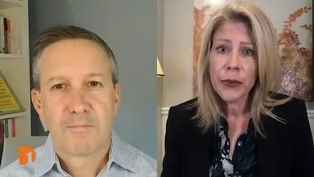
We will talk to higher ed journalist and author Jeffrey Selingo, on how the pandemic has changed college.
Then American Black Journal's ongoing series taking a closer look at the role of the black church in Detroit.
And we'll wrap it up with a story on pandemic pet adoptions.
It is all coming up, but we're starting off with one profession that is in dire need of workers and that's home health aides.
The need for caregiving in Michigan is rapidly growing with our aging population.
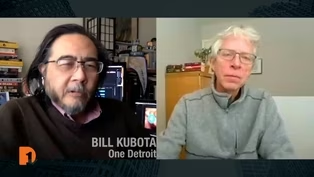
One Detroit's Bill Kubota has the story.
- We're an old state and we're getting older.
Somewhere along the line in that equation, We're gonna need more people to take care of us as we get older.
- So we focused on caregivers.
There's gonna be a national shortage.
- [Reporter] Sarah Rahal, the Detroit News.
Ted Roelofs Bridge Magazine, reporters.
They looked into the world of home health aides, caregivers on the frontlines with the collaborative media investigation, into the massive shortage of these specialized workers.
- And it's compounded by an issue that's been there for a long time which is really substandard pay for this kind of work.
So it's hard to attract and retain people to do this over time.
And COVID-19 has only made things worse.
- [Reporter] The industry had an estimated 82% turnover rate in 2018.
Another estimate in Michigan we're short 34,000 workers out of a workforce of 120,000.
Five years from now, a shortage of 200,000 workers as our aging population keeps growing.
- Were you surprised with what you found?
- No, frankly I've been reporting on issues touching on this for quite some time.
And it's one strand of many that the Michigan's been dealing with for a while.
- [Reporter] With wages averaging $13 an hour, fast food workers can make more.
To get enough hours, caregivers need to travel to multiple clients.
- 90% of people would love to stay in their own home and grow and die in their own home.
- But in many cases, that process is only impossible, at some point if someone can come in the home and help with basic needs, in some case greater needs.
- But a lot of people have turned to nursing homes which have taken a very hard hit during the pandemic and nursing homes have just not been an option for many people.
- Some people need help just with cooking and cleaning.
People need help bathing, maybe getting, you know, getting out in certain situations.
Without someone to do that work, then people are forced to leave their home when they really don't want to.
So this is a vital part of our workforce.
- It's not always just taking people to the grocery store and getting their groceries for them or helping them to and from places it's feeding them, caring for them, being there for them when their family isn't and being a part of their family.
and the caregivers that we talked to felt more stress than ever.
- Direct care work can be dangerous, not just the risk of COVID.
Moving and lifting old disabled people can cause injury.
- Detroit was so much different, you know, there's one in five caregivers, lack transportation.
- [Reporter] Car insurance costs, mass transit struggles, childcare issues.
But now because of the pandemic, the government provides battle pay of swords - We've had a temporary $2 an hour increase for direct care workers in Michigan going back into last year.
And there's discussions now about extending that out maybe through September, that helps.
But that alone will not solve this problem.
- Everyone that we've talked to has said that there is a need for a program that works.
- [Reporter] One in five home health workers is now between the age of 55 to 64.
How long can they keep going?
- In Detroit, they wanna encourage more people to join the industry when they're younger.
And that's one of their outreach solutions is to reach out to these kids instead of saying, "Hey don't go to work at McDonald's, come do a very valuable job that can make a real difference in the world and can really build your resume and in terms of healthcare."
And it's somewhat working.
They're getting a lot of people in the ages of 21 to 28 who wanna take this on as a part-time job.
- [Reporter] Rahal and Roelofs reports were supported by the Solutions Journalism Network.
They've revealed some ideas not much seen in the news until now.
- But did you find much coverage in recent years about home care?
- We rarely found articles that really dove deep into caregiving solutions and agency solutions and what people were doing that was unique.
We really had to dig and hunt for things that we could refer back to.
- And looking in this project we've we tried to find some concrete solutions.
What, you know, what are some hopeful things that can be done?
And one of the things I looked at was there's a cooperative out of New York City that was started, I think way back in 1985.
Basically this is a home healthcare agency.
- [Reporter] The COAP gives aides at least 30 hours a week, pays $15 an hour with benefits.
It's turnover rate around 20%.
That's four times lower than the industry average.
- They been able to piece together a foundation grants and other federal state assistance.
And that's not gonna be something that's gonna be easily done everywhere.
But it's a good sign that if you support these people, if you give them good benefits, they're gonna be more loyal, there'll be better workers, and they'll stay in the job.
Some of the area agencies on aging we're doing creative things.
- [Reporter] In Bay City funds were found to help 80 of their workers.
- And there was one agency that we're paying workers $1000 dollars bonus, If they stayed on the job for a year.
That might sound crazy but this is what they need to do to get try to get people to stay on the job.
They had success with that.
- The Experts that we talked just say, "The majority of people don't want to do the job because they don't feel appreciated."
There's just a lack of respect.
- Unless we're suddenly rolling as a society to say we value this work so greatly that we're gonna increase the pay by, pick a number $5 an hour, $10 an hour.
Where's that money gonna come from?
So it's a difficult issue.
(soft music) - We've been talking a lot about higher education, college and universities in a COVID-19 world not just the remote learning but how that changes the value of the education as well and how the pandemic really is a disruptor.
I was reading a recent column that talked about the future of college admissions.
And as a parent of high school junior that's definitely on my radar.
And it mentioned a new book out this month called, "Who gets in and why.
A year inside college admissions" and the author is journalist Jeffrey Selingo who joins me now.
Jeffrey, it's good to see you.
- It's great to be here.
Thank you.
- You know, you've been writing about higher ed about higher ed for over 20 years and before we get into what you found in the book while you embedded in three schools and took a look at the admissions processes there.
I'd like to get a big picture from your perspective of how COVID has really changed college and maybe perhaps altered the future of higher ed.
- Well, I think one big way it's changed is that now many students are living off campus taking classes remotely.
And one of the things that colleges have always sold is the idea of residential education in a specific location.
But when you're online, you kind of lose both of those things.
You not only lose the residential piece, living, and eating and socializing with your friends, but you're also losing the idea that you're going to college most often in a specific location, whether it's a city or a rural area or a specific state.
In colleges have sold both of those things as the kind of the ideal of American higher education.
And they've lost that in the pandemic.
In terms of admissions, probably the biggest change right now is more than 400 colleges and universities have gone test optional over the summer, largely because it's practically impossible right now especially for high school seniors to take the SAT or ACT - If the students can't have that on campus college experience right now because of COVID and not knowing how long this might go.
Does this change now where students are going to wanna go especially since we're looking at how much college costs these days.
- I think you're gonna start to see some shifts in student choices.
I think for one, number one, I think students are gonna stay closer to home particularly if the pandemic continues because I think parents don't want them far off, if they're going to have to be, you know, stuck coming home.
The second thing I think is you're gonna see many more students considering public colleges or local community colleges at least to get their start.
Community college is really offering a low cost option, particularly if you're gonna be online, you might as well be online close to home anyway.
And many of those courses could transfer public colleges I think are also going to become more popular for their lower costs.
- Are you gonna start to see colleges and universities have to offer more in a different way?
Is it going to be more technology?
Is it going to be a different things to try to differentiate themselves?
- I think you're going to see two things.
First of all, I think online education in some form or fashion is here to stay.
We're gonna see a lot more hybrid education.
Meaning, even when the pandemic is over, I think elements of what we've been through over the last couple of months with online education is going to be here to stay.
I think students and parents are going to be looking for colleges that provide them a job after graduation.
And what are the activities during college that helped prepare them for a job.
Internships, project-based learning, other types of hands-on coop programs and things like that gets students into the workplace out of the classroom.
I think parents and students are going to be looking especially in this economy, for those colleges that help prepare them for the workforce afterwards.
- Are we going to see the loss?
Are we gonna see colleges shut down?
Are we gonna see certain ones?
- We will going to see some colleges shut down.
- That won't be able to survive this.
- Yeah.
Yeah.
We are already seeing some colleges shut down.
I think we will see an increase.
I think we're gonna see some colleges merge.
But I colleges are pretty resilient places over time.
Many of them have lasted centuries and much longer than many Fortune 500 companies.
They tend to be resilient.
- So this brings us now down the road to admissions and what you have just recently written about.
What do colleges and universities have to do now to try to recruit to try to get eyeballs on their school.
- You know, it's very hard right now because most of the recruiting in higher education is person to person.
They have open houses on weekends and they do the college tour where you're actually, you know, eating in the dining hall, seeing the dorm rooms, they have admissions officers fan out across the country visiting high schools.
None of that is happening right now.
In some ways though, I think this is actually a better time for, to search for colleges because you're not limited by geography, you're not limited by an itinerary, of how many colleges you could get to go see in a day there now a ton of virtual programs.
There was a lot of students who have recorded these great videos on YouTube showing a day in the life of their colleges.
So you get a real feel from real students.
What it's like, you have admissions officers now who can't travel.
And so they're in their offices doing zoom meetings, having calls with students.
So in many ways, if you're a student looking at colleges, you can have a much broader perspective now on what might be a good fit for you.
- This year.
American Black Journalists focusing on the role of the black church here in Detroit.
We have a series of reports that you can find at onedetroitpbs.org.
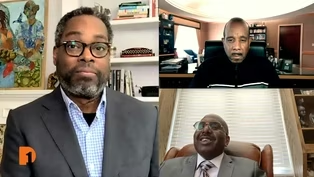
And on this interview, Stephen Henderson talks with Bishop Charles Ellis III of Greater Grace Temple and Reverend Charles Christian Adams of Hartford Memorial Baptist church.
About the role of the church in meeting more than just spiritual needs.
- What we're talking about today is the work that you guys do beyond the church walls, the roles you play in our community and in trying to keep the community together, lift the community up and develop the community.
Bishop Ellis, I'll start with you.
- I'm carrying on a 25 years now, legacy from my father.
He was the first to move beyond the walls of the church and in terms of a Montessori Daycare Center and then a Christian school that went from kindergarten to the eighth grade.
And then a apartment, so duplexes that allow people to live in affordable housing and then the credit union, federal credit union.
So I'm just curious on that legacy.
We've tried to specialize for years you know, going beyond the walls administering to people outside of these confines of Greater Grace Temple.
- Yeah.
Reverend Adams?
- Yes.
And it's really divine providence that we would be on the show together, Bishop Ellis and myself because his father and my father were contemporaries and colleagues and very good friends.
And they've been a lot of the same work housing.
Also, we have pride to ignite employment opportunities through economic development.
So all the church property there is a development, The Jason Development Corporation entity in the church - You talk about why especially for the black community the church is this incredible engine of economic development and opportunity, Bishop Ellis?
- Well, I will say that it's always been, you know, when you think about the church coming out of slavery of the church was their gathering place, even on the plantation, down by the Riverside.
I think about the songs.
If you're saying those spiritual songs and hymns I'm gonna lay down my burdens down by the Riverside.
Those were gasping places.
And many times those songs that they saying were messages that they were sharing one with another, other slave, masters did not understand and could not comprehend.
So the church was always that place of trust for black people.
It was always a place of integrity for black people.
It was always that place where you knew that you could get a fair deal.
You knew that you can get somebody who would be sensitive to your plight into your situation and with not just you know, lay hands on you and pray for you, you know, and give you a spiritual high and then, you know, release you and say, "Hey, make it for yourself."
It was always that institution that wrapped his arms around you.
We know the burden and we know the plight of not having enough and just barely making it.
And that's why we've always been, you know, an economic engine as well.
We want to see our people educated.
We want to see them be able to apply for jobs and and listen, I give credit to the UAW and to a lot of institutions and thank God that we have people like you and others in places of influence that when opportunities come you bring it to the church and say, you know, "Bishop I need 20 good people" you know, and I'm gonna give them a break on your integrity and on your word, you know, and that's what we've been blessed to have probably in the last 30 or 40 years.
And that's made a tremendous difference in people in our congregations which is our community getting a fair shake on the American dream.
- Yeah.
Reverend Adams?
- Yeah, absolutely.
That is a powerful quest because this is a cross that has been compelled to bet.
We have to be so many people, counselors, preachers, pastors, economic developers.
We have to employment agencies.
We have to have so many roles and so many hats because of the necessity of access to it.
Now, if somebody has an emotional crisis and in a wealthy neighborhood, they hire a psychoanalyst at $200 or $300 an hour or more.
And they make an appointment.
These are unanimous appointments.
We feel ourselves and we walk people through changes and challenges in life because we have to, 'cause people can't afford that.
And, but it's a wall that we gladly flat.
We start the engine for economic development because corporations are skiddish about coming into the community and paying the black tax.
We have to make the case that you can make money in the African-American community.
And when they can't get the small business loans they have to come to visit the credit union because they can't get the money elsewhere.
And we have to create the opportunities that are in other communities, just because of the demographic differences.
But we have to play that role.
Now the question is for me Stephen, when do we start making sure that we compel the government to do their job because we shouldn't have to play all these roles.
It's the government's job to make sure everybody has access to fair housing.
It's the government's job.
We're paying taxes, just like everybody else.
This myth that African-Americans are just somehow living off the fat of the land.
And we're not paying any taxes, that's a lie.
And the economic of many of the economic development entities that we're talking about it engines pay taxes.
And look, the government has to provide equal access to health care.
The government has to provide equal access to education.
The government has to provide equal access to opportunity and we have to continue to pressure them to do it.
We have to do much.
We have to continue to fight.
We have to continue to advocate and ultimately it will help everybody.
Injustice anywhere is injustice everywhere.
- You can find more from American Black Journal at onedetroitpbs.org.
And finally, there has been a wave of pet adoption since the pandemic, but some of these nonprofits that are matching pets with owners need some help themselves.
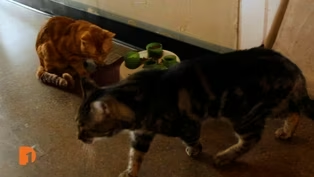
One Detroit Editor, Chris Jordan takes us to the Catfe in Ferndale where he found his new friend, Tom Tom.
(cat meows) - [Chris] One piece of good news to come out of the pandemic was a dramatic increase in pet adoptions with some animal rescues reporting that their adoption rates as much as doubled.
I was part of that wave adopting senior cat, Tom, Tom from the Ferndale cat shelter in Catfe last August.
Ferndale Catfe is a nonprofit who have been busier than ever during COVID.
Although meeting those demands during a pandemic has had its own challenges.
- In 2020, we did almost 1,000 individual adoptions.
In 2019, we did just under 500.
So more than a double and still going.
I mean, our first few months in 2021 have been really really big as well, so we're on track to probably have a similar number this year if I had to guess.
- The pandemic has been really hard on a lot of people economically, but also psychologically, emotionally.
people have had to give up their pets because they have had to given up a home or an apartment but also people are suffering a lot of well, emotional or psychological problems.
- A lot of the municipal shelters were closed.
during the pandemic, we didn't have that option.
It wasn't something that we even wanted to try to do.
We needed to make ourselves available to the community.
People and of cats, you know, to make sure that they got what they needed.
We are boutique rescue.
You want to call it that?
And I like the intimacy of how we connect our adopters with new family companions.
- Different cats resonate with different people.
And we sort of facilitate the matchmaking process.
- We're trying to create a long-term match not something that you're gonna get the cat home, and then three days later you're gonna realize it's a disaster.
And you know, it doesn't work to your family or your lifestyle.
In the before times, when people wanted to adopt a cat, they would either come to the Catfe and meet the cat or they would go to the foster's home, if the cat was in foster, do a meet and greet.
And then myself or another volunteer would go to their home and do what we call our home visit.
- When COVID hit.
We changed, for cats that are in foster, we did meet and greets virtually or FaceTime or zoom.
And then as far as how would Catfe has operated.
- [Kevin] We restricted by reservations, limiting the number of people who should come in here each hour.
And we also have more cats in here for people to come visit almost twice as many as when we were open before the pandemic.
- The biggest challenge that our adoption team has faced during the pandemic is just the demand.
I mean, the applications come in constantly and people get really upset if they don't hear back from you.
- We subsist solely on donations, we're a 501(c)(3).
And in COVID, that kind of squashed a lot of that.
We can't do our cat bingo, we can't do our cat yoga, or cat Pilates and our annual fundraiser was canceled last year.
- We were lucky and that we received a grant last year from Petco and that really saved us.
We had to close the Catfe lounge for five months out of the last 12.
So we lost a lot of income with that.
So that Petco grant really helped us to just survive.
- I know you saw an increase in adoptions.
Do you also see more, like people reaching out to support in other ways?
- Oh yeah.
Lots of, everybody wanted to foster because everyone was stuck at home.
So there's a lot of crossover people that get involved in our organization wanna help more, you know, so that's really a gift.
I think people discovered what these great and wonderful about adopting from a small shelter and having a relationship with a small shelter.
It's like they're joining the family, you know.
(Deanne laughs) - And that is gonna do it for One Detroit this week.
Thanks so much for joining me.
For all of the stories that we're working on.
Just head to onedetroitpbs.org.
Find us on social media at One Detroit.
I will see you next week, take care and be well.
- You can find more at onedetroitpbs.org or subscribe to our social media channels and sign up for our One Detroit newsletter.
- [Narrator 1] From Delta faucets to Behr paint.
Masco corporation is proud to deliver products that enhance the way consumers all over the world, experience and enjoy their living spaces.
Masco Serving Michigan Communities since 1929.
- [Narrator 2] Support for this program provided by the Cynthia & Edsel Ford Fund for Journalism at Detroit Public TV.
The Kresge Foundation.
Community Foundation for Southeast Michigan.
- [Narrator 1] The DTE Foundation is a proud sponsor of Detroit Public TV.
Among the state's largest foundations, committed to Michigan focused giving.
We support organizations that are doing exceptional work in our state.
Visit DTEFoundation.com to learn more.
- [Narrator 2] Business Leaders for Michigan, dedicated to making Michigan a top 10 state for jobs, personal income, and a healthy economy.
Also brought to you by and viewers like you.
(soft music)
Video has Closed Captions
Clip: S4 Ep36 | 5m 17s | Christy talks w/ higher ed journalist Jeffrey Selingo about the future of higher education (5m 17s)
Video has Closed Captions
Clip: S4 Ep36 | 6m 4s | The need for caregivers is rapidly growing along w/ MI's aging population | E436/S1 (6m 4s)
Ministry Beyond the Church Walls
Video has Closed Captions
Clip: S4 Ep36 | 6m 37s | In Detroit, the church's role goes beyond just meeting the community's spiritual needs. (6m 37s)
Video has Closed Captions
Clip: S4 Ep36 | 4m 23s | Pet Adoption in a Pandemic | Episode 436/Segment 4 (4m 23s)
Providing Support for PBS.org
Learn Moreabout PBS online sponsorship
- News and Public Affairs

Top journalists deliver compelling original analysis of the hour's headlines.

- News and Public Affairs

FRONTLINE is investigative journalism that questions, explains and changes our world.












Support for PBS provided by:
One Detroit is a local public television program presented by Detroit PBS