Colorado Voices
Artists
10/27/2021 | 26m 40sVideo has Closed Captions
Coloradans can experience local art at every corner. Meet creators & hear their stories.
Colorado is overflowing with artists - but rarely do we hear directly from the minds behind the canvases.
Problems playing video? | Closed Captioning Feedback
Problems playing video? | Closed Captioning Feedback
Colorado Voices is a local public television program presented by RMPBS
Colorado Voices
Artists
10/27/2021 | 26m 40sVideo has Closed Captions
Colorado is overflowing with artists - but rarely do we hear directly from the minds behind the canvases.
Problems playing video? | Closed Captioning Feedback
How to Watch Colorado Voices
Colorado Voices is available to stream on pbs.org and the free PBS App, available on iPhone, Apple TV, Android TV, Android smartphones, Amazon Fire TV, Amazon Fire Tablet, Roku, Samsung Smart TV, and Vizio.
Providing Support for PBS.org
Learn Moreabout PBS online sponsorship(Music) - But allowing us to tell our own stories and have pride.
- That sense of longing for belonging is so strong in all of us.
- By memory, I could probably draw the outline of the mountains that surround me.
I know all the rivers and creeks and other people who live here.
- They encourage me to just be me and do me.
(Music) - Artists are culture keepers.
- When we make the effort, we can be a very beautiful mess all together.
- But I feel like language is quite limited.
- I wouldn't be doing what I'm doing if I didn't know who I am.
- I think the artist who are the most successful are the artists who commit to what they think is cool.
- Art to me is self-expression.
- The idea is that like the more you dive into the work you're greeted in this very happy way.
But then you're also confronted with a very serious topic or a conversation that might be a little uncomfortable.
- If I told you the message behind my heart, you know, I think they'll be there-- There will be no point for you to actually explore and discover.
- Hi, I'm Kate Perdoni.
Colorado is home to so many artists, the landscape, the culture, the people here all inspired the works behind the brushstrokes, the spray cans and the dance moves.
From Mural Festivals to world-renowned museums.
We're taking you inside the workspaces of some of the creative minds who call Colorado home.
Here are the voices of artists.
- Art to me is I think part of it is culture.
Art to me is self-expression and I also I think just from an indigenous perspective look at it as medicine.
Artists are culture keepers and that's the main purpose of what we do.
Commentary politically, socially, culturally, on whatever is happening in our communities or in our homes.
These are people that are often dismissed but carry a significant amount of what's needed to be said or done in real-time.
My name is Gregg Deal.
I am a husband and a father, an artist, and a professional disruptor.
I think my art sort of works within that ethos to sort of disrupt ideas or areas or thoughts, or you know, political issues, what have you-- that ends up playing-- I think all of those things have to be playing a part in the work that I do.
I suppose the thing that I'm trying to say or the expression that I have within my work, is really just sharing my perspective from my experience as an indigenous person as a human being.
Oftentimes my work ends up looking like a social mirror back at sort of reflecting back at society, I create my artwork for all the things.
It is my job, so it's how I make my living and how I care for my family.
I also create art for the sake of art.
I created for myself to feel better.
I created it for myself because I feel compelled to do it.
I'll create it sometimes to have a message is it's all of those things.
It's sort of like taking a shower you know, or you're like in this mindless state and you know you come up with your greatest ideas in the shower.
It does allow me to think critically about like what does it mean to be an indigenous person?
What does it mean to be an indigenous artist?
What does it mean to be a father?
What does it mean to be a husband?
Like, I can look at all of these things because none of them are mutually exclusive.
They all inform where I'm at and to be honest, what I'm creating, I would be creating regardless.
I feel compelled to do it and the result of that is also just trying to navigate what some of those things mean.
There's work that I create that I just let loose and just let it be out there.
I don't make any money off of it.
Work that would be about, missing and murdered indigenous women girls and two spirit.
An epidemic in our indigenous communities.
I don't make money off of those types of pieces because I believe that they just need to be out there.
Yeah, I make a living at this.
This is what I do for work, but I feel like I'm in a place of privilege where I can sort of dip my toe and social activism, personal work, contemporary art.
I get to do all of the things I already know who I am.
I wouldn't be doing what I'm doing if I didn't know who I am, whether or not my work connects me with my communities.
I feel that I'm already connected, which allows me to have the voice that I have within my work.
There's some people that are gonna hate my work.
And then there's some people are gonna love it and except both as part of the process of creating work and having it out in in the public sphere.
I'd like to think that there's definitely some changes taking place in terms of how more frequently we're seeing indigenous people.
But those things can always go back to the way they were, so we have to keep pushing, no matter what.
Not just indigenous people, black indigenous people of color, people on different gender spectrums.
And we need to continue to push to allow spaces for those folks as well.
I think the greatest challenge.
For me as an artist or challenges that I've seen other artists like me sort of face is based on the power structures that are the art world and the way that the art world assumes that art must be done.
What that voice has to look like, who's invited to the table?
Who is allowed to speak?
What is an appropriate medium, and how are those mediums expressed?
And how do those mediums navigate the real world?
The biggest challenges is being somebody who's indigenous that might not fall in line with the status quo or the expectation of artists, and being able to freely express yourself inspire of that.
We're seeing some changes take place in the art world following Black Lives Matter last year.
And sort of creating a different set of voices and circumstances, but it's still a challenge.
We need to try to keep those things at the forefront, and so that's that, I think is the biggest effort is remaining consistent having integrity in your work, and continuing to push forward, even if those mediums or those narratives don't fit what people think art should be.
(Music) - I came to Denver as a blank canvas.
Denver itself was a blank canvas.
It's really hard to be a self-taught artist.
An artistic color in a city where there is no history kept of any of that.
You know of any artists of color before you.
My heritage doesn't force my work, but at the end of the day, I'm more influenced by what I'm seeing on a day-to-day basis.
I don't know who I am before I said to the canvas, this is a conversation I'm having.
So if I don't know my opinions and who I am, I can't have this conversation.
There's no point of having this conversation because I'm not bringing anything to the table.
I feel like I'm really just a citizen of the world because people try to place me inboxes.
I don't belong.
It says I'm a kid from my to get from Congolese neighborhood.
Founded in the heart of Brussels.
I'm a first-generation western.
I've lived most of my life in the United States.
My sisters they call me Bravo.
My mother calls me Lio.
So to the world, I'm Bumbakini the artist.
I'm from a tribe called the Yaca, which is part of the Kuba tribe, which was a great Kingdom in central Africa.
I traced all the way back to the Pygmaeus and I'm blessed because I know my history.
And I know many people with my same-- same color, especially those of us that live in America.
They don't know those histories.
They don't know where they can trace their lineage back, and that's something that I carry with me, and that's something that's presently in my heart as well.
I-- you know, I guess in a sense has been my whole life, because my mother is an art creator.
So I grew up and was born into a household that was centered around art.
When I was actually in the womb.
My mother was set up her first exhibition and in Belgium.
As a curator, so I think really just from the start.
I believe art comes from within.
It's a--it's, It's not like a nine to five thing you know, it's like you gotta be ready to create.
I think that hopefully art, you know, in this generation, the Black artist can, can talk about more than just being a black artist or being a person of color in the world.
I hope that then gets a point where we could just make whatever we want that has nothing to do with our race things of that nature.
You know, I think I think it's time--the time is also now for the Black artist to be liberated.
You know, I grew up in museums that didn't have any black bodies represented at all you know, and these are great painters like, you know, Flemish-Dutch Masters.
Never seen any art from people like me in a museum.
So I want to change that narrative.
So that's why I'm here and that's my life mission.
I'm not gonna stop till it happens.
And if it doesn't happen, I'm gonna open the museum on my own.
So, that is going to happen.
My people are going to be represented in different voices of all kinds will be represented.
I think this is the time the time is now.
For me today is one of the best times to be alive as an African.
My African Americans, because there's a lot more openness around the conversations around lineas around people are actually doing our DNA tests, figure out where they're from in Africa, and what those cultures beholden, what the histories they haven't known before.
So it's really interesting to see how, to see how is transitioned over time, subtle changes, some more overt.
Definitely when Black Lives Matter was ramping up in the States and you saw a lot of demonstrations and supporters of equal United States come out and hit the streets.
I think my art took the same tone.
It became very in your face approach.
I just channel what's going on in the world.
I just channel what I dream about a channel experience I have in life or experiences that others shared with me.
I try to find spaces within canvases and within other works, illustrated those things that have I picked up on and my spirit is deliberating on it.
So, my art, realy is for me is something that's-- it's not of me.
I think it's up the world and I'm just a vessel for it to-- a conduit for it to be.
You know, shared with others and talk about.
I think that messages and what is involved in your artwork does change over time.
You know you have different experiences you go.
You become a father or mother.
You lose people and maybe that brings you to new realizations and me I think my art is all about just life.
It's about like what is-- What is this life?
Art is one only ways we have to differentiate ourselves from other species of animals and it shows there's more to the human.
And there are to most animals on this world.
So if I told you the message behind my heart, you know, I think there would no point for you to actually explore and discover what those messages are.
So, I can't really tell you what that is, where those messages are a third one message.
If there are multiple messages.
I think that's for you, the viewer to figure out what the message is and something's going to make obvious, and over the top, but why?
Why those things are obvious?
And why are there things not obvious?
And there's a lot of nuances?
So, our work, and especially being a NEO expressionist abstract painter in losses, can be endless and limitless.
So, you know, I'm not going to sit here and say that my art is about nothing, because it's not about nothing, it's about something.
And that's for you to figure out.
(Music) - I can't find my paintbrush.
I've no idea what I did with it.
We are currently in my studio in Denver, Colorado.
Some people are really good at taking care of their brushes.
I am not.
I also need my colors are very bright and wild and crazy.
A lot of the planning process takes place here in this studio, there might be a lot of prep work that happens here in the studio.
I'm Moe Gram.
I am a local Denver artist.
I think my heart and soul is in large-scale collage.
My mood and the moment has a huge impact on how I choose color and what I'm feeling.
It could be anything from somebody's cat tree that they're throwing away, it could also be scraps of paper.
It could be a sticky note that somebody left on my car.
It could be personal items.
Things found in different strange places like alleyways.
I've used everything from sanitary napkins.
I'm really just looking around naming the things that I'm looking at.
I was born in sort of a tough-love environment where everybody loved on each other really hard, but they also held each other to really high expectations with the idea and the belief that there's no reason why we can't get there.
But then there was also a lot of laughter, a lot of fun, and my grandmothers are like that as well.
So, I think a lot of my work is reflected in the way that they love people.
It's this idea that we can have really tough conversations and we can be firm in our understanding, or we can be firm in our beliefs while also being open to conversations.
But like those difficult conversations don't have to be bad either.
So, when people look at my work, they are greeted with a lot of bright color and crazy weirdness.
Things are flying everywhere, but the idea is that, like the more you, dive into the work you're, you're greeted in this very happy way.
But then you're also confronted with a very serious topic or a conversation that might be a little uncomfortable.
Only to say is it's fine, it's Okay, we can talk about it, you know it's alright get in here, let's just have a chat.
We just like so many really big pivotal moments in my career were supposed to happen in June of 2020.
My brushes are frequently ruined and I'm working on it.
I'll get better at it.
I had this like very like woo like here.
We go like this.
Is it this moment that I've been waiting for for so long?
The moment where everything changes.
And sure enough, it was like skirt.
Nobody's having fun.
I was like what?
(Music) I just recently finished a mural in Boulder through the Streetwise Mural festival.
I also, I'm working on a few commissions that are going to be installed in different buildings throughout the country.
I'm doing a little bit of everything I just helped with design some of the set for Alice in Wonderland.
With family, theater, and wheelchair sports camp.
I'm kind of all over the place.
Part of the reason I've been able to have so so much success is because Denver, I believe, is a city who does care quite a bit about the arts, especially as a young emerging artist who is learning and growing and becoming.
And so I think we're a lot of artists, especially young artists, have a really hard time.
Is that they're trying on all these different hats.
Trying to figure out what their style is and figure out their niche.
You finally get to a place where you have to choose.
Am I going to do what I think is cool, or am I going to keep trying to do what everybody else thinks is cool?
When you are greeted with my work, it too is a very chaotic.
But nicely curated mess.
I think a very intrinsic part of my work and part of what I hope to communicate to people is that we're all a mess.
And that's Okay.
(Music) - So I have a drawer and it's so full of all of my notebooks and sketchbooks.
They're very messy just what you would imagine.
The first time I sat down to write a comic and make a comic, it was more just out of a feeling of like this is a medium where I feel like I can fully express myself.
This is a media where I can explain what's going on in my brain to other people because I can put arrows and I can draw bubbles.
I can make crazy expressions and things like that.
My name is Will Betke Brunswick and I'm a cartoonist.
I came to cartooning more from reading comics then from like drawing them.
There's just such a variety of comics out there.
I think that people relate to comics because they invite the reader in.
I think also because people associate comics with being fun, and that takes away of some of the barriers I think people can feel like they're doing something that's enjoyable and relaxing and maybe nostalgic for some people.
So, this is my current lined notebook that I'm working in.
And, yeah, I usually just look to any open page and draw my Penguins.
My artistic style is pretty simple line drawings, partly because that's just the way that I like to draw, and also because I feel like it invites people in and sort of a friendly way.
And then I go in for the like hard commentary or like humor or grief or like deep emotions.
The drawing style almost balances out the weight of whatever is I'm talking about, because often I am talking about like heavy or intense subjects.
These are small comics that I made there about school resource officers and racism in Boulder County, and this one is called.
So, your kid is nonbinary.
And identify as a nonbinary trans person, and so I gave it to my dad to sort of say.
Here are some ideas this is what I want to communicate to you.
My title of my like comics businesses, Trans, Boy Comics, and so a lot of them have to do with trans issues or being trans or uplifting the trans community or celebrating trans people.
And also, some of them are educational, so much of it is about my life, and since I'm trans like I see the world through this trans lens.
And so even comics that are just like humor comics are often like funny things that I experience as a trans person.
That other trans people could relate to.
But I also know that for some people who are cysts are reading my comics as a way of like learning about me and my trans identity, and so I try to just be also aware that cysts people are also reading my work.
I hope that people feel connection and joy, and I definitely hope that other people feel like they can make comics.
That's something that I really hope is that other people feel inspired to sort of share their stories via comics.
It's important for me to use my work to talk about bigger issues because these are things that I care about and things that I'm thinking about anyway, and so my comics really are what's going on in my brain on paper.
And so if I'm thinking about it, chances are I'm going to make a comic about it.
(Music) ♪ - Dance to me is a way of expressing myself.
It's a way of getting energy out.
It's a way of stress relief.
It's all of the above.
I've been dancing for about 15 years.
Growing up, I went to a studio that did a lot of different types of dance, so I did tap, jazz, ballet kind of all over the board.
I kind of refined that down to a more classical shape, focused primarily on ballet.
I think dance gives both the dancer as an individual.
As well as the honest Members, a way of accessing different emotions and which is why I like that one so much because it with that character work.
It really lets us access people who don't no just dance.
So, they don't have to be here to watch dance.
They can be here to access a part of themselves, and that's a really beautiful thing I think.
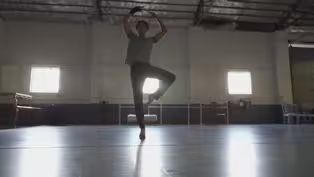
I'm Henry McCall.
I'm a dancer with Wonder Bound.
I'm somebody who has to constantly doing something, constantly moving and this is been a great fit for me here.
Wonderbound is a contemporary ballet company.
It's in Denver.
We don't or we perform and try to serve our community here.
We have dancers from all over the country.
We spend a lot of time together in the city, and out of the city's so we get along together quite well.
We have to that's part of the job.
That's why we're all here.
(Music) My wife is also a dancer.
She's been dancing since she was even younger than me.
She is now also working with Wonderbound.
So, it's been really wonderful to have her here.
(Music) Me and my wife definitely enjoy spending all of our time together, which is the only reason why this works.
Coming out of like lockdown at the pandemic.
It was 24/7.
It was us and now working together.
It's 24/7 and I love it.
It's nice I don't have to.
I mean, I don't have to go through and explain what my day was to her because she was there.
If I'm working on a step that I've been having trouble with and like repetitively working on it, my wife will definitely be watching and after I do it you can ask anyone in the company.
I will look over to her for feedback.
As far as advice on where my momentum needs to be, what?
My arm looked like.
(Music) Here I found a place where I can use my theatrical side that contemporary side that I did have there was a large part of my training as well as that classical side, so it's contemporary ballet with a heavy tilt to delicate, and character work.
Dancing means a lot of things.
I feel like it started as a way for a hyperactive kid to just get energy out.
It's just another way to express myself to move my body to feel good and to work through things to achieve things for myself.
Becoming a professional dancer is such a weird thing because everyone does it a little bit for fun.
And so yeah, when I say I'm a dancer, people often don't know what that means.
They don't know that I work nine to five.
They don't know that I work 40 hours a week.
I don't know that I have health insurance.
They don't know that I go home and have hobbies and live with my wife.
And I have dogs and all that jazz, and so it's.
It is an interesting thing, kind of trying to give people who don't know dance that a clearer image there because I mean to me it's-- it's the world that I've known.
So, it's just life and there is more just life in it than I think people realize.
(Music) - Thank you so much to the artist who welcomed us into their spaces and share their stories.
Join us for more voices from around Colorado at rmpbs.org Thanks for joining us.
(Music)
Spanish Caption - CO Voices - Artists
Video has Closed Captions
Clip: 10/27/2021 | 26m 40s | Coloradans can experience local art at every corner. Meet creators & hear their stories. (26m 40s)
Providing Support for PBS.org
Learn Moreabout PBS online sponsorship
- News and Public Affairs

Top journalists deliver compelling original analysis of the hour's headlines.

- News and Public Affairs

FRONTLINE is investigative journalism that questions, explains and changes our world.












Support for PBS provided by:
Colorado Voices is a local public television program presented by RMPBS