Colorado Voices
Farmworkers
8/27/2021 | 27m 40sVideo has Closed Captions
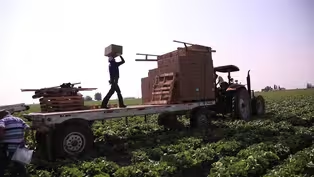
Colorado farmworkers share stories about their lives, their health, and their safety.
In this episode of Colorado Voices, agricultural workers and their families share stories about their lives, their health, and their safety.
Problems playing video? | Closed Captioning Feedback
Problems playing video? | Closed Captioning Feedback
Colorado Voices is a local public television program presented by RMPBS
Colorado Voices
Farmworkers
8/27/2021 | 27m 40sVideo has Closed Captions
In this episode of Colorado Voices, agricultural workers and their families share stories about their lives, their health, and their safety.
Problems playing video? | Closed Captioning Feedback
How to Watch Colorado Voices
Colorado Voices is available to stream on pbs.org and the free PBS App, available on iPhone, Apple TV, Android TV, Android smartphones, Amazon Fire TV, Amazon Fire Tablet, Roku, Samsung Smart TV, and Vizio.
Providing Support for PBS.org
Learn Moreabout PBS online sponsorship(gentle music) (upbeat music) - For allowing us to tell our own stories and have pride.
- That sense of longing for belonging is so strong in all of us.
- By memory, I could probably draw the outline of the mountains that surround me.
I know all the rivers and creeks.
I know the people who live here.
- They encourage me to just be me and do me.
(upbeat music) (gentle acoustic guitar music) - [Sonia Gutiérrez] Colorado is home to so many different landscapes, including more than 32 million acres of farmland.
- [Man] The days were long and the rows were longer.
(laughing) - [Sonia Gutiérrez] The land produces everything from mushrooms, potatoes to lettuce and corn.
- We're passionate of who we are, where we come from.
- [Sonia Gutiérrez] And more than 195,000 people help bring those foods to our table.
- On your table, every single day.
(gentle acoustic guitar music) - I'm Sonia Gutiérrez.
Tonight, we're meeting farmworkers, the people whose work touches all of our lives, and yet their stories are rarely told.
Stories about their health and safety, both at home and at work.
Over the past couple of months, we've met people with deep pride in what they do, and people who have experienced a lot of loss.
(light Mexican music) - You get in, you come in around 6:30-ish, seven in the morning, and I'm on the ground and bent over, cutting lettuce, cutting two rows, throwing the lettuce, wrapping them, putting them in bags.
When you're out in the field, it's like nobody cares what you are, what you're doing.
You can be you, you can laugh out loud.
- [Reporter] David Ramon Miguel says he started working in the lettuce fields in Center, Colorado, when he was just a teenager.
His family had moved to Guatemala after his parents were deported.
Then David's uncle, Miguel Francisco, brought him back to the US, took him in, and took him to work.
- He brought me at a young age, and he took us out there, and he would help us, he would teach us what to do.
- [Minga] Every summer I would work in the fields with my dad.
Everybody knew him as Pancho.
- [Reporter] Minga Francisco is David's cousin.
David's uncle, Miguel, - That was his nickname, Pancho, Panchito, Pancho.
- [Reporter] Or Pancho, was Minga's dad.
- It was hard, it was hard work.
And I thought, oh my gosh, how do you guys, like, how do you guys wake up in the morning and think, I wanna do this?
- [Reporter] For years, the family traveled across the country, working in different farms.
- Eventually my mom was tired of that migrant life, and she decided we're gonna stay here in Center.
So they settled down in Center, and they both found jobs in potato warehouses.
I remember my dad, he was so dedicated to working, he would work up to 12 at night sometimes.
He was there until basically his last days.
- [Reporter] Miguel Francisco's last days- - [Minga] It was end of April, beginning of May.
- [Reporter] Came in the spring of 2020.
(truck whooshing) - [Minga] When the pandemic was getting closer to home- - [Reporter] One by one, members of the family started getting sick.
- My dad was in denial.
He's like, "No, no, I just have a cold.
I'm always coughing, it's okay.
I'm fine, I'm okay."
And we're like, "Dad, I know you might feel okay, but it's protocol, please go get tested."
He refused.
- [Reporter] Miguel worked at the Mountain King Potato Warehouse in Center, and Minga says her dad had been told he had to give two weeks notice if he was going to miss work.
She now knows he was legally entitled to paid sick time, something she didn't know then.
- He said, "I'm not sick, I'm not sick.
I am fine, I'm going to work."
He would grab a towel, freeze it overnight, and then in the morning, right before walking into the warehouse, put it on his forehead for few minutes, get his temperature check, and walk right in the doors.
- [Reporter] Minga admits it was a huge risk for her dad to go into work sick, but in her dad's eyes, he had no other choice as the family's main bread winner.
- Well, when word got out that we tested positive for COVID, they told him, "I'm sorry, we know your family's sick, we need you to go home."
And I remember he was upset.
He thought, who told them?
And we're like, it's not like we went out there and said, "Hey, we have COVID," because, I mean, sadly, it was embarrassing at that time.
We were one of the first few families here to get sick with COVID.
One day he told my other brother that he was living with at that time, he told him, "Hey, I do not feel well, please take me to the hospital."
So my brother took him in, and that was the last time we got to see him.
- [Reporter] Miguel Francisco was just 56 years old.
(truck whooshing) He wasn't the only one working at the potato warehouse who got sick.
Health officials said dozens of people tested positive in the outbreak at Mountain King.
- Things have changed now, and it's so much different.
My mom is now working at that same warehouse, and I see the difference just from my mom.
Like now, okay, if I'm feeling sick, I just have to call 'em the night before or that morning.
And I wanna say it was that, because they realized, oh my gosh, if we would have let this person stay home, maybe all of these other people wouldn't have gotten sick.
Things could have turned out differently.
- [Sonia Gutiérrez] We asked several times to interview Mountain King managers about sick time procedures when the pandemic began.
They did not respond in time for our broadcast deadline.
- Those big outbreaks were happening, it was shutting down everything.
- [Reporter] Nicholas Lara is the health engagement coordinator for Valley-Wide Health Systems.
Their mobile clinic provided testing during the COVID outbreak in the area, and now it's bringing the vaccine to farms.
- The farmers have been really quick to being in touch with us and getting our staff out there mobilized to provide those vaccinations.
- [Reporter] Valley-Wide says it has vaccinated about 1,000 farm workers so far, mostly with the one-dose Johnson & Johnson shot.
And it seems workers are well aware of the risks they face.
Lara says at each of the farms the mobile clinic has visited, 100% of the workers have agreed to be vaccinated.
- [Nicholas] Dramatically changes the way that they live on a day-to-day basis just having the vaccine.
They can operate a little bit more freely without being masked up the entire time in those dormitory-style living situations.
It's almost like a better thing for them to get the vaccine.
- [Reporter] For Minga Francisco, her mother, and her sons, - [Minga] They loved him, they loved him.
- [Reporter] The vaccine represents hope, hope COVID-19 won't take any more from them than it already has.
- [Minga] I was a daddy's girl, as you can tell in these pictures.
He always had me in his arms.
- [Reporter] The virus took Miguel Francisco, a man known to his community as Pancho, - [Minga] And he was really young then.
- [Reporter] A man who showed his family how much he loved them by going to work.
Now Pancho's nephew is honoring his memory by doing the same.
- I was a teacher, you know, and recently got unemployed .... Decided, you know what, let me just go back to the fields, and he'd probably be all happy that I'm actually out here.
He was a really good guy, awesome man.
(quiet music) COVID-19 added another element of risk to agricultural work, a profession that is already known to be one of the most dangerous jobs around.
This spring in Northern Colorado, a workplace accident cost a dairy worker his life and helped mobilize a call for change.
(gentle piano music) It had only been six weeks since Juan Panzo Temoxtle started working at Shelton Land and Cattle in Weld County.
- [Operator] Dispatcher 911, what is the address of your emergency?
(gentle music) (sirens wailing) - [Jason Shelton] Yeah, two, two, two, nine- - [Sonia Gutiérrez] It only took six weeks for him to encounter one of the most horrendous dangers a dairy worker can face.
- [Jason Shelton] I have an individual, an employee, that fell into a manure pit in a piece of equipment.
(gentle music) (sirens wailing) - [Sonia Gutiérrez] A liquid manure pit.
- [Operator] Is he awake?
- [Jason Shelton] No.
- [Operator] Is he breathing?
- [Jason Shelton] No.
- [Operator] Are you able to get him out, Jason?
- [Jason Shelton] No, we cannot get him out of the cab.
So, the door's jammed shut.
- [Operator] And so, are you able to get inside of the cab with him?
- [Jason Shelton] What's that?
- [Operator] Is someone able to get inside of the cab with him at all?
- [Jason Shelton] No, no.
(somber piano note playing) - [Sonia Gutiérrez] March 30th, 2021.
(dramatic music) (body scuffling) A weld county Sheriff's deputy learns Juan was training on a manure vacuum.
The Sheriff's office blurred this video before they gave it to us.
It showed paramedics performing CPR on Juan.
- [Deputy] Okay, are you the- - [Jason Shelton] I'm the owner?
- [Deputy] Okay, do you know what happened?
- [Jason Shelton] Yeah, so the gentlemen here was operating this piece of machinery.
- [Deputy] The black one?
- [Jason Shelton] Yeah, the black one.
- [Sonia Gutiérrez] Juan one was inside when that massive machine ended up in a 12 foot pool of cow waste and started to sink.
- [Jason Shelton] I don't know if he mis-operated the vehicle and plunged it into the pit or what, but obviously the piece of machinery went into the pit here and the cab was completely closed up.
- [Sonia Gutiérrez] Two people jumped into frigid liquid to try to save Juan.
- [Deputy] He went into the water to try so save him?
- [Jason Stenton] Yeah.
- [Deputy] Okay, - [Sonia Gutiérrez] But those rescue efforts failed.
These are the two men who tried to pull Juan from the pit.
One of the would-be rescuers told the deputy what he saw.
- He was on the front end of this piece of equipment, he was training the guy.
And I was standing right over here.
- [Deputy] He was training him?
- Yeah, so I was standing right over here, working on this valve when it popped in.
So, he jumped off the side of it as it came over the edge.
And then I jumped in to try to pull this guy out of the cab.
- [Sonia Gutiérrez] The man who's talking, employee Taylor Cross, told investigators in a written statement, he saw the equipment Juan was driving back up, approach the curb at a higher rate of speed, hit the curb, then broke through the emergency stop.
Then he wrote, "It started sinking into the pit."
- [Deputy] So, when you guys, was the door locked?
- No, so with the pressure though, so I was able to front work the latch, but I could not pull the door open.
- [Sonia Gutiérrez] The Weld County Coroner's Office told us Juan's cause of death was anoxic brain injury due to drowning.
They ruled it an accident.
The Occupational Safety and Health Administration, or OSHA, opened an investigation which has not yet been completed.
- [Deputy] It's gonna be considered a crime scene until the investigator does his thing.
- [Sonia Gutiérrez] Weld County Sheriff's Department, who were following on the bodycam here, closed their investigation because they were only looking for criminal activity.
And a deputy wrote that what happened to Juan was purely an accident.
(camera clicking) Juan's family thinks more could have been done to protect him.
- (speaks in foreign language) - [Sonia Gutiérrez] Alonso Panzo Temoxtle is Juan's brother.
He says Juan had only been in the States for a year and a half.
- (speaking in foreign language) (gentle piano music) - [Sonia Gutiérrez] He came to the US hoping to earn enough money and build his family a home in Mexico.
He was almost done saving up what he needed when he died.
(gentle piano music) Instead he left behind his wife and three kids, ages 11, seven and five.
- (speaking in foreign language) - [Sonia Gutiérrez] He says Juan's widow is still in shock over what happened.
(car rumbling) We reached out to Shelton Land and Cattle.
While they declined an on-camera interview because of the ongoing investigation, they did provide a written statement saying in part, "We cannot adequately express this deep sadness we feel over the accident that involved one of our employees.
Our sympathy is with the family as we all mourn his loss.
Safety protocols and physical barriers were in place at the time of the tragedy, and our team is working with the Weld County Sheriff's Office and OSHA in full cooperation with their efforts as the investigation of this truly unfortunate incident continues."
What happened to Juan may seem like a freak accident, but it has happened before in other dairies across the country.
In fact, Rocky Mountain PBS found records of at least 10 incidents like this one, investigated by OSHA in eight states, dating back to 1997.
Each involved workers dying after their equipment or vehicles ended up in manure pits on dairy farms.
- In agriculture, they have really some of the highest workplace fatality rates and workplace injury rates compared to any other industry in the United States.
- [Sonia Gutiérrez] Bethany Alcauter works with the National Center for Farmworker Health.
She says, despite these known dangers, there are few specific regulations placed on farms and dairies when it comes to worker safety.
- It's just a dangerous industry.
And so if there's not these enforcement mechanisms, and if there's not the resources to build in the safety structures, it becomes really difficult.
- [Sonia Gutiérrez] In the other 10 cases we reviewed of deaths similar to Juan's, OSHA handed down initial fines to employers that average just about $6,800, fines ranging from 1,500 to more than 13,000 per incident.
And there may be even more incidents we don't know about because OSHA doesn't investigate or track every farmworker's death.
- It's a little bit of a wild west.
Yeah, employers have a legal general duty to protect the health and safety of their workers.
But without the presence of having like really specific rules that the employer has to follow, it's really difficult for OSHA to do very much.
It's really not OSHA's choice, they're very limited on their manpower.
- [Sonia Gutiérrez] OSHA confirms they have not inspected Shelton Land and Cattle in the five years before the fatal accident.
At the state level, Colorado's Department of Public Health and Environment regulates and inspects dairy farms, but it has the authority to focus on food safety and environmental impact, not workplace safety.
- (speaking in foreign language) - [Sonia Gutiérrez] Juan's nephew, Martin Quihua, says he has worked on five dairy farms.
He wishes his uncle had received more training on the vacuum he was driving and he wishes the pit had been surrounded by some sort of barrier he says he's seen in other dairies, like tall barriers made of stone.
- (speaking in foreign language) (drums and shakers playing) - [Sonia Gutiérrez] Advocates for farmworkers in Colorado cited Juan's death while rallying behind a farmworkers bill of rights at the state capital.
(drums playing) (crowd cheering and clapping) - Congratulations to all the hard work related to this bill- - [Sonia Gutiérrez] It creates some basic workplace protections for farmworkers, including the right to unionize, take water breaks during hot summer days and potentially earn overtime pay.
(crowd clapping) Governor Jared Polis, signed it into law in June.
- This is about people.
This is about the fact that they can't even bring up, that they have unsafe work environments- - [Sonia Gutiérrez] House representative, Yadira Caraveo, was one of the co prime sponsors of the bill.
- It seems like may have been the case in this dairy farm, when somebody with no training was put directly at the position where they ended up dying.
So, it's an important first step in acknowledging that agriculture cannot function without these workers.
It's not just about who owns the farm, it's about who works the farm.
- [Sonia Gutiérrez] While it's not clear that anything in this bill of rights would have prevented what happened to Juan, lawmakers and advocates hope they are creating safer and healthier workplaces for people like him, a father who came to our country, hoping to build a home for his family, a father who will never come home again.
- (speaking in foreign language) (somber piano note playing) (slow rockabilly music) - [Sonia Gutiérrez] As we traveled, we met so many people dedicated to the work of farming.
In Center, Colorado, Ignatius Hueveos is still working lettuce fields at 80 years old.
And we met people who are dedicated to helping workers like him find a comfortable place to call home.
(slow rockabilly music) - [Amalia Baltazar] So, we're basically at a parking lot for mobile homes, where a lot of or agriculture workers or migrant workers work and live here.
- [Sonia Gutiérrez] It's just before 8:00 PM in Alamosa, Colorado.
- [Amalia Baltazar] They're not the greatest conditions.
- [Sonia Gutiérrez] Many farmworkers are getting home from work.
Amalia Baltazar, promotora (indistinct) San Luis, an advocate for agricultural workers, is showing us around the neighborhood.
- They drive either to Center, to Monte Vista, or going down to south, to work in the fields.
(engine purring) - [Sonia Gutiérrez] She says people work 10 to 16 hour work shifts, almost daily.
And yet, she says this is often the best they can afford to live in.
- There's no heating.
There's no air.
I mean, there's holes in their floor.
And mom and dad are worried about them getting hurt.
And this is where they live.
- [Sonia Gutiérrez] When we asked farmworkers about their living conditions, so many said they're blessed to have what they have.
- (speaking in foreign language) - [Sonia Gutiérrez] For 15 years, Rafael Cruz Garcia has worked as a farmworker in Alamosa.
He lives in a small apartment with his grown son.
- (speaking in foreign language) - [Sonia Gutiérrez] Life here is very different from his home country in Guatemala.
- (speaking in foreign language) - [Sonia Gutiérrez] Although he's happy to live in a place with a lot of work, that means he's away from his family.
- (speaking in foreign language) - And to hear him say that earlier is, I have everything that I need.
Why?
They have families in their countries that might not have a roof over their head, that might not have a plate of food to feed their childrens at the end of the day.
- [Sonia Gutiérrez] In Alamosa, affordable housing is hard to come by.
When harvest season comes around and a lot of new farmworkers move into town, housing is even harder to find.
- The demand's there, but the housing isn't.
- [Sonia Gutiérrez] Raymond Hurtado understands that issue well.
He's a project director for San Luis Valley Farmworker Housing, one of the largest organizations providing more than 130 housing units for farmworkers in the area, rental units called, Tierra Nueva.
- I think it's important to provide safe, clean, affordable housing for families.
- (speaking in foreign language) - [Sonia Gutiérrez] Fernando Armijo Mijares has lived at Tierra Nueva for more than a decade with his family.
The opportunity to live somewhere like this is why he decided to make Center his home.
- (speaking in foreign language) - [Sonia Gutiérrez] Some units at Tierra Nueva are smaller and more like dorms, several farmworkers share them.
And not everyone has an opportunity to live here.
- [Raymond Hurtado] Right now we have zero availability.
- [Sonia Gutiérrez] Raymond says sometimes farmworkers who are turned away, have to live in a homeless shelter in Alamosa called, La Puente.
- Or they end up living all packed together in some rental property somewhere.
So, it's very difficult.
It really breaks my heart to turn people away.
- [Sonia Gutiérrez] Raymond is hoping to expand, but the pandemic has delayed those plans.
- I started since I was probably about seven years old.
- [Sonia Gutiérrez] Center promotora, Anita Rodriguez, says she comes from a family of migrant workers who travel from community to community, working different crops.
- I mean, if anybody knows what it is to work out in the fields and now be paid for it, let me tell you, you would think that something has changed and it hasn't.
- [Sonia Gutiérrez] She says a lot of workers she has helped, don't have a comfortable place to live.
- I mean, it's still sad when you go inside their housing and you see just beds, you know, side by side, you know, beds.
And, especially when you see a 70 year old guy working in there, you know, I mean that is actually working out in the fields and stuff like that.
You're just like, oh my God, that could be my dad.
- [Sonia Gutiérrez] It's work they do with honor, work they're proud of, work everyone we talk to agrees, they deserve more for.
(gentle music) (farmworkers talking) - When they come here, they have belts that are like on the last, last button, the last hole.
And by the time they leave, they have to make holes.
That's how skinny they get.
- [Sonia Gutiérrez] Even though they work all day to help feed our communities, farmworkers can't always afford food for themselves.
We watched an effort to help feed the people who feed us.
(Music) (traffic droning) Three and a half miles from the Costco in Arvada is the farm that takes food right back into the hands that harvest the food we eat, farmworkers.
To the people whose job it is to grow our fruits and vegetables, but can't afford them themselves.
Today, we're following our food from frontline farming in Arvada, to the food bank of the Rockies.
We're telling the story of how community-based values first farms and organizations- - This is our warehouse- - [Sonia Gutiérrez] Are trying to revolutionize the way we think about food.
- We have a beautiful group of people here that are helping us pack food boxes.
Why is it that we have these contradictions?
That the people that grow our food can't afford the food that is in our communities.
(indicator beeping) (machine clunking) - [Sonia Gutiérrez] At our third stop, Denver Food Hub, farmer, Roberto Mezo, says it has to do with low wages, lack of access and economic opportunities.
- A system that prioritizes profits over people.
- [Sonia Gutiérrez] Here, they fill over 200 boxes with fresh produce from other farms with similar visions, eliminating middlemen and distribution so more of the profit reaches farmworkers.
But he says it will cost consumers a little more.
- That is the dignified price.
That is how the people that grow that food can eat that food.
- At the end of the day for the consumer, who's between two boxes of blueberries.
The difference for us to support all of this is a few bucks.
- Pretty much.
Yeah.
- [Sonia Gutiérrez] After the food and boxes are packed into the back of the truck, we drive more than an hour to Wiggins, Colorado.
- (speaking in foreign language) - [Sonia Gutiérrez] Where Dolores Del Campo with Project Protect Promotora Network, is waiting in a two car garage.
(truck door clanking) Within minutes, women from across Northern Colorado, help unload boxes and groceries.
- (speaking in foreign language) - [Sonia Gutiérrez] Almost just as fast, they finished packing the boxes with groceries from the food bank.
- (speaking in foreign language) - [Sonia Gutiérrez] Six different cars are loaded with 30 to 40 boxes going to six different areas of Northern Colorado.
- (speaking in foreign language) - [Sonia Gutiérrez] Dolores says each person taking boxes lives in the area they distribute.
They know who needs help.
Promotora, Marcela Natividad, took 40 boxes of groceries to a dairy in Wiggins.
- (speaking in foreign language) - [Sonia Gutiérrez] The groceries were all gone within an hour.
- (speaking in foreign language) - [Sonia Gutiérrez] Three families had to be turned away.
- (speaking in foreign language) - [Sonia Gutiérrez] She says that happens almost every time she delivers to this farm.
And that's the hardest part, to see the need and run out of resources.
- (speaking in foreign language) - [Sonia Gutiérrez] As promotoras, their job is to look for farms that won't shoo them away.
Sometimes, she says, they have to park on the street where farmworkers pull out of work to give them the boxes of food.
- (speaking in foreign language) - [Sonia Gutiérrez] They're willing to do whatever it takes to get farmworkers fed.
- (speaking in foreign language) - [Sonia Gutiérrez] Because, she says, they're worth it.
- (speaking in foreign language) - [Sonia Gutiérrez] Chavelo Figeroa says he works 10 hour days with only one day off a week.
- (speaking in foreign language) - [Sonia Gutiérrez] He picks up food for his family every time the promotoras stop by the dairy.
- (speaking in foreign language) - [Sonia Gutiérrez] He says it's been 20 years since he started working here and still, he has to make the tough choices between groceries or clothes for his three kids.
- (speaking in foreign language) - [Sonia Gutiérrez] Transportation is also an issue for farmworkers, several of them have to carpool with Chavelo.
- (speaking in foreign language) - [Sonia Gutiérrez] In total, he says 12 kids will feed off these boxes of groceries.
- (speaking in foreign language) - [Sonia Gutiérrez] For those of us who expect fresh produce on store shelves, Chavelo hopes we recognize the sacrifice it took from the people picking them.
- [Chavelo Figeroa] (speaking in foreign language) (uplifting music) - Thank you to everyone who trusted us with their stories.
For more on these stories and other Colorado voices, visit our website, rmpbs.org.
For Rocky Mountain PBS, I'm Sonia Gutiérrez.
(uplifting music)
Spanish Caption CO Voices Farmworkers
Video has Closed Captions
Clip: 8/27/2021 | 27m 40s | Colorado farmworkers share stories about their lives, their health, and their safety. (27m 40s)
Providing Support for PBS.org
Learn Moreabout PBS online sponsorship
- News and Public Affairs

Top journalists deliver compelling original analysis of the hour's headlines.

- News and Public Affairs

FRONTLINE is investigative journalism that questions, explains and changes our world.












Support for PBS provided by:
Colorado Voices is a local public television program presented by RMPBS